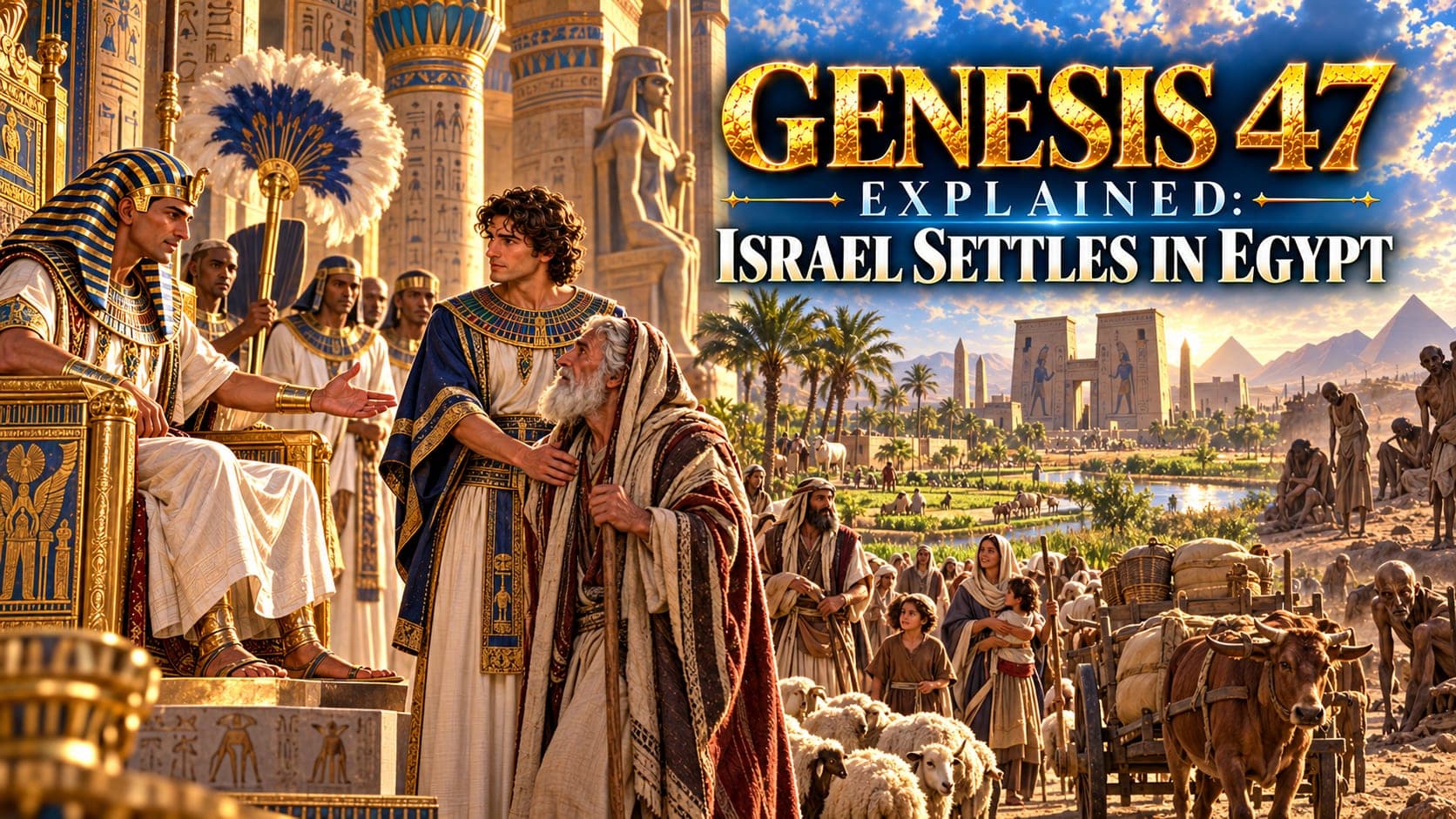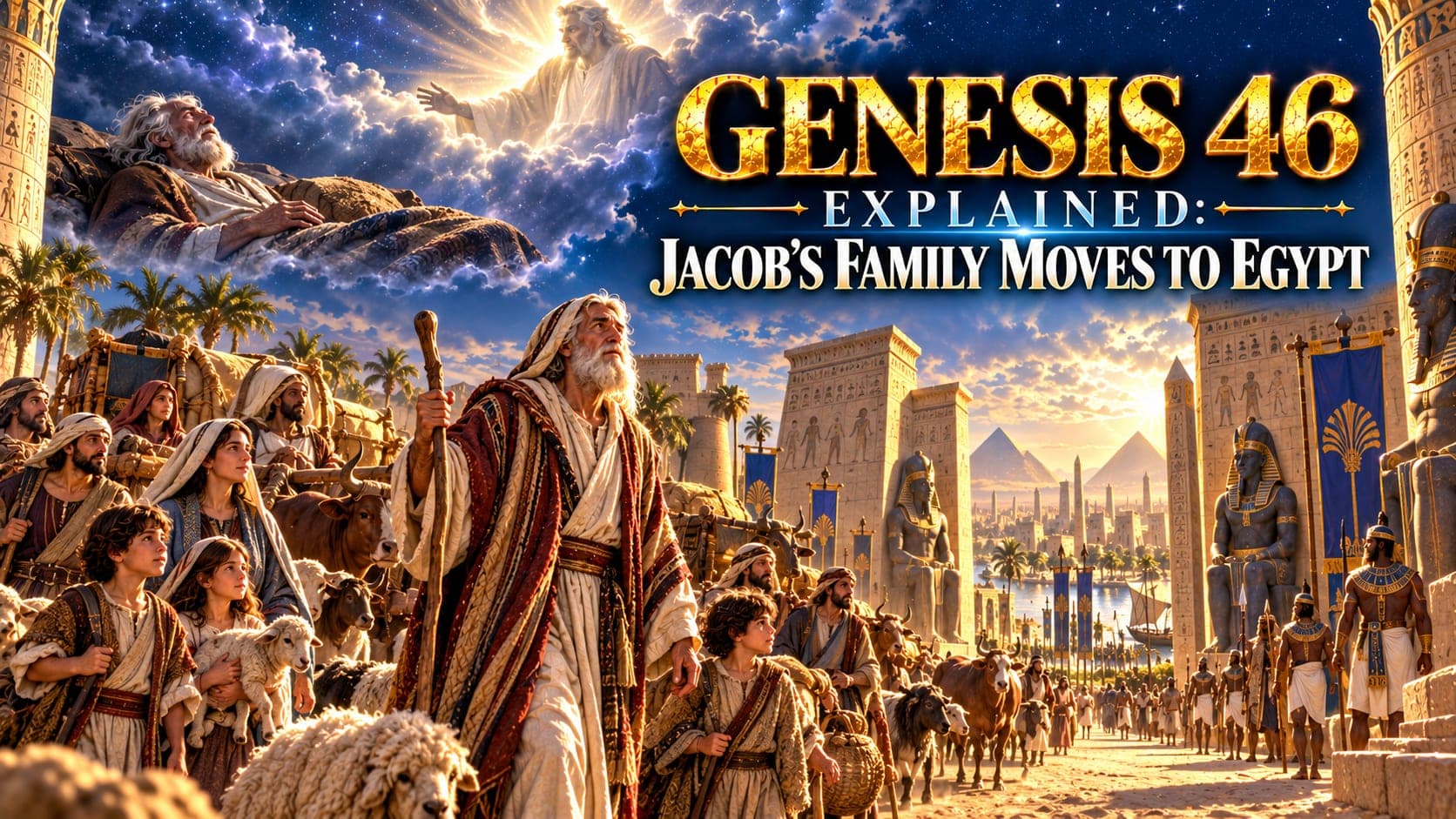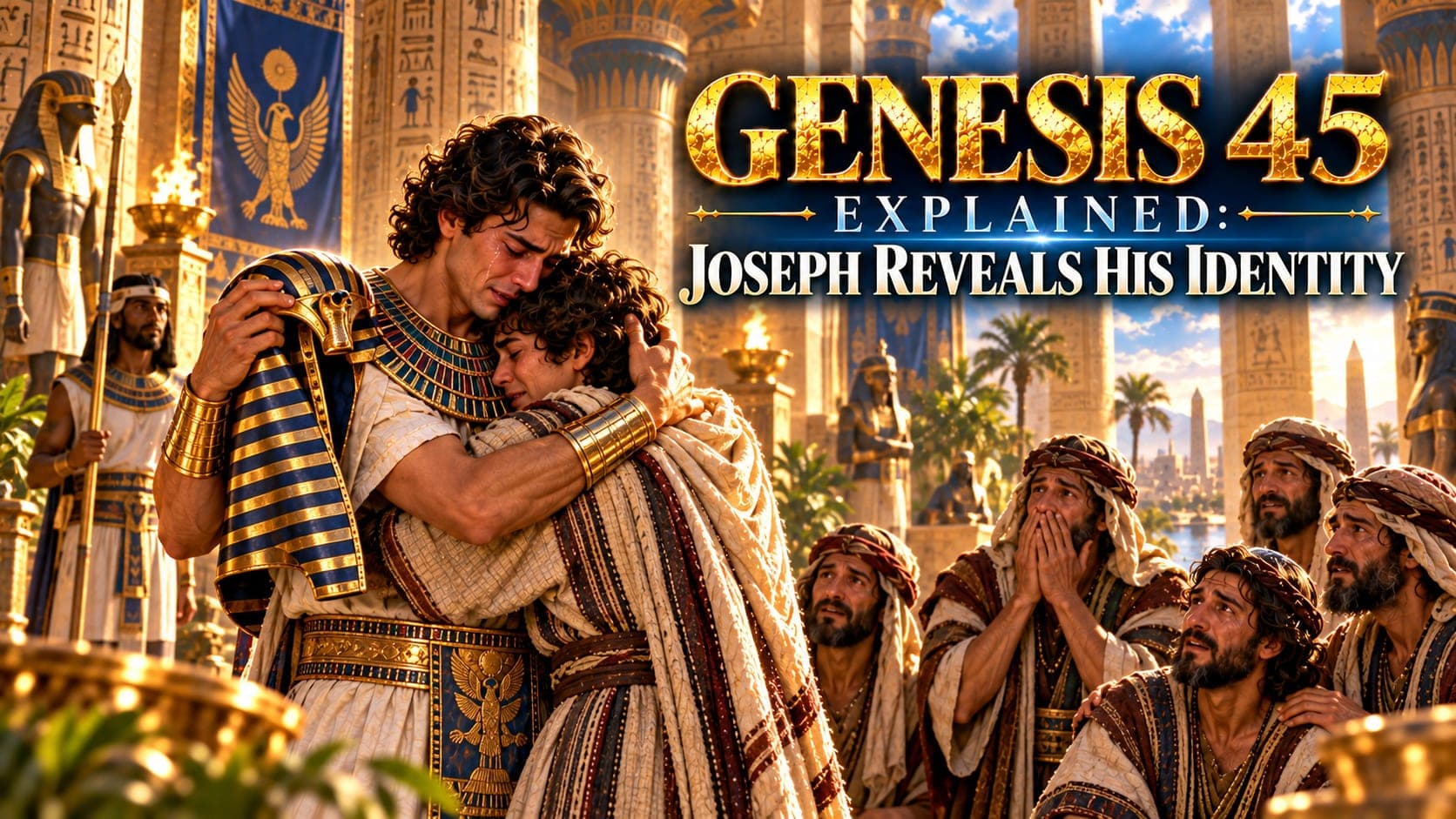
📖 Genesis 48 Explained: Jacob Blesses Ephraim Over Manasseh
An old man who cannot see clearly anymore reaches out his hands, and somehow puts them in exactly the wrong order on purpose.
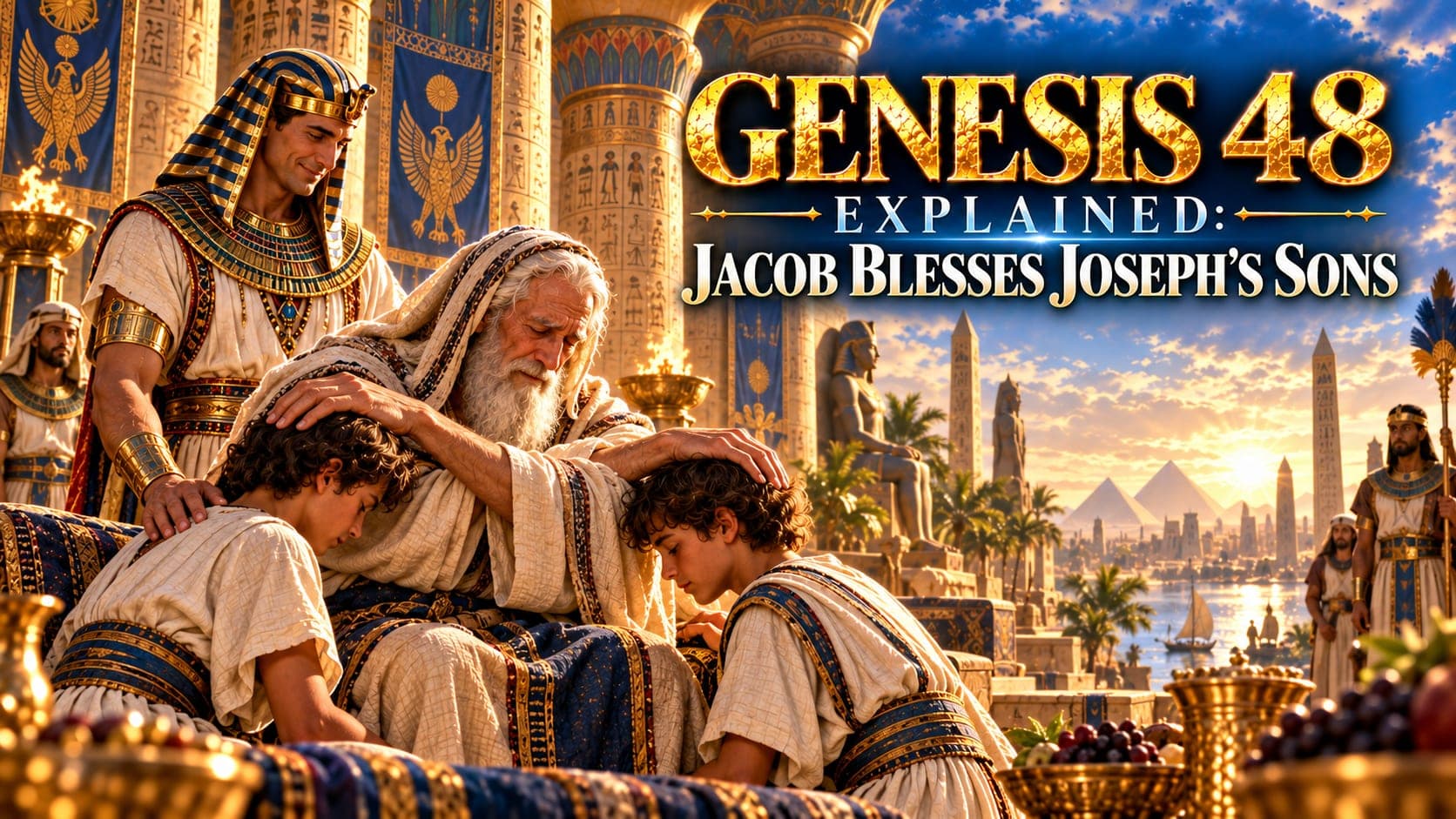
Genesis 48 explained is the chapter where Jacob, now dying in Egypt, calls for Joseph's two sons, claims them as his own, and crosses his arms to bless the younger boy ahead of the firstborn. Joseph tries to correct him. Jacob refuses to be corrected.
Maybe you have watched someone make a choice everyone around them thought was a mistake, only to find out later they knew exactly what they were doing.
- ❓ Why does Jacob adopt his own grandsons as sons?
- ❓ Why does he suddenly bring up Rachel's death in the middle of a blessing?
- ❓ Was crossing his hands an accident, or did Jacob know exactly what he was doing?
- ❓ And what does Jacob mean about taking land from the Amorite with his sword and his bow?
📌 The man who once took a blessing that was not his by trickery now hands one out on purpose, in broad daylight, and defends it when challenged.
This walkthrough goes through Genesis 48 in order: Joseph bringing his sons to a dying father, Jacob adopting them into Israel's own family line, the sudden memory of Rachel, the blessing itself with its crossed hands, and the strange final verse about a portion won by the sword.
A man with failing eyes sees further into the future than anyone standing in that room.
What Happened Just Before This Chapter
Genesis 47 ended with Jacob, settled in the best land Egypt had to offer, asking Joseph to swear an oath: carry my body out of Egypt and bury it with my fathers in Canaan. Jacob got that promise. He did not get an easy ending to his life story.
Genesis 48 opens some time later, with the sickness Jacob knew was coming for him finally arriving. Before he dies, he has one more piece of family business to settle, and it concerns the two grandsons born to him in a country he never meant to call home.
The full account of how those two boys came to exist, and how their father ended up ruling Egypt in the first place, is covered in the story of Joseph.
Genesis 48 Explained Verse by Verse
1. Joseph Brings His Sons to a Dying Man (verses 1 and 2)
The chapter opens with a message, and Joseph does not wait to act on it.
"And it came to pass after these things, that one told Joseph, Behold, thy father is sick: and he took with him his two sons, Manasseh and Ephraim."
"And one told Jacob, and said, Behold, thy son Joseph cometh unto thee: and Israel strengthened himself, and sat upon the bed."
📌 Notice the order the names come in. Manasseh is named first because he is the firstborn. Keep that order in mind, because this whole chapter is about to turn it upside down. And notice Jacob's own effort: too weak to rise easily, he still gathers his strength to sit up for what is coming. This is not a man drifting toward death. It is a man preparing to do one last piece of work.
2. Jacob Remembers the Promise, and Adopts Two Grandsons as Sons (verses 3 to 6)
Before Jacob does anything else, he reaches back decades, to a promise made at a place called Luz.
"And Jacob said unto Joseph, God Almighty appeared unto me at Luz in the land of Canaan, and blessed me,"
"And said unto me, Behold, I will make thee fruitful, and multiply thee, and I will make of thee a multitude of people; and will give this land to thy seed after thee for an everlasting possession."
Luz is the old name for Bethel, where Jacob fled as a young man running from his brother and woke up from a dream of a ladder reaching into heaven. Jacob is dying in a foreign country, surrounded by Egyptian wealth, and the thing he reaches for is not Egypt's comfort. It is a promise God made him when he had nothing but a stone for a pillow.
Then comes the decision that reshapes his whole family tree.
"And now thy two sons, Ephraim and Manasseh, which were born unto thee in the land of Egypt before I came unto thee into Egypt, are mine; as Reuben and Simeon, they shall be mine."
"And thy issue, which thou begettest after them, shall be thine, and shall be called after the name of their brethren in their inheritance."
📌 Jacob names Ephraim and Manasseh alongside Reuben and Simeon, his own oldest sons. He is not just blessing two grandsons. He is formally pulling them up a generation, giving each of them a tribal inheritance equal to one of his own sons, instead of leaving them folded inside a single portion under Joseph's name. Any children Joseph has after these two will simply be counted under Ephraim or Manasseh. This single decision is why Israel is later counted as twelve tribes even though Levi receives no land of its own and Joseph, strictly speaking, is only one son.
3. A Grief Thirty Years Old, Spoken in the Middle of a Blessing (verse 7)
Right after that legal, formal decision, Jacob's mind goes somewhere unexpected.
"And as for me, when I came from Padan, Rachel died by me in the land of Canaan in the way, when yet there was but a little way to come unto Ephrath: and I buried her there in the way of Ephrath; the same is Bethlehem."
💡 Rachel, Joseph's mother and Jacob's great love, died giving birth to Benjamin on the road, as told in Genesis 35. She never saw Joseph again after he was sold away, and she never knew he survived.
Jacob is about to give Joseph's sons a double inheritance, standing in for the mother who is not here to see it. He cannot talk about elevating her son's children without the old grief surfacing in the same breath. Grief and blessing are not opposites in this verse. They sit right next to each other.
4. Dim Eyes, Clear Faith: "I Had Not Thought to See Thy Face" (verses 8 to 11)
Only now does Jacob actually notice the two boys standing in the room.
"And Israel beheld Joseph's sons, and said, Who are these?"
"And Joseph said unto his father, They are my sons, whom God hath given me in this place. And he said, Bring them, I pray thee, unto me, and I will bless them."
"Now the eyes of Israel were dim for age, so that he could not see. And he brought them near unto him; and he kissed them, and embraced them."
Jacob's eyes are failing exactly the way Isaac's did when Jacob himself took advantage of it years earlier, back in Genesis 27. The difference is what happens next.
"And Israel said unto Joseph, I had not thought to see thy face: and, lo, God hath shewed me also thy seed."
📌 For twenty two years Jacob believed Joseph was dead. Now he is not only looking at his son's face again, he is holding his son's children. Every word of this verse is a man naming, out loud, a gift he never expected to live long enough to receive.
5. Crossed Hands: The Younger Gets the Greater Blessing (verses 12 to 20)
Joseph sets his sons up the correct way, by age and by custom.
"And Joseph brought them out from between his knees, and he bowed himself with his face to the earth."
"And Joseph took them both, Ephraim in his right hand toward Israel's left hand, and Manasseh in his left hand toward Israel's right hand, and brought them near unto him."
Joseph positions Manasseh, the firstborn, directly across from Jacob's stronger right hand. That is the expected arrangement. The right hand belongs to the older son. Jacob does something else entirely.
"And Israel stretched out his right hand, and laid it upon Ephraim's head, who was the younger, and his left hand upon Manasseh's head, guiding his hands wittingly; for Manasseh was the firstborn."
⚠️ The text goes out of its way to tell you this was not a mistake. "Guiding his hands wittingly" means knowingly, on purpose. Jacob's eyes are dim, but his decision is not blind. He reaches across his own body to put his stronger hand on the younger boy's head.
Then the blessing itself:
"And he blessed Joseph, and said, God, before whom my fathers Abraham and Isaac did walk, the God which fed me all my life long unto this day,"
"The Angel which redeemed me from all evil, bless the lads; and let my name be named on them, and the name of my fathers Abraham and Isaac; and let them grow into a multitude in the midst of the earth."
💡 Jacob calls on three things in one breath: the God his fathers walked with, the God who fed him his whole life, and the Angel who redeemed him from evil. He is tying two boys born in Egypt back to a line of promise that started with Abraham.
Joseph sees the crossed hands and steps in to fix what he assumes is an error.
"And when Joseph saw that his father laid his right hand upon the head of Ephraim, it displeased him: and he held up his father's hand, to remove it from Ephraim's head unto Manasseh's head."
"And Joseph said unto his father, Not so, my father: for this is the firstborn; put thy right hand upon his head."
📌 Even the man running Egypt cannot talk his dying father out of this. Joseph physically tries to move Jacob's hand back to the correct order. Jacob refuses.
"And his father refused, and said, I know it, my son, I know it: he also shall become a people, and he also shall be great: but truly his younger brother shall be greater than he, and his seed shall become a multitude of nations."
Jacob does not deny Manasseh's place. He simply states, plainly, what he believes God has shown him: Manasseh will be great, and Ephraim will be greater still. Jacob confirms it by setting the order permanently.
"And he blessed them that day, saying, In thee shall Israel bless, saying, God make thee as Ephraim and as Manasseh: and he set Ephraim before Manasseh."
💡 That line, "God make thee as Ephraim and as Manasseh," became a blessing Jewish fathers still speak over their sons. Ephraim is named first in it, exactly as Jacob set him, exactly as his tribe would later outgrow his older brother's in size and influence in the land.
6. One Last Promise, and a Strange Inheritance (verses 21 and 22)
Jacob closes this scene by turning from the boys back to their father.
"And Israel said unto Joseph, Behold, I die: but God shall be with you, and bring you again unto the land of your fathers."
"Moreover I have given to thee one portion above thy brethren, which I took out of the hand of the Amorite with my sword and with my bow."
📌 Jacob names death plainly, then immediately points past it. He will not personally go back to Canaan alive. He states as fact that God will still carry the family there, the same promise he has repeated since this chapter opened.
The last verse of the chapter is one of the harder lines in Genesis, and the next section takes it on directly.
Hard Questions Genesis 48 Raises
What does Jacob mean about taking land "with my sword and with my bow"? The text never records Jacob personally fighting anyone with a weapon anywhere else in Genesis. "Amorite" itself is sometimes used in the Old Testament as a broad label for Canaan's inhabitants in general, not only one specific people group, the way Genesis 15:16 and Amos 2:9 and 10 use it. That wider use is why many readers connect this verse to Genesis 34, where Jacob's sons Simeon and Levi attacked the city of Shechem, ruled by Hamor the Hivite, after Dinah was violated there, an act Jacob condemned at the time rather than led. Bible teachers read Genesis 48:22 one of two main ways. Some take it as Jacob, as head of the family, speaking of that conquest as his own because it happened under his household, the way a king might speak of a battle his army won. Others take it as a reference to an event Genesis simply never recorded in detail, since Jacob's life before and after his years with Laban has real gaps in the text. What the verse does not support is Jacob personally wielding a sword himself in some battle scene the Bible describes elsewhere, because no such scene exists in Genesis.
Why does Jacob adopt Ephraim and Manasseh instead of leaving them under Joseph? Giving them each a tribal portion equal to Reuben or Simeon means Joseph effectively receives a double inheritance through his two sons. This repays, in a quiet and legal way, the honor due to Joseph for saving the entire family from famine, without taking anything away from his older brothers' own tribal shares.
Was crossing his hands really intentional, or is this just how an old, nearly blind man happened to reach? Genesis 48:14 answers this directly: Jacob guided his own hands "wittingly," meaning knowingly. The text removes the possibility of accident on purpose, so the reader cannot write this off as an old man's confusion.
Is this the same kind of blessing Jacob once stole from Esau? It looks similar on the surface. Both involve a younger son receiving what custom reserved for the older one. The difference is consent and honesty. Genesis 27 shows Jacob deceiving his own father to take a blessing meant for someone else. Genesis 48 shows Jacob, in full view of everyone in the room, openly choosing to bless the younger son and explaining exactly why when questioned. One is theft. The other is a father's stated judgment, given in the open.
Top 5 Bible Verses From Genesis 48
1. Genesis 48:11
"And Israel said unto Joseph, I had not thought to see thy face: and, lo, God hath shewed me also thy seed."
Twenty two years of believing his son was dead end in a grandfather holding his son's children. Few verses in Genesis carry this much relief in so few words.
2. Genesis 48:14
"And Israel stretched out his right hand, and laid it upon Ephraim's head, who was the younger, and his left hand upon Manasseh's head, guiding his hands wittingly; for Manasseh was the firstborn."
A nearly blind old man reaches across his own body on purpose. The whole chapter turns on this one deliberate movement.
3. Genesis 48:16
"The Angel which redeemed me from all evil, bless the lads; and let my name be named on them, and the name of my fathers Abraham and Isaac; and let them grow into a multitude in the midst of the earth."
Jacob ties two boys born in Egypt back to Abraham's own promise, in the same breath he names the God who has carried him his whole life.
4. Genesis 48:19
"And his father refused, and said, I know it, my son, I know it: he also shall become a people, and he also shall be great: but truly his younger brother shall be greater than he, and his seed shall become a multitude of nations."
Jacob does not deny his older grandson's place. He simply refuses to let custom override what he is convinced God has shown him.
5. Genesis 48:21
"And Israel said unto Joseph, Behold, I die: but God shall be with you, and bring you again unto the land of your fathers."
A dying man states his own death plainly, then points past it to a promise he will not live to see fulfilled himself.

Frequently Asked Questions About Genesis 48
What happens in Genesis 48?
Jacob, dying in Egypt, calls for Joseph's sons Ephraim and Manasseh, adopts them as his own with a tribal inheritance equal to his other sons, and crosses his hands to give Ephraim, the younger son, the greater blessing ahead of Manasseh, the firstborn.
Why did Jacob bless Ephraim instead of Manasseh?
Genesis 48:19 has Jacob state plainly that he believes Ephraim's descendants will become greater than Manasseh's. The text does not explain how Jacob knew this, only that he acted on it deliberately and refused Joseph's attempt to correct him.
Why does Jacob adopt his own grandsons as sons?
Genesis 48:5 has Jacob name Ephraim and Manasseh alongside Reuben and Simeon, giving each of them a tribal share equal to one of his own sons. This is why Israel's twelve tribes include both Ephraim and Manasseh as separate tribes rather than one combined tribe of Joseph.
Why does Jacob bring up Rachel's death in this chapter?
Genesis 48:7 recalls Rachel dying on the road near Ephrath, also called Bethlehem, while giving birth to Benjamin. Jacob raises it right after deciding to elevate Joseph's sons, the son Rachel never saw again after he was sold away.
Was crossing his hands a mistake because Jacob was going blind?
No. Genesis 48:14 says Jacob guided his own hands "wittingly," meaning on purpose and with full knowledge of what he was doing, even though his eyesight had failed.
What does "which I took out of the hand of the Amorite with my sword and with my bow" mean?
Genesis never records Jacob personally fighting anyone in battle. The Old Testament sometimes uses "Amorite" as a broad label for Canaan's inhabitants in general, which is why many readers connect this to the attack his sons Simeon and Levi carried out on Shechem, ruled by Hamor the Hivite, in Genesis 34, with Jacob speaking of it as head of the household. The exact meaning is genuinely debated.
Is this the same kind of deception as Jacob stealing Esau's blessing?
No. In Genesis 27, Jacob deceived his father to take a blessing meant for Esau. In Genesis 48, Jacob openly tells Joseph what he is doing and why, with no deception involved, even when Joseph tries to talk him out of it.
What tribe became the greater one, Ephraim or Manasseh?
Ephraim grew into one of the largest and most influential tribes in Israel's later history, eventually so prominent that the northern kingdom is sometimes referred to by its name in the Old Testament's prophetic books.
What happens after Genesis 48?
Genesis 49 opens with Jacob calling together all twelve of his sons to deliver a final blessing and prophecy over each one before he dies.
Final Thoughts
Genesis 48 is a quiet chapter, and almost everything in it is deliberate.
📌 A dying man's clearest moments are not always physical. Jacob's eyes are dim, but he still names a promise from decades earlier, still remembers a wife he buried on a road, and still knows exactly which hand belongs on which head.
📌 The same man who once took a blessing by deception now gives one openly, and stands by it when questioned. Genesis 48 is not a repeat of Genesis 27. It is the same choice made honestly this time.
📌 Grief and blessing do not always arrive on a schedule. Jacob cannot raise Joseph's sons without Rachel's death surfacing in the same breath, and the chapter lets both stand together without rushing past either one.
You may be holding a decision right now that everyone around you thinks is backward.
So here is your one next step.
If you believe God has shown you something, say it plainly, the way Jacob did, instead of letting someone else's assumptions decide for you.