📖 Genesis 35 Explained: Bethel, Rachel's Death, and the Twelve Sons of Israel
Jacob's sons have just wiped out an entire city.
By his own words in the last chapter, his name now stinks among every tribe around him.
Genesis 35 explained is where God answers that mess, not with an army or an apology, but with one command: go back to Bethel. In twenty nine verses Jacob buries the hidden idols his household still carried, finishes a vow he made two decades earlier, hears his new name confirmed a second time, buries the wife he loved most on the side of a road, watches his oldest son disgrace him, and buries his own father. Few chapters anywhere in Genesis pack this much worship, grief, and family into one stretch of road.
Maybe you know what it is like when one hard thing follows another with barely a breath between them.
- ❓ Why does God send Jacob back to Bethel right after the massacre at Shechem?
- ❓ Why did Jacob's own household still have foreign gods hidden among them?
- ❓ Why does Rachel die just when Jacob finally reaches safety?
- ❓ What does Reuben do that earns him a curse that follows him for life?
📌 This chapter answers a question you may not have thought to ask: what happens right after the worst day of your life? Jacob does not get a pause. He gets a command, an act of worship, a birth, two deaths, and a long delayed reunion with his father, nearly all in one breath.
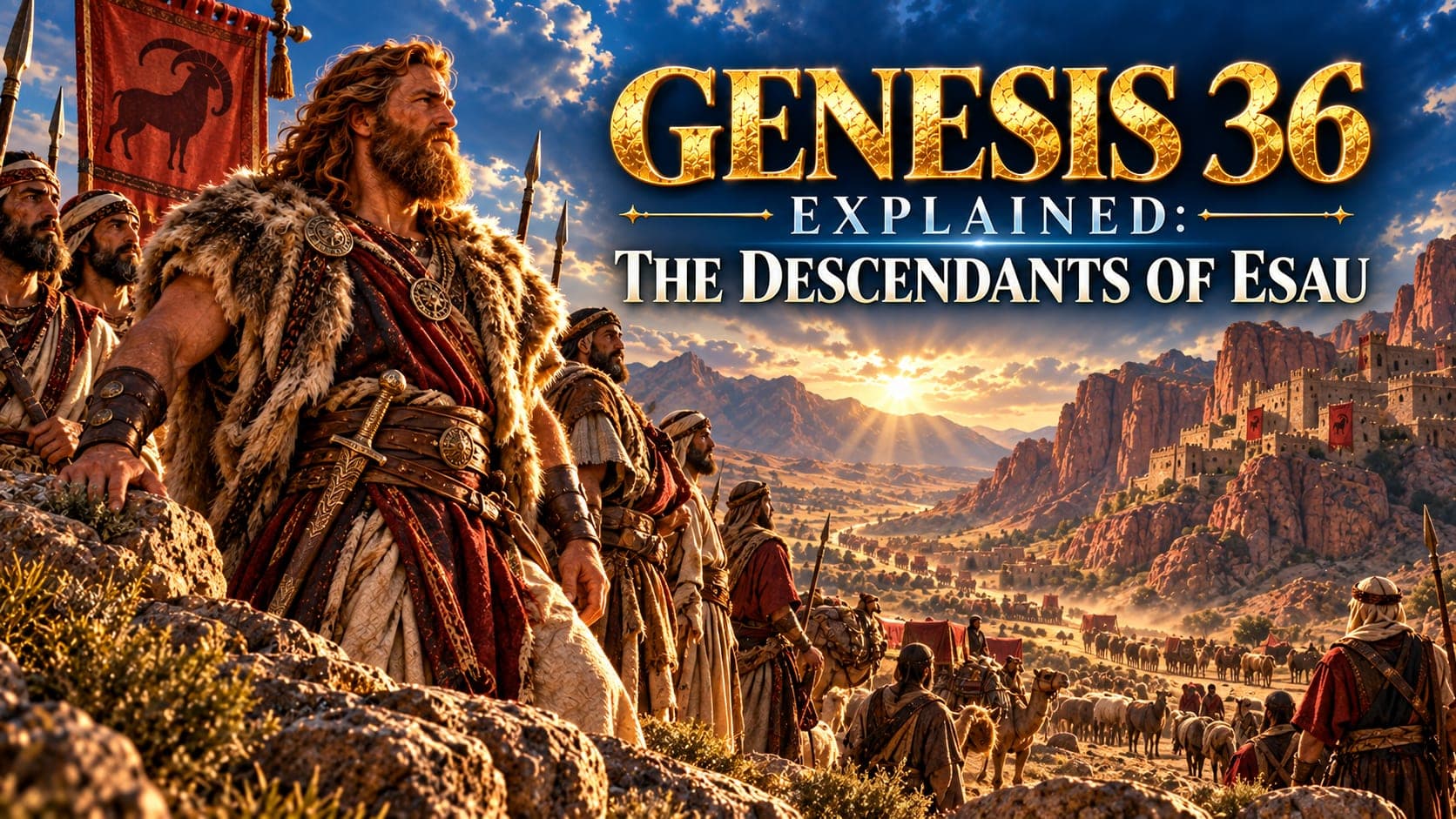
This walkthrough goes through Genesis 35 in order: the command back to Bethel, the household turning from its idols, the altar and the death of an old nurse nobody expects to be named, God confirming Jacob's new name a second time, Rachel's death giving birth to Benjamin, Reuben's sin and the completed list of twelve sons, and Isaac's death at the very end.
Watch how much of this chapter is about going back: back to Bethel, back to a vow, back to a father Jacob had not seen in over twenty years.
What Happened Just Before This Chapter
Genesis 34 ended with Jacob smelling of blood he did not spill himself. Simeon and Levi had just killed every man in Shechem, and Jacob's only recorded response was fear that the Canaanites and Perizzites around him would band together and destroy his small household in return.
📌 Genesis 35 opens with God answering that fear, though not the way Jacob might have expected. God does not send an army or broker a peace deal. He sends Jacob back to the one place still tied to an unfinished promise, an altar Jacob vowed to build the night he fled from Esau with nothing but a walking stick, recorded back in Genesis 28. Twenty years, two wives, eleven sons, and a wrestling match at Peniel later, that vow is still sitting unfinished.
Genesis 35 Explained Verse by Verse
1. God Calls Jacob Back to Bethel (verse 1)
The chapter opens with a single word of command, dropped into a household still shaken from Shechem.
"And God said unto Jacob, Arise, go up to Bethel, and dwell there: and make there an altar unto God, that appeared unto thee when thou fleddest from the face of Esau thy brother."
📌 God does not mention the massacre at all. No rebuke, no explanation, just a fresh instruction pointed at an old promise. Compare it to what Jacob actually vowed on his way out of Canaan:
"And Jacob vowed a vow, saying, If God will be with me, and will keep me in this way that I go, and will give me bread to eat, and raiment to put on, So that I come again to my father's house in peace; then shall the LORD be my God:"
💡 God kept His side of that vow years ago. Jacob has been fed, clothed, and protected the whole way. The altar is the one piece Jacob still owes, and God calls it in at the exact moment Jacob is most likely to want to run from Shechem toward anywhere but obedience.
2. The Household Turns From Its Hidden Idols (verses 2 to 5)
Before Jacob takes a single step toward Bethel, he deals with something that should not have still been in his camp.
"Then Jacob said unto his household, and to all that were with him, Put away the strange gods that are among you, and be clean, and change your garments: And let us arise, and go up to Bethel; and I will make there an altar unto God, who answered me in the day of my distress, and was with me in the way which I went."
⚠️ "Strange gods" plural means this was not one stray idol. Some of these may go back to the household gods Rachel took from her father Laban years earlier. Others were likely plunder carried out of Shechem after the massacre. Either way, Jacob has apparently known his people were carrying foreign gods and only deals with it now, on the way to build an altar to the God who actually delivered him.
"And they gave unto Jacob all the strange gods which were in their hand, and all their earrings which were in their ears; and Jacob hid them under the oak which was by Shechem."
The earrings are an odd detail, and many readers connect them to charms or amulets tied to pagan worship, a common practice in the ancient world, though Genesis never explains exactly what these particular ones were for. Whatever they meant, Jacob buries all of it in the ground, in the same town where his daughter was assaulted and a city was destroyed. He is not just cleaning house. He is leaving Shechem behind, literally burying the past in it.
"And they journeyed: and the terror of God was upon the cities that were round about them, and they did not pursue after the sons of Jacob."
📌 This is God's actual answer to Jacob's fear from the end of Genesis 34. Jacob worried aloud that his neighbors would gather and destroy him. Instead those same neighbors are struck with a fear of their own and never lift a hand. Jacob asked for safety. God supplied it without Jacob ever raising a weapon.
3. Bethel Again, and a Death No One Expects to Read (verses 6 to 8)
Jacob finally arrives at the place he first met God, running from his brother with nothing.
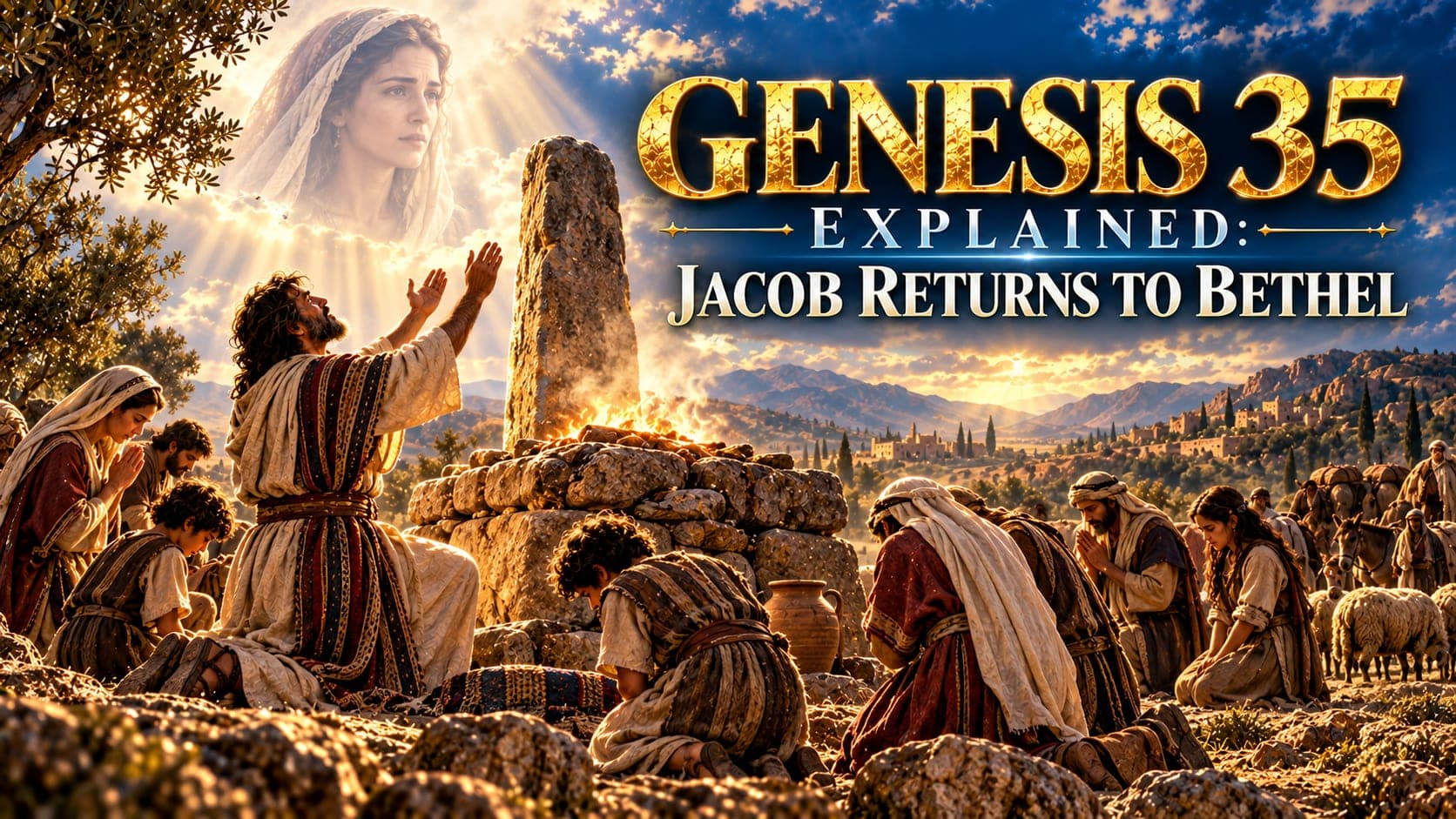
"So Jacob came to Luz, which is in the land of Canaan, that is, Bethel, he and all the people that were with him. And he built there an altar, and called the place Elbethel: because there God appeared unto him, when he fled from the face of his brother."
💡 The place was already called Bethel, meaning house of God, from Jacob's dream of the ladder years before. Now Jacob renames it Elbethel, God of Bethel, shifting the focus off the place itself and onto the God who met him there. The location did not save him. God did.
Then, without warning, the narrative drops in a death that has nothing to do with the altar.
"But Deborah Rebekah's nurse died, and she was buried beneath Bethel under an oak: and the name of it was called Allonbachuth."
⚠️ Genesis never says how Deborah joined Jacob's household. She was Rebekah's nurse from back when Rebekah left her own family to marry Isaac. Her presence here likely means she was sent to Jacob at some point, perhaps when Rebekah promised in Genesis 27 to send for him once it was safe to come home. What the verse does not say is just as loud as what it does. Rebekah herself is never mentioned again after that promise, and this quiet burial of her old nurse may be the closest Genesis comes to marking Rebekah's own death.
4. God Confirms the Name Israel a Second Time (verses 9 to 13)
God had already renamed Jacob once, alone in the dark at the Jabbok. Now He does it again, in the open, at an altar.
"And God appeared unto Jacob again, when he came out of Padanaram, and blessed him. And God said unto him, Thy name is Jacob: thy name shall not be called any more Jacob, but Israel shall be thy name: and he called his name Israel."
📌 The name Israel was first given in the dark, during a wrestling match Jacob barely understood. Read the full story in Genesis 32. Here God repeats it in daylight, at an altar, with no struggle attached. What Jacob received in a fight he now receives as a settled fact. The name sticks either way, but this second telling reads like God making sure Jacob knows it was never just about surviving one night.
"And God said unto him, I am God Almighty: be fruitful and multiply; a nation and a company of nations shall be of thee, and kings shall come out of thy loins; And the land which I gave Abraham and Isaac, to thee I will give it, and to thy seed after thee will I give the land."
💡 "God Almighty," El Shaddai, is the exact title God used with Abraham back when He sealed the covenant of circumcision. Using it here folds Jacob directly into the same promise made to his grandfather: descendants too many to count, a whole line of kings, and land that is still Jacob's own family land, not a new grant. Nothing in this blessing is new. It is the Abrahamic covenant, confirmed onto the man who will carry its name forward.
5. Rachel Dies Giving Birth to Benjamin (verses 16 to 20)
The family leaves Bethel, and the chapter turns from worship to grief within a handful of verses.
"And they journeyed from Bethel; and there was but a little way to come to Ephrath: and Rachel travailed, and she had hard labour. And it came to pass, when she was in hard labour, that the midwife said unto her, Fear not; thou shalt have this son also."
Rachel once cried out, desperate for children, that she would die without them. Now, with her second son on the way, the fear she once spoke turns real in the opposite direction.
"And it came to pass, as her soul was in departing, (for she died) that she called his name Benoni: but his father called him Benjamin."
⚠️ With her last breath, Rachel names her son Benoni, son of my sorrow. Jacob immediately renames him Benjamin, son of my right hand. He does not erase her grief, but he refuses to let it be the only word spoken over his son. One father, one moment, two names, and Jacob chooses which one the boy carries for the rest of his life.
"And Rachel died, and was buried in the way to Ephrath, which is Bethlehem. And Jacob set a pillar upon her grave: that is the pillar of Rachel's grave unto this day."
📌 Rachel is the only one of Jacob's four wives not buried in the family tomb at Machpelah. Sarah, Rebekah, and later Leah all rest together there. Rachel is buried alone on the roadside near Bethlehem, marked by a pillar the text says still stood when Genesis was written. The woman Jacob loved most is the one he buried apart from everyone else.
6. Reuben's Sin, and the Twelve Sons Complete (verses 21 to 26)
The family keeps moving, and the chapter drops one more heavy line before it turns to a list of names.
"And it came to pass, when Israel dwelt in that land, that Reuben went and lay with Bilhah his father's concubine: and Israel heard it. Now the sons of Jacob were twelve:"
⚠️ "Israel heard it" is the whole reaction Genesis records in the moment. No confrontation, no punishment listed here, nothing but silence, the same pattern already seen once in this family when Jacob said nothing right after hearing what happened to Dinah. Whatever Jacob felt, the text does not let you watch it, only note that he knew.
"The sons of Leah; Reuben, Jacob's firstborn, and Simeon, and Levi, and Judah, and Issachar, and Zebulun:"
The list continues with Rachel's two sons, Joseph and Benjamin, then the sons of Bilhah and Zilpah, the two handmaids. Twelve names, stated plainly as twelve for the first time in Genesis. Every tribe that will one day carry Israel's name traces back to one of these men, born across years of rivalry, longing, and heartbreak between two sisters and their servants.
7. Jacob Comes Home, and Isaac Dies (verses 27 to 29)
The chapter closes where Jacob's whole journey began, back at his father's door.
"And Jacob came unto Isaac his father unto Mamre, unto the city of Arbah, which is Hebron, where Abraham and Isaac sojourned."
📌 This is the reunion the vow in Genesis 28 was always aiming at. Jacob fled this house with a stolen blessing and a brother wanting him dead. He returns with two wives, twelve sons, and a new name, and finally stands in front of his father again.
"And the days of Isaac were an hundred and fourscore years. And Isaac gave up the ghost, and died, and was gathered unto his people, being old and full of days: and his sons Esau and Jacob buried him."
💡 Isaac lived to a hundred eighty years, and both of his sons bury him together, the same way Isaac and his own half brother Ishmael once buried their father Abraham. Twice in two generations, brothers who were once at odds stand side by side at their father's grave. Whatever Jacob and Esau still carried from their old rivalry, it does not keep them from showing up together for this.

Hard Questions Genesis 35 Raises
Why does God send Jacob back to Bethel right after the massacre, instead of addressing what Simeon and Levi did? Genesis never states a reason. The command simply follows the massacre in the text, without approval or rebuke attached to either event. What the command does accomplish is practical and spiritual at once: it moves Jacob's family away from an increasingly dangerous position and turns Jacob's attention toward an old, unfinished act of worship instead of fear or retaliation.
Why does Rachel die right when Jacob finally reaches safety? The text gives no explanation beyond hard labor. Genesis does not moralize her death as punishment or lesson. It simply records it, the same honest way it records every other loss in this family, without softening it or explaining it away.
What exactly did Reuben do, and why did it matter so much? Lying with a father's concubine was not treated as an ordinary affair in the ancient world. Later in Scripture, Absalom does something similar with his father David's concubines in 2 Samuel 16, and it is described as a deliberate claim to his father's authority. Read against that background, Reuben's act looks less like a private failure and more like an attempt to claim his father's place while Jacob was still alive.
"Unstable as water, thou shalt not excel; because thou wentest up to thy father's bed; then defiledst thou it: he went up to my couch."
That is Jacob's own verdict, given decades later on his deathbed. First Chronicles confirms exactly what it cost Reuben:
"Now the sons of Reuben the firstborn of Israel, (for he was the firstborn; but, forasmuch as he defiled his father's bed, his birthright was given unto the sons of Joseph the son of Israel: and the genealogy is not to be reckoned after the birthright."
Why does Jacob stay silent about Reuben, the same way he stayed silent about Dinah? Genesis does not explain either silence. What connects them is a pattern: in this family, Jacob's real verdict on serious harm does not come in the moment. It comes decades later, in Genesis 49, delivered all at once to sons who had long since stopped expecting it.
Practical Tips From Genesis 35
This chapter moves fast, and it still has plenty for how you handle vows, grief, and unfinished business.
- Go back and finish what you vowed, even years late. Jacob had put off the altar at Bethel for two decades. God still called him back to it instead of letting it stay forgotten.
- Deal with what is competing with God in your own house. The foreign gods had traveled with Jacob's family for years before he finally addressed them. Notice what you have been carrying without dealing with it.
- Worship does not exempt you from grief. Jacob built an altar, heard a blessing, and buried his wife within the same short stretch of road. Faith and loss can sit right next to each other.
- Watch what you speak over someone in a hard moment. Rachel named her son after her sorrow. Jacob chose to rename him after strength instead. What you call something after a loss shapes how it is carried forward.
- Silence after real harm still has consequences later. Jacob's quiet response to Reuben did not make the issue disappear. It waited, unresolved, until Genesis 49.
- Reconciliation pays off in ways you may not see right away. Esau and Jacob only stood together at their father's grave because of what happened at their reunion back in Genesis 33. Old wounds that actually heal make room for moments like this one.
Top 5 Bible Verses From Genesis 35
1. Genesis 35:1
"And God said unto Jacob, Arise, go up to Bethel, and dwell there: and make there an altar unto God, that appeared unto thee when thou fleddest from the face of Esau thy brother."
The command that opens the whole chapter, calling Jacob back to a vow he made twenty years earlier, right in the aftermath of the massacre at Shechem.
2. Genesis 35:10
"And God said unto him, Thy name is Jacob: thy name shall not be called any more Jacob, but Israel shall be thy name: and he called his name Israel."
The name first given during a wrestling match at Peniel, now confirmed in daylight at an altar, settling what Jacob will be called for the rest of his life.
3. Genesis 35:18
"And it came to pass, as her soul was in departing, (for she died) that she called his name Benoni: but his father called him Benjamin."
Rachel's dying words and Jacob's immediate response, one name for sorrow and another chosen for strength, both spoken over the same child in the same moment.
4. Genesis 35:22
"And it came to pass, when Israel dwelt in that land, that Reuben went and lay with Bilhah his father's concubine: and Israel heard it. Now the sons of Jacob were twelve:"
A single verse that carries Reuben's costly failure and the completed count of Israel's twelve sons back to back, with no reaction recorded in between.
5. Genesis 35:29
"And Isaac gave up the ghost, and died, and was gathered unto his people, being old and full of days: and his sons Esau and Jacob buried him."
The chapter's closing verse, showing two brothers who once wanted each other dead standing together at their father's grave.

Frequently Asked Questions About Genesis 35
What does Genesis 35 mean?
It records God calling Jacob back to Bethel to finish an old vow, Jacob's household giving up its hidden idols, God confirming Jacob's new name Israel, Rachel's death giving birth to Benjamin, Reuben's sin with his father's concubine, the completed list of Jacob's twelve sons, and Isaac's death.
Why did Jacob bury the idols under the oak near Shechem?
Genesis 35:4 says he hid the foreign gods and earrings under an oak before traveling on to Bethel. Burying them there, in the same town where his daughter was assaulted and a city destroyed, physically left both the idolatry and that chapter of violence behind him.
Why does God rename Jacob Israel again, after already doing it in Genesis 32?
The first naming happened alone, at night, during a wrestling match Jacob barely understood. Genesis 35:10 repeats it in the open, at an altar, confirming that the name was never just about that one desperate night at the Jabbok.
How did Rachel die, and where is she buried?
Genesis 35:16 to 19 says she died in hard labor giving birth to her second son, on the road between Bethel and Ephrath. Unlike Sarah, Rebekah, and Leah, she was buried on that road rather than in the family tomb at Machpelah, marked by a pillar the text says still stood when Genesis was written.
What does the name Benjamin mean?
Rachel named him Benoni with her last breath, meaning son of my sorrow. Genesis 35:18 says Jacob immediately renamed him Benjamin, son of my right hand, choosing a name of strength over one of grief.
What did Reuben do, and why did it matter so much?
Genesis 35:22 says Reuben lay with Bilhah, his father's concubine. Jacob later curses this act on his deathbed in Genesis 49:4, and 1 Chronicles 5:1 confirms that it cost Reuben his birthright as firstborn, which passed instead to Joseph's sons.
Why does Genesis list all twelve of Jacob's sons in this chapter?
Genesis 35:22 to 26 gives the first full count of Jacob's sons as twelve, now that Benjamin has been born. Every tribe of Israel traces back to one of these men, so this list marks the family being complete for the first time.
How old was Isaac when he died, and who buried him?
Genesis 35:28 and 29 says Isaac lived a hundred eighty years and was buried by both of his sons, Esau and Jacob, together.
Did Rebekah die before this chapter?
Genesis never records Rebekah's death directly. The closest the text comes is Genesis 35:8, which mentions the death and burial of Deborah, Rebekah's nurse, without any further word about Rebekah herself.
How does Genesis 35 connect to the rest of the Bible?
The twelve sons named here become the twelve tribes of Israel. Reuben's failure here shapes Jacob's final words to him in Genesis 49 and the tribal history recorded in 1 Chronicles 5. Centuries later, the prophet Hosea still points back to Bethel as the place where God spoke with Jacob, showing how far this one chapter's events kept echoing forward.
Final Thoughts
Genesis 35 does not slow down long enough for any one event to be the whole story.
📌 An unfinished vow does not expire. Twenty years after Jacob made it, God still called it in, and Jacob still built the altar.
📌 Worship and grief can happen in the same breath. Jacob heard a blessing at Bethel and buried his wife on the very next stretch of road. One did not cancel out the other.
📌 What you call something after a loss matters. Rachel named her son after her sorrow. Jacob chose a different name for him to carry. You get to make a similar choice with your own hard moments.
You may be in a season that feels like this chapter, one heavy thing arriving right after another, with no space to catch your breath.
So here is your one next step.
Find the one vow, promise, or unfinished act of obedience you have been putting off, and finish it this week, the same way Jacob finally built that altar.