📖 Genesis 49 Explained: Jacob's Final Blessing Over His Twelve Sons
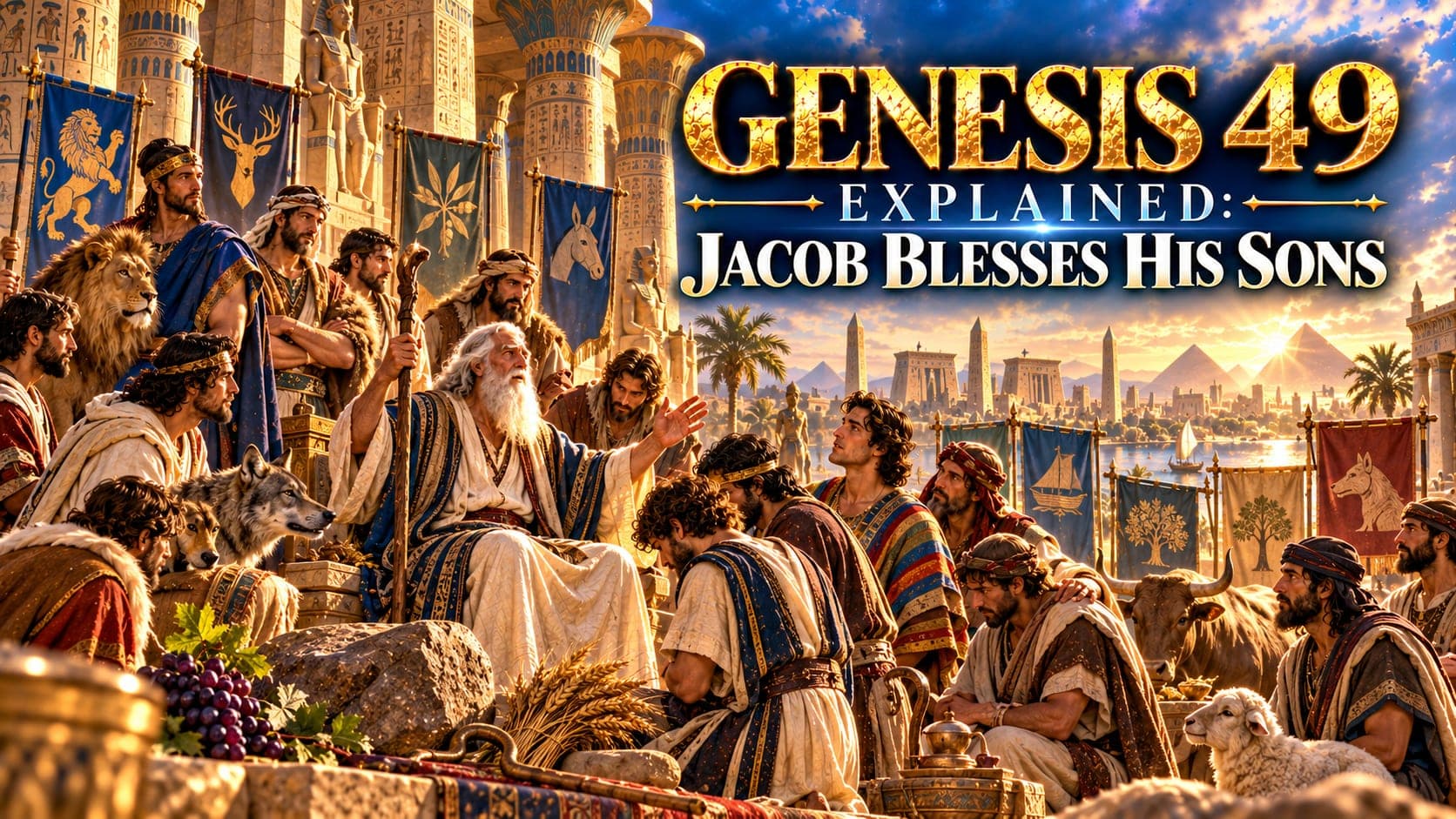
A dying man calls his twelve sons to his bed, and speaks over every single one of them by name.
Genesis 49 explained is Jacob's last chapter alive, a long poem of blessing and correction that sorts out, son by son, who gets honored, who gets corrected for something done years earlier, and which brother's line will carry the family's whole future.
Maybe you have wondered whether the things you did years ago still follow you into how people see you now.
- ❓ Why does the oldest son, Reuben, get passed over?
- ❓ What does "the sceptre shall not depart from Judah" actually mean?
- ❓ Why does Jacob suddenly cry out to God in the middle of blessing Dan?
- ❓ And why does a man about to die spend his last words on a burial plot?
📌 This is not twelve separate speeches. It is one father, naming twelve futures, and some of what he says will not come true for centuries.
This walkthrough goes through Genesis 49 in order: Reuben, Simeon, and Levi losing their place, Judah receiving the blessing that will carry the royal line, nine more brothers given shorter but real words of their own, and the last charge Jacob gives before he finally dies.
Underneath the old language is a father who still sees his sons clearly, right to the end.
What Happened Just Before This Chapter
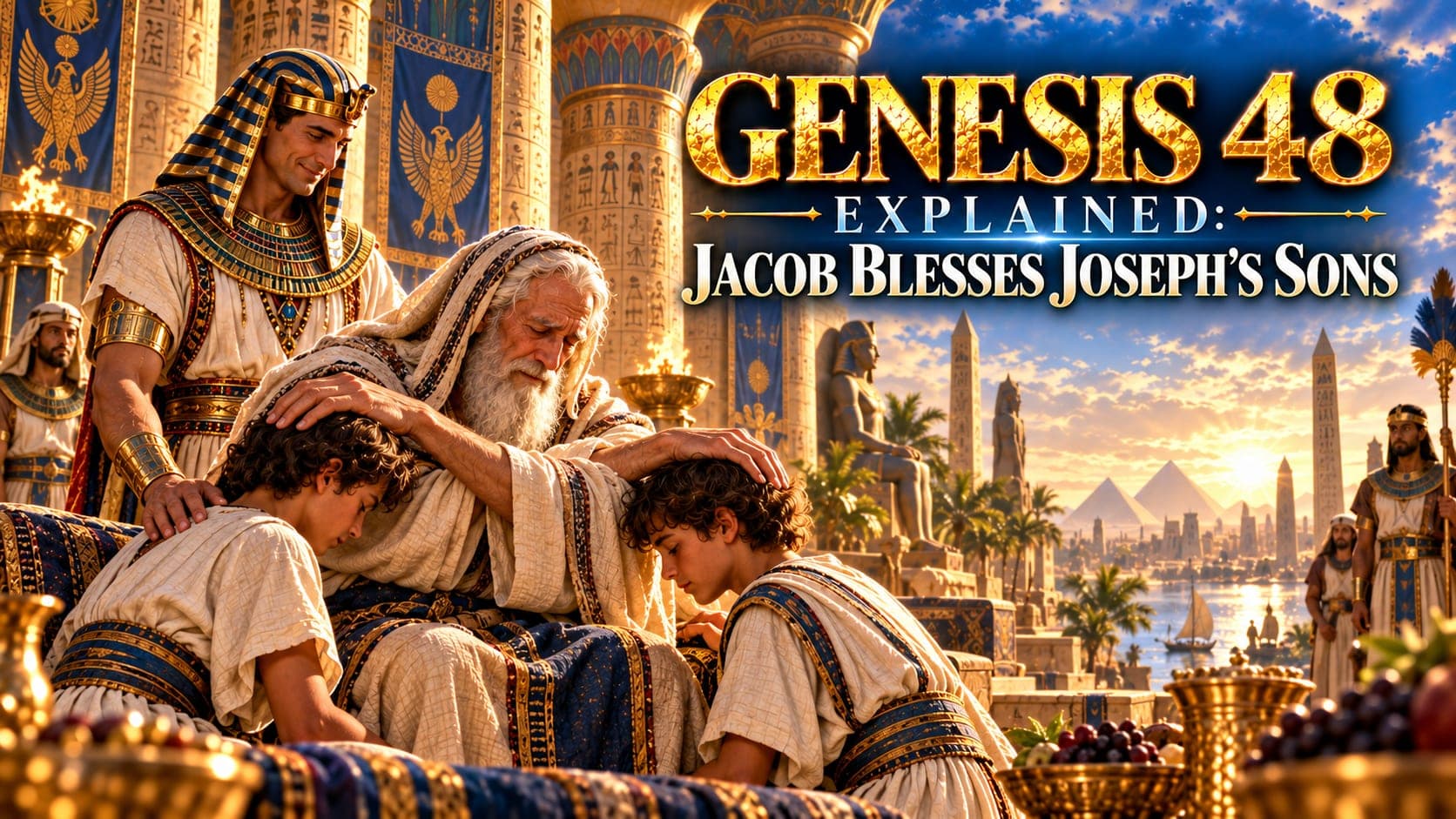
Genesis 48 ended with Jacob, dying in Egypt, adopting Joseph's two sons as his own and crossing his hands to bless the younger ahead of the firstborn. That chapter was a preview of what is about to happen on a much larger scale. Genesis 49 is Jacob doing the same thing, son by son, for all twelve of his own children.
The full account of how this family ended up in Egypt in the first place, and how one son in particular rose from a prison cell to run the country, is covered in the story of Joseph.
Genesis 49 Explained Verse by Verse
1. The Summons: "Gather Yourselves Together" (verses 1 and 2)
The chapter opens with a call, not a whisper. A dying man wants every son in the room.
"And Jacob called unto his sons, and said, Gather yourselves together, that I may tell you that which shall befall you in the last days. Gather yourselves together, and hear, ye sons of Jacob; and hearken unto Israel your father."
📌 Notice the phrase "the last days." Jacob is not only handing out fatherly advice. He frames what comes next as something that reaches forward, past his own lifetime and past the lives of his sons, into the future of the nation they will become.
He is called both Jacob and Israel in these two verses, the same way he has carried both names since the night he wrestled with God. Here, at the very end, both names are still his.
2. Reuben, Simeon, and Levi: The Sons Who Lose Their Place (verses 3 to 7)
Jacob starts with his oldest son, and the blessing turns into something else almost immediately.
"Reuben, thou art my firstborn, my might, and the beginning of my strength, the excellency of dignity, and the excellency of power: Unstable as water, thou shalt not excel; because thou wentest up to thy father's bed; then defiledst thou it: he went up to my couch."
📌 Jacob names exactly what Reuben was, and exactly what cost him that standing. Years earlier, in Genesis 35, Reuben slept with Bilhah, his father's concubine and the mother of two of his own brothers. That single act, not a lifetime of smaller failures, is what Jacob says cost him the firstborn's place. 1 Chronicles makes the same point centuries later, as a settled fact of Israel's own family record.
"Now the sons of Reuben the firstborn of Israel, (for he was the firstborn; but, forasmuch as he defiled his father's bed, his birthright was given unto the sons of Joseph the son of Israel: and the genealogy is not to be reckoned after the birthright."
Then two more brothers get grouped together, for a different reason.
"Simeon and Levi are brethren; instruments of cruelty are in their habitations. O my soul, come not thou into their secret; unto their assembly, mine honour, be not thou united: for in their anger they slew a man, and in their selfwill they digged down a wall. Cursed be their anger, for it was fierce; and their wrath, for it was cruel: I will divide them in Jacob, and scatter them in Israel."
⚠️ Jacob is still talking about Shechem, decades later. In Genesis 34, after their sister Dinah was violated, Simeon and Levi slaughtered the men of an entire city and took its women and goods. Jacob condemned it at the time, telling them they had made him stink among the people of the land. Here, with nothing left to lose by speaking plainly, he turns that same event into a lasting consequence: no single territory of their own, scattered instead among the other tribes.
💡 That one line lands differently for each brother. Simeon's tribe was eventually absorbed inside Judah's territory rather than holding ground of its own. Levi never received a tribal homeland at all, but generations later, when Levi's descendants stood apart from the rest of Israel at Sinai rather than joining a different rebellion, that same scattering became the reason Levites were placed among every other tribe as priests, the curse turned into a kind of service. Jacob never lives to see that part. He only names the consequence.
3. Judah: The Lion, the Sceptre, and the Mystery of Shiloh (verses 8 to 12)
After two brothers lose ground, the fourth son receives the longest, richest blessing in the entire chapter.
"Judah, thou art he whom thy brethren shall praise: thy hand shall be in the neck of thine enemies; thy father's children shall bow down before thee. Judah is a lion's whelp: from the prey, my son, thou art gone up: he stooped down, he couched as a lion, and as an old lion; who shall rouse him up?"
📌 Judah is not the oldest, but he becomes the leader. The same brother who once suggested selling Joseph in Genesis 37, then later stood surety for Benjamin and offered his own life in his place, is now pictured as a lion no one dares wake. The image is not a brother who merely survives his mistakes. It is a brother whose family will actually bow to his line.
Then comes the single hardest verse to translate in the whole chapter.
"The sceptre shall not depart from Judah, nor a lawgiver from between his feet, until Shiloh come; and unto him shall the gathering of the people be."
⚠️ Scholars genuinely disagree on what "Shiloh" means here. The Hebrew word behind it is unusual enough that it has been read at least three ways: as the name of the town of Shiloh, where Israel's tabernacle later stood; as a title meaning something like "the one to whom it belongs," pointing to a coming ruler who rightfully owns the sceptre; or as a word tied to rest and peace. What stays constant across all three readings is the main promise of the verse itself: the right to rule will stay with Judah's line until someone arrives who gathers the whole people to himself.
That promise is why King David, Israel's greatest king, comes from Judah, and it is why the New Testament reaches straight back to this verse when it talks about Jesus.
"And one of the elders saith unto me, Weep not: behold, the Lion of the tribe of Juda, the Root of David, hath prevailed to open the book, and to loose the seven seals thereof."
💡 "The Lion of the tribe of Juda" is not a new title invented in Revelation. It is this chapter, read centuries later and applied to Jesus by name.
"Binding his foal unto the vine, and his ass's colt unto the choice vine; he washed his garments in wine, and his clothes in the blood of grapes: His eyes shall be red with wine, and his teeth white with milk."
These last two verses picture a land so overflowing with grapes and milk that wine is almost wasted on washing clothes. Whatever else Shiloh means, Judah's future is described as abundant, not scraped together.
4. Six Brothers in a Few Lines Each: Zebulun Through Naphtali (verses 13 to 21)
After Judah's long blessing, the pace changes completely. Six brothers receive only a line or two each, but every line still says something specific.
"Zebulun shall dwell at the haven of the sea; and he shall be for an haven of ships; and his border shall be unto Zidon."
"Issachar is a strong ass couching down between two burdens: And he saw that rest was good, and the land that it was pleasant; and bowed his shoulder to bear, and became a servant unto tribute."
📌 Zebulun gets a coastline. Issachar gets a warning wrapped inside a compliment. Issachar is strong enough to carry real weight, like a working donkey, but the picture is of a tribe that will choose comfortable, fertile land and accept paying tribute over fighting to stay fully free.
Then Dan's blessing takes an unexpected turn.
"Dan shall judge his people, as one of the tribes of Israel. Dan shall be a serpent by the way, an adder in the path, that biteth the horse heels, so that his rider shall fall backward."
"I have waited for thy salvation, O LORD."
💡 Dan's own name sounds like the Hebrew word for "judge," and his picture is not a lion charging head on but a snake striking from the side of the road, bringing down a much bigger rider through ambush rather than open strength. Scripture never explains why Jacob suddenly breaks off into a personal cry to God right in the middle of this one son's blessing. The most common reading is that the image of a small, hidden danger, and perhaps a glimpse of how Dan's tribe would later struggle and wander, pulled Jacob's mind straight to the one thing steady underneath everything else he is naming: he is still waiting on God, not on any son, for the rescue that matters most.
"Gad, a troop shall overcome him: but he shall overcome at the last."
"Out of Asher his bread shall be fat, and he shall yield royal dainties."
"Naphtali is a hind let loose: he giveth goodly words."
📌 Each of these three gets one verse, and each verse still fits who they become. Gad's own name plays on the Hebrew word for a raiding troop, matching a tribe that would face real attacks but ultimately hold its ground. Asher is pictured through rich food, fitting fertile land. Naphtali is pictured as a swift, graceful deer with a gift for speech, a short line that still manages to say something about both movement and words.
5. Joseph: Blessed Above His Brothers (verses 22 to 26)
Joseph receives the other long blessing in the chapter, matched almost verse for verse against Judah's.
"Joseph is a fruitful bough, even a fruitful bough by a well; whose branches run over the wall: The archers have sorely grieved him, and shot at him, and hated him:"
📌 "The archers have sorely grieved him" is not a vague metaphor. It is his own brothers who sold him into slavery back in Genesis 37, Potiphar's wife who lied about him, and years in an Egyptian prison for a crime he never committed. Jacob names the attack plainly before he names what carried Joseph through it.
"But his bow abode in strength, and the arms of his hands were made strong by the hands of the mighty God of Jacob; (from thence is the shepherd, the stone of Israel:)"
"Even by the God of thy father, who shall help thee; and by the Almighty, who shall bless thee with blessings of heaven above, blessings of the deep that lieth under, blessings of the breasts, and of the womb:"
💡 Joseph's strength is never described as his own grit alone. Every line credits the God of Jacob for holding his hands steady through years that should have broken him.
"The blessings of thy father have prevailed above the blessings of my progenitors unto the utmost bound of the everlasting hills: they shall be on the head of Joseph, and on the crown of the head of him that was separate from his brethren."
📌 "Separate from his brethren" is the same idea behind Genesis 48. Joseph was already set apart in distance for over twenty years, sold away from his family. Jacob's blessing reframes that same separation as the reason he ends up blessed above the rest, his two sons already given a double share of land in the last chapter.
6. Benjamin, and the Blessing Complete (verse 27 and 28)
The youngest son gets the shortest, sharpest image in the whole chapter.
"Benjamin shall ravin as a wolf: in the morning he shall devour the prey, and at night he shall divide the spoil."
💡 This is a fierce image for the brother Jacob once guarded so carefully he would not let him travel to Egypt at all. Generations later, Benjamin's tribe produces some of Israel's fiercest fighters and its first king, Saul, a tribe small in number but never easily overrun.
Then the chapter steps back to summarize what just happened.
"All these are the twelve tribes of Israel: and this is it that their father spake unto them, and blessed them; every one according to his blessing he blessed them."
📌 The word used here is "blessed," covering every son, even Reuben, Simeon, and Levi. Correction and blessing are not treated as opposites in this verse. Naming a hard truth about someone and still blessing them happen in the very same breath.
7. One Last Charge, and Jacob's Death (verses 29 to 33)
With the blessings finished, Jacob has exactly one more thing he wants settled.
"And he charged them, and said unto them, I am to be gathered unto my people: bury me with my fathers in the cave that is in the field of Ephron the Hittite, In the cave that is in the field of Machpelah, which is before Mamre, in the land of Canaan, which Abraham bought with the field of Ephron the Hittite for a possession of a buryingplace."
"There they buried Abraham and Sarah his wife; there they buried Isaac and Rebekah his wife; and there I buried Leah."
📌 Jacob names the exact family plot, and the exact people already in it. Abraham and Sarah, Isaac and Rebekah, and Leah. Rachel is missing from that list on purpose, not by accident. She died on the road near Bethlehem, as Genesis 35 records, and was buried there instead. Jacob's last instructions are specific enough to settle any confusion about where he belongs and who he expects to lie beside.
The chapter, and Jacob's life, end together in one verse.
"And when Jacob had made an end of commanding his sons, he gathered up his feet into the bed, and yielded up the ghost, and was gathered unto his people."
💡 There is no illness described here, no final struggle. A man finishes the one piece of work he still had left to do, then simply lies back and is gone. The same man who once deceived his own father to steal a blessing, back in Genesis 27, dies here having handed out twelve blessings of his own, honestly, with nothing hidden.

Hard Questions Genesis 49 Raises
Is Genesis 49 a prophecy, or just a father's hopes for his sons? The text calls it a blessing, and frames it as describing "that which shall befall you in the last days," language stronger than a simple wish. Some of it reads as plain correction based on what already happened, like Reuben's and Simeon and Levi's lines. Other parts, especially Judah's, describe a future Jacob never lived to see unfold. Most Bible teachers read this chapter as a mix of fatherly judgment on the past and genuine forward looking blessing, not a single simple category.
Why are Simeon and Levi cursed together if Levi later becomes the priestly tribe? The curse in Genesis 49:7 is being scattered rather than holding one tribal territory. That outcome happened to both brothers, but it played out very differently. Simeon's territory ended up absorbed inside Judah's land. Levi received no territory at all, but was instead placed among every other tribe as priests and teachers. The same consequence, scattering, became judgment for one tribe and a form of service for the other.
What does "the sceptre shall not depart from Judah... until Shiloh come" actually mean? The Hebrew word translated "Shiloh" is genuinely difficult, and careful readers land in more than one place: the town of Shiloh, a title meaning something like "the one to whom it belongs," or a word connected to rest. What is not disputed is the main promise: rule stays with Judah's descendants until a particular figure arrives who draws the whole people to himself. The New Testament applies that arrival to Jesus by name in Revelation 5:5.
Why does Jacob cry out "I have waited for thy salvation, O LORD" in the middle of blessing Dan? Genesis never explains the interruption directly. The most widely held reading connects it to the serpent like, ambush style danger just described for Dan, and to Dan's later history of struggle, as if the image of a small hidden threat pulled Jacob's attention away from his sons for a moment, back to the God he is actually trusting for rescue.
Top 5 Bible Verses From Genesis 49
1. Genesis 49:10
"The sceptre shall not depart from Judah, nor a lawgiver from between his feet, until Shiloh come; and unto him shall the gathering of the people be."
The verse that ties Judah's descendants to Israel's kings, and that the New Testament reaches back to when it names Jesus the Lion of the tribe of Judah.
2. Genesis 49:4
"Unstable as water, thou shalt not excel; because thou wentest up to thy father's bed; then defiledst thou it: he went up to my couch."
A firstborn's whole future undone by one decision years earlier, named plainly instead of softened.
3. Genesis 49:18
"I have waited for thy salvation, O LORD."
One line, breaking out of the blessing entirely, from a man who still knows where his own hope actually rests.
4. Genesis 49:24
"But his bow abode in strength, and the arms of his hands were made strong by the hands of the mighty God of Jacob; (from thence is the shepherd, the stone of Israel:)"
Joseph's years of betrayal and prison credited, in the end, to the God who kept his hands steady through all of it.
5. Genesis 49:33
"And when Jacob had made an end of commanding his sons, he gathered up his feet into the bed, and yielded up the ghost, and was gathered unto his people."
A life full of deception, exile, and grief ends with one last piece of work finished, and nothing left unsaid.

Frequently Asked Questions About Genesis 49
What happens in Genesis 49?
Jacob, near death in Egypt, calls his twelve sons together and speaks a blessing over each one in birth order, naming both their failures and their futures, before charging them to bury him in Canaan and then dying.
Why did Reuben lose his birthright?
Genesis 49:4 and 1 Chronicles 5:1 both tie it to one specific act: Reuben slept with Bilhah, his father's concubine, recorded back in Genesis 35:22. That single betrayal, not a pattern of smaller failures, is what cost him the firstborn's standing.
Why are Simeon and Levi cursed in Genesis 49?
Genesis 49:5 to 7 ties their curse directly to the massacre at Shechem in Genesis 34, when they killed the city's men after their sister Dinah was violated. The consequence named is being scattered rather than holding one territory of their own.
What does "the sceptre shall not depart from Judah" mean?
It promises that the right to rule stays with Judah's descendants until a figure called Shiloh arrives, drawing the whole people to himself. Israel's kings, including David, came from Judah, and the New Testament applies this verse to Jesus in Revelation 5:5.
Who or what is Shiloh in Genesis 49:10?
The Hebrew word is genuinely difficult to translate, and careful readers understand it as either the town of Shiloh, a title meaning something like "the one to whom it belongs," or a term connected to rest. What all three readings share is the promise of a ruler who eventually gathers the whole people to himself.
Why does Jacob suddenly say "I have waited for thy salvation, O LORD"?
This single line interrupts Dan's blessing in Genesis 49:18, and Scripture never explains why it appears exactly there. Many readers connect it to the serpent like danger just described for Dan, as if the image pulled Jacob's focus briefly back to his own trust in God.
Why is Joseph's blessing so long?
Genesis 49:22 to 26 matches Judah's blessing as the longest in the chapter. It directly names the betrayal Joseph survived, sold by his own brothers and falsely accused in Egypt, and credits his strength through all of it to God rather than to Joseph himself.
Why did Jacob insist on being buried in Canaan instead of Egypt?
Genesis 49:29 to 31 has Jacob name the exact cave at Machpelah where Abraham, Sarah, Isaac, Rebekah, and Leah were already buried. Being buried there, rather than in Egypt, kept his final resting place tied to the land God had promised his family rather than to the country that only ever sheltered them from famine.
Why isn't Rachel mentioned among the family buried at Machpelah?
Rachel died giving birth to Benjamin on the road near Bethlehem, as Genesis 35 records, and was buried there rather than carried to the family cave. Jacob's list in Genesis 49:31 names only those actually buried at Machpelah, which is why her name is absent.
How does Genesis 49 connect to Jesus?
Genesis 49:10 promises that rule stays with Judah's line until a coming ruler gathers the people to himself. Revelation 5:5 calls Jesus "the Lion of the tribe of Juda," and Hebrews 7:14 notes that he came from Judah, a tribe with no priestly line of its own, which is part of why his priesthood is described differently from Levi's.
What happens after Genesis 49?
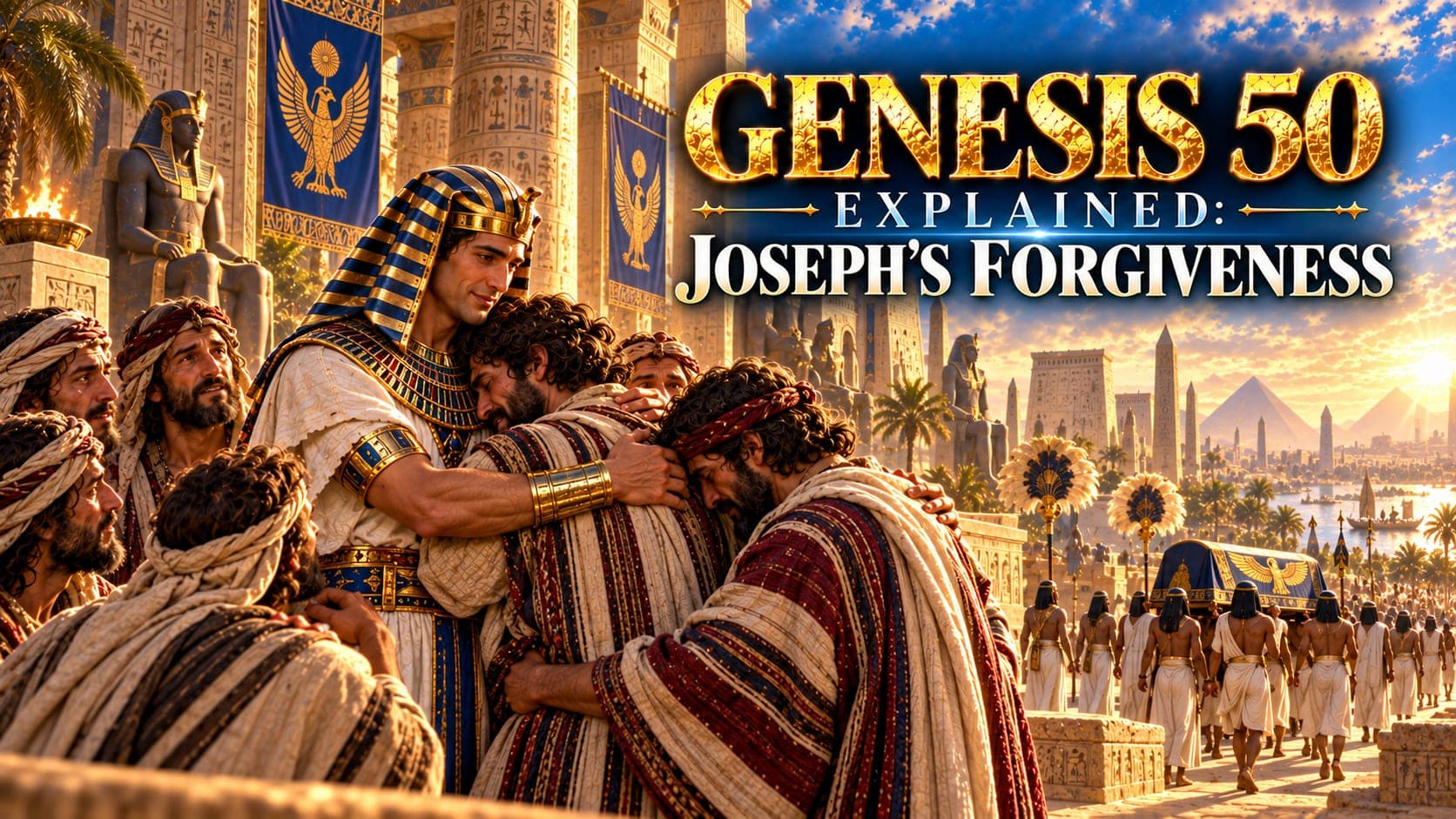
Genesis 50 closes the book with Joseph mourning his father, carrying his body back to Canaan for burial exactly as he swore, and finally reassuring his brothers of his forgiveness before his own death many years later.
Final Thoughts
Genesis 49 is twelve blessings long, and not one of them is generic.
📌 What you did years ago can still shape what people say about you now. Reuben, Simeon, and Levi are not condemned for who they are at the end of their lives. They are named for one specific thing they did, and that naming carries real weight.
📌 Correction and blessing can sit in the very same sentence. Genesis 49:28 calls the whole speech a blessing, even the parts that read like a rebuke. Jacob does not have to choose between being honest with his sons and loving them.
📌 A promise can outlast the person who first received it. Judah's blessing describes a ruler Jacob never met. Reuben's and Simeon and Levi's consequences played out generations after Jacob was gone. None of it needed him to be alive to come true.
You may be carrying something from years ago that still shapes how people see you, for better or worse.
So here is your one next step.
Name honestly, the way Jacob did for each of his sons, what from your own past is still shaping your present, and bring that to God instead of pretending it is not there.