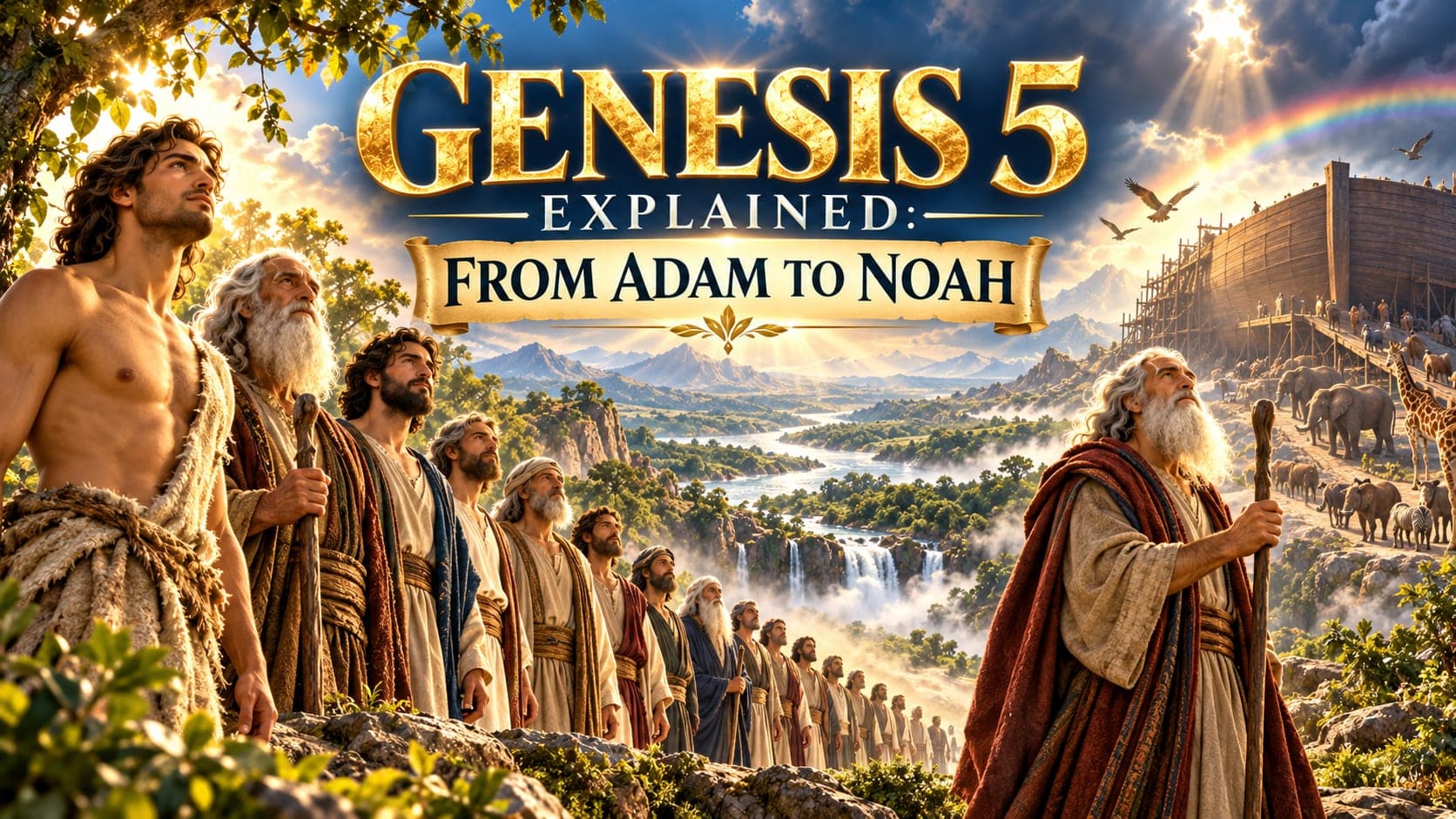
📖 Genesis 5 Explained: The Genealogy From Adam to Noah
Ten names. Eight deaths. One man who never died at all.
Genesis 5 explained is a family tree, the line from Adam down to Noah, and most readers skim past it looking for the next story.
Do not skim this one.
- ❓ Did people in this chapter really live over 900 years?
- ❓ Why does one man in the list never die at all?
- ❓ And why does the exact same word show up eight separate times?
📌 Genesis 5 is a genealogy with a heartbeat. Underneath the names is a repeated word, and one man who breaks the pattern completely.
This walkthrough goes through the whole chapter in order: the repeated formula, the man who never died, the oldest person ever recorded, and the son whose name carried a father's hope for relief.
A list of names has never told you this much about your own story.
What Happened Just Before This Chapter
Genesis 4 ended with two very different family lines already taking shape.
Cain's descendants built the first city and made music and tools, but the same line produced Lamech, a man who bragged about killing someone. Meanwhile Adam and Eve had another son, Seth, and by the end of the chapter people had started calling on the name of the LORD again.
📌 Genesis 5 is Scripture choosing which line to follow. It opens by naming itself "the book of the generations of Adam," then walks straight through Seth's family, not Cain's. Cain's line disappears from the text entirely after chapter four. Seth's line is the one that leads, ten generations later, to Noah.
Genesis 5 Explained Verse by Verse
1. Still Made in God's Likeness (verses 1 and 2)
The chapter opens by reaching all the way back past the murder in the last chapter, past the fall, back to the very beginning.
"This is the book of the generations of Adam. In the day that God created man, in the likeness of God made he him; Male and female created he them; and blessed them, and called their name Adam, in the day when they were created."
📌 This is worth pausing on. Genesis 3 recorded the fall. Genesis 4 recorded a murder. And here, two chapters later, God's likeness on Adam is stated again, without qualification. Sin damaged everything, but it did not erase the image of God stamped into humanity at creation. That is the same truth Genesis 1 already established, restated here as the foundation this whole genealogy stands on.
Notice also that "Adam" names both the man and the pair together, "male and female created he them." The name belongs to both of them from the start.
2. A Different Kind of Likeness (verse 3)
One verse later, the wording repeats with a small but heavy change.
"And Adam lived an hundred and thirty years, and begat a son in his own likeness, after his image; and called his name Seth."
Verse 1 says God made man in God's likeness. Verse 3 says Adam made a son in Adam's own likeness. Same phrase, different source.
💡 Seth still carries the image of God, because every descendant of Adam does. But he also carries Adam's likeness now, a fallen father's nature passed down to every child born after Eden. Paul makes this exact link centuries later:
"Wherefore, as by one man sin entered into the world, and death by sin; and so death passed upon all men, for that all have sinned... Nevertheless death reigned from Adam to Moses, even over them that had not sinned after the similitude of Adam's transgression, who is the figure of him that was to come."
"Death reigned from Adam to Moses." Genesis 5 is the receipt for that sentence, written out name by name.
3. The Word That Repeats Eight Times (the whole chapter)
From here the chapter settles into a formula, one man after another. Here is the pattern for Adam himself.
"And Adam lived an hundred and thirty years, and begat a son in his own likeness, after his image; and called his name Seth: And the days of Adam after he had begotten Seth were eight hundred years: and he begat sons and daughters: And all the days that Adam lived were nine hundred and thirty years: and he died."
Lived. Begat. Lived some more. Begat sons and daughters. Then, one short sentence: and he died.
The same closing line lands on Seth, Enos, Cainan, Mahalaleel, Jared, Methuselah, and Lamech. Nine hundred and thirty years for Adam. Nine hundred and twelve for Seth. Nine hundred and five for Enos. The numbers are staggering, and every single name still ends the same way.
📌 Genesis 3:19 told Adam "dust thou art, and unto dust shalt thou return." Genesis 5 is that sentence carried out, generation after generation, no matter how long a life lasted first.
⚠️ Long life was never the same thing as escaping the curse. It only delayed the last line of the verse.
4. Enoch: The Name That Breaks the Pattern (verses 21 to 24)
Seven names into the list, the formula suddenly stops working the way it has every time before.
"And Enoch lived sixty and five years, and begat Methuselah: And Enoch walked with God after he begat Methuselah three hundred years, and begat sons and daughters: And all the days of Enoch were three hundred sixty and five years: And Enoch walked with God: and he was not; for God took him."
No "and he died." Instead, "he was not; for God took him." Enoch is the shortest lived man in the whole list, and the only one who never reaches the refrain everyone else does.
📌 "Walked with God" is repeated twice about Enoch in these four verses, and Scripture uses that exact phrase about only one other man in the whole Bible. You can read the full picture of what that phrase means, and who else earns it, in every man who walked with God.
The New Testament reaches back to confirm exactly what happened to him:
"By faith Enoch was translated that he should not see death; and was not found, because God had translated him: for before his translation he had this testimony, that he pleased God."
"And Enoch also, the seventh from Adam, prophesied of these, saying, Behold, the Lord cometh with ten thousands of his saints, To execute judgment upon all, and to convince all that are ungodly among them of all their ungodly deeds which they have ungodly committed, and of all their hard speeches which ungodly sinners have spoken against him."
Jude even names Enoch's place in this genealogy, "the seventh from Adam," the same count Genesis 5 gives him. One man, in a chapter built entirely around death, walks straight out of it instead.
5. Methuselah: The Oldest Life on Record (verses 25 to 27)
Enoch's son picks up right where the pattern left off, and outlasts everyone.
"And Methuselah lived an hundred eighty and seven years, and begat Lamech: And Methuselah lived after he begat Lamech seven hundred eighty and two years, and begat sons and daughters: And all the days of Methuselah were nine hundred sixty and nine years: and he died."
Nine hundred sixty and nine years. No one else in Scripture reaches that number. Methuselah is the longest recorded human life in the Bible, and he is the son of the one man in this chapter who never died at all.
📌 Add up every age given so far in this chapter, from Adam's hundred and thirty years at Seth's birth all the way through Methuselah's birth, and something lines up that the text never states outright. Methuselah is born 687 years after Adam. He lives 969 years, which puts his death at year 1,656 counting from Adam's creation. Keep adding through Lamech and Noah using the ages given later in this same chapter, and Noah is 600 years old the year the flood comes:
"And Noah was six hundred years old when the flood of waters was upon the earth."
Run that number back through the genealogy and it lands on year 1,656 from Adam as well. The same year Methuselah's life ends is the year the flood begins. Scripture never comments on this directly, so it cannot be called anything more than an observation sitting inside the numbers themselves, but it is there for anyone who adds them up.
6. A Name Meant to Carry Hope (verses 28 to 32)
The chapter closes on Methuselah's son, and this Lamech could not be more different from the boasting Lamech who closed out chapter four.
"And Lamech lived an hundred eighty and two years, and begat a son: And he called his name Noah, saying, This same shall comfort us concerning our work and toil of our hands, because of the ground which the LORD hath cursed. And Lamech lived after he begat Noah five hundred ninety and five years, and begat sons and daughters: And all the days of Lamech were seven hundred seventy and seven years: and he died. And Noah was five hundred years old: and Noah begat Shem, Ham, and Japheth."
📌 Two men named Lamech appear in back to back chapters, and they could not be more opposite. Cain's Lamech bragged about murder. Seth's Lamech names his own son out of exhaustion and hope, longing for relief from ground that has been hard to work since Eden was lost.
Noah does not end up removing that curse. He builds an ark instead, and starts the human race over after the flood. But a father naming his son "comfort" is still the same longing that runs through the rest of the Bible, all the way to a different Son who actually does bring the rest this Lamech was hoping for.

Hard Questions Genesis 5 Raises
Did people really live for centuries? The text states it plainly and repeatedly, with specific numbers for each man, not round or symbolic figures. Most Christians read these as literal years. A few have suggested the years might mean shorter units like months, but that reading breaks down fast: it would mean some of these men fathered children before the age of ten, which the text never treats as unusual. Scripture itself does not explain why lifespans were this long before the flood and then shrink steadily in the chapters that follow. What it does say is that length of life never bought anyone an exemption from "and he died."
Why did God take Enoch and no one else in this list? The text gives a reason for what made Enoch different, that he walked with God and pleased Him, but it never explains why that same closeness was not extended to Seth or Methuselah in the same way. That is a real gap between what the text says and what it leaves unanswered. What it does show clearly is that being taken instead of dying was tied to Enoch's walk with God, not to luck or timing.
Does the Methuselah and flood connection mean anything? The math checks out from the numbers given in Genesis 5 and 7. What it means is where Christians differ. Some see it as a quiet picture of God's patience running out exactly when it was going to run out all along. Others treat it as simply how the genealogy happened to land, without reading a deeper message into it. The text itself offers the numbers and stays silent on the meaning, so certainty beyond that is opinion, not the text.
Top 4 Bible Verses From Genesis 5
1. Genesis 5:1 and 2
"This is the book of the generations of Adam. In the day that God created man, in the likeness of God made he him; Male and female created he them; and blessed them, and called their name Adam, in the day when they were created."
The image of God restated after the fall and a murder, the foundation the rest of this genealogy stands on.
2. Genesis 5:24
"And Enoch walked with God: and he was not; for God took him."
The one line in the entire chapter that refuses to end in death. A close walk with God, and an ending nobody else in this list gets.
3. Genesis 5:27
"And all the days of Methuselah were nine hundred sixty and nine years: and he died."
The longest life recorded anywhere in Scripture, belonging to the son of the one man who never had to say this line about himself.
4. Genesis 5:29
"And he called his name Noah, saying, This same shall comfort us concerning our work and toil of our hands, because of the ground which the LORD hath cursed."
A tired father naming his son out of hope for relief. The ache behind that name runs all the way through the rest of the Bible.

Frequently Asked Questions About Genesis 5
What is the point of Genesis 5?
It traces the line of Seth from Adam to Noah, keeping the promised family line separate from Cain's line in Genesis 4, and it shows death reigning over every name on the list except one.
Why did people live so long in Genesis 5?
Scripture records the ages without explaining the cause. Most readers take the numbers as literal years, especially since lifespans decline steadily in the generations after the flood, in the chapters that come later.
Who was the oldest person in the Bible?
Methuselah, at nine hundred sixty and nine years, the longest life given anywhere in Scripture. He was Enoch's son and Noah's grandfather.
Why didn't Enoch die?
Genesis 5:24 says he walked with God and God took him. Hebrews 11:5 adds that he was taken up without seeing death because he pleased God through faith.
Is it true Methuselah died the year of the flood?
Adding the ages given in Genesis 5 and Genesis 7:6 puts his death in the same year the flood arrives. The text never comments on this directly, so it stands as an observation from the numbers rather than a stated claim of Scripture.
Why does Genesis 5 repeat "and he died" so many times?
It carries out the sentence God gave Adam in Genesis 3:19, that he would return to dust. Eight names in this chapter end that same way, showing the curse reaching every generation regardless of how long each life lasted.
What does "walked with God" mean?
It describes an ongoing, close, obedient relationship with God, not a single good decision. Genesis 5 uses it about Enoch specifically, marking him out from every other name in the chapter.
Why does the Bible call Noah's birth a comfort?
Lamech named him hoping for relief from the hard labor of working ground that God had cursed back in Genesis 3. Noah did not remove that curse, but he did carry humanity through the flood into a fresh start.
How does Genesis 5 connect to Jesus?
Luke's Gospel traces Jesus's genealogy back through this exact line, Noah, Lamech, Methuselah, Enoch, all the way to Seth and Adam, showing the promised family line from Genesis 5 leading straight to Christ.
Why does this chapter matter if it is just a list of names?
Because the list is not neutral. It records the weight of death on an entire family line, and it records the one exception to that weight, which is the closest thing to a preview of resurrection hope anywhere this early in the Bible.
Final Thoughts
Genesis 5 looks like a list. It reads like a sentence carried out.
📌 Eight times this chapter says "and he died," carrying out exactly what God told Adam back in Eden. No lifespan, however long, bought anyone a way around it.
📌 One name breaks the pattern completely. Enoch walked with God, and instead of dying, he was simply taken. The rest of the chapter makes that exception impossible to miss.
📌 Even a tired father naming his son hoped for something better than what he had. Lamech named Noah for comfort he never fully received. The ache in that name still points forward, past Noah, to the one who finally answers it.
You are somewhere in a genealogy too, carrying both the image of God and the weight Adam passed down.
So here is your one next step.
Read the names in this chapter out loud, slowly, and let "and he died" land each time. Then read Enoch's line again, and let that one exception be the hope you carry into the next chapter.