📖 Numbers 32 Explained: Gad, Reuben, and the Land East of Jordan
Two tribes love the land they already have.
They do not love what is still ahead of them.
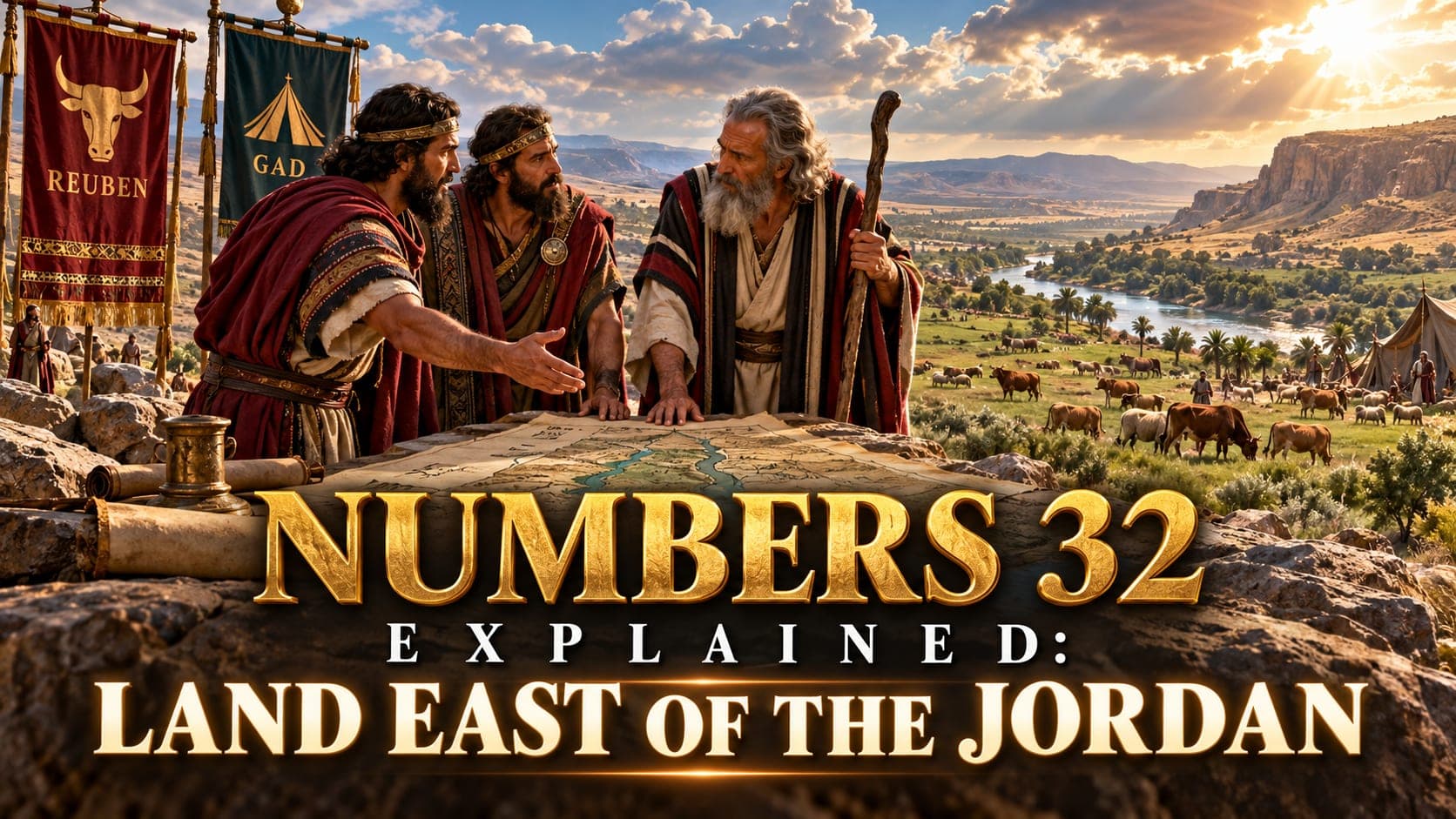
Numbers 32 explained is the chapter where Reuben and Gad look at the grazing land east of the Jordan, land Israel already won from two defeated kings, and ask Moses for permission to stay there instead of crossing over into Canaan with everyone else. Moses hears the request and immediately hears something underneath it: the exact sound of the ten spies who talked Israel out of entering the promised land forty years earlier.
Maybe you have asked God for the easier version of something He told you to finish.
- ❓ Why does Moses compare this request to the sin that cost Israel forty years in the wilderness?
- ❓ Is it wrong that Reuben and Gad wanted land outside the borders of Canaan itself?
- ❓ What does "be sure your sin will find you out" actually mean in this chapter?
- ❓ Why does half the tribe of Manasseh end up with land nobody heard them ask for?
📌 Numbers 32 is not a chapter about two tribes finding a shortcut. It is a chapter about the difference between a compromise God can work with and a compromise that repeats an old sin.
This walkthrough goes through the whole chapter in order: the request itself, Moses' sharp memory of Kadesh Barnea, the compromise Gad and Reuben offer in response, the conditions Moses sets before he agrees to anything, the vow repeated in front of the whole leadership, and the cities that got new names once the land was finally divided.
Forty two verses, and almost the whole chapter turns on one question nobody in it ever says out loud: are you staying behind, or are you simply going first.
What Happened Just Before This Chapter
Numbers 31 ended with Israel's war against Midian finally settled, the spoil divided, and gold from grateful officers resting inside the tabernacle as a memorial. That chapter closed one account. Numbers 32 opens a different one, and it reaches back further than last chapter's war.
Eleven chapters earlier, in Numbers 21, Israel fought two kings on the road toward Moab: Sihon, king of the Amorites, and Og, king of Bashan. Both kingdoms fell completely.
"And Israel smote him with the edge of the sword, and possessed his land from Arnon unto Jabbok, even unto the children of Ammon: for the border of the children of Ammon was strong."
"And the LORD said unto Moses, Fear him not: for I have delivered him into thy hand, and all his people, and his land; and thou shalt do to him as thou didst unto Sihon king of the Amorites, which dwelt at Heshbon. So they smote him, and his sons, and all his people, until there was none left him alive: and they possessed his land."
That left Israel holding a wide stretch of good land east of the Jordan River, outside the actual borders of Canaan. It sat there, already conquered, already Israel's by right of battle, while the story moved on to a census, a war with Midian, and a count of captured gold. Numbers 32 is the moment somebody finally looks at that land and asks what should happen to it.

Numbers 32 Explained Verse by Verse
1. A Request Built on Good Grazing Land (verses 1 to 5)
The chapter opens with a plain fact about two tribes and their herds.
"Now the children of Reuben and the children of Gad had a very great multitude of cattle: and when they saw the land of Jazer, and the land of Gilead, that, behold, the place was a place for cattle;"
Reuben and Gad were cattle people. Large herds need large pasture, and the recently emptied land of Gilead, taken from Sihon just chapters earlier, was exactly the kind of open country they needed. They name nine towns in it by name before making their case to Moses, Eleazar the priest, and the leaders of the whole congregation together.
"Even the country which the LORD smote before the congregation of Israel, is a land for cattle, and thy servants have cattle: Wherefore, said they, if we have found grace in thy sight, let this land be given unto thy servants for a possession, and bring us not over Jordan."
📌 Notice the last four words: "bring us not over Jordan." That is the whole request in miniature. Not more land in Canaan. Not a different inheritance. An exemption from crossing over at all.
💡 Their reasoning was not dishonest. The LORD really had struck down this country before Israel's own eyes, and it really was good for cattle. A true observation can still be used to ask for the wrong thing.
2. Moses Hears Kadesh Barnea All Over Again (verses 6 to 15)
Moses does not answer the request on its own terms. He answers the pattern he thinks he hears inside it.
"And Moses said unto the children of Gad and to the children of Reuben, Shall your brethren go to war, and shall ye sit here? And wherefore discourage ye the heart of the children of Israel from going over into the land which the LORD hath given them?"
⚠️ Moses does not hear a logistics question. He hears discouragement, the exact word used for what wrecked an entire generation. Then he says who he means.
"Thus did your fathers, when I sent them from Kadeshbarnea to see the land. For when they went up unto the valley of Eshcol, and saw the land, they discouraged the heart of the children of Israel, that they should not go into the land which the LORD had given them."
This is the twelve spies of Numbers 13 and Numbers 14, the mission Moses himself sent out from Kadesh Barnea. Ten of them came back and talked an entire nation out of entering the land God had already promised. Moses was there. He watched what that sentence cost.
"Surely none of the men that came up out of Egypt, from twenty years old and upward, shall see the land which I sware unto Abraham, unto Isaac, and unto Jacob; because they have not wholly followed me: Save Caleb the son of Jephunneh the Kenezite, and Joshua the son of Nun: for they have wholly followed the LORD."
📌 Only two men out of that whole generation get named as exceptions: Caleb and Joshua. Everyone else who refused to go up died in the wilderness over the next forty years, the exact sentence Moses now sees repeating itself in front of him.
"And, behold, ye are risen up in your fathers' stead, an increase of sinful men, to augment yet the fierce anger of the LORD toward Israel. For if ye turn away from after him, he will yet again leave them in the wilderness; and ye shall destroy all this people."
💡 Moses is not accusing Gad and Reuben of cowardice toward battle. He is accusing their request of doing to this generation what the spies' report did to the last one: handing the rest of Israel a reason to lose heart before Canaan is even in sight.
3. The Offer That Changes the Terms (verses 16 to 19)
Gad and Reuben do not argue with Moses. They answer with a different proposal entirely.
"And they came near unto him, and said, We will build sheepfolds here for our cattle, and cities for our little ones: But we ourselves will go ready armed before the children of Israel, until we have brought them unto their place: and our little ones shall dwell in the fenced cities because of the inhabitants of the land."
📌 The first request was about where their families and herds would live. The new offer is about where the fighting men would go. Those are two different questions, and Moses had collapsed them into one.
"We will not return unto our houses, until the children of Israel have inherited every man his inheritance. For we will not inherit with them on yonder side Jordan, or forward; because our inheritance is fallen to us on this side Jordan eastward."
💡 They are not asking to sit out the conquest. They are asking to go first, fight alongside everyone else until the whole job is finished, and only then come home to land they already have a claim on. That is a very different shape than the spies ever offered.
4. Moses Sets the Terms, and the Verse Everyone Remembers (verses 20 to 24)
Moses agrees, but not without binding the offer into a condition with real teeth.
"And Moses said unto them, If ye will do this thing, if ye will go armed before the LORD to war, And will go all of you armed over Jordan before the LORD, until he hath driven out his enemies from before him, And the land be subdued before the LORD: then afterward ye shall return, and be guiltless before the LORD, and before Israel; and this land shall be your possession before the LORD."
Then comes the warning side of the same condition.
"But if ye will not do so, behold, ye have sinned against the LORD: and be sure your sin will find you out."
📌 That sentence is not a general promise about every hidden sin in your life. It is Moses naming one specific risk: a broken word to God and to your own people does not quietly disappear. More on how far that verse should stretch sits in the hard questions below.
"Build you cities for your little ones, and folds for your sheep; and do that which hath proceeded out of your mouth."
💡 That last line is almost a dare. Moses does not simply accept the offer. He tells them to do exactly what they just said, nothing softer, with the full weight of their own words now sitting on their shoulders.
5. The Vow Repeated in Front of Witnesses (verses 25 to 32)
Gad and Reuben answer with a vow, not a negotiation.
"And the children of Gad and the children of Reuben spake unto Moses, saying, Thy servants will do as my lord commandeth."
Moses then does something careful. He does not simply take their word for it. He turns to the men who will actually have to enforce the arrangement after he is gone, Eleazar the priest, Joshua, and the heads of the tribes, and spells out the same terms to them directly: give Gad and Reuben this land if they cross over armed, settle them in Canaan instead if they do not.
"And the children of Gad and the children of Reuben answered, saying, As the LORD hath said unto thy servants, so will we do. We will pass over armed before the LORD into the land of Canaan, that the possession of our inheritance on this side Jordan may be ours."
📌 Gad and Reuben's own vow gets repeated twice in this chapter, once straight to Moses in verse 25, and again in verse 31 after Moses has just set the same terms in front of Eleazar and Joshua. Nothing about this agreement was casual or private. Every witness who could later hold them to it heard it directly.
6. The Land Divided and the Cities Rebuilt (verses 33 to 42)
Once the terms are settled, Moses makes the grant official.
"And Moses gave unto them, even to the children of Gad, and to the children of Reuben, and unto half the tribe of Manasseh the son of Joseph, the kingdom of Sihon king of the Amorites, and the kingdom of Og king of Bashan, the land, with the cities thereof in the coasts, even the cities of the country round about."
📌 A third group shows up here that never spoke a word in the whole chapter: half the tribe of Manasseh. Verses 39 to 42 explain why. Clans within Manasseh had gone out on their own and simply taken parts of Gilead by force, and Moses folds their conquest into the same settlement rather than undoing it.
"And the children of Machir the son of Manasseh went to Gilead, and took it, and dispossessed the Amorite which was in it."
"And Jair the son of Manasseh went and took the small towns thereof, and called them Havothjair. And Nobah went and took Kenath, and the villages thereof, and called it Nobah, after his own name."
💡 Jair and Nobah both do something nobody else named in the chapter does. Havothjair means villages of Jair, and Nobah renames Kenath after himself in the very same verse. Turning a conquered place into your own personal legacy is a very old temptation, and Scripture simply records it without comment.

Hard Questions Numbers 32 Raises
Was it wrong for Reuben and Gad to settle outside the actual borders of Canaan? The text never condemns the final arrangement. Moses himself grants the land in verse 33, and later Scripture treats it as a legitimate inheritance, not a mistake. What the chapter does flag as dangerous is the first version of the request, the one that offered to stay behind while everyone else fought. The second version, built on going to war first and settling only after, is the one Moses actually approves.
Did staying east of the Jordan carry a real cost later, even if it was not sin at the time? Scripture does not pretend the arrangement was risk free. Generations later, these same two and a half tribes built an altar at the Jordan on their way home from helping conquer Canaan, and it nearly started a war with the rest of Israel before they explained themselves.
"And when they came unto the borders of Jordan, that are in the land of Canaan, the children of Reuben and the children of Gad and the half tribe of Manasseh built there an altar by Jordan, a great altar to see to."
"And the children of Reuben and the children of Gad called the altar Ed: for it shall be a witness between us that the LORD is God."
That whole episode reads like the anxiety of a people worried that living on the far side of a river would someday mean being forgotten by the rest of Israel. Centuries later, 1 Chronicles records something harder still.
"And they transgressed against the God of their fathers, and went a whoring after the gods of the people of the land, whom God destroyed before them. And the God of Israel stirred up the spirit of Pul king of Assyria, and the spirit of Tilgathpilneser king of Assyria, and he carried them away, even the Reubenites, and the Gadites, and the half tribe of Manasseh, and brought them unto Halah, and Habor, and Hara, and to the river Gozan, unto this day."
📌 The text gives its own reason for that exile, idolatry, not geography. It does not say these tribes fell away because they lived east of the Jordan. It says they turned to the gods of the people around them. Living farther from the center of Israel's worship may well have made that drift easier, but Scripture names the sin itself, not the address, as the cause.
Did Gad and Reuben actually keep the vow they made in this chapter? Yes. Deuteronomy records Moses confirming the same arrangement again before he died, and Joshua later leads them across the Jordan armed exactly as they promised.
"But your wives, and your little ones, and your cattle, (for I know that ye have much cattle,) shall abide in your cities which I have given you; Until the LORD have given rest unto your brethren, as well as unto you, and until they also possess the land which the LORD your God hath given them beyond Jordan: and then shall ye return every man unto his possession, which I have given you."
A vow sworn in Numbers 32 gets fulfilled in full later in the story. Whatever risk came with their choice of land, breaking their word to Moses was not part of it.
Top Verses From Numbers 32
1. Numbers 32:5
"Wherefore, said they, if we have found grace in thy sight, let this land be given unto thy servants for a possession, and bring us not over Jordan."
The request in its original, unfiltered form, before Moses pushes back and before Gad and Reuben revise their offer into something very different.
2. Numbers 32:12
"Save Caleb the son of Jephunneh the Kenezite, and Joshua the son of Nun: for they have wholly followed the LORD."
The two names Moses measures every later generation against. Out of an entire exodus generation, only these two wholly followed, and that phrase is exactly what this chapter is testing again.
3. Numbers 32:23
"But if ye will not do so, behold, ye have sinned against the LORD: and be sure your sin will find you out."
The most quoted line in the chapter, aimed at one specific broken promise, not every private sin a person could ever commit.
4. Numbers 32:24
"Build you cities for your little ones, and folds for your sheep; and do that which hath proceeded out of your mouth."
Moses holding Gad and Reuben to their own words, the moment their offer stops being a negotiation and becomes a debt they owe.
5. Numbers 32:33
"And Moses gave unto them, even to the children of Gad, and to the children of Reuben, and unto half the tribe of Manasseh the son of Joseph, the kingdom of Sihon king of the Amorites, and the kingdom of Og king of Bashan, the land, with the cities thereof in the coasts, even the cities of the country round about."
The arrangement made official, land already won by battle now permanently assigned before a single tribe has crossed the Jordan.

Frequently Asked Questions About Numbers 32
What is Numbers 32 about?
Numbers 32 records Gad and Reuben asking Moses for land east of the Jordan instead of crossing into Canaan. Moses compares the request to the sin of the twelve spies, and the two tribes respond by offering to fight alongside Israel first and settle the land only after Canaan is conquered.
Why did Reuben and Gad want land east of the Jordan?
Numbers 32:1 and 4 say they had very large herds of cattle, and the land of Gilead, recently taken from Sihon the Amorite king, was good pasture. They asked Moses directly for permission to settle there instead of receiving land inside Canaan.
Why did Moses get angry at their request?
Numbers 32:6 to 9 show Moses comparing their request to the ten spies who discouraged Israel from entering the promised land at Kadesh Barnea, a sin that cost that entire generation forty years in the wilderness. He feared Gad and Reuben were about to repeat it.
What does "be sure your sin will find you out" mean in Numbers 32:23?
In context it is a specific warning, not a general promise about every hidden sin. Moses is telling Gad and Reuben that if they fail to keep their vow to fight alongside Israel, that broken promise will not stay quietly buried.
Did Gad and Reuben actually keep their promise?
Yes. Deuteronomy 3:18 to 20 shows Moses confirming the same arrangement again before his death, and the book of Joshua records their armed men crossing the Jordan and fighting alongside the rest of Israel exactly as they vowed in Numbers 32:25 to 32.
Why is the half tribe of Manasseh included in Numbers 32?
Numbers 32:39 to 41 explain that clans within Manasseh, led by Machir and Jair, had already taken parts of Gilead on their own initiative. Moses folded their conquest into the same land grant given to Gad and Reuben rather than reversing it.
What happened to these tribes after they settled east of Jordan?
Joshua 22 records them building an altar at the Jordan that nearly caused a war with the rest of Israel before they explained its meaning. Generations later, 1 Chronicles 5:25 and 26 says they were carried into exile by Assyria because of idolatry, not because of where they lived.
Was it a sin for Reuben and Gad to want land outside of Canaan?
The text does not treat the final arrangement as sin. Moses grants the land officially in Numbers 32:33 once the tribes agree to fight first. What concerned him was the first version of the request, which offered to stay behind entirely while Israel went to war without them.
Who were Sihon and Og, and why does their land matter here?
Sihon, king of the Amorites, and Og, king of Bashan, were two kings Israel defeated in Numbers 21 on the way to Moab. Their conquered territory east of the Jordan is exactly the land Gad, Reuben, and half of Manasseh request and receive in Numbers 32.
What is the connection between Numbers 32 and the twelve spies?
Moses directly references the spies sent out from Kadesh Barnea in Numbers 32:8 and 9, the same event told in Numbers 13 and 14. He sees Gad and Reuben's original request as a possible repeat of the discouragement that kept Israel out of Canaan for forty years.
Final Thoughts
Numbers 32 is not a chapter about two tribes settling for less. It is a chapter about how a request gets tested before it gets granted.
📌 A good observation can still support a wrong request. Gad and Reuben were right that the land was good for cattle. That truth almost became an excuse to stay behind while everyone else fought.
📌 Moses did not reject the compromise. He rejected the shape of it first. Once the offer changed from staying home to going first, the same two tribes received the same land with his full blessing.
📌 A vow spoken in front of witnesses carries weight a private intention never does. Gad and Reuben repeated their promise three times, to Moses, in his exact terms, and in front of Eleazar and Joshua, before anyone acted on it.
You probably are not negotiating tribal land this week. But you likely have your own version of asking for the comfortable version of a hard assignment.
So here is your one next step.
Look at the last request you made that tried to keep the reward without the part that actually cost you something, and ask whether it needs the same revision Gad and Reuben's offer got.