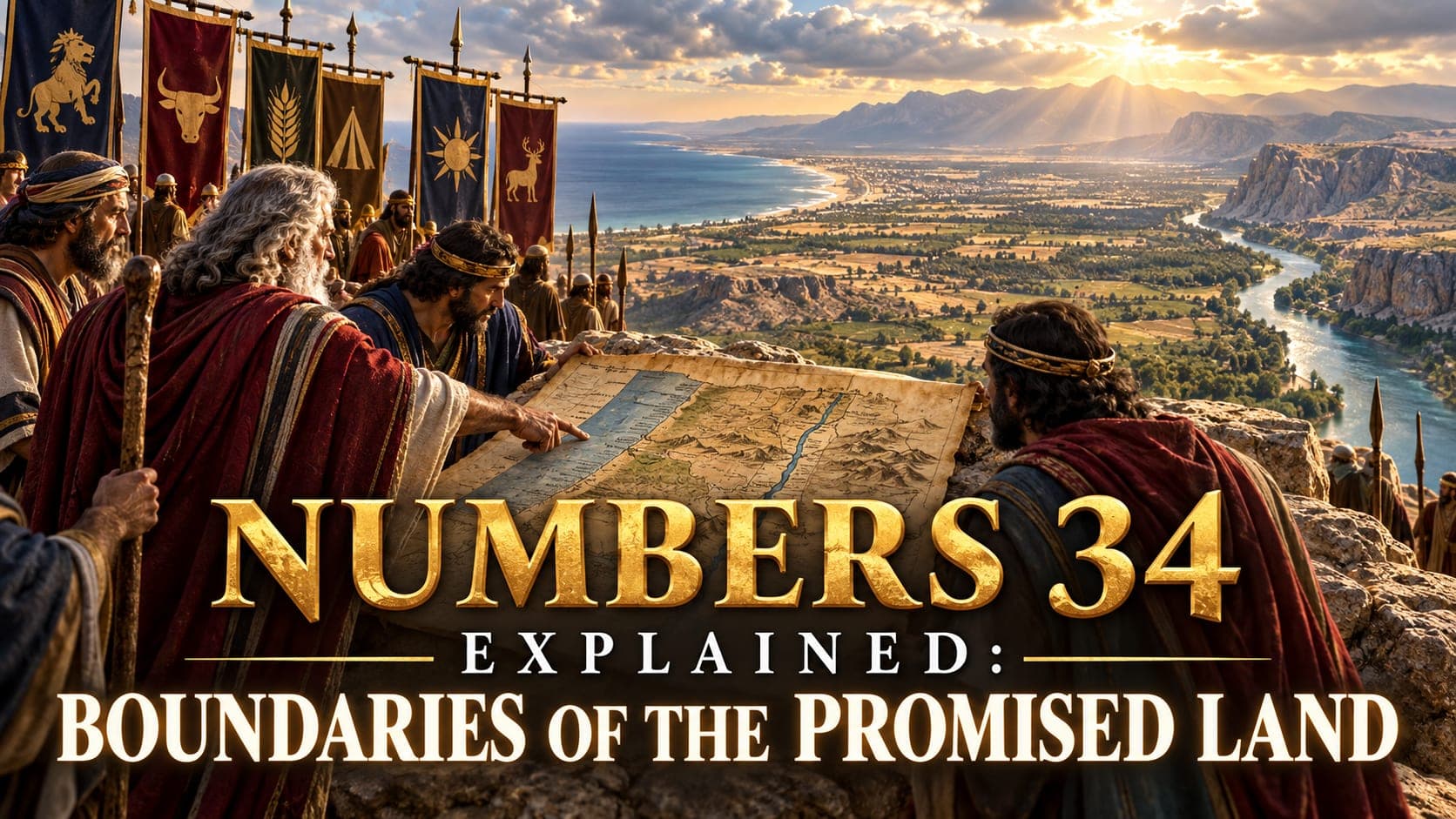
📖 Numbers 34 Explained: The Borders of Canaan and the Men Who Drew Them
A promise finally gets an address.
Twenty nine verses turn "the land" into an actual shape with edges.
Numbers 34 explained is the chapter where God tells Moses exactly where Canaan starts and exactly where it stops: a south edge, a west edge, a north edge, and an east edge, named point by point. Then the chapter pauses to remind everyone that two and a half tribes already have land outside those very lines. It closes by naming the twelve men, one by one, who will actually hand the land out.
Maybe a promise has only ever felt real to you once it came with real terms attached.
- ❓ Why does God spell out mountains and rivers instead of just saying "Canaan"?
- ❓ Why pause the border description to mention tribes who are not even getting this land?
- ❓ Why name twelve individual men instead of simply saying "the leaders will divide it"?
- ❓ Why does Levi have no representative on that list at all?
📌 Numbers 34 is not a geography lesson tacked onto the end of the book. It is the promise made to Abraham finally getting fixed, measurable lines.
This walkthrough covers the chapter in order: why the border needed drawing at all, the south line from the wilderness of Zin to the river of Egypt, the west and north lines up to the Great Sea and mount Hor, the east line that closes the loop at the Jordan, the reminder about the land already settled outside these borders, and the twelve names chosen to divide what is left.
Twenty nine verses, and the lines matter as much as any battle report in this book.
What Happened Just Before This Chapter
Numbers 33 ended with the full itinerary of Israel's journey finally written down, closing with a direct command: drive out the people of Canaan, destroy their idols, and divide the land by lot once Israel crosses the Jordan.
But that command never said where the land actually began or ended. Before any lot gets cast, before any tribe gets a single acre, Numbers 34 answers the question that command left open: divide what land, exactly.

Numbers 34 Explained Verse by Verse
1. Why the Border Needed Drawing at All (verses 1 and 2)
The chapter opens the same way Numbers 33 did, with a direct command from God through Moses.
"Command the children of Israel, and say unto them, When ye come into the land of Canaan; (this is the land that shall fall unto you for an inheritance, even the land of Canaan with the coasts thereof:)"
📌 "The land of Canaan with the coasts thereof" is the whole point of the chapter stated in one breath. A promise of land only works if someone can point to where it starts and where it stops. Up to this chapter, Canaan has been a destination. From here, it becomes a shape on a map.
💡 The word coasts in Numbers 34 does not mean a seashore. It is an old English word for borders or boundary lines, used the same way throughout this chapter and in the border lists of Joshua that will later echo it almost word for word.
2. The South Border: Zin to the River of Egypt (verses 3 to 5)
The boundary starts at the bottom of the land and works along the ground Israel already knows.
"Then your south quarter shall be from the wilderness of Zin along by the coast of Edom, and your south border shall be the outmost coast of the salt sea eastward: And your border shall turn from the south to the ascent of Akrabbim, and pass on to Zin: and the going forth thereof shall be from the south to Kadeshbarnea, and shall go on to Hazaraddar, and pass on to Azmon: And the border shall fetch a compass from Azmon unto the river of Egypt, and the goings out of it shall be at the sea."
📌 Every name in this line is ground Israel has already walked. The wilderness of Zin and Kadeshbarnea are the same places where Miriam died and where Moses struck the rock in Numbers 20. The salt sea is the Dead Sea. The southern edge of the promised land is drawn through the exact wilderness where the thirty eight lost years happened.
💡 Akrabbim means scorpions. Bible teachers connect the name to the Scorpion Pass, a steep climb along this same stretch of desert, likely named for the creatures that lived there.
⚠️ The "river of Egypt" here is not the Nile. More on that in the hard questions below, because the two names look identical in English but are not the same river.
3. The West and North Borders: The Great Sea to Mount Hor (verses 6 to 9)
The west border takes one verse, because the Mediterranean coastline does the work on its own.
"And as for the western border, ye shall even have the great sea for a border: this shall be your west border."
💡 The great sea is the Mediterranean. Unlike every other border in this chapter, the west edge of the land needs no list of landmarks. The sea itself is the landmark.
The north border is where the chapter starts naming places that never come up anywhere else in the walk through Canaan.
"And this shall be your north border: from the great sea ye shall point out for you mount Hor: From mount Hor ye shall point out your border unto the entrance of Hamath; and the goings forth of the border shall be to Zedad: And the border shall go on to Ziphron, and the goings out of it shall be at Hazarenan: this shall be your north border."
⚠️ This mount Hor is almost certainly not the mountain where Aaron died. Aaron's mount Hor sat in Edom, far to the south, near the stops Numbers 33 already named. This mount Hor anchors the far north of the whole land, toward Hamath, a region well north of Canaan itself. Same name, two different mountains.
💡 Hamath marks the northern limit the Bible uses more than once to describe the full reach of the land, from the border of Hamath in the north down to Egypt in the south.
4. The East Border Closes the Loop (verses 10 to 12)
The last side brings the boundary back down to where Israel is actually camped.
"And ye shall point out your east border from Hazarenan to Shepham: And the coast shall go down from Shepham to Riblah, on the east side of Ain; and the border shall descend, and shall reach unto the side of the sea of Chinnereth eastward: And the border shall go down to Jordan, and the goings out of it shall be at the salt sea: this shall be your land with the coasts thereof round about."
📌 The sea of Chinnereth is the sea later generations call the Sea of Galilee. From there the line follows the Jordan River south, all the way back down to the salt sea where the south border already started. Four sides, and the loop closes exactly where it began.
💡 Notice what the east border is: the Jordan River itself for most of its length. The river Israel is about to cross is not only a crossing point. It is drawn here as the eastern wall of the promised land itself.
5. The Land Already Outside These Lines (verses 13 to 15)
As soon as the borders close, Moses points out something the borders themselves already made obvious.
"And Moses commanded the children of Israel, saying, This is the land which ye shall inherit by lot, which the LORD commanded to give unto the nine tribes, and to the half tribe: For the tribe of the children of Reuben according to the house of their fathers, and the tribe of the children of Gad according to the house of their fathers, have received their inheritance; and half the tribe of Manasseh have received their inheritance: The two tribes and the half tribe have received their inheritance on this side Jordan near Jericho eastward, toward the sunrising."
📌 Reuben, Gad, and half of Manasseh are missing from this chapter because their land sits outside the border it just drew. Numbers 32 already settled their request for land east of the Jordan. Numbers 34's east border runs along that same river, which means their inheritance was never going to be inside these lines in the first place.
💡 Nine tribes and a half tribe are left to divide the land these borders describe. Two tribes and a half tribe already have theirs. The arithmetic of twelve full tribes still works, it is just split across two different pieces of ground.
6. The Twelve Men Chosen to Divide What Is Left (verses 16 to 29)
The chapter ends the way it began, with a direct word from God, this time naming the people who will finish the job.
"And the LORD spake unto Moses, saying, These are the names of the men which shall divide the land unto you: Eleazar the priest, and Joshua the son of Nun."
📌 Only two names get the job of dividing the entire land, and neither one is Moses. Moses drew the borders. Eleazar the priest and Joshua will be the ones who actually hand the land out, which tells you plainly who is expected to still be standing once Israel crosses the Jordan.
Then one prince from each remaining tribe joins them, named one by one.
"And of the tribe of the children of Simeon, Shemuel the son of Ammihud. Of the tribe of Benjamin, Elidad the son of Chislon. And the prince of the tribe of the children of Dan, Bukki the son of Jogli."
💡 The first name on the list of princes belongs to Judah: Caleb the son of Jephunneh, the same Caleb who stood with Joshua as the two faithful spies in Numbers 14. Forty years later he is still here, still trusted with responsibility over the very land he once risked his life to report on honestly.
⚠️ Ten princes are named for ten tribes, not twelve. Reuben and Gad have no prince on this list, because their land was already settled outside these borders in Numbers 32. Levi has no prince either, and the chapter does not explain why here. More on both in the hard questions below.
"These are they whom the LORD commanded to divide the inheritance unto the children of Israel in the land of Canaan."
💡 The chapter closes on that single sentence. Borders drawn, names recorded, and the entire assignment handed to twelve specific men before a single tribe has set foot across the Jordan.

Hard Questions Numbers 34 Raises
Is the mount Hor in verse 7 the same mountain where Aaron died? Almost certainly not. Aaron's mount Hor sits on the border of Edom, far south, named among the camps in Numbers 33. The mount Hor in this chapter anchors the far north of the land, near Hamath, well beyond Canaan's northern edge. The text never says these are different mountains outright, but their positions make it clear they cannot be the same place. Two landmarks happen to share a name that simply means "the mountain."
Is the "river of Egypt" in verse 5 the Nile? No. Bible teachers widely agree that the river of Egypt named as a border marker, here and later in Joshua, refers to a seasonal desert stream, usually identified with the Wadi el Arish, not the Nile River itself. The Nile sits far deeper into Egypt than any border of Canaan ever reached. The name overlaps in English translation, but the geography does not.
Why does Joshua's border for Judah read almost identically to this chapter? Because it describes the same line.
"And it went out to the south side to Maalehacrabbim, and passed along to Zin, and ascended up on the south side unto Kadeshbarnea, and passed along to Hezron, and went up to Adar, and fetched a compass to Karkaa: From thence it passed toward Azmon, and went out unto the river of Egypt; and the goings out of that coast were at the sea: this shall be your south coast."
📌 Judah's southern border in Joshua 15 runs through the same Akrabbim, the same Zin, the same Kadeshbarnea, and the same river of Egypt as Numbers 34's southern border. The national boundary Moses drew here becomes the tribal boundary Joshua later records. The map in this chapter was not a suggestion. It is the exact line later chapters build on.
Why are Reuben, Gad, and Levi missing from the list of twelve princes? Reuben and Gad already received their inheritance east of the Jordan in Numbers 32, outside the very borders this chapter describes, so they had no stake in dividing land that was never going to be theirs. Levi is different. The tribe of Levi never received a territory of its own anywhere in Israel. Their inheritance was the priesthood itself and scattered cities within the other tribes' land, not a region to divide by lot, so a Levite prince on this particular list would have had nothing to represent.
Did Israel ever actually possess the full land these borders describe? Not completely, and Scripture is honest about that. These borders describe a smaller, fixed region than the full promise God made to Abraham.
"In the same day the LORD made a covenant with Abram, saying, Unto thy seed have I given this land, from the river of Egypt unto the great river, the river Euphrates:"
Genesis 15:18 stretches the promise all the way to the Euphrates, far beyond Numbers 34's northern line at Hamath. Centuries later, Solomon's kingdom came close to that wider reach.
"And Solomon reigned over all kingdoms from the river unto the land of the Philistines, and unto the border of Egypt: they brought presents, and served Solomon all the days of his life."
💡 Even Solomon's influence, not full settled possession, is what reached that far. The specific, measured land of Numbers 34 was fully divided and settled under Joshua. The wider promise to Abraham stretched further than Israel ever fully occupied at one time.
Top Verses From Numbers 34
1. Numbers 34:2
"Command the children of Israel, and say unto them, When ye come into the land of Canaan; (this is the land that shall fall unto you for an inheritance, even the land of Canaan with the coasts thereof:)"
The whole chapter in one command. A promised land only means something once its edges are named, and this verse is where that naming begins.
2. Numbers 34:5
"And the border shall fetch a compass from Azmon unto the river of Egypt, and the goings out of it shall be at the sea."
A border marker often confused with the Nile, but almost certainly a much smaller desert stream, a reminder that the promised land was never meant to swallow Egypt itself.
3. Numbers 34:12
"And the border shall go down to Jordan, and the goings out of it shall be at the salt sea: this shall be your land with the coasts thereof round about."
The moment the loop closes. Four borders named, and the Jordan itself drawn as the eastern wall of the land Israel is about to enter.
4. Numbers 34:17
"These are the names of the men which shall divide the land unto you: Eleazar the priest, and Joshua the son of Nun."
Two names given full responsibility for the entire division of the land, a direct answer to who would lead once Moses was no longer there to do it himself.
5. Numbers 34:29
"These are they whom the LORD commanded to divide the inheritance unto the children of Israel in the land of Canaan."
The closing line of a chapter that is really one long piece of preparation, borders and names, finished before a single tribe has crossed the river.

Frequently Asked Questions About Numbers 34
What is Numbers 34 about?
Numbers 34 lays out the exact south, west, north, and east borders of the land of Canaan, confirms that Reuben, Gad, and half of Manasseh already have their inheritance outside those borders, and names the twelve men who will divide the remaining land among the other tribes.
What are the four borders of the promised land in Numbers 34?
The south border runs from the wilderness of Zin to the river of Egypt. The west border is the Great Sea, the Mediterranean. The north border runs to mount Hor and the entrance of Hamath. The east border follows the Jordan River down to the salt sea.
Is the river of Egypt in Numbers 34 the Nile River?
Most Bible teachers say no. The border marker called the river of Egypt is widely identified with a seasonal desert stream, the Wadi el Arish, rather than the Nile. Joshua 15:4 uses the same name for the same southern border marker.
Is mount Hor in Numbers 34 the same place where Aaron died?
No, almost certainly not. Aaron's mount Hor was in Edom, far to the south, as Numbers 33:37 and 38 describe. The mount Hor in Numbers 34:7 marks the far northern edge of the land near Hamath, a different location that happens to share the same name.
Why are Reuben and Gad not on the list of princes who divide the land?
Numbers 34:14 and 15 explain that Reuben, Gad, and half of Manasseh already received their inheritance east of the Jordan in Numbers 32, outside the borders this chapter describes. They had no claim to divide because their land was never part of these lines.
Why is there no prince from the tribe of Levi in Numbers 34?
Levi never received a territory of its own in Israel. Their inheritance was the priesthood and scattered cities within the other tribes' land, not a region to be divided by lot, so Levi had nothing to assign through this particular list of princes.
Who were Eleazar and Joshua, and why are they named first?
Eleazar was the high priest after Aaron, and Joshua was Moses' successor as Israel's leader. Numbers 34:17 names them first and gives them final responsibility for dividing the land, confirming who would carry Israel's leadership once Moses was gone.
Does the land in Numbers 34 match the full promise God made to Abraham?
Not exactly. Genesis 15:18 stretches Abraham's promise as far as the Euphrates River, well beyond Numbers 34's northern border at Hamath. Solomon's influence later reached that wider extent, as 1 Kings 4:21 describes, but Israel's settled territory matched the smaller borders drawn in this chapter.
Did these borders actually get used later in the Bible?
Yes. Joshua 15:3 and 4 describes Judah's southern border using nearly the same landmarks as Numbers 34:3 to 5, including Akrabbim, Kadeshbarnea, and the river of Egypt, showing that this chapter's lines directly shaped the later tribal allotments.
Final Thoughts
Numbers 34 looks like pure logistics, and underneath it is a chapter about a promise becoming specific.
📌 A promise with no edges is easy to doubt. A promise with named borders is not. God does not simply tell Israel they will have land. He tells them where it starts and where it stops, point by point.
📌 Being outside the lines does not mean being outside the promise. Reuben, Gad, and half of Manasseh sit outside this chapter's borders entirely, and their inheritance was no less real for it.
📌 God prepares the handoff before the crossing ever happens. Eleazar and Joshua are named, the princes are named, and the entire assignment is settled while Israel is still camped on the wrong side of the Jordan.
You are probably not measuring a border this week. But you likely have a promise in your own life that has stayed vague for too long, something you believe God said without ever pinning down what it actually looks like in practice.
So here is your one next step.
Take one promise you have been trusting God for in general terms, and write down the specific shape you expect it to take, the way Numbers 34 turned Canaan from an idea into a line on a map.