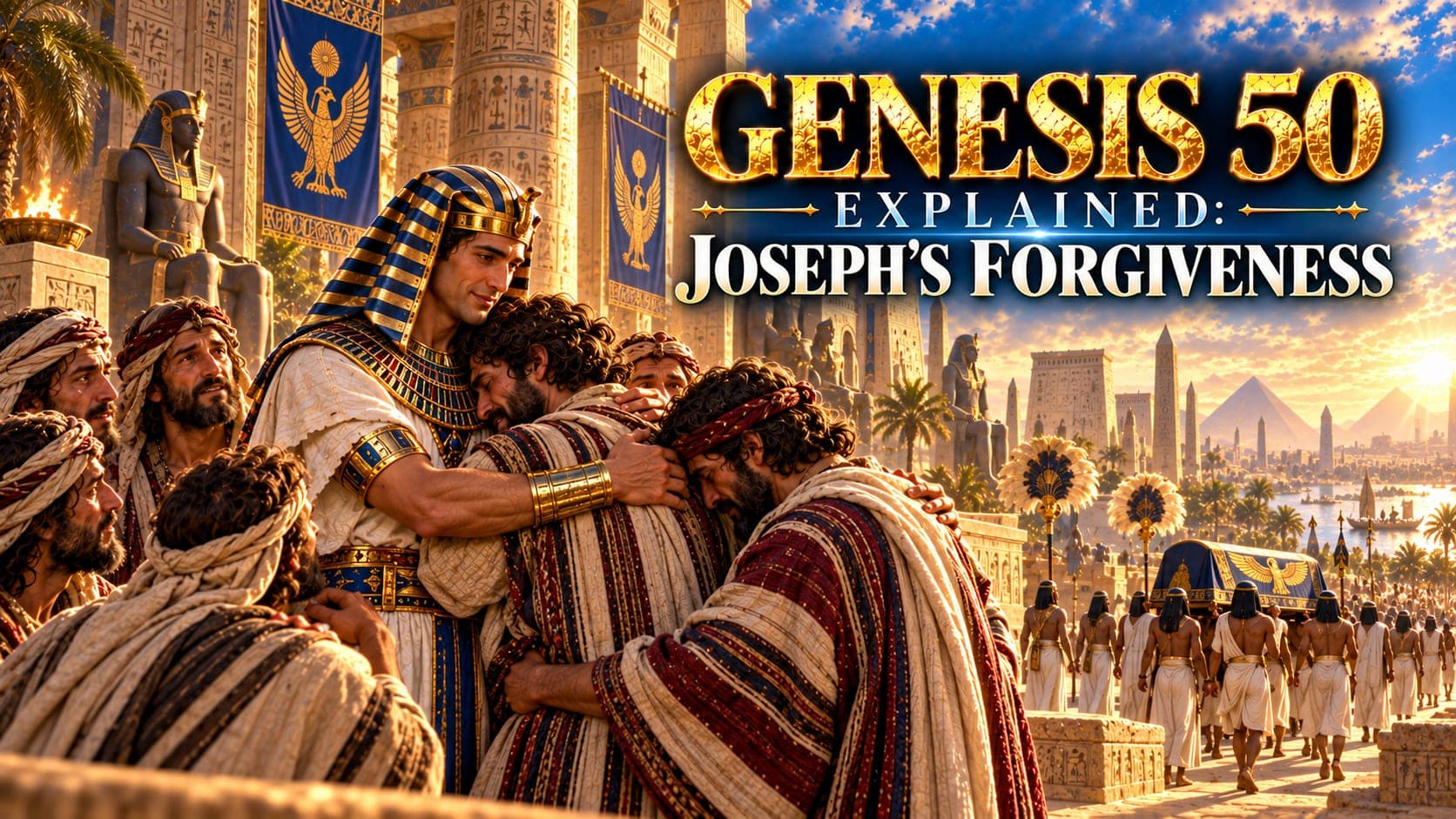
📖 Genesis 50 Explained: Joseph's Forgiveness and a Coffin in Egypt
A man who once dreamed that his whole family would bow down to him spends this chapter burying his father and reassuring the brothers who sold him into slavery.
Genesis 50 explained is the last chapter of the first book of the Bible, and it closes two stories at once. It finishes Jacob's life with a funeral that stretches across two countries, and it finishes Joseph's story with the line that sums up everything that happened to him since the day his brothers threw him in a pit.
Maybe you have wondered whether forgiveness ever really settles anything, or whether it just gets repeated every time the old wound gets poked.
- ❓ Why does Joseph ask Pharaoh for permission through other people instead of going himself?
- ❓ Why does an entire Egyptian funeral procession travel out to bury a Hebrew shepherd?
- ❓ Did Jacob really leave a message asking Joseph to forgive his brothers, or did they make it up?
- ❓ And why does the whole book of Genesis end with a coffin instead of a promise?
📌 The moment Jacob dies in this chapter, his sons are suddenly afraid Joseph has been faking kindness toward them the whole time.
This walkthrough goes through Genesis 50 in order: Joseph's grief and the forty days it took to embalm his father, the request made to Pharaoh through other officials, the massive funeral that crosses from Egypt into Canaan, the brothers' fear once their father is gone, Joseph's answer to them, and the oath Joseph leaves behind about his own bones before Genesis ends.
A book that opened in a garden closes in a coffin, and somehow that is not where the story actually ends.
What Happened Just Before This Chapter
Genesis 49 ended with Jacob finishing a blessing over each of his twelve sons, then charging them one last time to bury him in the family cave at Machpelah rather than in Egypt. The final verse of that chapter is simple and sudden: Jacob finishes speaking, lies back, and dies.
Genesis 50 opens in the room right after that, with the son who ran Egypt now facing his father's body instead of his father's voice.
The full account of how a Hebrew shepherd's son ended up second in command of Egypt in the first place is covered in the story of Joseph.
Genesis 50 Explained Verse by Verse
1. Joseph's Grief, and Forty Days to Embalm a Patriarch (verses 1 to 3)
The most powerful man in Egypt does not act like it in the first verse of this chapter.
"And Joseph fell upon his father's face, and wept upon him, and kissed him."
📌 No title or office stops Joseph from falling on his father's body and weeping openly. The man who once had to leave a room to hide his tears in front of his brothers now grieves without needing to hide anything.
Then he turns to the practical work grief still requires.
"And Joseph commanded his servants the physicians to embalm his father: and the physicians embalmed Israel."
"And forty days were fulfilled for him; for so are fulfilled the days of those which are embalmed: and the Egyptians mourned for him threescore and ten days."
💡 Forty days for embalming and seventy days of mourning both match the lengths Egyptian custom used for its own people of high rank. Jacob was a foreign shepherd, yet he is honored with the full process Egypt reserved for someone important.
⚠️ Notice who is doing the mourning. It is not just Jacob's own family. The text says "the Egyptians mourned for him," a nation grieving a man they only knew because his son had saved their lives.
2. Asking Pharaoh Through Someone Else (verses 4 to 6)
With the mourning period over, Joseph still does not walk straight into Pharaoh's presence to make his request.
"And when the days of his mourning were past, Joseph spake unto the house of Pharaoh, saying, If now I have found grace in your eyes, speak, I pray you, in the ears of Pharaoh, saying,"
"My father made me swear, saying, Lo, I die: in my grave which I have digged for me in the land of Canaan, there shalt thou bury me. Now therefore let me go up, I pray thee, and bury my father, and I will come again."
💡 Joseph routes the request through Pharaoh's own household instead of asking face to face. A man still in mourning, by custom unshaven and dressed for grief, was not fit to appear directly before a king. The same man who shaved and changed his clothes before his very first meeting with Pharaoh back in Genesis 41 is keeping the same kind of protocol here, even in his grief.
Pharaoh's answer takes one verse.
"And Pharaoh said, Go up, and bury thy father, according as he made thee swear."
📌 Pharaoh does not question the request or ask Joseph to send someone in his place. Twenty years of saving Egypt from famine has earned Joseph enough trust that a king lets his most valuable official leave the country for a funeral.
3. A Funeral That Crosses Two Countries (verses 7 to 14)
What leaves Egypt next is not a quiet family burial party.
"And Joseph went up to bury his father: and with him went up all the servants of Pharaoh, the elders of his house, and all the elders of the land of Egypt,"
"And all the house of Joseph, and his brethren, and his father's house: only their little ones, and their flocks, and their herds, they left in the land of Goshen."
"And there went up with him both chariots and horsemen: and it was a very great company."
📌 Egyptian royal officials, Egyptian elders, chariots, and horsemen all travel to Canaan to bury a man who arrived in Egypt as a starving refugee seventeen years earlier. The children and the herds stay behind in Goshen, which tells you plainly this is a funeral journey, not the family relocating back to Canaan for good.
The procession stops short of the burial site for one more act of mourning.
"And they came to the threshingfloor of Atad, which is beyond Jordan, and there they mourned with a great and very sore lamentation: and he made a mourning for his father seven days."
"And when the inhabitants of the land, the Canaanites, saw the mourning in the floor of Atad, they said, This is a grievous mourning to the Egyptians: wherefore the name of it was called Abelmizraim, which is beyond Jordan."
💡 Abelmizraim means "the mourning of Egypt." The watching Canaanites do not even name the place after Jacob. They name it after how loudly Egypt grieved for him, which tells you how large and visible this procession really was.
Only after that seven day stop does the burial itself finally happen.
"And his sons did unto him according as he commanded them:"
"For his sons carried him into the land of Canaan, and buried him in the cave of the field of Machpelah, which Abraham bought with the field for a possession of a buryingplace of Ephron the Hittite, before Mamre."
"And Joseph returned into Egypt, he, and his brethren, and all that went up with him to bury his father, after he had buried his father."
📌 Jacob's sons keep the exact promise he asked for in Genesis 49: burial alongside Abraham, Sarah, Isaac, Rebekah, and Leah, in the land God promised, not in the land that only ever sheltered them. Then every single person who traveled up for the funeral goes back down to Egypt. Nobody stays in Canaan yet.
4. The Brothers' Fear, and a Message From a Father Who Already Died (verses 15 to 18)
With Jacob gone, something the brothers had apparently been carrying quietly for seventeen years comes out into the open.
"And when Joseph's brethren saw that their father was dead, they said, Joseph will peradventure hate us, and will certainly requite us all the evil which we did unto him."
⚠️ Seventeen years of living safely in Goshen, fed by Joseph's own hand, and the brothers still assume his kindness was only for their father's sake. The moment Jacob is no longer there to protect them, they expect the old debt to come due.
So they send word to Joseph rather than facing him in person at first.
"And they sent a messenger unto Joseph, saying, Thy father did command before he died, saying,"
"So shall ye say unto Joseph, Forgive, I pray thee now, the trespass of thy brethren, and their sin; for they did unto thee evil: and now, we pray thee, forgive the trespass of the servants of the God of thy father. And Joseph wept when they spake unto him."
💡 Genesis never records Jacob actually saying these words to anyone, which has led many readers to wonder if the brothers invented or dressed up the message themselves, borrowing their dead father's authority because they were too afraid to simply ask for forgiveness in their own name. Whether the words are exactly Jacob's or not, what breaks Joseph is not the message. It is that his own brothers still think he needs to be begged.
They do not stop at a message. They come in person next.
"And his brethren also went and fell down before his face; and they said, Behold, we be thy servants."
📌 This is the exact picture from Joseph's own dreams as a teenager. Back in Genesis 37, Joseph dreamed that sheaves and then stars would bow down to him, and his brothers hated him for saying it out loud. Decades later, here they are, bowing down and calling themselves his servants, in the one moment where Joseph has nothing left to gain by making the dream come true.
5. "Ye Thought Evil Against Me, but God Meant It Unto Good" (verses 19 to 21)
Joseph's answer is the line this whole book has been building toward.
"And Joseph said unto them, Fear not: for am I in the place of God?"
📌 Joseph refuses the one role his brothers are offering him. They come ready to be judged. Joseph will not sit in the seat that belongs to God alone, even though he has every worldly power to do exactly that.
"But as for you, ye thought evil against me; but God meant it unto good, to bring to pass, as it is this day, to save much people alive."
💡 Joseph does not soften what his brothers did. He calls it evil, plainly, with no excuse attached. And in the very same sentence he says God was working a good purpose through that same evil the whole time, without ever needing the evil itself to become good. The pit, the slavery, the false accusation, and the prison were real wrongs done to a real person, and God's rescue of a whole region from famine runs straight through every one of them.
Then comes the reassurance in plain, practical terms.
"Now therefore fear ye not: I will nourish you, and your little ones. And he comforted them, and spake kindly unto them."
📌 Joseph does not just say the right words once and move on. He repeats the promise to provide for their children, and the text adds that he comforted them and spoke kindly, not just once at this crisis moment but as an ongoing posture toward brothers who still half expected him to turn on them.
6. Joseph's Long Life, and One Last Oath About His Bones (verses 22 to 26)
The chapter steps back from the scene with the brothers to summarize the rest of Joseph's life in a few verses.
"And Joseph dwelt in Egypt, he, and his father's house: and Joseph lived an hundred and ten years."
"And Joseph saw Ephraim's children of the third generation: the children also of Machir the son of Manasseh were brought up upon Joseph's knees."
💡 A hundred and ten years was considered the ideal full life in ancient Egyptian thinking, and Joseph reaches it exactly, living long enough to hold his own great-grandchildren. The boy who was ripped away from his family at seventeen gets decades with four generations under one roof.
Near the end, Joseph speaks about a future he will not live to see.
"And Joseph said unto his brethren, I die: and God will surely visit you, and bring you out of this land unto the land which he sware to Abraham, to Isaac, and to Jacob."
"And Joseph took an oath of the children of Israel, saying, God will surely visit you, and ye shall carry up my bones from hence."
📌 Joseph has run Egypt for decades, yet his last recorded wish is to leave it. He does not ask to be embalmed and left in an Egyptian tomb forever. He makes the next generation swear to carry his bones out when God finally brings them to the promised land, a promise that will not be kept for several centuries. Hebrews singles out this exact moment as an act of faith.
"By faith Joseph, when he died, made mention of the departing of the children of Israel; and gave commandment concerning his bones."
💡 Joseph never sees the exodus happen. He trusts a promise he will only experience after he is dead, and asks to be carried toward it anyway. Exodus 13:19 later records Moses doing exactly what was sworn, carrying Joseph's bones out of Egypt generations later, and Joshua 24:32 records them finally being buried in Shechem once the family reaches the land.
Genesis ends on a single, quiet verse.
"So Joseph died, being an hundred and ten years old: and they embalmed him, and he was put in a coffin in Egypt."
⚠️ The first book of the Bible opens with a garden and closes with a coffin. But it is a coffin with an oath attached to it, waiting for a promise that has not been kept yet. Genesis ends unfinished on purpose, because the story was never meant to end in Egypt.

Hard Questions Genesis 50 Raises
Did Jacob really ask Joseph to forgive his brothers, or did they make it up? Genesis 50:16 and 17 present it as Jacob's dying instruction, but Genesis never records Jacob actually saying this to anyone earlier in the text. Many readers take this as the brothers genuinely relaying a private conversation Genesis simply never recorded in full. Others read it as the brothers borrowing their father's authority because they were too afraid to ask for forgiveness in their own name. The text itself does not settle which one it is.
Does "God meant it unto good" mean the brothers were not really guilty? No. Genesis 50:20 names what they did as evil in the same sentence it names what God did with it. Joseph never tells his brothers their sin was not real or not serious. He tells them that a real evil did not get the last word, because God was working a rescue plan through it the whole time.
Why couldn't Joseph ask Pharaoh for permission himself? Egyptian court custom expected a man to be shaved, washed, and properly dressed before appearing before the king, the same standard Joseph met before his very first audience with Pharaoh in Genesis 41. A man still inside his mourning period for his father likely did not meet that standard, which is the most common reason given for why Joseph routed the request through Pharaoh's household instead.
Why is the mourning stop at Atad described as "beyond Jordan" when Machpelah is west of the Jordan River? Genesis does not explain the exact route the funeral procession took from Egypt to Hebron. The detail has led many readers to conclude the caravan traveled up through the Transjordan region before crossing west into Canaan, rather than along the shorter coastal route, though Genesis itself never states a reason for the choice.
Top 5 Bible Verses From Genesis 50
1. Genesis 50:20
"But as for you, ye thought evil against me; but God meant it unto good, to bring to pass, as it is this day, to save much people alive."
The verse the entire Joseph story has been pointing toward, naming both the real evil done against him and the real good God brought out of it, without pretending either one away.
2. Genesis 50:19
"And Joseph said unto them, Fear not: for am I in the place of God?"
A man with total power to punish refuses the one role his brothers hand him, trusting final judgment to God instead of taking it for himself.
3. Genesis 50:17
"So shall ye say unto Joseph, Forgive, I pray thee now, the trespass of thy brethren, and their sin; for they did unto thee evil: and now, we pray thee, forgive the trespass of the servants of the God of thy father. And Joseph wept when they spake unto him."
Seventeen years after reconciling with his brothers, Joseph still weeps to learn they doubted whether his kindness was real.
4. Genesis 50:25
"And Joseph took an oath of the children of Israel, saying, God will surely visit you, and ye shall carry up my bones from hence."
A man at the height of Egyptian power plans his own exit from Egypt, trusting a promise he will not live to see kept.
5. Genesis 50:26
"So Joseph died, being an hundred and ten years old: and they embalmed him, and he was put in a coffin in Egypt."
The last verse of Genesis, ending the book that opened in Eden with a coffin, and an unfinished promise, in a foreign land.

Frequently Asked Questions About Genesis 50
What happens in Genesis 50?
Joseph mourns his father Jacob, has him embalmed, and leads a massive funeral procession to bury him in Canaan. Back in Egypt, his brothers fear revenge now that their father is gone, Joseph reassures them that God used their evil for good, and the chapter closes with Joseph's own long life, his oath about his bones, and his death.
Why did Joseph have his father embalmed?
Embalming and a long mourning period were standard Egyptian funeral customs for people of high rank. Genesis 50:2 and 3 describe the usual forty days for embalming and seventy days of mourning, the same process Egypt used for its own, extended here to a foreign shepherd because of his son's standing.
Why didn't Joseph ask Pharaoh for permission in person?
Genesis 50:4 has Joseph route the request through Pharaoh's own household rather than appearing directly. A man still in his mourning period, by custom unshaven and dressed for grief, likely did not meet the standard expected for approaching the king, the same standard Joseph met with a shave and a change of clothes before his first meeting with Pharaoh in Genesis 41.
What does Abelmizraim mean, and why was it named that?
Abelmizraim means "the mourning of Egypt." Genesis 50:11 says the local Canaanites named the site after watching the size and intensity of the Egyptian funeral procession stopped there, a detail that shows how large and visible the company honoring Jacob really was.
Did Jacob really tell Joseph to forgive his brothers?
Genesis 50:16 and 17 present it as Jacob's final instruction, but Genesis never records Jacob saying these specific words anywhere earlier in the text. Readers are genuinely divided over whether this is a real message Genesis simply did not record in full, or the brothers borrowing their father's name out of fear.
What does "Am I in the place of God?" mean?
Joseph is refusing to act as his brothers' final judge. Genesis 50:19 shows him turning away the one role they expect him to take, leaving ultimate judgment to God rather than using his own power over them to settle the score himself.
What does "ye thought evil against me, but God meant it unto good" mean?
It means both things are fully true at once. The brothers' intentions in selling Joseph were genuinely evil, and Genesis 50:20 never excuses that. At the same time, God worked through that same evil to save an entire region from famine, without needing the evil itself to stop being wrong.
Why did Joseph make Israel swear to carry his bones out of Egypt?
Genesis 50:25 has Joseph trust that God would eventually bring his family out of Egypt to the promised land, and he wants to be carried there too rather than stay buried in Egypt forever. Hebrews 11:22 calls this an act of faith, and Exodus 13:19 records Moses actually carrying out the oath generations later.
How does Genesis 50 end the book of Genesis?
Genesis opens with God creating a world called very good and closes with Joseph's body in a coffin in a foreign country. The ending is deliberately unresolved, carrying an unfulfilled oath about bones and a promise about a land still to come, setting up the book of Exodus that follows.
What happens after Genesis 50?
The book of Exodus opens with Jacob's family, now numbering seventy people, settled in Egypt and multiplying rapidly. Joseph and his entire generation have died, and a new king comes to power who does not remember what Joseph did for Egypt at all.
Final Thoughts
Genesis 50 closes the book quietly, but almost nothing in it is small.
📌 Forgiveness is not a one time transaction. It gets tested again. Joseph forgave his brothers years earlier, and still has to reassure them, in person, after their father's death removes the one thing they thought was keeping them safe.
📌 Naming real evil and trusting God's good purpose are not opposites. Genesis 50:20 does both in a single sentence, refusing to let either truth cancel out the other.
📌 Faith can plan past your own funeral. Joseph never sees the exodus, yet he gives orders for his own bones based on a promise he will not live to watch come true.
You may be the one still waiting to fully believe someone's forgiveness is real, or the one who has said the words but needs to say them again.
So here is your one next step.
Name one evil that was done to you honestly, the way Joseph did, and then ask God to show you even one place where He has already brought good out of it.