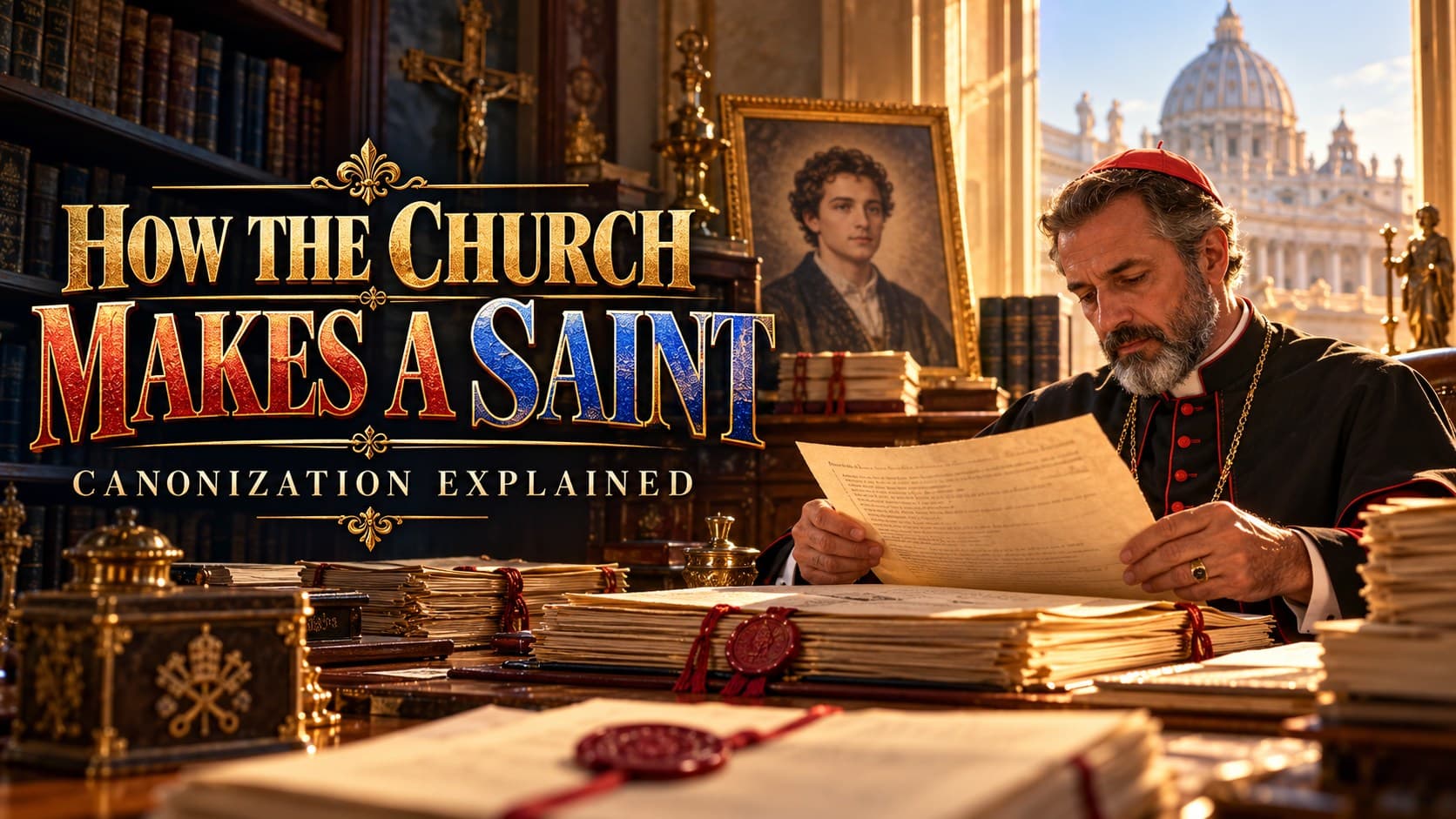
📖 How Does the Church Make a Saint? Canonization Explained
Someone just died, and a friend who knew them says it plainly. She was a saint. A headline somewhere says the Vatican has opened a cause for a nun, a priest, or a layperson you have never heard of. Nobody ever explains what either sentence actually means.
Maybe you grew up Catholic and watched a canonization on the news without ever learning the steps that led up to it. Maybe you are Protestant and the whole idea feels borrowed from a different religion entirely, something closer to a legal proceeding than anything you read about in church.
📌 Here is the plain answer. Canonization is a real, formal process inside the Catholic Church, not a vote and not a vibe. It runs through a local bishop, a tribunal, a Vatican office, a panel of theologians, an actual medical board, and a Pope who signs the final decree. Most causes take decades. Some never finish at all.
This guide walks through every real step, from a bishop opening a file to two verified miracles and a declaration read aloud in Saint Peter's Square. You will see where Mother Teresa and John Paul II actually fit into that timeline, who checks a miracle before any theologian even weighs in, and the straightforward reason a large share of Christians never adopted this process to begin with.
Every historical and doctrinal claim below links back to a named source you can check for yourself.
Why This Matters for Your Faith
It is easy to treat this as church bureaucracy, interesting trivia with no real weight on your own walk with God.
⚠️ But strip away the paperwork and one real question is sitting underneath all of it. How does anyone actually know whether a life was worth imitating. Not admired from a distance. Imitated.
Scripture answers that question before any Vatican office ever existed.
"Wherefore seeing we also are compassed about with so great a cloud of witnesses, let us lay aside every weight, and the sin which doth so easily beset us, and let us run with patience the race that is set before us,"
Every Christian, Catholic or Protestant, is told to run a race while watching lives that already finished theirs well. Canonization is the Catholic Church's own careful, documented attempt to answer who belongs on that list, and to show its work doing it.
Whether or not you accept the process, the instinct behind it, that a finished life can still teach you something about how to run your own, is one every believer already owns.

How the Catholic Church Actually Names a Saint
1. It Starts With a Bishop, Not a Vote in Rome
Catholic Straight Answers lays out where every cause actually begins. After someone dies with a local reputation for holiness, what the Church calls fame of sanctity, a cause can open once the normal five year waiting period has passed.
The local bishop, not a Vatican office, starts things moving. He appoints a tribunal, gathers testimony from people who actually knew the person, examines their writings for soundness of doctrine, and records any favors reported through their intercession.
📌 A sealed, authenticated copy of all of it then goes to Rome. At that point the person is formally called a Servant of God, the first real title in the process.
The Roman office receiving that file has changed names more than once. Vatican News traces it to the Sacred Congregation of Rites, set up by Pope Sixtus V in 1588, which Paul VI split in 1969 into one body for worship and a separate Congregation for the Causes of Saints. John Paul II renamed it again in 1988, and Pope Francis' 2022 constitution gave it its current name, the Dicastery for the Causes of Saints.
2. Venerable: Nine Theologians Vote on Heroic Virtue
Once the Dicastery accepts a cause, a postulator, appointed to argue for the candidate, pulls everything into one document. Catholic Straight Answers describes it as part biography, part legal brief, part scholarly argument, known as the positio.
A Vatican official called the promoter of the faith, popularly nicknamed the devil's advocate, raises formal objections against the file. The 1907 Catholic Encyclopedia, hosted on New Advent, describes a process built entirely around answering his questions, called dubia, before any stage can move forward. In that era there was, by its account, only one promoter of the faith and one assistant handling every single cause in the whole Church.
A panel of nine theologians then votes on whether the evidence shows heroic virtue, or in a martyr's case, death specifically for the faith. Catholic Straight Answers reports that six positive votes send the cause to the Dicastery's own bishops and cardinals, and a two thirds vote there sends it on to the Pope himself.
If he agrees, he signs a decree and the person becomes Venerable. Nothing about that title is a guess or a feeling. It is a formal judgment that a specific life produced the fruit Jesus said to look for.
"Ye shall know them by their fruits. Do men gather grapes of thorns, or figs of thistles?"
3. Blessed: One Miracle Changes Everything, Unless the Candidate Died a Martyr
Venerable is not yet permission to publicly venerate anyone. Catholic Straight Answers is specific about what closes that gap. One verified miracle, attributed to the candidate's intercession after death, is required for beatification, unless the candidate is a martyr, who can be beatified on the martyrdom alone.
Even then, beatification is limited. The newly titled Blessed can be venerated publicly, but Catholic Straight Answers notes that permission usually only covers one diocese, country, or religious order, not the whole Church at once.
💡 Why a miracle at all. EWTN quotes Monsignor Michele Di Ruberto, once an undersecretary at the Dicastery, putting the Church's own logic plainly. People can be wrong about who was holy. A miracle, by definition, comes only from God, who does not deceive. In that framework a verified miracle functions as God's own confirmation of a human judgment that could otherwise be mistaken.
That logic is not new. Peter leaned on the same connection between miracles and divine approval the very first time he preached after Pentecost.
"Ye men of Israel, hear these words; Jesus of Nazareth, a man approved of God among you by miracles and wonders and signs, which God did by him in the midst of you, as ye yourselves also know:"
4. Who Actually Checks a Miracle: The Vatican's Own Medical Board
A reported miracle does not go to theologians first. Aleteia traces organized medical review of these claims back to 1743, when the future Pope Benedict XIV, already an expert on canonization law, created the first standing register of physicians for the job.
The board in its current form dates to 10 July 1959, when Pope John XXIII merged two earlier bodies into a single Medical Board, often called the Consulta Medica. Two experts carry out a first review of the case. A seven member commission from that board then studies it in full.
📌 Nothing moves forward on a simple majority. Aleteia reports that revised 2016 rules require the commission's conclusions to be approved by a qualified majority, at least five of seven doctors, or four of six when a smaller panel sits, and that a single case cannot be sent back for review more than three times. Only once that panel finds no natural explanation does the file move on to the theologians who weigh its spiritual meaning.
5. Saint: A Second Miracle and the Pope's Final Word
Canonization asks for the same proof again. Catholic Straight Answers states that a second miracle, attributed to the candidate's intercession after beatification, is normally required before a Blessed can become a Saint. That one plus one standard is itself a modern simplification. The 1907 Catholic Encyclopedia describes a far heavier older requirement, up to four miracles for beatification alone depending on how the evidence was gathered, before John Paul II's 1983 reform cut it down to the standard used today.
The Pope reviews the finished file personally and makes the declaration in public, usually at a Mass in Saint Peter's Square, the same square where Pope Francis canonized Mother Teresa on 4 September 2016, the final word on a cause that had opened almost two decades earlier.
Once that happens, the person's feast day enters the Church's own calendar for every parish, not just the one diocese beatification allowed. That is the same calendar behind the difference between a solemnity, a feast, and a memorial, and the reason All Saints Day exists at all, as one shared day for every canonized name the ordinary calendar has no room for individually.
📌 One more claim needs stating carefully, not flattened into a fact. The 1907 Catholic Encyclopedia, citing Aquinas, says most theologians across history have held that the Pope cannot err when he canonizes. The same entry is just as clear that this has never been formally defined as a required article of faith, only treated as theologically certain, and that a minority of serious theologians have disputed it. Say it the way that source does. Widely held, not universally settled.
6. The Five Year Rule, and Why Popes Keep Waiving It
That five year wait mentioned at the very start is not absolute. Catholic Straight Answers confirms it is the normal rule before a cause can even open, set as part of John Paul II's 1983 reform. It is also entirely within the Pope's own discretion to set aside.
Mother Teresa is the clearest example. EWTN News, carried through Catholic News Agency, reported in 2005 that John Paul II himself had waived the wait for her, letting her cause open only two years after her 1997 death instead of five. She was beatified in October 2003 on the strength of a healing credited to her in 2002, and VOA News reported that the Vatican approved a second miracle, the inexplicable cure of a Brazilian man's brain tumors, in December 2015, clearing the way for canonization.
John Paul II received the same courtesy in reverse. That same 2005 report records Pope Benedict XVI announcing, within weeks of John Paul II's own death, that he would waive the five year wait for him as well. UPI reported that Pope Francis canonized John Paul II on 27 April 2014, and the Associated Press reported that roughly 120,000 people filled Saint Peter's Square when Francis canonized Mother Teresa there on 4 September 2016.
⚠️ Notice what a waiver does and does not do. It moves the paperwork faster. It never skips the tribunal, the theologians, the medical board, or the two miracles. Every shortcut in this process has still run through the whole process.
7. Where Protestants Read the Same Bible and Land Somewhere Else Entirely
Most Protestant traditions have no version of this process at all, and it is worth hearing the actual biblical case rather than dismissing the whole thing as a difference in style.
GotQuestions makes the core argument directly. It reads the New Testament as using the word saint for every believer, living or dead, not for a smaller class the Church certifies later. Paul opens an entire letter addressing a whole ordinary congregation that way.
"Paul, an apostle of Jesus Christ by the will of God, to the saints which are at Ephesus, and to the faithful in Christ Jesus:"
From there, GotQuestions argues that Scripture gives every believer direct access to God and never instructs anyone to route a prayer through someone already in heaven, which leaves the Protestant case against the whole practice resting on something simpler than a disagreement over paperwork.
📌 Say the actual disagreement plainly, because it is not about the history above. Catholic teaching does not claim canonization manufactures holiness. It claims to recognize a holiness the Church believes already exists in heaven. Most Protestant readers reject the premise underneath that claim, that a believer in heaven can hear and relay a prayer at all, which is the same disagreement running underneath the wider split between Catholic and Protestant church calendars. It is worth adding that the earliest saints, figures like Andrew the apostle, were never run through this tribunal at all. Their recognition came from centuries of ordinary veneration, long before Rome built a formal process for anyone else.

Practical Tips for Thinking About Canonization Well
You do not have to resolve every doctrinal question here to let this topic shape you honestly. Seven ways to do that.
- Learn the real steps before repeating a headline. A phrase like the Vatican opened her cause means something specific, a bishop's tribunal and a sealed file, not an announcement that someone is already a saint.
- Separate the formal title from the New Testament word. Knowing that Scripture calls every believer a saint, while Rome reserves the capital letter title for a certified few, will keep you from treating the two claims as the same argument.
- Read an actual positio story, not just the headline. The life behind a canonization is almost always more specific and more human than the one sentence version that made the news.
- Watch for a miracle claim reported before the medical board has ruled. News coverage often runs ahead of the Vatican's own process, which can take years on a single case.
- If you are Protestant, you can still read these lives. A canonized biography can instruct you about faith under pressure the same way any Christian biography can, without asking you to pray through that person to get there.
- Remember heroic virtue is not the same as a sinless life. The Church is certifying a pattern of faithfulness carried to an unusual degree, not claiming the person never failed at anything.
- Let any approved example point you back to Christ, not past Him. Whatever your tradition, the entire point of studying a finished life is wanting to finish your own the way Hebrews 12:1 describes.
Top Bible Verses Behind the Idea of Canonization
None of these verses mention a tribunal or a medical board. They are the raw material underneath the question canonization is actually trying to answer: who finished well, and how would anyone know.
1. Hebrews 12:1
"Wherefore seeing we also are compassed about with so great a cloud of witnesses, let us lay aside every weight, and the sin which doth so easily beset us, and let us run with patience the race that is set before us,"
This is the verse the whole instinct behind canonization actually rests on. A finished life is not just a memory. It is meant to change how you run the part of the race still in front of you.
2. Philippians 3:17
"Brethren, be followers together of me, and mark them which walk so as ye have us for an ensample."
Paul says this about an ordinary group of believers around him, not about a figure certified centuries later. It is the same pattern a canonized life runs on, scaled down to people Paul's readers could actually watch with their own eyes.
3. 1 Peter 5:4
"And when the chief Shepherd shall appear, ye shall receive a crown of glory that fadeth not away."
Every stage of canonization is ultimately trying to describe someone the Church believes already holds this crown. The title saint is a claim about where a life landed, not an award for how it looked along the way.
4. Mark 16:17 and 18
"And these signs shall follow them that believe; In my name shall they cast out devils; they shall speak with new tongues; They shall take up serpents; and if they drink any deadly thing, it shall not hurt them; they shall lay hands on the sick, and they shall recover."
Jesus ties miraculous signs to faith long before any Vatican medical board existed. The modern miracle requirement is a very old Christian instinct wearing a formal, documented process.
5. 2 Timothy 2:2
"And the things that thou hast heard of me among many witnesses, the same commit thou to faithful men, who shall be able to teach others also."
Paul is describing exactly what canonization is trying to protect across centuries instead of one conversation. A faithful life, witnessed and passed down so someone far later can still learn from it.

Frequently Asked Questions About Canonization
What is canonization in simple terms?
Canonization is the Catholic Church's formal, final declaration that a specific person is in heaven and worthy of public veneration by the whole Church, reached through a bishop's investigation, a Vatican review, verified miracles, and a decree the Pope signs and announces publicly.
What are the four steps to becoming a saint?
Servant of God, once a bishop opens the cause. Venerable, once nine theologians and the Pope agree the evidence shows heroic virtue. Blessed, after one verified miracle, unless the candidate is a martyr. Saint, after a second verified miracle and the Pope's final declaration.
How many miracles does the Catholic Church require?
Under the current rules from John Paul II's 1983 reform, one verified miracle is required for beatification and a second for canonization, two in total for a non martyr. Martyrs can be beatified without one, though a miracle is still required for them to be canonized.
Can the Pope waive the five year waiting period?
Yes. It is entirely at his discretion. John Paul II waived it for Mother Teresa only two years after her death, and Benedict XVI waived it for John Paul II himself within weeks of his death. The waiver only speeds up when a cause can open, not any step that follows it.
Do martyrs need a miracle to be beatified?
No. A martyr can be beatified on the evidence of dying for the faith alone. A verified miracle still has to be confirmed before that same martyr can be canonized as a saint.
Who is the devil's advocate in the canonization process?
The official title is promoter of the faith. His job is to raise every real objection against a cause before it can advance, so that a title like Blessed or Saint only survives genuine scrutiny rather than popular pressure alone.
Is a canonization considered infallible?
Most Catholic theologians across history have held that the Pope cannot err when he canonizes, but this has never been formally defined as a required article of faith, and a minority of theologians have historically disputed it. Beatification, by contrast, is generally treated as a permission rather than a binding judgment.
How long does canonization usually take?
There is no fixed timeline, and many causes stall for decades waiting on evidence or a verified miracle. Mother Teresa's cause moved unusually fast at under twenty years from death to canonization, largely because two different popes chose to waive waiting periods and expedite review along the way.
Who actually verifies a reported miracle?
A standing panel of Vatican appointed physicians, often called the Consulta Medica, examines whether a reported cure has any natural medical explanation. Only once that panel cannot explain it does the case move on to the theologians who weigh its spiritual meaning.
Do Protestants believe in canonizing saints?
Most Protestant traditions do not practice this at all. Sites like GotQuestions argue the New Testament already calls every believer a saint and gives every believer direct access to God, leaving no need, in their reading, for a separate formal process. The practice itself stays largely a Catholic and Orthodox one.
Final Thoughts
Strip away the headlines and three things remain true.
📌 Canonization is a documented process, not an announcement. A bishop's tribunal, a positio, nine theologians, a medical board, and two verified miracles all stand between a death and a declared saint.
📌 The waivers only ever move the calendar. Every shortcut Rome has granted, to Mother Teresa, to John Paul II, still ran through the same tribunal and the same miracle standard everyone else faces.
📌 The real disagreement with Protestants is not about the steps. It is about whether a believer already in heaven can hear and carry a prayer at all. Settle that question and the rest of this process becomes a detail, not the argument.
Wherever you land on that question, Hebrews 12:1 still asks something of you directly. A finished life, examined honestly, is there to change how you run the part of the race still ahead of you.
📚 Sources
Every claim in this article traces back to one of these. All links checked 6 November 2026.
- Dicastery for the Causes of Saints
Vatican News · 2025
The source for the office's history from the 1588 Sacred Congregation of Rites through the 1969 split, the 1983 reform under Divinus Perfectionis Magister, and the 1988 and 2022 name changes.
- Divinus Perfectionis Magister
The Holy See (Pope John Paul II, 25 January 1983) · 1983
The primary source for the 1983 reform of the entire canonization procedure, including the five year waiting period and the simplified miracle standard.
- What Is the Official Process for Declaring Someone a Saint?
Catholic Straight Answers
The source for the step by step process: the bishop's tribunal, the postulator and positio, the nine theologian vote, the miracle requirements for Blessed and Saint, and the martyr exception.
- Beatification and Canonization
Catholic Encyclopedia (1907), via New Advent · 1907
The source for the historical development of the process, the role of the promoter of the faith, and the theological debate over whether canonization is an infallible act.
- Why Miracles Are Required for Canonizations
EWTN
The source for the Church's own stated reasoning, through Monsignor Michele Di Ruberto, for why a verified miracle functions as divine confirmation of a human judgment.
- Vatican Issues Stricter Procedures for Medical Examination of Miracles
Aleteia · 2016
The source for how the Medical Board, the Consulta Medica, reviews a reported miracle, its 1743 and 1959 origins, and the 2016 qualified majority rules.
- Canonization
GotQuestions.org
The source for the Protestant case against formal canonization, including its reading of the New Testament's use of the word saint for every believer.
- John Paul II's Sainthood Could Take Some Time, Cautions Vatican Official
EWTN News, carried by Catholic News Agency · 16 May 2005
The source for Benedict XVI waiving the five year wait for John Paul II's cause, and for John Paul II having earlier waived it for Mother Teresa.
- Pope Approves Sainthood for Mother Teresa
VOA News · 18 December 2015
The source for the timeline of Mother Teresa's two miracles, the 2002 healing and the December 2015 approval of the Brazilian man's cure.
- Pope Francis Declares John Paul II and John XXIII Saints
UPI · 27 April 2014
The source for the 27 April 2014 date Pope Francis canonized John Paul II.
- Mother Teresa, 'Saint of the Gutters,' Canonized at Vatican
Associated Press, via Valley News · 4 September 2016
The source for the 4 September 2016 canonization date and the estimated 120,000 people who filled Saint Peter's Square.