📖 Why Is Advent Purple? The Meaning of the Liturgical Colors
You walk into church on the first Sunday of Advent and the whole room has changed color overnight.
The priest or pastor is in purple. The banners are purple. Maybe even the candles on the wreath are purple, except for one.
Nobody hands you a program explaining why.
📌 Here is the plain answer. Purple is the color the Western church uses for Advent because it already meant two things long before Advent existed. It was the color of a king, because the dye cost more than almost anything else people wore. And it became the color of penance and preparation, borrowed from Lent, once the church started treating the weeks before Christmas as a season of getting ready rather than a season already celebrating.
That short answer hides a better story. Purple sat on the backs of kings, on a dye that cost more than gold, and on the shoulders of Jesus Himself the night Roman soldiers mocked Him as a king He actually was. This guide walks through where the color came from, why some churches use blue instead, and what it has to do with you sitting in a pew this December.
Every historical claim below links back to a named source, so you can check it yourself.
Why This Matters for Your Faith
It would be easy to file this under trivia. A color is a color.
⚠️ But the church did not pick colors by accident, and this one carries real weight. Purple is not decoration. It is a visual sermon, preached at you every single Sunday of Advent before a single word is spoken.
The sermon is this. You are not just counting down days until a party. You are waiting on a King, the same way Israel waited centuries for a King who would actually come.
That same color is what Roman soldiers forced onto Jesus to mock Him as exactly that, a King, hours before the cross.
💡 Advent asks you to sit in that tension on purpose. The King is coming. The King was also mocked. Purple carries both truths at once.

What Purple Actually Means, and Where It Came From
1. Purple Was the Color of Kings Long Before the Church Touched It
Purple did not start out holy. It started out expensive.
In the ancient world, true purple dye came from a sea snail found along the eastern Mediterranean coast, in a process so labor heavy that the University of York, reporting on a 2026 find of purple dyed cloth in a Roman burial, states the dye was a commodity valued at up to three times the price of gold during the Roman period.
📌 That is not a color anyone wore by accident. Only the wealthiest people on earth could afford it, which is exactly why the Bible ties purple to kings and to wealth so often, starting with the tabernacle itself.
"Moreover thou shalt make the tabernacle with ten curtains of fine twined linen, and blue, and purple, and scarlet: with cherubims of cunning work shalt thou make them."
Later, after Gideon defeated the kings of Midian, Scripture notes exactly what he took from them as spoil.
"And the weight of the golden earrings that he requested was a thousand and seven hundred shekels of gold; beside ornaments, and collars, and purple raiment that was on the kings of Midian, and beside the chains that were about their camels' necks."
Purple raiment on the kings of Midian. Not a detail Scripture needed to mention, unless everyone already knew what that color on a king meant.
2. Purple Is Also the Color They Mocked Jesus With
Here is where the color turns. The same association with royalty is exactly why Roman soldiers chose purple the night they beat Jesus before the cross.
"And they clothed him with purple, and platted a crown of thorns, and put it about his head,"
They were not dressing Him for warmth. They were dressing Him as a king, on purpose, as a cruel joke. Mark records what happened once the mockery was finished.
"And when they had mocked him, they took off the purple from him, and put his own clothes on him, and led him out to crucify him."
📌 That is the part most Advent wreaths never mention. The color on the altar in December is the same color laid across the back of a man the world thought was lying about being a King.
Advent asks you to believe the soldiers were more right than they meant to be. The man in the purple robe really was the King, exactly as the Feast of Christ the King declares outright at the very end of the church year, right before Advent turns around and starts the waiting over again.
3. How the Church Actually Settled on This Color
The church did not always use purple, and it did not use it everywhere at once. The Liturgical Arts Journal traces an organized sequence of colors as far back as a ninth century document called the Ordo of St. Amand, with a twelfth century crusader church in Jerusalem later recording its own color list.
The figure most tied to fixing the system for Rome is Pope Innocent III, who died in 1216. The same source reports that in his work on the Mass, Innocent III specified white, red, green, and black as the main colors, with violet used only to a lesser extent.
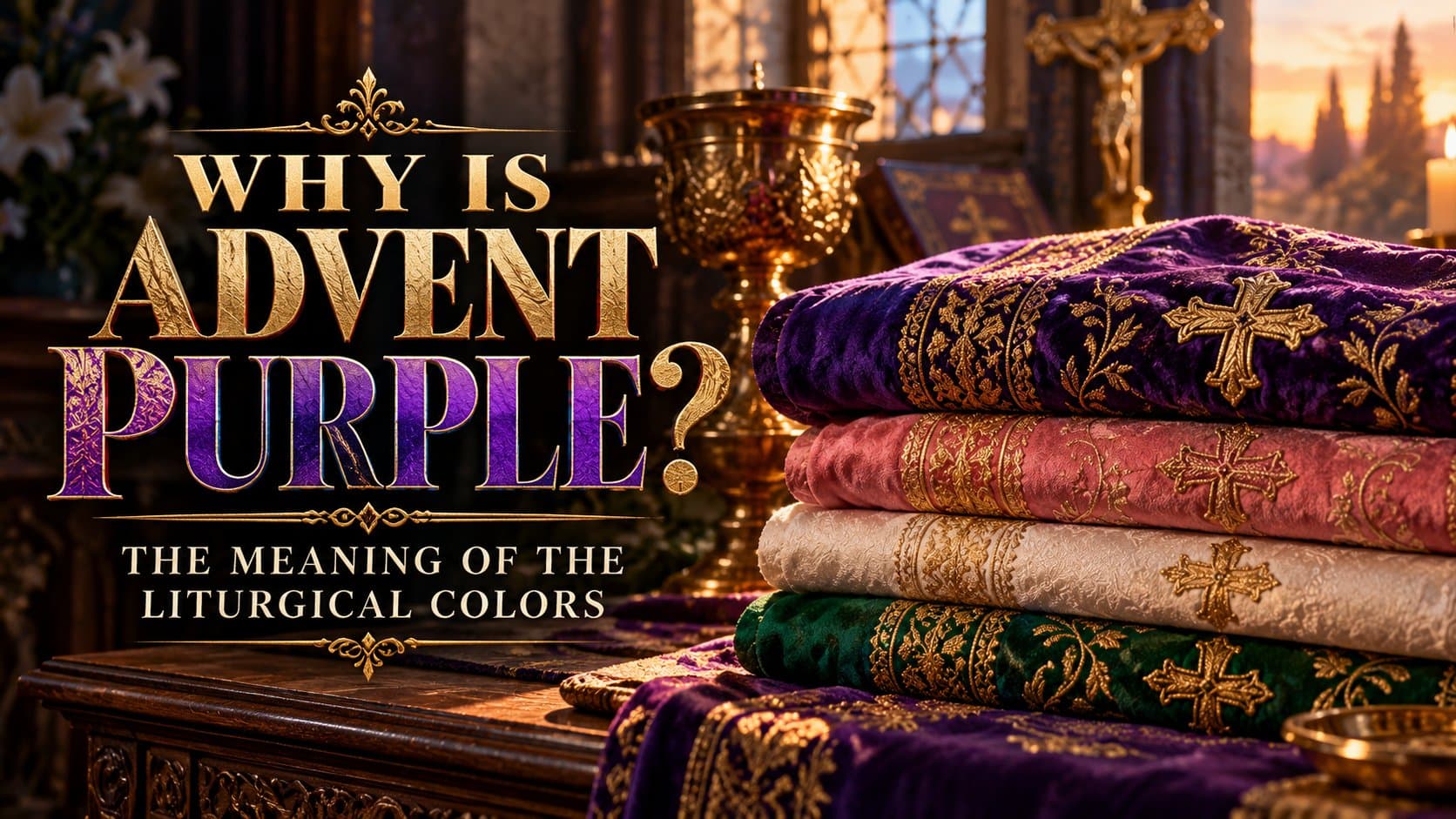
💡 Violet was not even the main penitential color at first. Black was. Violet only grew into common use for penitential seasons across the thirteenth and fourteenth centuries, slowly replacing black across the Roman rite. Rose joined the set in that same window, authorized for Gaudete Sunday in Advent and Laetare Sunday in Lent, the two Sundays that break the purple on purpose.
So the purple you see every December is not an unbroken custom reaching back to the apostles. It is a color that slowly won an argument against black over roughly two centuries.
4. Why the Church Still Calls It Violet, and Why Advent Borrowed Lent's Color
Open the current Catholic rulebook and you will not even see the word purple. The USCCB's own guide to the liturgical colors lists violet for Advent, for Lent, and for Masses for the Dead, with rose permitted on the Third Sunday of Advent and the Fourth Sunday of Lent.
Violet is the formal name. Purple is what most people call the same color in everyday speech, and the rubrics never specify an exact shade, which is why you will see everything from a deep red violet to a cooler blue violet across different parishes.
⚠️ Notice something in that USCCB list. Advent and Lent share the exact same color. Advent was not originally built as a penitential season to match Lent, but once the church began treating the weeks before Christmas as preparation rather than straight celebration, it reached for the color that already meant exactly that.
That shared color is part of why the church's own calendar groups Advent and Lent together as the two great seasons of getting ready, long before either one reaches its feast.
5. Why Some Churches Use Blue Instead, and Why That Claim Needs a Careful Word
Walk into some Anglican, Episcopal, or Lutheran churches in Advent and you will see blue, not purple, on the altar.
A popular explanation says this blue, often called Sarum blue, simply restores what the medieval English Sarum Rite always used for Advent, before the Reformation ever happened. That explanation is repeated often. It is also disputed by the historians who have actually looked at the old Sarum books.
A detailed review on the liturgy blog Pray Tell argues the exact colors the medieval Sarum Rite used are genuinely contested among scholars, and that the blue revival most churches practice today traces to nineteenth century interest in pre Reformation worship, not an unbroken medieval custom.
📌 Say it the honest way, not the tidy way. Blue for Advent is a real and widespread modern practice. The claim that it comes straight down, unchanged, from the Sarum Rite is weaker than the popular version of the story suggests.
Whatever its exact origin, the color stuck in Lutheran practice specifically. The Evangelical Lutheran Church in America's own worship blog describes blue as associated with Advent, suggesting hope, while noting that some assemblies use purple instead, tied to royalty and the king the church is awaiting. Neither answer is wrong inside its own tradition.
6. Rose Breaks the Purple on Purpose, and That Is the Whole Point
One Sunday a year, the purple stops, just for a day.
On Gaudete Sunday, the third Sunday of Advent, the USCCB's own color list permits rose in place of violet. The same pink candle on the Advent wreath matches the vestments that same morning.
💡 That one bright Sunday only works because every other Sunday is purple. A single rose candle in a wreath of pink would say nothing. A single rose Sunday inside a season of purple says the waiting is more than halfway over, and it is worth celebrating that fact out loud for a day before returning to the preparation.

Practical Tips for Letting Advent Purple Actually Teach You Something
You do not need to be Catholic, Anglican, or Lutheran for this color to shape your December.
- Let the color slow you down on purpose. Purple is not there to make the sanctuary pretty. It is there to tell you this season is about preparing, not rushing straight to the party.
- Remember what purple cost before you remember what it means. A dye once worth more than gold became the color the world used to mock a King who was not pretending.
- Do not treat blue versus purple as a real argument. Whichever color your own church uses, both are honest answers to the same waiting.
- Light the rose candle, or wear something lighter, on Gaudete Sunday. Let yourself feel the relief of one bright Sunday without skipping past the purple weeks around it.
- Read a purple themed passage each week. Judges 8:26, Mark 15:17, and Acts 16:14 use the same word for very different reasons.
- Ask what you are actually preparing for. Advent purple only teaches you anything if you let it ask a real question: are you ready for the King it points toward.
Top Bible Verses About Purple
Scripture never explains Advent vestments directly. But the word purple carries enough weight on its own to teach you something every time it shows up.
1. Esther 8:15
"And Mordecai went out from the presence of the king in royal apparel of blue and white, and with a great crown of gold, and with a garment of fine linen and purple: and the city of Shushan rejoiced and was glad."
Mordecai's promotion is announced the moment he steps out in purple. The color told the whole city everything it needed to know before any decree was read aloud.
2. Proverbs 31:22
"She maketh herself coverings of tapestry; her clothing is silk and purple."
The excellent woman of Proverbs 31 is not described as showing off. Purple belongs on a list of her being prepared and skilled, a sign of a household in order, not excess.
3. Mark 15:17
"And they clothed him with purple, and platted a crown of thorns, and put it about his head,"
This is the verse Advent purple is always quietly standing next to. The color was not a mistake. It was the one color loud enough to say king, even as a cruel joke.
4. Acts 16:14
"And a certain woman named Lydia, a seller of purple, of the city of Thyatira, which worshipped God, heard us: whose heart the Lord opened, that she attended unto the things which were spoken of Paul."
Lydia built her livelihood on this one expensive color, and Scripture names her trade before anything else. God then opened the heart of a woman who sold the color of kings, so she could finally meet the real one.
5. Revelation 18:12
"The merchandise of gold, and silver, and precious stones, and of pearls, and fine linen, and purple, and silk, and scarlet, and all thyine wood, and all manner vessels of ivory, and all manner vessels of most precious wood, and of brass, and iron, and marble,"
Near the end of the Bible, purple shows up one more time, in a list of everything Babylon loved and lost. The same color marking a true King in Advent marks empty luxury here. Purple was never magic. It meant whatever it was pointed at.

Frequently Asked Questions About Advent Purple
Why is purple the color of Advent?
Purple, formally called violet, marks Advent as a season of preparation and penance, the same role it plays during Lent. The color itself carries an older meaning too, tied to royalty and expense, which fits a season spent waiting for a King.
Is purple the same as violet in church?
Yes. The USCCB's guidelines use the word violet, while most people in the pew call it purple. The rubrics never define one exact shade, so parishes vary from a deep red violet to a cooler blue violet.
Who decided the church would use purple?
No single person invented it outright. Pope Innocent III named white, red, green, and black as the main Roman colors in the early thirteenth century, with violet used only to a lesser extent, then grew into the main penitential color over the next two centuries.
Why was purple dye so expensive in the Bible?
True purple dye came from a sea snail through a difficult, labor heavy process. Researchers at the University of York describe the finished dye as a commodity worth up to three times the price of gold during the Roman period.
Why did Roman soldiers put a purple robe on Jesus?
Mark 15:17 and 20 describe soldiers clothing Jesus in purple and crowning Him with thorns as a cruel mockery of His claim to be a King, a color chosen on purpose because everyone already knew what it meant.
Do all Christian churches use purple for Advent?
No. Many Catholic parishes use violet, while some Anglican, Episcopal, and Lutheran congregations use blue instead, often linked to hope rather than penance. Other Lutheran assemblies keep purple instead, tied to royalty and the awaited king.
Is the blue Advent tradition really from the medieval Sarum Rite?
That is the popular explanation, but it is disputed. Historians who have studied the medieval Sarum books say the exact colors it used are genuinely contested, and most trace the modern blue revival to nineteenth century interest in pre Reformation worship.
Why is one Advent Sunday rose instead of purple?
The third Sunday of Advent, Gaudete Sunday, permits rose vestments as a brief, deliberate break from the purple, marking the point where the season's waiting is more than halfway finished.
Does purple mean the same thing in Advent and in Lent?
Mostly. Both seasons use the color for preparation and self examination. Lent leans harder into penance for sin, while Advent leans toward hopeful waiting for a King who is already on the way.
What color was used for Advent before purple became standard?
Black held the main penitential role in the earlier Roman rite. Violet only grew into common use for penitential seasons like Advent and Lent across the thirteenth and fourteenth centuries, gradually taking over black's older place.
Final Thoughts
Strip away the history and three things remain true about the purple you will see this Advent.
📌 Purple meant king long before it meant church season. A dye worth more than gold became shorthand for royalty, which is exactly why Rome's soldiers reached for it to mock Jesus as a King they did not believe was real.
📌 The church's use of it is older than you might guess, and younger than you might assume. Pope Innocent III named it in the early thirteenth century. It still took two more centuries to fully replace black.
📌 Blue and rose are not rivals to purple. They are honest variations on the same waiting. Whichever color your own church lights this December, all of them point at the same King.
That King really did come wearing purple once, mocked by men who had no idea they were telling the truth. Advent asks you to believe they were right.
📚 Sources
Every claim in this article traces back to one of these. All links checked 6 November 2026.
- Understanding the Liturgical Colors
USCCB
The source for the current Catholic color assignments: violet for Advent, Lent, and Masses for the Dead, and rose permitted on the Third Sunday of Advent and the Fourth Sunday of Lent.
- A Brief History of Liturgical Colours
Liturgical Arts Journal · 2024
The source for the ninth century Ordo of St. Amand, the twelfth century Jerusalem color sequence, Pope Innocent III's color list in De Sacro Altaris Mysterio, and violet's thirteenth and fourteenth century rise over black as the main penitential color.
- Rare Purple Cloth
University of York · 2026
The source for Tyrian purple dye being valued at up to three times the price of gold during the Roman period, drawn from the university's analysis of purple dyed cloth found in Roman era burials.
- Sarum Blue: The Great Untruth
Pray Tell (J. Barrington Bates) · 2013
The source for the dispute among historians over what colors the medieval Sarum Rite actually used for Advent, and for tracing the modern Sarum blue revival to nineteenth century interest in pre Reformation worship.
- Liturgygrams: A Summary of Color Usage, According to the Church Year
ELCA Worship Blog
The source for blue being associated with Advent and hope in Evangelical Lutheran Church in America practice, with some congregations instead keeping purple, tied to royalty and the awaited king.