📖 What Is the Difference Between a Solemnity, Feast, and Memorial?
You open the parish bulletin and see a letter next to the date. A capital S. An F. A lowercase m.
Nobody explained the code. You are just supposed to know it.
Or maybe you noticed the priest said the Creed one Sunday and skipped it the next, on a day that still felt important.
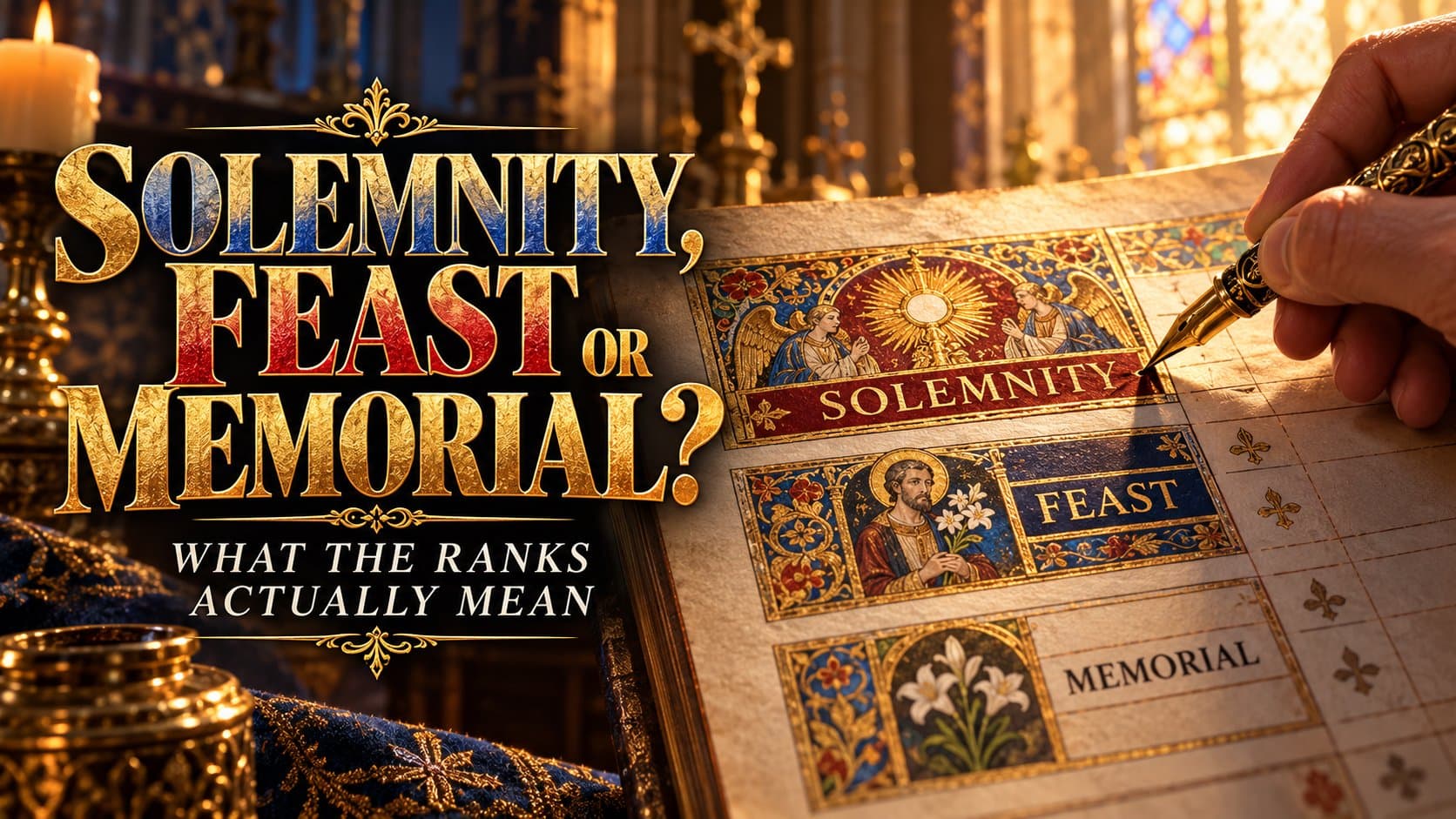
📌 Here is the plain answer. A solemnity, a feast, and a memorial are the three ranks the Catholic Church gives to the days on its calendar, in that order from highest to lowest. A solemnity is the top rank, kept with the fullest Mass, reserved for the biggest mysteries of the faith. A feast ranks below it, with fewer of those same elements. A memorial sits at the bottom, honoring a saint on an ordinary day, and comes in two kinds, obligatory and optional.
It is not a grading system for how much God loves a particular day. It is a way of telling a Catholic, at a glance, which days carry the weight of the whole church and which ones are a smaller, local act of remembering.
This guide walks through what actually separates the three ranks, where the words themselves come from in Scripture, why the same saint can rank differently in different places, and where Protestants land on a system most of them never grew up with.
Every historical and liturgical claim below links back to a named source, so you can go check it yourself.
Why This Matters for Your Faith
It is easy to wave this off as calendar trivia. Something only a sacristan needs to track.
⚠️ But look at what the ranking is actually doing. It is teaching you proportion. Not every good and holy thing carries the same weight, and a church that never said so would eventually treat the resurrection of Christ and a local saint's birthday as interchangeable.
A solemnity stops the ordinary calendar for something everyone needs to hear, like Easter or Pentecost. A memorial lets one parish, or one order, or one country, keep faith with a smaller story that still matters. The whole liturgical calendar is built on that same instinct, that time itself can be shaped to teach you what matters most.
💡 Scripture has its own word for this instinct. It calls the people who came before you a cloud of witnesses.
"Wherefore seeing we also are compassed about with so great a cloud of witnesses, let us lay aside every weight, and the sin which doth so easily beset us, and let us run with patience the race that is set before us,"
A solemnity reminds you of the center of that race, Christ himself. A memorial points at one runner who finished it well. Learning to tell them apart is learning to keep your own eyes on both without losing the center.

What Actually Separates a Solemnity, a Feast, and a Memorial
1. The Words Themselves Are Already in Your Bible
Before any pope or council ranked anything, these three words were already sitting in the Old Testament, attached to Israel's own appointed days.
Start with the word memorial.
"And this day shall be unto you for a memorial; and ye shall keep it a feast to the LORD throughout your generations; ye shall keep it a feast by an ordinance for ever."
📌 That single verse uses both words, memorial and feast, about Passover, the night God brought Israel out of Egypt. A memorial, in the Bible's own vocabulary, is something kept so a future generation remembers an act of God they did not witness themselves.
The word feast shows up on its own too, as a command, not a suggestion.
"Speak unto the children of Israel, and say unto them, Concerning the feasts of the LORD, which ye shall proclaim to be holy convocations, even these are my feasts."
And the word solemn, the root of solemnity, describes a gathering with its own weight.
"On the eighth day ye shall have a solemn assembly: ye shall do no servile work therein:"
💡 The church did not invent the idea of ranking sacred days. It inherited the idea from Israel, and simply built a system around it for its own calendar.
2. A Solemnity Is the Highest Rank the Church Has
The Vatican's own 1969 General Norms for the Liturgical Year and the Calendar states plainly that "solemnities are counted as the principal days in the calendar," and that a solemnity begins the evening before, at First Evening Prayer, the same way a Sunday does.
A liturgy explainer from EWTN, drawing on canon lawyer Father Edward McNamara, lays out what that actually looks like at Mass. A solemnity has three Scripture readings, the prayer of the faithful, and both the Gloria and the Creed, said in full even during Advent or Lent, which otherwise drop the Gloria entirely.
That list of solemnities includes Easter, Pentecost, the Immaculate Conception, Christ the King, the Sacred Heart, Saints Peter and Paul, and the birth of John the Baptist.
📌 Some solemnities are also holy days of obligation, days Catholics are asked to attend Mass the same as a Sunday, though which ones carry that obligation changes from country to country. That obligation is a separate rule layered on top of the rank, not the rank itself. Every holy day of obligation is a solemnity, but not every solemnity is a holy day of obligation.
3. A Feast Ranks One Step Below, and Loses One Element
A feast honors a mystery of the Lord, a title of Mary, or a saint of real importance, and it keeps most of a solemnity's weight, but not all of it.
The same EWTN explainer puts the difference in one line. A feast "usually has some proper prayers but has only two readings plus the Gloria," and no Creed. The Vatican's norms add that a feast, unlike a solemnity, does not get its own First Evening Prayer the night before, except when a feast of the Lord happens to fall on a Sunday.
Examples include the feasts of the archangels, most of the apostles, the Transfiguration, and the Exaltation of the Holy Cross.
❓ Here is where the ordinary names get confusing. People casually call plenty of church days a feast, including days that are actually ranked a solemnity. The Feast of the Annunciation is one of them. On the church's own calendar it is ranked a solemnity, Gloria, Creed, and all, even though its common name has carried the word feast for centuries. The name you hear in conversation and the rank on the calendar are two different questions.
4. A Memorial Is the Quietest Rank, and Comes in Two Kinds
A memorial is usually a saint's day, though a few memorials honor something about the Lord or Mary instead.
It has no Gloria. EWTN's explainer notes a memorial "has at least a proper opening prayer and may have proper readings suitable for the saint being celebrated," which is a much shorter list than a feast gets.
The Vatican's norms split memorials into two kinds. An obligatory memorial is meant to be kept every year it falls, like the Immaculate Heart of Mary. An optional memorial, like the Holy Name of Jesus, may be kept or quietly skipped, and the EWTN piece is clear that "from the point of view of the liturgical elements there is no difference between the optional and obligatory memorial." The difference is only whether it is expected.
📌 Memorials also give way. The Vatican's norms state that during the final week of Advent, December 17 through 24, and on every weekday of Lent, an obligatory memorial drops down and is kept as only a small commemoration inside that day's own Mass, not celebrated in full.
That is the same logic behind Exodus 12:14. A memorial exists so a day does not get forgotten. It was never meant to compete with the bigger story around it.
5. The Same Day Can Rank Differently Depending Where You Stand
This is the part that trips up most people learning the system for the first time. A rank is not fixed everywhere on earth.
EWTN's explainer gives a clean example in Saint Benedict. On the universal calendar used by the whole church, his day is an obligatory memorial. In Europe, where he is honored as a patron of the continent, the same day is raised to a feast. At Montecassino, the monastery he founded in Italy, it is kept as a solemnity.
One saint. One date. Three different ranks, depending on how close you stand to the story.
💡 That is not the church being inconsistent. It is the same principle as a family birthday. The whole company does not close for it, but the family treats it like the center of the week. All Saints Day and All Souls Day show a related kind of distinction, two days back to back that honor very different groups of people in very different ways.

Practical Tips for Using the Ranking Well
You do not need to memorize the whole liturgical calendar to let this shape how you pay attention.
- Listen for the Gloria and the Creed. If both are said, you are almost certainly in a solemnity. If only the Gloria is said, you are likely in a feast. If neither is said, you are probably on a memorial or an ordinary weekday.
- Learn the letter codes in your missal or bulletin. A capital S, capital F, capital M, and lowercase m are shorthand for solemnity, feast, obligatory memorial, and optional memorial. Once you know them, the calendar stops being code.
- Do not mistake a quiet rank for an unimportant saint. A memorial is lower on the calendar, not lower in the value of that person's life. Plenty of the most loved saints in church history are only kept as optional memorials.
- Find out who your own parish or diocese is named for. A local patron's day often outranks the universal calendar right where you live, the same way Saint Benedict's day is raised in Europe.
- Let the solemnities anchor your own year. Christmas, Easter, and Pentecost were raised to the top rank for a reason. Build your personal rhythm of prayer around the same days the whole church is built around.
- If you are not Catholic, treat this as a lens, not a rulebook. Catholic and Protestant church calendars differ on purpose, and understanding this system helps you read Catholic friends and history well, without asking you to adopt it wholesale.
- Teach the ranking to someone younger the next time it comes up. Explaining why one day got the Creed and another did not is a two minute lesson that sticks.
Top Bible Verses Behind the Words Solemnity, Feast, and Memorial
All three words were doing real work in Scripture long before a liturgical calendar existed.
1. Exodus 12:14, Where Memorial and Feast Meet
"And this day shall be unto you for a memorial; and ye shall keep it a feast to the LORD throughout your generations; ye shall keep it a feast by an ordinance for ever."
This is the night of the first Passover, and God himself commands the remembering before the event has even finished happening. A memorial was never an afterthought in Scripture. It was built into the instruction from the start.
2. Leviticus 23:2, the Feasts Belong to God
"Speak unto the children of Israel, and say unto them, Concerning the feasts of the LORD, which ye shall proclaim to be holy convocations, even these are my feasts."
Notice the possessive. God calls them my feasts, not Israel's calendar preference. A feast, from the very first chapter that uses the word, belongs to the one it honors, not to the people keeping it.
3. Numbers 29:35, a Solemn Assembly
"On the eighth day ye shall have a solemn assembly: ye shall do no servile work therein:"
The eighth day closes out the Feast of Tabernacles, and the text marks it as solemn precisely because it carries weight the surrounding ordinary days did not. Work stops. Attention is required. That is the same instinct behind a modern solemnity.
4. Joshua 4:7, Stones Set Up So Nobody Forgets
"Then ye shall answer them, That the waters of Jordan were cut off before the ark of the covenant of the LORD; when it passed over Jordan, the waters of Jordan were cut off: and these stones shall be for a memorial unto the children of Israel for ever."
Twelve stones, pulled from the middle of a dry riverbed, stacked up for one reason. So a child two generations later would ask what they meant, and get the whole story. That is exactly what a memorial on the calendar is still doing.
5. Luke 2:14, the Words Behind the Gloria
"Glory to God in the highest, and on earth peace, good will toward men."
This is the angels' song over Bethlehem, and it is the same line the Gloria hymn at Mass is built on. Every solemnity and feast that includes the Gloria is, in a real sense, putting the angels' own words back in your mouth.

Frequently Asked Questions About Solemnities, Feasts, and Memorials
What is the highest rank of a Catholic feast day?
A solemnity. It is the top of the three ranks, kept with the fullest Mass, including the Gloria and the Creed, and it is the rank reserved for days like Easter, Christmas, and Pentecost.
Is Christmas a solemnity or a feast?
Christmas is a solemnity, one of the handful of days the Vatican's own norms count among the very highest tier of the calendar, alongside Easter, Pentecost, and the Epiphany.
What do the letters S, F, and M mean on a Catholic calendar?
A capital S marks a solemnity, a capital F marks a feast, a capital M marks an obligatory memorial, and a lowercase m marks an optional memorial. The letters are shorthand for the exact rank system this guide walks through.
What is the difference between an obligatory and an optional memorial?
The Mass itself looks the same either way. The difference is whether the day is expected to be kept every year it falls, which is obligatory, or may be kept or skipped, which is optional. EWTN's own explainer notes there is no liturgical difference between the two, only a difference in rank.
Do Catholics have to celebrate every memorial?
No. Optional memorials may be passed over entirely, and even obligatory memorials step aside during the last week of Advent and every weekday of Lent, kept only as a brief mention rather than the full Mass of the day.
Why is the Feast of the Annunciation actually a solemnity?
Because the common name for a day and its official rank are two separate things. The Annunciation has been called a feast in everyday speech for centuries, but on the church's own calendar it carries the full solemnity rank, Gloria, Creed, and all.
Can the same saint rank differently depending on where you live?
Yes. Saint Benedict is an obligatory memorial on the universal calendar, a feast across Europe where he is honored as a patron, and a solemnity at Montecassino, the monastery he founded. The rank can rise with how close a place is to that saint's own story.
Do Protestant churches use solemnities, feasts, and memorials?
Mostly not by those names. This three tier ranking belongs to the Catholic calendar. Christianity Today has noted that many evangelical and nondenominational Christians grew up wary of church tradition altogether, sometimes pointing to Colossians 2:16 and its warning about judging one another over religious festivals, while others, including Lutherans and Anglicans, keep their own calendars of saints that work on a similar idea without using these exact Catholic terms.
Is a holy day of obligation the same thing as a solemnity?
Not quite. Every holy day of obligation is a solemnity, but not every solemnity is a holy day of obligation. The obligation to attend Mass is a separate rule laid on top of the rank, and it changes from country to country.
What happens when a solemnity falls on a Sunday in Lent?
The norms generally move it, because the Sundays of Lent and Advent outrank nearly everything else on the calendar. Exactly where it lands can vary by case, which is why a diocese sometimes asks Rome directly for a particular year's date.
Final Thoughts
Strip away the letters in the bulletin margin, and three things remain true.
📌 A solemnity, a feast, and a memorial are not three names for the same thing. They are three different weights, each one telling you how much the whole church is being asked to stop and pay attention that day.
📌 The words themselves are older than the ranking system. Memorial, feast, and solemn were already doing real work in the Old Testament, long before any missal gave them a letter code.
📌 Rank can shift depending on where you stand. A memorial in one country can be a feast in another and a solemnity at the one monastery that started it all.
You do not need a theology degree to use any of this. Next time you notice the Creed missing, or a letter you do not recognize next to a date, you will know exactly what the church is quietly telling you about that day.
📚 Sources
Every claim in this article traces back to one of these. All links checked 4 November 2026.
- Solemnities, Feasts, Memorials
Fr. Edward McNamara, ZENIT, via EWTN · 2008
The source for how the three ranks differ in practice at Mass (readings, Gloria, Creed), the obligatory versus optional memorial distinction, and the Saint Benedict example of rank changing by place.
- General Norms for the Liturgical Year and the Calendar
Sacred Congregation for Divine Worship, Vatican, via EWTN · 1969
The official source for the definitions of solemnities, feasts, and memorials, First Evening Prayer, and the rule that memorials step aside during the last week of Advent and on Lenten weekdays.
- Can You Explain How Solemnities, Feasts, and Memorials Differ?
Fr. Vincent Serpa, O.P., Catholic Answers · 2019
The source for the S, F, M, and m letter codes used on Catholic calendars to mark each rank.
- Christian Tradition: Why Follow the Church Calendar and Its Holy Days?
Elizabeth Woodson, Christianity Today · 2024
The source for why many evangelical and nondenominational Christians are wary of church tradition and festival days, including the reference to Colossians 2:16.