📖 How Do Christians Celebrate Epiphany Around the World?
In one house, a child leaves a shoe by the door tonight, hoping a king will fill it by morning. In another house, on the exact same date, grandparents cut into a cake looking for a tiny figurine. In another, a crowd walks toward a river before dawn, waiting for a priest to bless the water. None of these families would call what the others are doing strange. They would call it Epiphany.
You already know the basic meaning of the day if you have read what Epiphany actually celebrates. What this guide gives you is the part that never fits in one country's story: how wildly different the same feast looks once it leaves the church building and moves into kitchens, streets, and rivers on six continents.
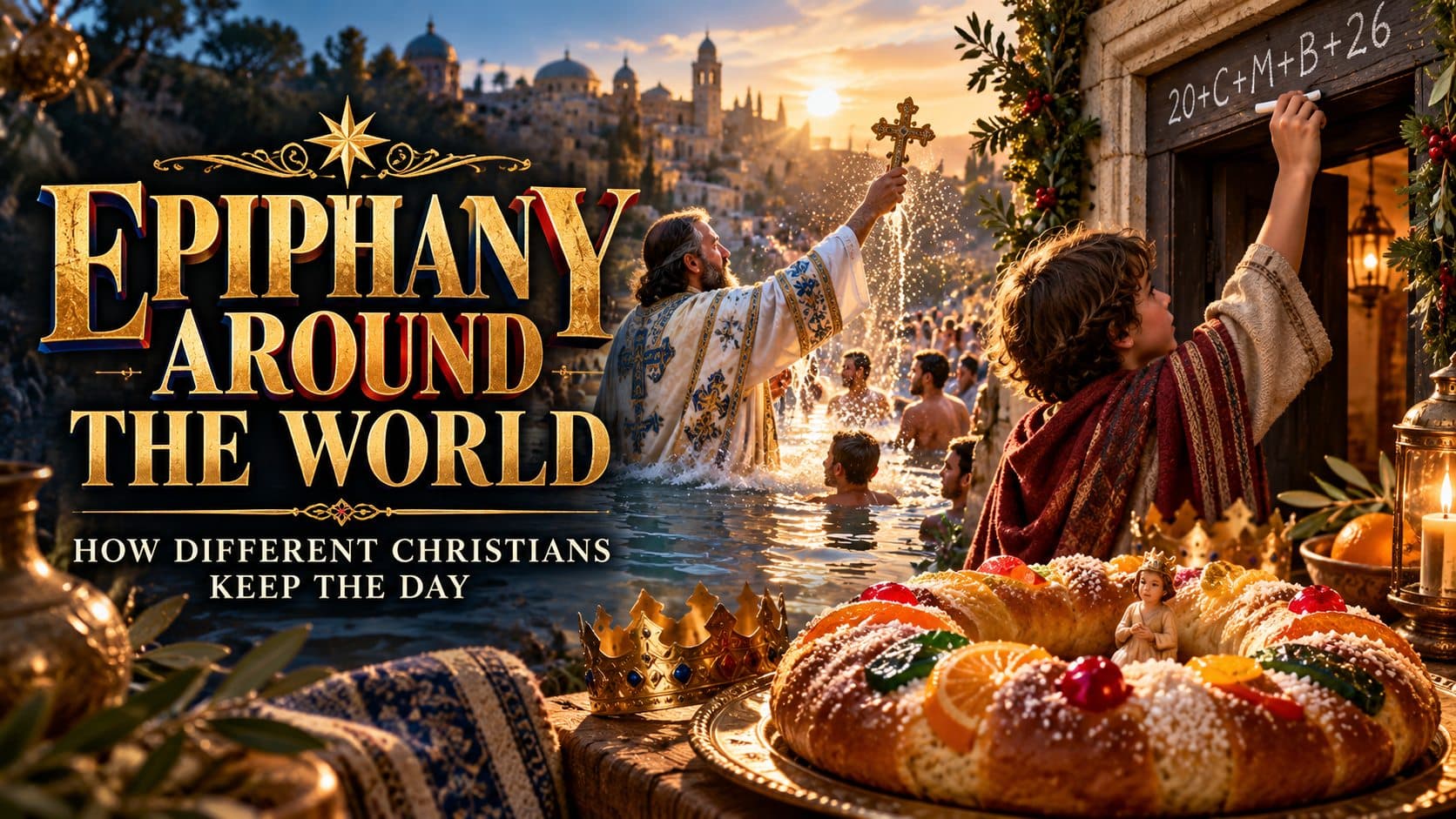
📌 Here is the plain answer. Epiphany is kept on or near January 6 by Christians from Spain to Ethiopia, and almost none of them keep it the same way. Spain and Latin America center it on gift giving kings. Italy gives the night to a kindly old woman with a broom. France and Germany each built a custom around food or song. Orthodox Christians in Russia and Ethiopia center the whole day on blessing water.
This guide walks through six of those customs, where each one actually comes from as far as it can be traced, and what they all still have in common underneath the very different surfaces.
Every historical claim below links back to a named source you can check for yourself.
Why This Matters for Your Faith
It would be easy to read a list like this as travel trivia. A cake here, a parade there, nothing that touches your own walk with God.
⚠️ But look at what all six customs are actually witnesses to. Every single one of them exists because Christians in a particular place decided this feast, about God revealing Himself to the whole world, was worth building a real habit around. John saw where that kind of spread was always heading.
"After this I beheld, and, lo, a great multitude, which no man could number, of all nations, and kindreds, and people, and tongues, stood before the throne, and before the Lamb, clothed with white robes, and palms in their hands;"
💡 That multitude is not a future promise with nothing behind it yet. It is already visible, in miniature, every January 6, in a Roscón de Reyes in Madrid, a star singer's chalk mark in Vienna, and a priest cutting a hole in river ice near Moscow. Different languages. Different customs. The same feast, because the same Christ showed Himself to all of them.

How Six Christian Cultures Keep the Same Day
1. Spain and Latin America: The Night the Kings Arrive
In Spain and across much of Latin America, Epiphany outranks December 25 for one thing: presents. NBC New York, reporting on the custom for its own readers, explains that in Spain and many Latin American countries, the Three Kings, not Santa Claus, are the ones credited with bringing gifts, and January 6 is the day children actually receive them.
The evening of January 5 belongs to the Cabalgata de Reyes, a parade in which people dressed as Melchior, Caspar, and Balthazar ride through city streets, often on floats or animals, throwing candy to children lining the route. Families leave out shoes the night before, the same NBC report notes, so the Kings have somewhere to leave the gifts once the children are asleep.
Food carries just as much weight as the gifts. The centerpiece is the Rosca de Reyes, a ring shaped sweet bread studded with candied fruit, with a small figurine of the baby Jesus baked inside. Whoever's slice holds the figurine is traditionally expected to host the next gathering, on Candlemas, February 2nd.
📌 The whole custom is a dramatized retelling of Matthew 2. The gifts the Magi once laid in front of a child in Bethlehem now arrive, every year, in the shoes of children who have never read that chapter but already know the story by heart.
2. Italy: La Befana Finishes What Christmas Started
Italy keeps the night before Epiphany for a very different visitor. Encyclopaedia Britannica's own entry describes La Befana in Italian tradition as the old woman who fills children's stockings with gifts on Epiphany, also called Twelfth Night.
She is usually pictured as a hunched, broom carrying old woman who slips down chimneys on the night of January 5, leaving sweets for children who have been good and a lump of coal, these days usually rock candy shaped like coal, for those who have not. The legend most often told about her has the Magi stopping at her house on their own journey and inviting her to come along. She said no. Afterward, the story goes, she regretted it and has spent every year since searching for the Christ child herself, leaving gifts at every house she passes in case He is there.
⚠️ Treat her backstory carefully. Nobody can trace exactly when or how the Befana tradition began. What is well documented is the custom itself: a national holiday in Italy on January 6 that closes out the Christmas season, with the old woman as its central character rather than the Magi directly.
3. France: A Cake, a Crown, and a Hidden Bean
France marks the day with the galette des rois, a round puff pastry cake usually filled with almond frangipane. The Connexion, an English language newspaper covering France, reports that the custom has existed in some form since at least the fourteenth century, though the record that far back is thin enough that it is worth treating as a tradition rather than a settled fact.
What is well attested is the modern custom. A small charm called a fève is hidden inside the cake before baking. The Connexion notes it was originally an actual dried bean, which gave the charm its name, before it was gradually replaced by a small porcelain or plastic figure late in the nineteenth century. Whoever's slice holds the fève wears a paper crown and is named king or queen for the day.
A 2019 survey for the French bakers' federation, cited by the same outlet, found that 94 percent of people in France eat a galette at some point during the Epiphany season, which makes the custom one of the most widely kept of any on this list, religious or not.
📌 The crown is the whole point. For one slice of cake, an ordinary person, often a child, gets treated like royalty at their own table. It is a small, edible echo of kings kneeling in front of someone far more ordinary than themselves in Bethlehem.
4. Germany and Austria: Children Dressed as the Magi, Singing for Others
In Germany and Austria, Epiphany is carried door to door by children. Dressed as the three kings and carrying a star on a pole, groups known as Sternsinger, star singers, go from house to house singing and asking for a donation, almost always for children's charities overseas rather than for themselves.
The modern organizing body behind the German action, the Kindermissionswerk, now known simply as Die Sternsinger, traces its own roots back to February 2, 1846, when a teenager named Auguste von Sartorius founded a children's aid group around one idea: children helping children. That same organization, based in Aachen, still runs the annual star singing collection today, supporting partner projects across Asia, Africa, and Latin America.
Many of these households also keep the custom of chalking the door, writing the year and the letters C, M, and B above the doorframe as a blessing for the house. In some homes the star singers write the chalk mark themselves as part of their visit, right in the middle of the twelve days the church calls Christmastide.
💡 This is the one custom on this list built entirely around giving, not receiving. The children playing kings are not collecting gifts for themselves. They are handing everything they collect to children they will never meet.
5. Russia: A Hole Cut in the Ice
Russia and other Eastern Orthodox countries do not center Epiphany on the Magi at all. They call it Theophany, and it belongs to Christ's baptism in the Jordan. Many of these same churches still follow the older Julian calendar, which is the same reason some Orthodox Christmases fall on January 7. The Orthodox Church in America describes the Great Blessing of Water as the rite at the heart of the day, performed in churches and then, often, repeated outdoors at a river, lake, or well.
In Russia that outdoor blessing has grown into one of the country's most striking winter images. Atlas Obscura's own coverage of the custom describes a cross shaped hole cut into the ice of a frozen river or lake, called an Iordan, after a priest blesses the water. Believers then climb down and immerse themselves, traditionally three times, in honor of the Trinity, in water that can be well below freezing in the open air.
⚠️ Do not treat the ice dive as the ancient part. The blessing of the water itself goes back to the earliest centuries of the Church. The icy plunge is a newer, popular addition, and some Orthodox clergy themselves have pushed back on treating it as a required practice rather than an optional, and genuinely risky, custom. Russian officials now prepare thousands of supervised sites each year largely for safety reasons.
6. Ethiopia: Timkat and the Procession of the Tabot
Few countries keep Epiphany louder, or longer, than Ethiopia. The Ethiopian Orthodox Tewahedo Church calls its own Epiphany celebration Timkat, and the Ethiopian Embassy's own account of the festival explains that the day marks Christ's baptism in the Jordan, the same event Eastern Orthodox Christians remember as Theophany.
On the eve of the feast, called Ketera, priests carry the tabot, a replica of the Ark of the Covenant normally kept hidden inside each church, in procession to a nearby river, pool, or specially built reservoir. The tabot stays there overnight under guard while crowds gather, sing, and keep an all night vigil. Toward dawn, a priest blesses the water, and the gathered crowd is sprinkled with it or, for many, immersed in it, as a renewal of their own baptismal vows.
In December 2019 UNESCO added Ethiopia's Epiphany celebration to its Representative List of the Intangible Cultural Heritage of Humanity, a recognition the Ethiopian Embassy itself announced and welcomed at the time.
📌 Notice what Russia and Ethiopia share that Spain, Italy, France, and Germany do not. Two very different Orthodox churches, thousands of miles apart, independently built their biggest Epiphany custom around the same thing: real water, really blessed, for real people to step into.

Practical Tips for Keeping Epiphany Wherever You Live
You do not have to move to Seville or Addis Ababa to let this feast shape your January 6. Here are seven ways to borrow from it honestly.
- Read Matthew 2:1 to 12 before you try any custom. Every tradition on this list is a response to that one chapter. Know the source before you borrow the symbol.
- Bake something, and say why you baked it. A simple ring shaped cake with a bean or small charm hidden inside can carry the same lesson the galette des rois carries, if you tell your family what it is for before you cut it.
- Give before you receive. Borrow the heart of the German star singers by having your family give something away, time, money, or a meal, on or near January 6, rather than only receiving.
- Let your kids ask who the Magi represent. They had no covenant claim on Israel's God, and they found Him anyway. Ask who around you still needs to hear that the door is open to them too.
- Learn one Eastern Orthodox custom on purpose. You do not need to find frozen water to appreciate what the Great Blessing of Water is actually saying about Christ's baptism.
- Do not adopt a custom you cannot explain. If you cannot say in one sentence why a tradition exists, you are borrowing decoration, not meaning. Learn the reason first.
- Close your own Christmas season with one deliberate act of worship. Whatever your family's custom, spend five minutes on January 6 thanking God that He showed Himself to people with no claim on Him at all, including you.
Top Bible Verses Behind These Epiphany Customs
Every custom above is a culture's own way of pointing back at these five verses.
1. Matthew 2:9 to 11
"When they had heard the king, they departed; and, lo, the star, which they saw in the east, went before them, till it came and stood over where the young child was. When they saw the star, they rejoiced with exceeding great joy. And when they were come into the house, they saw the young child with Mary his mother, and fell down, and worshipped him: and when they had opened their treasures, they presented unto him gifts; gold, and frankincense, and myrrh."
This single scene is the seed behind the Spanish Cabalgata, the shoes left out overnight, and every gift exchanged on January 6 anywhere in the world. The Magi gave first. Every custom built on gift giving is trying to copy that order.
2. Isaiah 60:3
"And the Gentiles shall come to thy light, and kings to the brightness of thy rising."
Written centuries before any Magi packed for their trip, this verse already pictures outsiders and kings drawn toward a light that was never their own to begin with. Every country on this list is still, in its own way, that light drawing in a different crowd.
3. Psalm 72:10 and 11
"The kings of Tarshish and of the isles shall bring presents: the kings of Sheba and Seba shall offer gifts. Yea, all kings shall fall down before him: all nations shall serve him."
Early readers heard this psalm echoing under Matthew's account of the Magi, which is most likely where the later legend of three crowned kings first grew from. The galette des rois crown and the Cabalgata's costumed kings are both, at bottom, dramatizing this exact verse.
4. Acts 10:34 and 35
"Then Peter opened his mouth, and said, Of a truth I perceive that God is no respecter of persons: But in every nation he that feareth him, and worketh righteousness, is accepted with him."
Peter said this out loud for the first time standing in the home of a Roman soldier, a Gentile with no claim on Israel's covenant at all. It is the same discovery the Magi made decades earlier at a much smaller scale, now stated as a rule for every nation, not just one visit.
5. Revelation 7:9
"After this I beheld, and, lo, a great multitude, which no man could number, of all nations, and kindreds, and people, and tongues, stood before the throne, and before the Lamb, clothed with white robes, and palms in their hands;"
This is where every custom on this list is ultimately headed. Not one culture keeping one tradition, but every nation and tongue, together, in front of the same throne. The Roscón, the galette, the star singers, and the Iordan are all small, present day rehearsals of that one future gathering.

Frequently Asked Questions About Epiphany Customs
How do different countries celebrate Epiphany?
Spain and much of Latin America center the day on gift giving kings and a parade called the Cabalgata de Reyes. Italy gives the night before to an old woman named La Befana. France eats a cake called the galette des rois. Germany and Austria send children dressed as the Magi door to door collecting for charity. Russia and Ethiopia, both Orthodox, center the day on blessing water.
Why do people in Spain open gifts on January 6 instead of December 25?
Because the Spanish tradition credits the Three Kings, not Santa Claus, with bringing the gifts, and the Kings are remembered on the day tied to their visit in Matthew 2, which the Western Church keeps as Epiphany, January 6.
Who is La Befana?
La Befana is a figure in Italian folklore, usually pictured as an old woman with a broom, who is said to leave gifts for children on the night before Epiphany. Her exact origin cannot be traced with certainty, though the most common legend ties her to the Magi themselves, who are said to have stopped at her house on their way to Bethlehem.
What is hidden inside a galette des rois?
A small charm called a fève, French for bean, because the charm was originally an actual dried bean before it was replaced by a small porcelain or plastic figure in the late nineteenth century. Whoever's slice contains it is crowned king or queen for the day.
What do the German star singers actually do?
Groups of children, usually three at a time dressed as the Magi and carrying a star on a pole, go house to house around Epiphany singing and collecting donations for children's charities, often overseas. Many also chalk a blessing above the door of the homes they visit.
Why do Russians cut a hole in the ice for Epiphany?
Russian Orthodox Christians call the day Theophany and center it on Christ's baptism, not the Magi. After a priest blesses a river or lake, many believers immerse themselves in the icy water three times, honoring the Trinity, as a popular custom alongside the Church's own Great Blessing of Water.
What is Timkat in Ethiopia?
Timkat is the Ethiopian Orthodox Tewahedo Church's own name for Epiphany. It centers on an overnight procession of the tabot, a replica of the Ark of the Covenant, to a body of water, followed by a blessing of that water at dawn. UNESCO added the celebration to its Intangible Cultural Heritage list in 2019.
Is Three Kings Day the same as Epiphany?
Yes. Three Kings Day, Dia de Reyes, and Epiphany all name the same day on the Western church calendar. The different names simply reflect which culture is naming it, and most Spanish speaking countries use Three Kings Day as their everyday term for it.
Do all Christians celebrate Epiphany the same way?
No, and that is really the whole point of this guide. Even Christians who agree on what the day means, God revealing Himself to the world, have built very different customs around it depending on their own country and church tradition.
Can a Protestant family borrow a Catholic or Orthodox Epiphany custom?
Nothing in Scripture forbids it, as long as the custom is kept with understanding rather than superstition. A family can bake a king cake, give to charity like the star singers do, or simply read Matthew 2 together without adopting the full liturgical calendar that produced the custom in the first place.
Final Thoughts
Strip away the cakes, the costumes, and the cold water, and three things remain true.
📌 One feast, many doors. Spain hands gifts through a parade. Germany hands them through a children's charity. Russia and Ethiopia hand a blessing through water. None of them is the real version with the others as imitations.
📌 Every custom is still answering Matthew 2. Whatever shape it takes in a given country, each tradition is some culture's own way of saying what the Magi said first: God showed Himself, and it was worth traveling for.
📌 The variety is not a flaw in the Church. It is the promise working exactly as written. Gentiles and kings were always going to come to the light from more directions than one.
Wherever you live, and whatever is on your own table this January, let the Spanish shoe, the Italian stocking, and the Ethiopian riverbank remind you of the same thing. Churches keep this calendar very differently, but they are all still keeping watch for the same God who showed up once and has never really left.
❓ Which of these six customs would actually teach your own family something true about Christ, not just something festive?
📌 He showed Himself to strangers once. He is still willing to be found, in every language there is.
📚 Sources
Every claim in this article traces back to one of these. All links checked 6 November 2026.
- What Is Three Kings Day and How Is It Celebrated?
NBC New York
The source for Spain and Latin America's Three Kings Day: the Cabalgata de Reyes parade, children leaving out shoes, and the Rosca de Reyes tradition.
- Befana
Encyclopaedia Britannica
The source for La Befana as the old woman of Italian Epiphany tradition who fills children's stockings on Twelfth Night.
- France's galette des rois: Six facts about this January 6 cake
The Connexion
The source for the galette des rois dating to at least the fourteenth century, the fève's change from a real bean to a porcelain charm, and the 2019 bakers' federation survey.
- Historie und Gründung
Kindermissionswerk "Die Sternsinger" e.V.
The source for the organization's own founding on 2 February 1846 by Auguste von Sartorius, and its present day name and mission behind the German and Austrian star singing custom.
- Fleeting Wonders: Russian Orthodox Christians Take the Epiphany Plunge
Atlas Obscura
The source for the Russian custom of cutting a cross shaped hole in river ice and immersing three times after the water is blessed.
- Feast of the Theophany of our Lord and Savior Jesus Christ
Orthodox Church in America (OCA)
The source for the Great Blessing of Water as the Orthodox Church's own rite at the center of Theophany.
- Ethiopian Epiphany Inscribed On UNESCO Intangible Cultural Heritage Lists
Embassy of Ethiopia, Washington D.C.
The source for Timkat's UNESCO inscription in December 2019 and the embassy's own description of the tabot procession and water blessing.