📖 How to Read the Bible in a Year Without Quitting in February
You have done this before.
January the first. New plan, good intentions, maybe a new Bible.
Genesis is great. Creation, the flood, Abraham, Joseph. You are flying.
Exodus holds up. Plagues, the sea, the mountain.
Then somewhere around the middle of February you hit a chapter about skin diseases and fabric, you miss a Tuesday, you miss the Wednesday catching up on the Tuesday, and by the time you look again it is March and the bookmark has not moved.
📌 If you want to know how to read the Bible in a year without quitting, the honest answer is that the problem is almost never discipline.
It is usually one of three things.
- 🔲 Nobody told you what the hard books are for.
- 🔲 You treated a missed day as a debt you had to repay.
- 🔲 You were reading for a streak instead of reading for the story.
All three are fixable, and none of the fixes require you to become a more disciplined person than you currently are.
This is not a motivational article. It is a practical one, about how a year of reading actually survives contact with a real life.
Why This Matters for Your Faith
Most Christians have never read the whole Bible. Not because they did not want to.
And the cost of that is not guilt. It is that you end up knowing a small set of famous passages very well and the rest of the book not at all. You know David and Goliath. You have no idea what the prophets were angry about. You can quote Philippians 4 and you have never read Leviticus 25, which is the chapter Jesus stands up and claims in Luke 4.
⚠️ The danger is not ignorance. It is that the parts you do not know are the parts that explain the parts you do.
The Bible is one story, not sixty six separate books stacked on a shelf. Reading it through once changes how you hear every sermon afterwards, because you finally know where things sit.
That is worth a year. And it is worth setting up so that a bad week in February does not end it.
Why Bible Reading Plans Fail, and What To Do Instead
Six things that decide whether you are still reading in June.
1. The plan is not the point
A reading plan is a route. It is not the destination, and it has no authority over you.
People quit because they start serving the plan instead of using it. The checkbox becomes the goal, and the moment the checkboxes break, the whole thing feels pointless.
Joshua was told to do something that sounds like a plan and is not.
"This book of the law shall not depart out of thy mouth; but thou shalt meditate therein day and night, that thou mayest observe to do according to all that is written therein: for then thou shalt make thy way prosperous, and then thou shalt have good success."
Notice there is no quantity in it. No chapters per day, no finish date. The instruction is about the book staying in his mouth and his mind, not about pace.
✅ Hold the plan loosely and the book tightly. If you need somewhere to start on the mechanics of reading itself, we cover that in how to read the Bible.
2. February is where it dies, and here is why
Almost every year plan runs Genesis to Revelation in order. That means January is narrative and February is law.
Leviticus is where most people stop. Chapters on offerings, on skin conditions, on what to do with a house that has mould in it. Read cold, with no idea why it is there, it feels like a phone book.
So here is the thing nobody tells you before you start. Leviticus is a book about a holy God choosing to live in the middle of an unclean people, and the enormous, detailed, expensive effort that took. Every page is answering one question: how can God live here without destroying us.
Read it with that question in your hand and the detail stops being noise. It becomes the measure of the problem that Jesus later solves.
📌 You do not have to understand every verse of Leviticus. You have to understand what the book is doing. That is enough to get you through it, and getting through it is what gets you to the prophets.
3. A missed day is not a debt
This is the one that kills more plans than Leviticus does.
You miss Monday. On Tuesday you now owe two days. By Thursday you owe four, and four days of reading is an hour you do not have, so you do none of it, and the debt becomes the reason to stop entirely.
The debt is imaginary. Nobody is counting. There is no penalty. God is not keeping a ledger of chapters.
When you miss days, do not catch up. Open the plan at today's date and read today's reading. The days you missed are simply days you did not read, and you can come back to them later in the year or never.
✅ Starting again on day nine is not failure. It is the only move that has ever worked. The alternative, waiting until the first of next month so you can start cleanly, is how people lose entire years.
There is something underneath this worth naming. The catch up instinct comes from treating reading as a performance you owe God, and a performance can be failed. That is not what is happening. Nothing in your standing with Him moves on the days you read, and nothing moves on the days you do not.
You read because the book feeds you, the same way you eat because you are hungry rather than to prove something to the kitchen. A missed meal is a missed meal. You do not eat four breakfasts on Thursday to make it right.
⚠️ Watch for the version of this that hides in a streak counter. The moment the number matters more than the chapter, a broken streak starts to feel like a broken relationship, and people walk away from the reading to avoid the feeling. If a counter is doing that to you, turn it off.
4. Read for the story, not for the streak
A streak is a number about you. A story is a thing you want to find out the end of. Only one of those survives a hard week.
The way to make it a story is to carry one question through the whole year. The best one is simple: where is God in this chapter, and what is He doing?
Some days the answer is obvious. Some days He is quiet and you have to look. In Esther His name never appears once, and the book is still about Him.
That question is what turns a genealogy into evidence and a list of laws into a portrait. It also means no day is wasted, because even a dull chapter answers it.
"And beginning at Moses and all the prophets, he expounded unto them in all the scriptures the things concerning himself."
That is Jesus, after the resurrection, walking two people through the Old Testament and showing them where He was in it the whole time. He treated the whole book as one story about Himself. So can you.
5. Attach it to a time you already own
"I will read more" is not a plan. "I will read after I put the kettle on and before I open my phone" is a plan.
Pick a moment that already exists in your day and bolt the reading to it. The first coffee. The train. The ten minutes after the kids are down. Lunch at your desk.
Pick the smallest reliable slot, not the most impressive one. Fifteen minutes you will actually take beats an hour you will skip. If you do want to build something longer eventually, we lay out a shape for it in how to spend one hour with God.
And read at the time of day your brain is actually awake. A lot of people fail at morning reading for no spiritual reason at all. They are just not morning people.
6. Have something to do with the hard chapters
You will hit passages that confuse you, bore you, or genuinely trouble you. That is normal and it is not a sign you are doing it wrong.
The rule that keeps you moving is this. Mark it and move on.
Do not stop the year to solve a verse. Underline it, put a question mark next to it, and keep reading. Half of them answer themselves two books later. A simple marking system makes this painless, and we describe one in a simple Bible highlighting system.
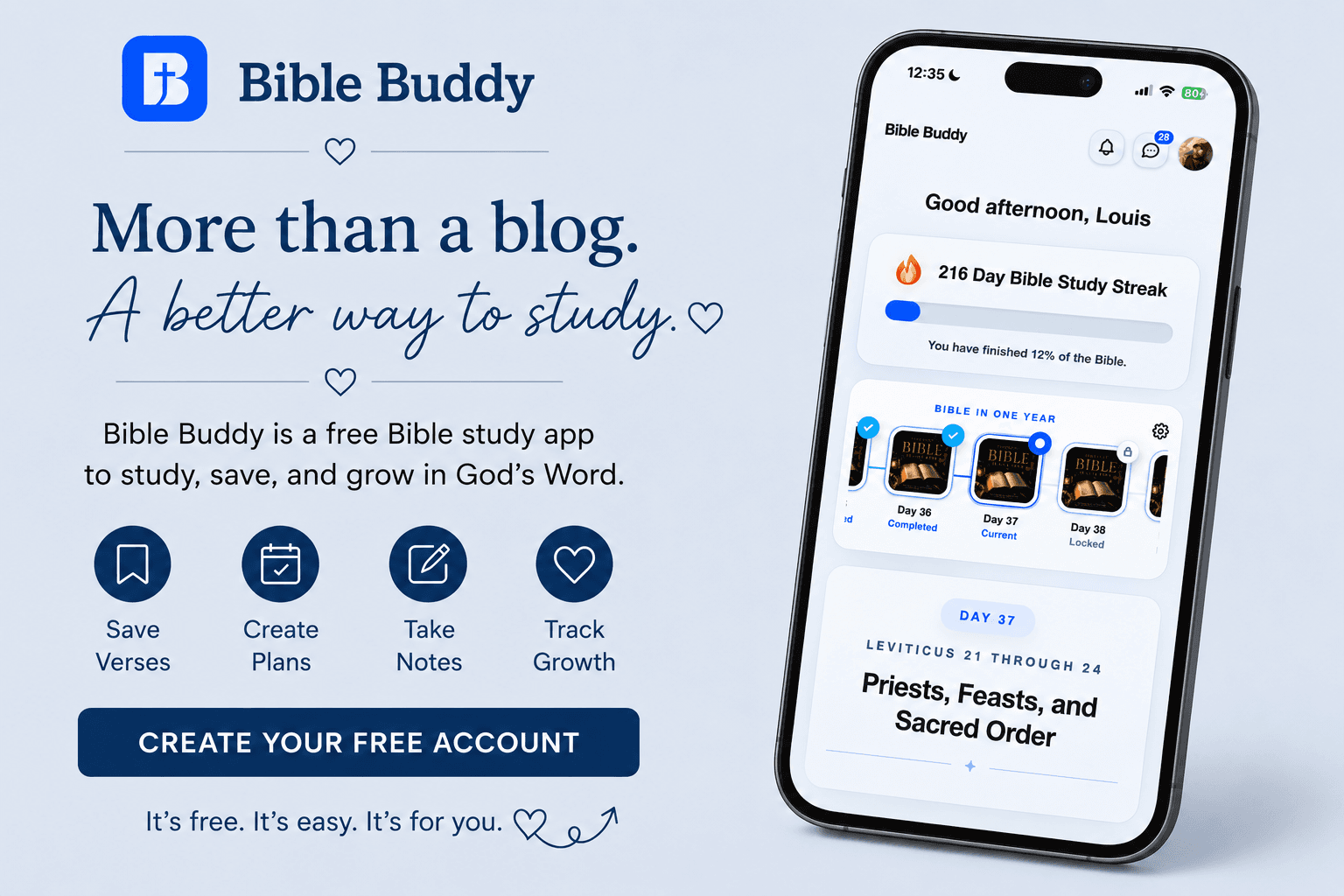
Reading a short explanation of the day's passage also helps more than people expect, because most confusion is missing context rather than missing faith. The Bible in One Year plan inside Bible Buddy walks through the same readings day by day for exactly that reason, and the day one study notes show the shape of it.
7. Know what the year ahead of you looks like
Most people start a year plan with no idea what is coming. Then the terrain changes under them and they assume something has gone wrong.
Here is the rough shape of a Genesis to Revelation year, so none of it surprises you.
- 📘 January is the easy month. Genesis and the start of Exodus are story. Enjoy it, and do not mistake the pace for how the whole year will feel.
- 📙 February and March are the law. Leviticus, Numbers, Deuteronomy. This is the stretch that ends most attempts. Go in knowing it is coming and knowing what it is for.
- 📗 Spring is the history. Joshua through the Kings and Chronicles. Battles, bad kings, good kings, and a nation slowly losing the plot. It reads quickly.
- 📕 Summer is the poetry. Job, Psalms, Proverbs. Psalms is long and it is also the place most people find they are no longer reading out of duty.
- 📒 Late summer and autumn are the prophets. The hardest reading after Leviticus, because the prophets assume you know the history you just read. You do now.
- 📖 The last stretch is the New Testament. And it lands completely differently when you have read everything behind it. This is the payoff, and it is why quitting in February costs so much.
📌 Nobody finds all six stretches equally easy, and nobody is supposed to. Expecting the difficulty to change is what stops you reading a hard month as evidence that you are failing.
It also helps to know the end before you start. The book opens in a garden and closes in a city, and almost everything in between is God refusing to give up on people who keep walking away from Him. That is the plot. Hold it, and even a flat week still belongs to something.

Practical Tips for Finishing the Year
Eight things that make the difference between January and December.
- 1. Decide now what a missed day means. Write it down before you start. "If I miss, I read today's reading tomorrow and skip what I missed." Deciding in advance removes the decision on the day you are least able to make it.
- 2. Pick a translation you can actually read. If the language fights you every morning, the year will not survive. Use a readable translation for the through read and save the heavier one for study.
- 3. Read out loud when you are tired. It sounds strange and it works. Your eyes can skim a page while your mind is somewhere else. Your mouth cannot.
- 4. Keep a one line journal. One sentence a day, not a page. What you noticed, or what you did not understand. It takes thirty seconds and it is the single best record of the year you will have.
- 5. Read the introduction to each book before you start it. Two minutes of context on who wrote it and why makes forty chapters make sense. This is the fix for the Leviticus problem and the prophets problem both.
- 6. Do not read it alone if you can help it. One other person doing the same readings, even by text, changes the odds enormously. You do not need a study group. You need one person who will notice if you go quiet.
- 7. Expect to be bored sometimes. Boredom is not a spiritual emergency. Some chapters are genealogies. Read them, notice they are mostly about God keeping a promise across generations, and carry on.
- 8. When you finish, start again. The second time through is where it opens up, because you now know where everything sits. You will not be the same reader who started.
Top Bible Verses About Reading God's Word
Psalm 119:105
"Thy word is a lamp unto my feet, and a light unto my path."
A lamp in the ancient world lit the next step, not the whole road. That is the honest picture of what daily reading gives you.
It is worth remembering on the days nothing seems to land. You are not looking for a floodlight over the next ten years. You are looking for enough light for tomorrow.
2 Timothy 3:16
"All scripture is given by inspiration of God, and is profitable for doctrine, for reproof, for correction, for instruction in righteousness:"
All scripture. Not the famous parts. Not the comfortable parts. The census lists and the building measurements too.
Paul wrote this when the scriptures he meant were mostly what we call the Old Testament. It is a direct argument for reading the whole thing rather than circling the same few chapters forever. For a wider look at what the book actually is, see what is the Bible.
Matthew 4:4
"But he answered and said, It is written, Man shall not live by bread alone, but by every word that proceedeth out of the mouth of God."
Jesus says this while He is starving in a desert, and He is quoting Deuteronomy. He had the words available because He knew them already.
Note the comparison He chooses. Bread is daily and unremarkable. Nobody celebrates eating. They just do it, and they weaken fast when they stop.
Isaiah 55:11
"So shall my word be that goeth forth out of my mouth: it shall not return unto me void, but it shall accomplish that which I please, and it shall prosper in the thing whereto I sent it."
This is the verse for the morning you read a chapter, feel nothing, and close the book wondering why you bothered.
The promise is about what the word does, not about what you felt while reading it. Effect is not the same as experience, and most of the work is slower than a single morning.
Galatians 6:9
"And let us not be weary in well doing: for in due season we shall reap, if we faint not."
In due season. Not immediately, and not on your schedule. The harvest language assumes a gap between the work and the result.
"If we faint not" is the only condition attached. Not if we do it perfectly. Not if we never miss. If we do not quit.
Frequently Asked Questions About Reading the Bible in a Year
How long does it take to read the Bible in a year?
Most through the year plans work out at roughly three to four chapters a day, which is around twelve to fifteen minutes of reading for most people. The time is rarely the real obstacle. The missed day and the hard book are.
What should I do if I miss a week?
Open today and read today. Do not try to recover the week. The plan is a route, not a contract, and the only version of this that ever finishes is the one where you rejoin at the current date without paying anything back.
Should I read the Bible in order?
Reading in order once is genuinely worth doing, because you see the shape of the whole story and how the pieces connect. If this is your very first attempt and the Old Testament has beaten you before, starting with a gospel and then going back to Genesis is a reasonable alternative.
Why is Leviticus so hard to read?
Because it is a legal and liturgical document written for a specific people in a specific situation, and it was never meant to be read like a story. Hold one question over it, how can a holy God live among people who are not, and the detail starts making sense as the answer rather than the obstacle.
Is it bad to use a reading plan on an app?
No. The format has never been the point. An app that tells you the day's reading and gives you a short explanation of it removes two of the three reasons people quit. Use whatever keeps the book open.
What if I do not understand what I am reading?
Mark it and keep going. Confusion is usually missing context, not missing faith, and a great deal of it clears up later in the same year. If the question is specifically about hearing God through what you read, start with how to know when God is speaking.
Is reading the Bible in a year too fast?
It is fast for study and right for perspective. A year read gives you the whole landscape; slow study gives you the detail. Most people benefit from doing one through read first so that later study has somewhere to sit.
Do I have to start on January the first?
No, and the belief that you do has cost more years of reading than any other idea here. Any date works. The calendar has no spiritual significance and a plan started in March finishes in March.
What if I have failed at this before?
Then you already know where your plan broke, which is more than a first timer knows. Name the exact point you stopped last time and build the fix into the setup before you begin. A previous failure is useful information, not a verdict.
What happens when I finish?
Start again. The second read is where the connections appear, because you now know what comes later. The same chapters will say things to you that you did not hear the first time round.
Final Thoughts
Three things to take into the year.
📌 The missed day is not a debt. Open today, read today. Every finished year belongs to somebody who skipped and carried on.
📌 Know what the hard books are doing. Leviticus is not an endurance test. It is the size of the problem Jesus came to solve.
📌 Carry one question, not a streak. Where is God in this chapter, and what is He doing? That question makes every day of the year worth something.
One thing to do today. Write down the time of day you will read and what you will do when you miss. Two sentences. That piece of paper is worth more than motivation.