📖 Joshua 20 Explained: Six Cities, One Refuge From Revenge
A man swings an axe. The head flies off the handle. His neighbor is dead, and he never meant for any of it to happen.
Joshua 20 explained is the chapter where Israel finally sets up six cities meant for exactly that man. Not a city for the guilty to hide in. A city for someone with innocent hands and a dead neighbor anyway, built so a grieving family's rage has somewhere to stop before it becomes a second death.
Maybe you have carried guilt for something you never intended, while someone else was still owed an explanation you could not give fast enough.
- ❓ Why does Israel need six whole cities just for accidents?
- ❓ What stopped a grieving family from taking revenge anyway?
- ❓ Why does the slayer's freedom depend on one specific man dying?
- ❓ What happened if he stepped outside the city gate too soon?
📌 Joshua 20 is only nine verses long, and every single one of them is about protecting someone the law has not yet decided is guilty.
This walkthrough moves through the whole chapter in order: the old command from Moses finally carried out, the exact kind of killing that qualified for refuge, what happened at the city gate, the avenger of blood who had to be held back, the high priest whose death set the slayer free, and the six named cities themselves, three on each side of the Jordan.
Nine verses, and they describe a kind of mercy the ancient world rarely bothered to build.
What Happened Just Before This Chapter
Joshua 19 closed out seven chapters of land division. Every tribe had a border. Joshua himself had finally received his own city, last of anyone. The long work of settling twelve tribes into one country was, on paper, finished.
But a country full of neighbors who now share fences, wells, and forests is also a country where accidents happen between people who used to be strangers scattered across a wilderness camp. Someone is going to swing an axe and lose the head of it. Someone is going to be in the wrong place when an ox bolts or a stone slips. Before any of that happens even once in the land, Joshua stops to build somewhere safe for it to land.

Joshua 20 Explained Verse by Verse
1. An Old Command, Finally Carried Out (verses 1 and 2)
The chapter opens with the LORD speaking directly to Joshua, not with a new idea but an old debt.
"The LORD also spake unto Joshua, saying, Speak to the children of Israel, saying, Appoint out for you cities of refuge, whereof I spake unto you by the hand of Moses:"
📌 This was not a brand new law dropped into chapter twenty. It was a promise made decades earlier, waiting for a land to exist in. The idea of a place to flee goes back even further than Moses naming cities. Before any city had a name, God had already told the people what the principle would be.
"And if a man lie not in wait, but God deliver him into his hand; then I will appoint thee a place whither he shall flee."
That verse comes from Exodus 21, given at Sinai, long before Israel had a single city anywhere. Then, with the people camped on the plains of Moab, Numbers 35 turned that promise into an actual instruction, six named cities, three on each side of the Jordan once the land was taken. Joshua 20 is the moment that instruction finally has ground under it.
2. Who Actually Qualified for Refuge (verse 3)
The next verse is careful about exactly who these cities were for.
"That the slayer that killeth any person unawares and unwittingly may flee thither: and they shall be your refuge from the avenger of blood."
💡 Unawares means it happened without the person seeing it coming. Unwittingly means there was no plan behind it. Both words point at the same thing from two angles: no intent, no malice, no plot. Deuteronomy 19 had already given Israel the exact picture of what this looked like in real life.
"As when a man goeth into the wood with his neighbour to hew wood, and his hand fetcheth a stroke with the axe to cut down the tree, and the head slippeth from the helve, and lighteth upon his neighbour, that he die; he shall flee unto one of those cities, and live:"
📌 Two friends. One axe. No warning, no grudge, no history of bad blood between them. That is the exact situation these cities were built for. Not a loophole for a murderer with a good story. A real door for a man whose hands were clean but whose neighbor was still dead because of him.
3. Declaring His Cause at the Gate (verse 4)
Reaching the city was not the end of the process. It was the start of one.
"And when he that doth flee unto one of those cities shall stand at the entering of the gate of the city, and shall declare his cause in the ears of the elders of that city, they shall take him into the city unto them, and give him a place, that he may dwell among them."
💡 The man did not get to just slip inside the walls unnoticed. He had to stand at the gate, in front of the elders, and say out loud what had happened. No anonymous entry, no hiding behind a city wall without ever explaining himself. The elders heard his account before they gave him a place to live.
⚠️ Notice what this is not. The elders at the gate were not yet pronouncing a final verdict. They were making a first judgment call, enough to let him in, while the real hearing still waited ahead of him.

4. Held Back From the Avenger, Not Yet Declared Innocent (verse 5)
Once inside, the city had one specific job: keep one man away from him.
"And if the avenger of blood pursue after him, then they shall not deliver the slayer up into his hand; because he smote his neighbour unwittingly, and hated him not beforetime."
The "avenger of blood" was usually the dead man's closest relative, the one custom expected to settle the score with his own hands. Ancient law across the whole region generally allowed this. Israel's law did not remove that family's pain or their claim. It simply refused to let raw grief skip straight to a second killing before anyone had actually weighed what happened.
📌 This protection was never a blanket pardon for every kind of killer. The very same chapter of Deuteronomy that gave the axe head example also drew the opposite case in plain language.
"But if any man hate his neighbour, and lie in wait for him, and rise up against him, and smite him mortally that he die, and fleeth into one of these cities: Then the elders of his city shall send and fetch him thence, and deliver him into the hand of the avenger of blood, that he may die."
⚠️ A city of refuge was never a hiding place for a man who hated his neighbor and planned the whole thing. The elders could, and were commanded to, hand a real murderer straight back out to the avenger of blood. The system protected the accidental killer precisely because it refused to protect the deliberate one.
5. Until the Death of the High Priest (verse 6)
The chapter names exactly how long this protection lasted, and the answer is strange at first glance.
"And he shall dwell in that city, until he stand before the congregation for judgment, and until the death of the high priest that shall be in those days: then shall the slayer return, and come unto his own city, and unto his own house, unto the city from whence he fled."
Not a fixed sentence of five years or ten. Release came tied to one man's death, a high priest the slayer had no control over and could not predict. He might walk free in a year. He might wait decades, depending entirely on how long that particular high priest lived.
⚠️ Staying inside the city line mattered the entire time. Numbers 35 is specific about what happened to a man who grew impatient and wandered past the city's border before the high priest died.
"But if the slayer shall at any time come without the border of the city of his refuge, whither he was fled; And the revenger of blood find him without the borders of the city of his refuge, and the revenger of blood kill the slayer; he shall not be guilty of blood: Because he should have remained in the city of his refuge until the death of the high priest."
💡 Step outside the line, and the law's protection stepped off with him. The avenger of blood could kill him there and face no guilt at all for it. The refuge was real, but it was bounded, and the man had to choose to stay inside it every single day of the wait.
📌 That wait, tied to the high priest's death rather than a calendar, is exactly what the book of Hebrews later picks up and reshapes around Jesus. Centuries after Joshua, a writer describing hope in Christ reaches for this same word.
"That by two immutable things, in which it was impossible for God to lie, we might have a strong consolation, who have fled for refuge to lay hold upon the hope set before us:"
"Fled for refuge" is the same picture as a man running for Kedesh or Hebron. But Hebrews describes a high priest who never dies and never needs replacing.
"But this man, because he continueth ever, hath an unchangeable priesthood. Wherefore he is able also to save them to the uttermost that come unto God by him, seeing he ever liveth to make intercession for them."
📌 In Joshua 20, freedom waited on a high priest's death. In Hebrews, the refuge never runs out, because that high priest never dies again. The type in this chapter is temporary by design. What it points toward is not.

6. Three Cities on Each Side of the Jordan (verses 7 and 8)
The chapter then names the six cities, grouped by which side of the river they stood on.
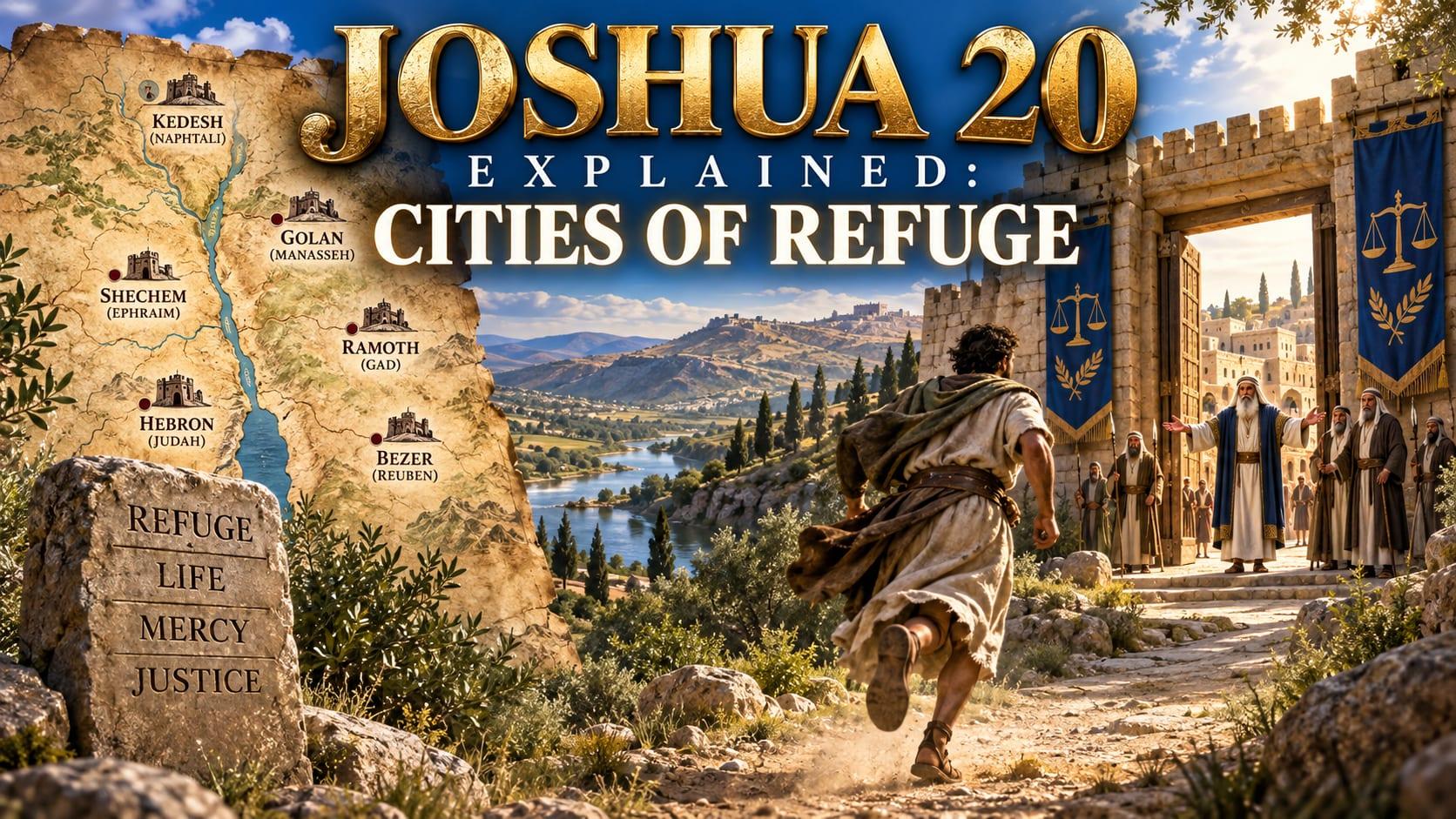
"And they appointed Kedesh in Galilee in mount Naphtali, and Shechem in mount Ephraim, and Kirjatharba, which is Hebron, in the mountain of Judah."
"And on the other side Jordan by Jericho eastward, they assigned Bezer in the wilderness upon the plain out of the tribe of Reuben, and Ramoth in Gilead out of the tribe of Gad, and Golan in Bashan out of the tribe of Manasseh."
📌 Kedesh, Shechem, and Hebron on the west side. Bezer, Ramoth in Gilead, and Golan on the east. Spread north to south on both banks of the Jordan, so that no one in the whole country had to run an impossibly long way to reach one.
Kedesh is not a new name to anyone reading the chapters in order. Joshua 19 had just listed it among Naphtali's fenced cities one chapter earlier, almost in passing. Now it turns out to be one of only six places in the entire land set apart for exactly this purpose.
Hebron carries its own long history. Abraham had bought a burial plot there for his wife generations before any tribe existed, a story told in Genesis 23, and Joshua 15 had already given that same city to Caleb for his own inheritance. A burial ground, a reward for faith, and now a refuge for the unintentional killer, all sitting on the same hillside.
7. A Refuge for the Stranger Too (verse 9)
The chapter closes by widening who the whole system actually covered.
"These were the cities appointed for all the children of Israel, and for the stranger that sojourneth among them, that whosoever killeth any person at unawares might flee thither, and not die by the hand of the avenger of blood, until he stood before the congregation."
📌 These cities were never an Israelite privilege closed to outsiders. A foreigner living among the tribes, with no family line to rely on and no tribal land to retreat to, got the exact same door as a native Israelite. Numbers had already said the same thing plainly.
"These six cities shall be a refuge, both for the children of Israel, and for the stranger, and for the sojourner among them: that every one that killeth any person unawares may flee thither."
In a world where a foreigner usually had the fewest protections of anyone, Israel built one piece of its legal system that treated a stranger's accidental hands exactly the same as a native son's.
Hard Questions Joshua 20 Raises
Did fleeing to a city of refuge prove the slayer was innocent? What the text says: verse 4 has him declare his cause to the elders at the gate, and verse 6 still requires him to stand before the congregation for judgment afterward. How this is read: entry was never a verdict. It was a pause, a safe place to wait while the real hearing was still ahead of him, and the elders could still hand a deliberate murderer over to the avenger of blood if the facts showed intent, exactly as Deuteronomy 19 describes.
Why tie his freedom to one man's death instead of a fixed number of years? The text does not explain the reasoning directly. What is plain is the effect: the slayer could not calculate his own release date, and the whole community's sense of when justice was finally settled was tied to something bigger than his individual case, the end of an entire high priest's service.
What actually happened if he left the city before the high priest died? Numbers 35:26 and 27 answer this directly, outside this chapter. The avenger of blood could kill him there and bear no guilt for it, because the slayer himself had broken the one condition keeping him safe. The refuge protected him only inside its own borders.
Why only six cities for the whole land, instead of a court in every town? The text does not say. What is clear from Numbers 35:14 is the deliberate split, three cities on each side of the Jordan, spaced so that reaching one was realistic from anywhere in Israel's territory, without needing one in every single town.

Top Verses From Joshua 20
1. Joshua 20:3
"That the slayer that killeth any person unawares and unwittingly may flee thither: and they shall be your refuge from the avenger of blood."
The whole chapter in one line: a real escape, built specifically for someone who never meant for any of it to happen.
2. Joshua 20:6
"And he shall dwell in that city, until he stand before the congregation for judgment, and until the death of the high priest that shall be in those days: then shall the slayer return, and come unto his own city, and unto his own house, unto the city from whence he fled."
Freedom tied to a death the slayer never controlled, a shape later writers of Scripture would reach for again when describing a far greater high priest.
3. Joshua 20:7
"And they appointed Kedesh in Galilee in mount Naphtali, and Shechem in mount Ephraim, and Kirjatharba, which is Hebron, in the mountain of Judah."
Three names on the west side of the Jordan, one of them a city whose history stretched all the way back to Abraham, now carrying a brand new purpose.
4. Joshua 20:9
"These were the cities appointed for all the children of Israel, and for the stranger that sojourneth among them, that whosoever killeth any person at unawares might flee thither, and not die by the hand of the avenger of blood, until he stood before the congregation."
The closing verse widens the whole chapter: this protection belonged to the stranger in the land exactly as much as it belonged to Israel's own sons.
Frequently Asked Questions About Joshua 20
What happened in Joshua 20?
Israel finally set up the six cities of refuge God had commanded through Moses years earlier, three cities west of the Jordan and three east of it. Anyone who killed another person by accident could flee to one, state his case at the gate, and be protected there from revenge until a formal hearing, or until the death of the high priest serving at that time.
What does "unawares and unwittingly" mean in Joshua 20:3?
It describes a killing with no plan and no warning behind it, like the axe head example in Deuteronomy 19:5, where the blade simply slips off its handle. Both words rule out intent. They do not describe carelessness being excused, only the complete absence of a plot.
Who was the avenger of blood?
Usually the closest living male relative of the person who had been killed, the one ancient custom expected to settle the death personally. The cities of refuge did not remove his grief or his claim. They stopped him from acting on it before anyone had weighed whether the killing was truly deliberate.
Could a real murderer hide in a city of refuge?
No. Deuteronomy 19:11 and 12 instructs the elders of a murderer's own city to fetch him out of the city of refuge and hand him over to the avenger of blood. These cities protected only the person who killed without hatred and without a plan, never someone who lay in wait for his neighbor.
What happened if the slayer left the city before the high priest died?
Numbers 35:26 and 27 says the avenger of blood could kill him outside the city's border without being guilty of murder. The protection only held as long as the slayer stayed inside the line. Stepping past it, even by his own choice, ended the refuge.
Why did release depend on the death of the high priest?
Joshua 20:6 states it as a fact without explaining the reasoning. What is clear is the effect: the slayer's freedom was never something he could schedule or earn on his own timetable. It arrived attached to something outside his control entirely.
Where were the six cities of refuge located?
Kedesh, Shechem, and Hebron sat west of the Jordan. Bezer, Ramoth in Gilead, and Golan sat east of it. Joshua 20:7 and 8 name all six, spread far enough apart that nowhere in Israel's territory was impossibly distant from one of them.
Were the cities of refuge only for Israelites?
No. Joshua 20:9 names "the stranger that sojourneth among them" alongside the children of Israel as equally protected, matching what Numbers 35:15 had already commanded generations earlier.
How do the cities of refuge relate to Jesus?
Hebrews 6:18 describes believers as people who have "fled for refuge" to the hope found in Christ, using the same picture as a man running for Kedesh or Hebron. Hebrews 7:24 and 25 then notes the difference: unlike the high priests of Joshua's day, Jesus never dies, so the refuge He offers never runs out waiting on anyone's death.
Final Thoughts
Joshua 20 is short, but it builds something most ancient nations never bothered to build.
📌 An accident was never treated the same as a murder. The whole chapter exists to draw that line clearly, with real cities and real elders standing at the gate to judge it.
📌 Protection had a condition attached. The slayer had to stay inside the line he was given. Mercy here was real, but it was not loose.
📌 Freedom waited on someone else's death, not his own effort. That shape, a refuge opened by a high priest's death, is exactly the picture Hebrews later hands to anyone who has fled to Christ.
You are probably not fleeing toward Kedesh or Hebron this week. But you may be carrying guilt for something you never planned, still waiting for somewhere safe to stand while it gets sorted out.
So here is your one next step.
Read Hebrews 6:18 again, slowly, and let "fled for refuge" describe exactly what it is to run to Christ instead of running from Him.