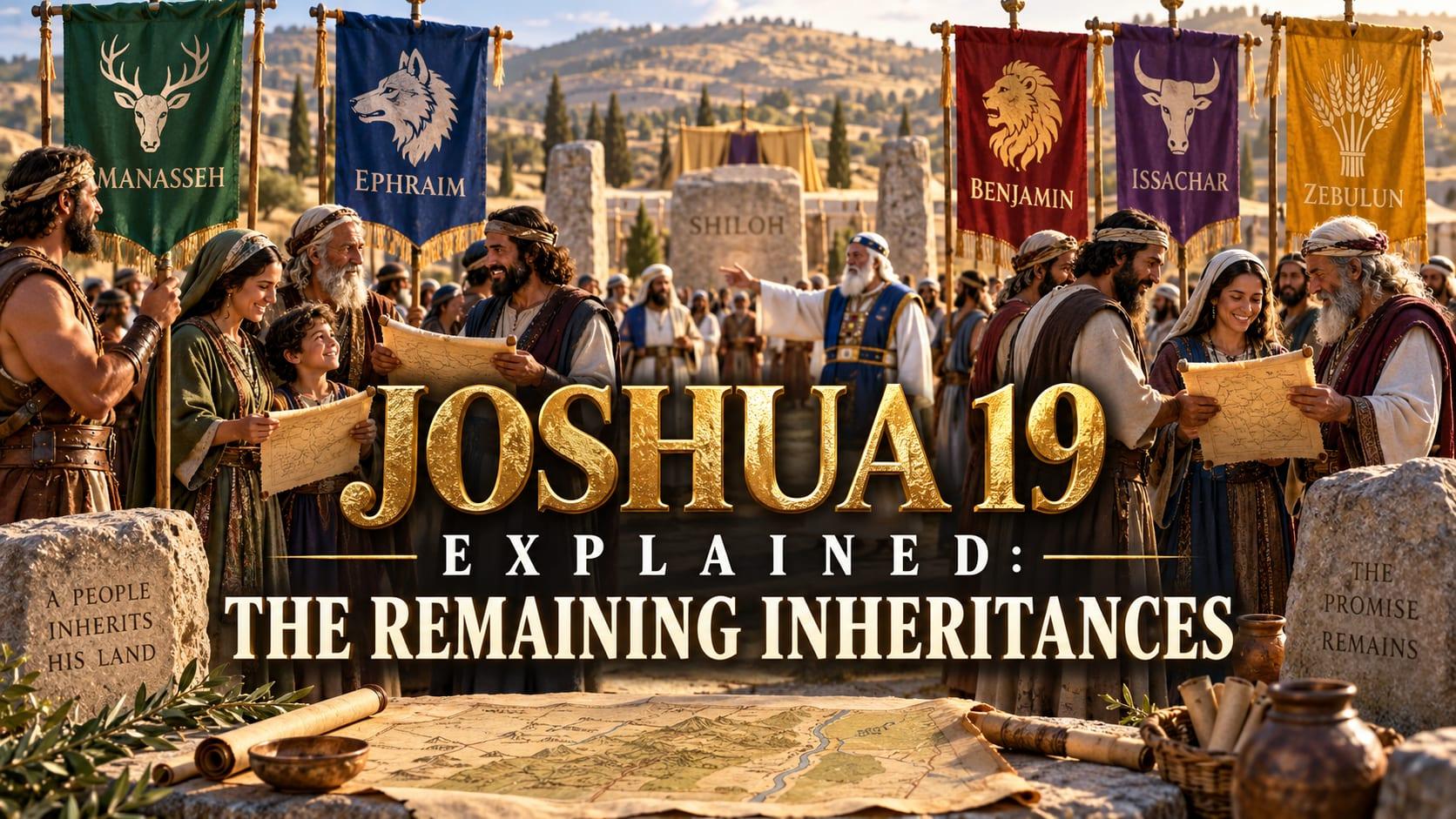
📖 Joshua 19 Explained: Six Tribes and the Last Lot of All
Six tribes get their land in one chapter. One of them gets land inside someone else's. One gets land too small to live on.
Joshua 19 explained is the chapter that finishes the whole land division Joshua started back in chapter thirteen. Simeon, Zebulun, Issachar, Asher, Naphtali, and Dan all receive their inheritance here, one lot after another, and then the chapter ends on the one man who had been dividing out everyone else's ground this entire time finally receiving his own.
Maybe you have watched someone else get served first, over and over, while they kept the smallest portion for themselves until the very end.
- ❓ Why did Simeon not get a separate piece of land like every other tribe?
- ❓ Why does a chapter about a lot already decided end with a tribe going out to conquer more land on its own?
- ❓ Why does a city Naphtali receives here matter again in the very next chapter?
- ❓ Why did Joshua wait until the last page of this long division to ask for anything for himself?
📌 The man who divided the whole land for eleven tribes before his own put himself dead last on the list, and received the smallest kind of reward on it: one city.
This walkthrough moves through the whole chapter in order: Simeon's inheritance swallowed up inside Judah's own territory, Zebulun and Issachar and Asher and Naphtali's borders one after another, Dan's land that turned out to be too small for Dan, and the single city Joshua finally asked for once every other tribe already had theirs.
Fifty one verses, six tribes, and one long overdue reward.
What Happened Just Before This Chapter
Joshua 18 set up the tabernacle at Shiloh, rebuked seven tribes for sitting on land already given to them, and then settled Benjamin's border and cities through a survey and a lot cast before the LORD.
Joshua 19 keeps casting that same set of lots. Benjamin took the first one in chapter eighteen. This chapter works through the second lot all the way to the seventh, finishing every tribe still waiting on ground, and then closes out the entire land division that has run since Joshua 15 gave Judah its enormous territory.

Joshua 19 Explained Verse by Verse
1. Simeon's Inheritance Inside a Brother's Land (verses 1 to 9)
The second lot goes to Simeon, and it looks nothing like the other six lots in this chapter.
"And the second lot came forth to Simeon, even for the tribe of the children of Simeon according to their families: and their inheritance was within the inheritance of the children of Judah."
📌 Every other tribe in this book gets a border of its own. Simeon gets a list of cities sitting entirely inside Judah's territory instead. Thirteen cities, then four more, Beersheba among them, all carved out of ground Joshua 15 already assigned to Judah. The chapter itself says exactly why.
"Out of the portion of the children of Judah was the inheritance of the children of Simeon: for the part of the children of Judah was too much for them: therefore the children of Simeon had their inheritance within the inheritance of them."
That is the stated, practical reason: Judah received more land than it could use, so a slice of it went to Simeon. But Simeon not receiving its own territory also lines up with words spoken over this tribe generations earlier, when a dying Jacob looked back on something his sons Simeon and Levi had done at Shechem after their sister Dinah was wronged, a violent act Genesis 34 records in full.
"Simeon and Levi are brethren; instruments of cruelty are in their habitations. O my soul, come not thou into their secret; unto their assembly, mine honour, be not thou united: for in their anger they slew a man, and in their selfwill they digged down a wall. Cursed be their anger, for it was fierce; and their wrath, for it was cruel: I will divide them in Jacob, and scatter them in Israel."
💡 Jacob did not say Simeon would lose its inheritance. He said Simeon would be scattered, not gathered into one solid block of its own. A tribe with its cities planted inside another tribe's territory, with no single connected border of its own, is exactly what scattered looks like on a map. Genesis 49 is read as that old word reaching the ground, centuries after it was spoken.
2. Zebulun's Border Reaches the Sea (verses 10 to 16)
The third lot goes to Zebulun, and this one reads like every other normal tribal border in the book.
"And the third lot came up for the children of Zebulun according to their families: and the border of their inheritance was unto Sarid:"
"And their border went up toward the sea, and Maralah, and reached to Dabbasheth, and reached to the river that is before Jokneam;"
💡 Zebulun's line climbs from Sarid in the center of the territory and stretches toward the Mediterranean on one side, with the rest of the border looping east and north through named towns before closing. Jacob had also spoken over this son, long before any of these towns had an Israelite living in them:
"Zebulun shall dwell at the haven of the sea; and he shall be for an haven of ships; and his border shall be unto Zidon."
The twelve cities listed at the end of this section sit in the lower Galilee, a fertile strip of hill and valley that would, centuries later, hold the town of Nazareth and the shore towns where Jesus would call His first disciples. None of that is in this chapter. The chapter only records a border. What that border quietly becomes, later, is its own story.

3. Issachar, Pressed Between Bigger Neighbors (verses 17 to 23)
The fourth lot goes to Issachar, and the list of towns runs straight through the Jezreel valley.
"And the fourth lot came out to Issachar, for the children of Issachar according to their families."
"And their border was toward Jezreel, and Chesulloth, and Shunem,"
"And the coast reacheth to Tabor, and Shahazimah, and Bethshemesh; and the outgoings of their border were at Jordan: sixteen cities with their villages."
⚠️ Sixteen cities, bounded by Zebulun to the north and Manasseh to the south, in some of the richest farmland in the whole country. Jacob's blessing over Issachar, like the one over Zebulun, had already named this long before the lot was cast.
"Issachar is a strong ass couching down between two burdens: And he saw that rest was good, and the land that it was pleasant; and bowed his shoulder to bear, and became a servant unto tribute."
Good land that attracted stronger neighbors on every side is exactly the kind of place that ends up paying tribute to someone, whether a local king or a passing army. Joshua 19 does not say Issachar ever actually paid tribute to anyone. It only records the borders of the land Jacob's words had already described as pleasant enough to make a man bow his shoulder and settle for it.
4. Asher's Border Reaches Toward Tyre and Zidon (verses 24 to 31)
The fifth lot goes to Asher, and this border runs further north than any other tribe's land in the whole book.
"And the fifth lot came out for the tribe of the children of Asher according to their families."
"And Hebron, and Rehob, and Hammon, and Kanah, even unto great Zidon;"
"And then the coast turneth to Ramah, and to the strong city Tyre; and the coast turneth to Hosah; and the outgoings thereof are at the sea from the coast to Achzib:"
📌 Asher's own border is drawn right up against two cities that tribe would never actually hold. Zidon and Tyre were major Phoenician port cities, wealthy and fortified, and being named as a border marker is a very different thing from being conquered. The lot describes where Asher's land was supposed to reach. It does not claim Asher ever took Zidon or Tyre themselves, and nothing later in Scripture says Asher ever did.
5. Naphtali's Fenced Cities, Including One You Will See Again (verses 32 to 39)
The sixth lot goes to Naphtali, bordering Asher on the west and reaching the Jordan on the east.
"The sixth lot came out to the children of Naphtali, even for the children of Naphtali according to their families."
"And the fenced cities are Ziddim, Zer, and Hammath, Rakkath, and Chinnereth,"
"And Kedesh, and Edrei, and Enhazor,"
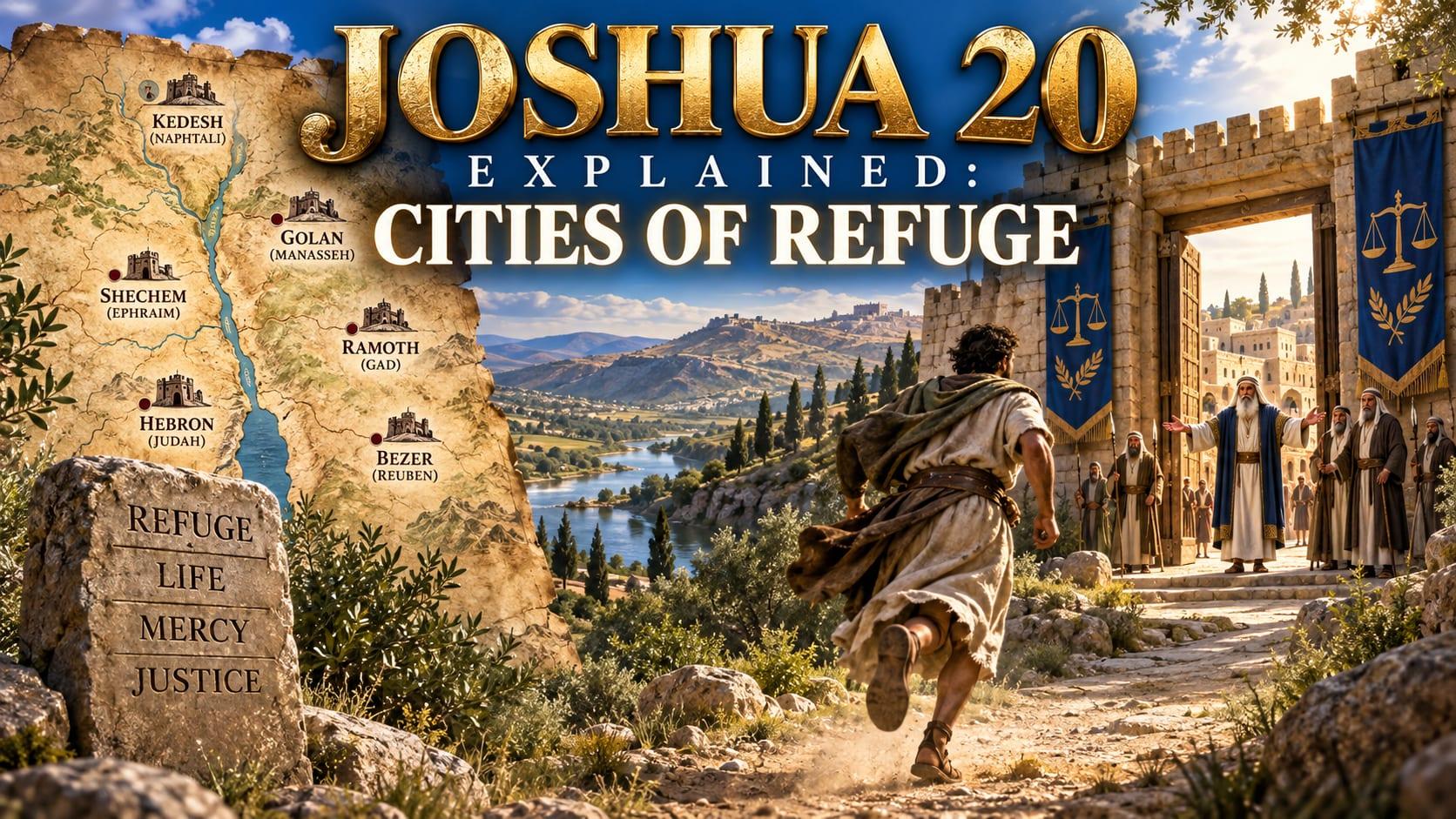
💡 Kedesh is easy to read past in a list of nineteen city names, but hold onto it. The very next chapter names this same Kedesh in Naphtali as one of the cities of refuge, a place set apart so someone who killed another person by accident could flee there and be safe from revenge until a fair hearing could happen. Joshua 19 hands Naphtali a city. Joshua 20 reveals what that city was about to become for the whole nation.
Chinnereth also deserves a second look. That name belongs to the body of water better known later as the Sea of Galilee, the same water Jesus would walk on and calm with a word, named here for the first time in the Bible as a city on its shore.

6. Dan's Land Was Too Small, So Dan Went and Took More (verses 40 to 48)
The seventh and final tribal lot goes to Dan, and this is the one tribe in the chapter whose story does not end where its border does.
"And the seventh lot came out for the tribe of the children of Dan according to their families."
"And the coast of their inheritance was Zorah, and Eshtaol, and Irshemesh,"
"And the coast of the children of Dan went out too little for them: therefore the children of Dan went up to fight against Leshem, and took it, and smote it with the edge of the sword, and possessed it, and dwelt therein, and called Leshem, Dan, after the name of Dan their father."
⚠️ Dan is the only tribe in this chapter whose lot was not the end of the story. Its assigned coast, squeezed near Ephraim and the Philistine cities on the coastal plain, was not enough room for the tribe to actually live in. So Dan marched north, far outside the territory this very lot had just given it, conquered a city called Leshem, and renamed it after their own father. This is the same event Judges 18 tells again in far more detail, under the city's other name, Laish, two accounts of one migration recorded at two different points in Israel's history.
📌 That renamed city is the reason the phrase "from Dan to Beersheba" shows up again and again later in the Old Testament, meaning the whole land, north to south. Dan sits at the northern end, Beersheba, one of Simeon's cities from earlier in this very chapter, sits near the southern end. The whole expression traces back to two place names this one chapter already put on the record.
7. The Last Lot of All Goes to Joshua Himself (verses 49 to 51)
With all twelve tribes finally settled, the chapter turns to the one man who had been dividing everyone else's ground this whole time.
"When they had made an end of dividing the land for inheritance by their coasts, the children of Israel gave an inheritance to Joshua the son of Nun among them:"
"According to the word of the LORD they gave him the city which he asked, even Timnathserah in mount Ephraim: and he built the city, and dwelt therein."
📌 Joshua does not take first pick. He asks last, after twelve tribes and six separate lots are already finished, and he receives one city. Caleb, his fellow spy from decades earlier, had already received his own request for Hebron and its surrounding hill country back in Joshua 15. Joshua asked for nothing of that size. One city in the hill country of his own tribe of Ephraim, built by his own hand once he received it, was enough.
"These are the inheritances, which Eleazar the priest, and Joshua the son of Nun, and the heads of the fathers of the tribes of the children of Israel, divided for an inheritance by lot in Shiloh before the LORD, at the door of the tabernacle of the congregation. So they made an end of dividing the country."
That one closing sentence ends a process that started seven chapters earlier. Every lot, every border, every list of cities since Joshua 15 opened with Judah's territory finally lands in this single verse. The land is no longer merely conquered. It is divided, named, and recorded.

Hard Questions Joshua 19 Raises
Why did Simeon not receive a separate territory of its own like every other tribe in this chapter? What the text says: verse 1 states plainly that Simeon's inheritance was within Judah's own territory, and verse 9 explains the practical reason, Judah's portion was too large for Judah to use. How this is read: the arrangement also lines up with Genesis 49:5 through 7, where Jacob said Simeon, alongside Levi, would be divided and scattered because of violence done at Shechem. The text does not force that connection, but the two accounts fit together without strain, a practical land surplus and an old word about scattering landing on the same tribe.
Does Dan conquering Leshem in verse 47, outside the border the lot had just set in verse 41, undercut the lot system this whole section of the book relies on? What the text says: verses 40 and 41 record Dan's assigned coast near Zorah and Eshtaol, and verse 47 says that coast "went out too little for them," so Dan fought for and took a city further north. How this fits: the lot decided what land belonged to Dan by right. It did not promise that land would be enough to live on, and it did not forbid a tribe from taking more ground beyond its assigned border through its own conquest. Judah and the house of Joseph had already expanded their own holdings this same way in earlier chapters.
Is the account of Dan taking Leshem in Joshua 19:47 the same event Judges 18 describes in much greater detail, under the name Laish? What the text says: Joshua 19:47 gives one verse, naming the city Leshem and recording that Dan renamed it after their own tribal father. Judges 18 tells a longer story of five Danite spies scouting a city called Laish and the tribe later attacking it. How this is read: both accounts describe the same migration and the same renamed city, Leshem and Laish being two names for one place. Judges 18 simply tells with more detail a move that Joshua 19 had already recorded in brief.
Why does Joshua wait until every other tribe has land before asking for his own, instead of claiming a portion earlier the way Caleb did? What the text says: verse 49 places Joshua receiving his inheritance only after "they had made an end of dividing the land," the very last transaction recorded in the whole section. How this is read: nothing in the text explains Joshua's motive directly. What is plain is the order itself, every tribe served before the man doing the serving asked for anything of his own.
Top Verses From Joshua 19
1. Joshua 19:9
"Out of the portion of the children of Judah was the inheritance of the children of Simeon: for the part of the children of Judah was too much for them: therefore the children of Simeon had their inheritance within the inheritance of them."
The only tribe in the chapter with no border of its own, settled inside a brother's surplus instead, in a way an old deathbed word had already described.
2. Joshua 19:47
"And the coast of the children of Dan went out too little for them: therefore the children of Dan went up to fight against Leshem, and took it, and smote it with the edge of the sword, and possessed it, and dwelt therein, and called Leshem, Dan, after the name of Dan their father."
A lot that was not enough, answered by a tribe that went and took more rather than staying inside too small a line.
3. Joshua 19:50
"According to the word of the LORD they gave him the city which he asked, even Timnathserah in mount Ephraim: and he built the city, and dwelt therein."
One city, asked for last, after everyone else already had theirs. The man who divided the whole country kept the smallest share for himself.
4. Joshua 19:51
"These are the inheritances, which Eleazar the priest, and Joshua the son of Nun, and the heads of the fathers of the tribes of the children of Israel, divided for an inheritance by lot in Shiloh before the LORD, at the door of the tabernacle of the congregation. So they made an end of dividing the country."
The single sentence that closes an entire section of the book. Seven chapters of borders and lists end here, in a tent at Shiloh, before the LORD.
Frequently Asked Questions About Joshua 19
What happened in Joshua 19?
Six remaining tribes received their land by lot: Simeon within Judah's own territory, then Zebulun, Issachar, Asher, Naphtali, and Dan each with their own border and cities. Dan's land was too small, so that tribe conquered the city of Leshem and renamed it Dan. The chapter closes with Joshua receiving his own city, Timnathserah, and a final statement that the whole land division was complete.
Why did Simeon not get its own tribal territory?
Joshua 19:9 says Judah received more land than it needed, so a portion of cities within Judah's borders went to Simeon instead of a separate region. This also fits Genesis 49:5 through 7, where Jacob said Simeon and Levi would be scattered rather than settled together because of violence they had done years earlier.
Why did Dan have to conquer more land after already receiving a lot?
Joshua 19:47 says Dan's assigned coast was too small for the tribe to actually live in. Rather than stay confined to it, Dan marched north, fought for a city called Leshem, took it, and renamed it Dan after their own tribal father.
Is Leshem the same city as Laish in Judges 18?
Yes. Joshua 19:47 names the city Leshem in a single verse. Judges 18 tells the same conquest in much greater detail, calling the city Laish before Dan renamed it, including the story of the five spies who scouted it first.
Why does the phrase "from Dan to Beersheba" describe the whole land of Israel?
Dan, renamed in Joshua 19:47, sits at the northern edge of the land. Beersheba, one of Simeon's cities listed in Joshua 19:2, sits near the southern edge. Together the two names became shorthand later in the Old Testament for the full length of Israelite territory.
What city did Joshua receive, and where was it?
Joshua 19:50 names the city Timnathserah, located in the hill country of Ephraim, Joshua's own tribe. He asked for it only after every other tribe had already received its inheritance, and he built the city himself once it was given to him.
Why does Kedesh matter in Joshua 19:37?
Kedesh is listed here as one of Naphtali's fenced cities. The very next chapter, Joshua 20, names this same Kedesh as one of the cities of refuge, a place where someone who killed another person accidentally could flee for safety until a fair hearing could take place.
Did Asher ever actually control Tyre and Zidon?
Joshua 19:28 and 29 name Zidon and Tyre only as border markers for where Asher's territory was meant to reach, not as cities the tribe conquered. Both were major, well defended Phoenician cities, and nothing in Joshua 19 claims Asher ever took them.
How many tribes receive land in Joshua 19?
Six: Simeon, Zebulun, Issachar, Asher, Naphtali, and Dan, covering the second through seventh lots. The first lot, Benjamin's, was already recorded in Joshua 18.
What does Joshua 19:51 mean by "made an end of dividing the country"?
It is the formal closing statement for the entire land division that began in Joshua 13, confirming that Eleazar the priest, Joshua, and the tribal leaders had finished casting every lot at Shiloh before the LORD, and that no tribe was left waiting on an inheritance.
Final Thoughts
Joshua 19 moves fast through six very different inheritances, but three things are worth carrying out of it.
📌 Not every inheritance looks like everyone else's, and that does not make it smaller. Simeon received cities inside a brother's land instead of a border of its own, yet it still received exactly what verse 9 says it was owed.
📌 A lot that is too small is not the end of the story. Dan did not sit inside a cramped coast complaining. It went north and took a city, then built an identity around the name it gave that city, one that still marks a map reference centuries later.
📌 The one who serves everyone else can still ask, but he asks last. Joshua divided eleven other inheritances before his own, and even then requested only a single city.
You are probably not casting lots at Shiloh this week. But you likely know what it is to watch everyone else get served while you wait at the end of the line.
So here is the one thing this chapter actually asks of you.
Keep serving before you ask, the way Joshua did, and trust that what is genuinely yours will still be there once everyone else has theirs.