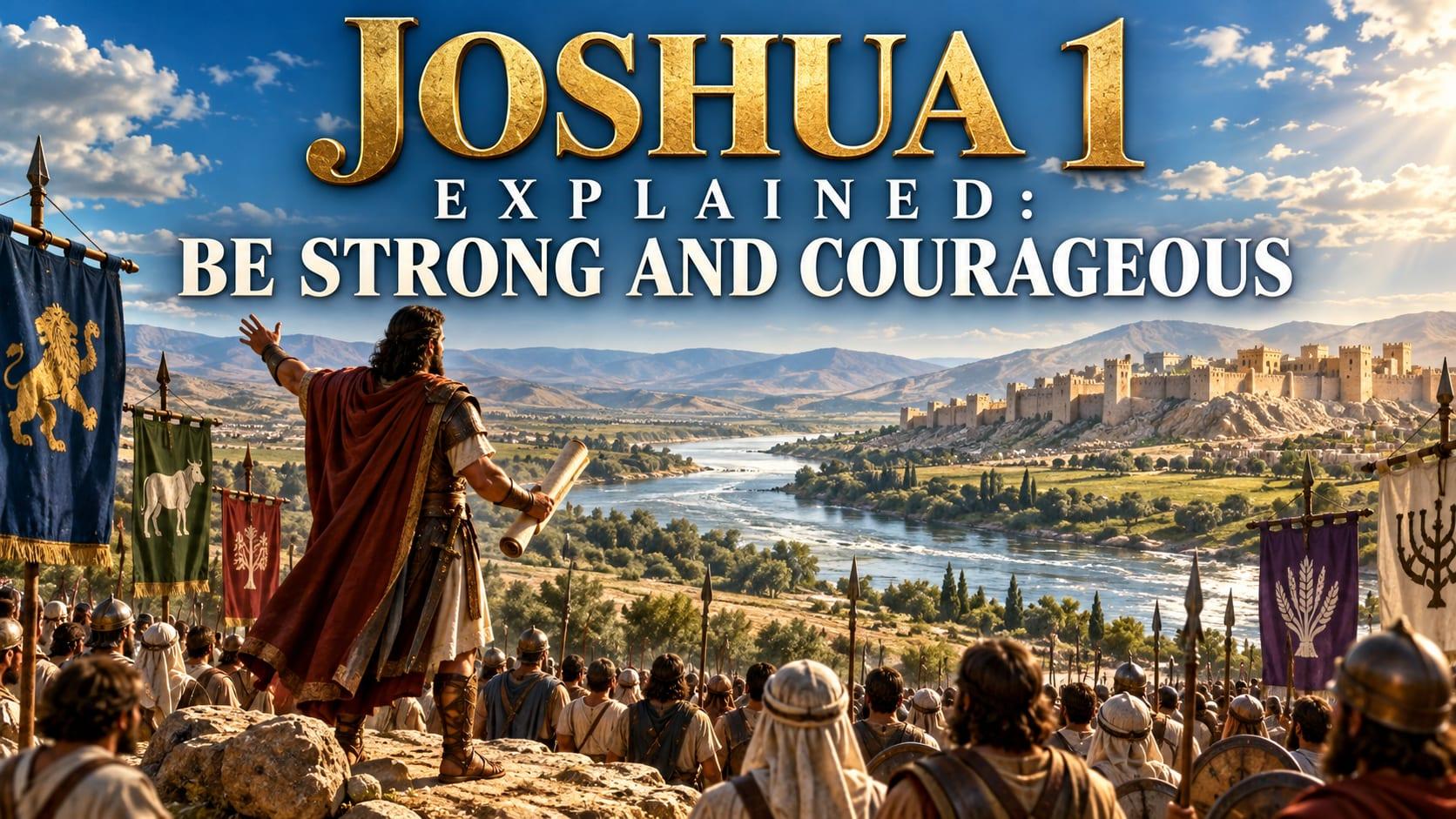
📖 Joshua 1 Explained: Be Strong and of a Good Courage
One leader is gone. A whole nation is waiting to see what the new one does first.
Joshua 1 explained is the first chapter of a brand new book, and it opens with the hardest possible moment to start one. Moses, the only leader Israel has ever known, is dead. The man who stepped out of the sea with them, who argued with God on their behalf more than once, who climbed a mountain and came back with the law written in stone, will never speak to this nation again.
Maybe you have stood where Joshua stood.
- ❓ Taking over something someone else built, with everyone watching to see if you can hold it.
- ❓ Told to be brave by people who have no idea how unqualified you feel.
- ❓ Carrying a promise that is bigger than anything you have actually seen happen yet.
📌 God does not wait for Israel to mourn before He speaks to Joshua. He speaks while the grief is still fresh, and the first thing out of His mouth is a job, not a eulogy.
This walkthrough goes through the whole chapter: God's charge to Joshua, the promise He repeats about the land, the command to be strong and courageous that shows up four times in eighteen verses, and the moment the entire nation answers back.
This is the chapter every new leader needs, whether or not you ever lead a nation anywhere.
What Happened Just Before This Chapter
Deuteronomy 34 ended with Moses climbing Mount Nebo, seeing the whole promised land laid out in front of him, and dying there without ever crossing the river. God buried him in a grave no one has ever found, Israel wept for thirty days, and the Torah closed by saying no prophet since had matched him.
None of that was a surprise by the time it happened. Back in Numbers 27, God had already told Moses to lay his hands on Joshua and give him a public charge in front of Eleazar the priest and the whole congregation. Moses did exactly that, and did it again later, charging Joshua directly in Deuteronomy 31. The succession was never in doubt. What was still missing was the moment God Himself would speak to Joshua the way He used to speak to Moses. Joshua 1 is that moment.

Joshua 1 Explained Verse by Verse
1. Moses Is Dead. God Speaks Anyway (verses 1 to 5)
The book opens on the same sentence that closed the last one.
"Now after the death of Moses the servant of the LORD it came to pass, that the LORD spake unto Joshua the son of Nun, Moses' minister, saying,"
📌 Notice what Joshua is called here. Not general, not successor, not even leader. "Moses' minister." That is the only title this chapter gives him before God starts talking, and it is a title that describes who Joshua served, not what he is about to become. Everything that follows in this chapter is God upgrading that title Himself, in real time.
God does not open with comfort. He opens with a command.
"Moses my servant is dead; now therefore arise, go over this Jordan, thou, and all this people, unto the land which I do give to them, even to the children of Israel."
💡 Two short facts, side by side, with nothing softening the gap between them. Moses is dead. Arise. There is no instruction here to grieve longer, to wait for a clearer sign, or to call a council first. The nation has already spent thirty days mourning. Now there is a river to cross.
Then God restates the same promise He gave Moses, almost word for word.
"Every place that the sole of your foot shall tread upon, that have I given unto you, as I said unto Moses. From the wilderness and this Lebanon even unto the great river, the river Euphrates, all the land of the Hittites, and unto the great sea toward the going down of the sun, shall be your coast."
That same boundary line, from the wilderness and Lebanon to the Euphrates, had already been spoken once before, in Deuteronomy 11. God is not handing Joshua a smaller promise than He gave Moses. He is handing him the exact same one, unedited, and telling him to go take it.
The promise closes with the line Joshua will need most in the chapters ahead.
"There shall not any man be able to stand before thee all the days of thy life: as I was with Moses, so I will be with thee: I will not fail thee, nor forsake thee."
📌 "As I was with Moses, so I will be with thee" is the whole hinge of this book in one sentence. Joshua is not being told he has Moses' authority. He is being told he has Moses' God, and that is the only part of the job that was ever going to matter.
2. Be Strong and of a Good Courage, One More Time (verses 6 to 9)
What comes next is not a new phrase for Joshua. It is already the third time he has personally been told this.
"Be strong and of a good courage: for unto this people shalt thou divide for an inheritance the land, which I sware unto their fathers to give them."
Moses said these same words to Joshua once already, publicly, and God repeated them to him again shortly after.
"And Moses called unto Joshua, and said unto him in the sight of all Israel, Be strong and of a good courage: for thou must go with this people unto the land which the LORD hath sworn unto their fathers to give them; and thou shalt cause them to inherit it."
💡 Counted across Joshua 1 alone, the words "strong" and "courage" or "courageous" each show up four separate times in eighteen verses, from God in verses 6, 7, and 9, and again from the people themselves in verse 18. This is not a single pep talk. It is the one instruction everyone around Joshua keeps repeating, from three different mouths, before he has taken a single step toward the river.
The second time God says it, He ties the courage directly to something specific.
"Only be thou strong and very courageous, that thou mayest observe to do according to all the law, which Moses my servant commanded thee: turn not from it to the right hand or to the left, that thou mayest prosper whithersoever thou goest."
"This book of the law shall not depart out of thy mouth; but thou shalt meditate therein day and night, that thou mayest observe to do according to all that is written therein: for then thou shalt make thy way prosperous, and then thou shalt have good success."
📌 The courage God is asking for is not courage to fight. It is courage to stay inside the law when it would be easier to improvise. Joshua is about to face walled cities, kings, and armies, and the very first thing God links his success to is not a battle plan. It is whether the book of the law stays in his mouth.
God says it a third time in this chapter alone, and this time pairs it with the opposite of fear.
"Have not I commanded thee? Be strong and of a good courage; be not afraid, neither be thou dismayed: for the LORD thy God is with thee whithersoever thou goest."
⚠️ Scripture never says outright that Joshua was afraid, so reading this as proof of fear goes further than the text does. What the repetition does show plainly is that the size of the task in front of Joshua was real enough that God addressed it three separate times in this one conversation, before Joshua had taken a single step toward the river. Courage commanded this many times is not an insult to the person receiving it. It is a leader being told, as clearly as language allows, exactly what the job will cost him.

3. Joshua Gives His First Order (verses 10 and 11)
God stops speaking, and Joshua moves immediately. No pause, no gathering of elders to confirm what he just heard.
"Then Joshua commanded the officers of the people, saying, Pass through the host, and command the people, saying, Prepare you victuals; for within three days ye shall pass over this Jordan, to go in to possess the land, which the LORD your God giveth you to possess it."
💡 This is the first command Joshua gives as Israel's leader, and it is almost entirely practical. Pack food. Three days. That is it. No speech about his own qualifications, no restating of the promise God just gave him. Joshua takes the word he was given and turns it straight into logistics.
📌 The man who just heard "be strong and of a good courage" three times answers it by telling people to pack food, not by making a speech about himself. Whatever courage looked like in Joshua, it looked like work first.
4. The Promise Two and a Half Tribes Already Made (verses 12 to 15)
Joshua's next move is narrower. He turns to three specific tribes who already have land of their own, on the wrong side of the river for what is coming.
"And to the Reubenites, and to the Gadites, and to half the tribe of Manasseh, spake Joshua, saying, Remember the word which Moses the servant of the LORD commanded you, saying, The LORD your God hath given you rest, and hath given you this land."
Reuben, Gad, and half of Manasseh had already settled east of the Jordan, and the deal that let them do it was struck years earlier in Numbers 32.
"And will go all of you armed over Jordan before the LORD, until he hath driven out his enemies from before him, And the land be subdued before the LORD: then afterward ye shall return, and be guiltless before the LORD, and before Israel; and this land shall be your possession before the LORD."
📌 Joshua is not inventing a new obligation here. He is collecting on a promise Moses already negotiated, word for word, years before this chapter. These two and a half tribes already have their land and their rest. What they still owe is their presence in every fight still ahead for everyone else.
"Your wives, your little ones, and your cattle, shall remain in the land which Moses gave you on this side Jordan; but ye shall pass before your brethren armed, all the mighty men of valour, and help them; Until the LORD have given your brethren rest, as he hath given you, and they also have possessed the land which the LORD your God giveth them: then ye shall return unto the land of your possession, and enjoy it, which Moses the LORD's servant gave you on this side Jordan toward the sunrising."
💡 The families and livestock stay put. Only the fighting men cross. This is not these tribes abandoning their own land to help someone else. It is a nation treating a promise made years earlier as something still binding, even now that the man who brokered it is gone.

5. "All That Thou Commandest Us We Will Do" (verses 16 to 18)
The chapter ends with the one thing that could have gone very differently. The answer.
"And they answered Joshua, saying, All that thou commandest us we will do, and whithersoever thou sendest us, we will go."
"According as we hearkened unto Moses in all things, so will we hearken unto thee: only the LORD thy God be with thee, as he was with Moses."
📌 Israel does not promise Joshua blind loyalty. They promise him the same kind of obedience they gave Moses, and then immediately pray for the one thing that made Moses worth obeying. Their confidence in Joshua is tied to God's presence with him, not to Joshua's own resume. Then comes the line that is easy to read past too fast.
"Whosoever he be that doth rebel against thy commandment, and will not hearken unto thy words in all that thou commandest him, he shall be put to death: only be strong and of a good courage."
⚠️ That is the people speaking, not God, and it is their own vow of loyalty rather than a law God handed down for Joshua to enforce. However it sounds today, in context it mirrors the kind of binding, high stakes loyalty oath that ancient covenant language often used, the same seriousness Israel had already shown by swearing full obedience to Moses. The chapter does not record Joshua ever invoking it against anyone. What it does record is a nation choosing, on its own, to treat obeying its new leader as a matter this serious, right as they repeat the same command Joshua has now heard four times: be strong and of a good courage.
Hard Questions Joshua 1 Raises
Does God commanding courage four times mean Joshua was secretly terrified? What the text says: God and Moses together tell Joshua to be strong and courageous four times across this chapter and the one before it, and the text never once states that Joshua felt fear. What is reasoned rather than stated: a command repeated this many times, to a man about to lead an invasion with no living precedent to copy, says more about the size of the task than about Joshua's private emotions. Courage commanded is not evidence of courage missing. It can just as easily be preparation for a fight everyone already knows will be hard.
Was the death penalty in verse 18 a real law Joshua could enforce, or something else? What the text says: the people themselves say it, as part of their own pledge of obedience, not as a command God gives Joshua to carry out. How it has been understood: this reads as covenant language, the kind of serious, binding self oath ancient treaties used to express total loyalty, similar in weight to Israel's earlier promise to obey Moses "in all things." Nothing later in Joshua shows this verse being used as an actual legal sentence against a rebellious Israelite.
Why does God repeat a boundary reaching the Euphrates when Israel never controlled all of it? What the text says: Joshua 1:4 restates the same far boundary, from Lebanon to the Euphrates, already given earlier in Deuteronomy 11. What history shows: Israel under Joshua settled a much smaller territory than this outer boundary describes. Most Bible teachers point to the reign of Solomon, generations later, as the closest the nation ever came to that full extent, and read the wider promise as describing the land's maximum potential rather than a guarantee every generation would occupy every mile of it at once.

Top Verses From Joshua 1
1. Joshua 1:5
"There shall not any man be able to stand before thee all the days of thy life: as I was with Moses, so I will be with thee: I will not fail thee, nor forsake thee."
The verse the whole chapter turns on. Joshua's qualification was never his own strength. It was the same presence that had carried Moses, now promised to him by name.
2. Joshua 1:8
"This book of the law shall not depart out of thy mouth; but thou shalt meditate therein day and night, that thou mayest observe to do according to all that is written therein: for then thou shalt make thy way prosperous, and then thou shalt have good success."
Success for Israel's new general is tied to a book, not a battle plan. Constant meditation on the law comes before any mention of strategy or strength.
3. Joshua 1:9
"Have not I commanded thee? Be strong and of a good courage; be not afraid, neither be thou dismayed: for the LORD thy God is with thee whithersoever thou goest."
The fourth time this exact charge reaches Joshua, now paired directly with the reason it is even possible: God's presence everywhere he goes next.
4. Joshua 1:16
"And they answered Joshua, saying, All that thou commandest us we will do, and whithersoever thou sendest us, we will go."
A whole nation, freshly grieving its only leader, hands its full obedience to an untested successor without a single recorded objection.
5. Joshua 1:2
"Moses my servant is dead; now therefore arise, go over this Jordan, thou, and all this people, unto the land which I do give to them, even to the children of Israel."
The two facts the whole book of Joshua stands on, stated back to back with no transition. Grief is real, and the river still has to be crossed.
Frequently Asked Questions About Joshua 1
What does Joshua 1 mean?
Joshua 1 records God commissioning Joshua directly after Moses's death, repeating the promise of the land, commanding him four times to be strong and courageous, and ending with Israel vowing full obedience to its new leader. It is the hinge between the wilderness generation and the conquest of Canaan.
Why did God say "be strong and of a good courage" so many times?
Counting Joshua 1 together with Moses' earlier charges in Deuteronomy 31, Joshua hears that exact command four separate times before he ever crosses the Jordan. The repetition matches the weight of the task in front of him, leading a nation into territory none of them had ever taken by force before.
Why is Joshua called "Moses' minister" at the start of the chapter?
It describes the only role Joshua had held up to that point, serving directly under Moses. The rest of the chapter is God replacing that title with a new one, giving Joshua the same promise of presence Moses had carried for forty years.
What was the three day deadline in verse 11 about?
Joshua's first order as leader told the people to prepare food because they would cross the Jordan within three days. It was a practical command, not a prophecy, setting the whole nation in motion the same day Joshua received his charge from God.
Who were the Reubenites, Gadites, and half tribe of Manasseh in Joshua 1?
They were the two and a half tribes who had already received land east of the Jordan, under an agreement from Numbers 32 that required their fighting men to cross and help the rest of Israel before returning home. Joshua 1:12 to 15 is Joshua holding them to that earlier promise.
Does Joshua 1:18 mean Joshua could have people executed for disobeying him?
The verse is the people's own pledge of loyalty, not a law God commanded Joshua to enforce. It reads as covenant style language expressing total commitment, similar in weight to Israel's earlier vow to obey Moses in everything, and nothing later in the book shows it being carried out as an actual legal sentence.
Why does Joshua 1 repeat the same land boundaries from Deuteronomy?
God restates the exact boundary He had already given earlier, from Lebanon to the Euphrates, to make clear Joshua inherits the full promise, not a reduced version of it. Israel never occupied every mile of that boundary under Joshua, with most teachers pointing to Solomon's reign generations later as the closest the nation came.
Is Joshua 1 only about military leadership?
No. The chapter ties Joshua's success directly to the book of the law staying in his mouth day and night, before it ever mentions strategy or strength. The central qualification for the conquest ahead is obedience to what was already written, not battlefield skill.
How does Joshua 1 connect to the rest of the book?
Every piece set up here, Joshua's commission, the three day deadline, the eastern tribes' promise, and Israel's vow of obedience, plays out directly in the chapters that follow, starting with the spies Joshua sends into Jericho in the very next chapter.
Final Thoughts
Joshua 1 is short, and it covers one of the hardest transitions in the whole Bible without wasting a verse on self pity.
📌 Grief and the next step are not opposites. God spoke to Joshua, and Joshua gave his first order, while the thirty days of mourning for Moses were barely over.
📌 Courage, in this chapter, is not a feeling. It is obedience to a book. Every promise of strength and success ties straight back to the law staying in Joshua's mouth, not to his own confidence.
📌 A promise made years earlier still held. The eastern tribes' deal with Moses in Numbers 32 did not expire when Moses did. Joshua collected on it the same day he took charge.
You may never lead a nation across a river. You will almost certainly step into something someone else built, feeling less ready for it than everyone around you assumes.
So here is your one next step.
Read Joshua 1:9 slowly today, and notice that the command to be strong comes with a reason attached, not alone.