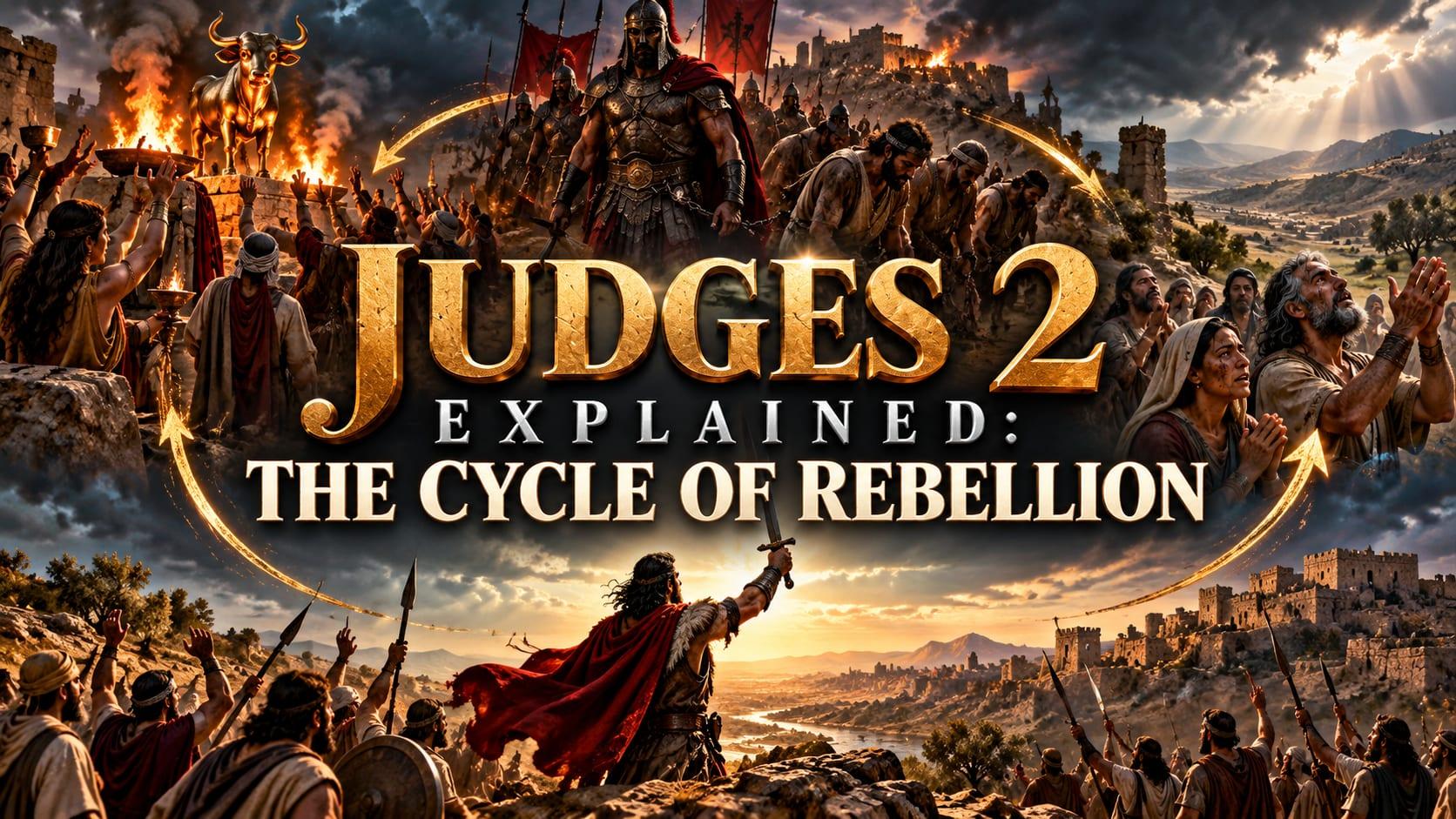
📖 Judges 2 Explained: The Generation That Knew Not the LORD
A messenger shows up with a question nobody wants to answer, and a whole nation starts crying at a place that gets a new name because of it.
Judges 2 explained is the chapter that stops telling you what happened tribe by tribe and starts telling you why. It repeats Joshua's death, almost word for word from the book before it, then uses that repeat as a hinge to swing the whole story in a new direction. One generation served the LORD. The next one did not even know Him. And in between those two sentences sits the pattern that runs the entire book of Judges.
Maybe you have watched something your parents built carefully just quietly stop mattering to the next generation.
- ❓ Why does the chapter repeat Joshua's death after Joshua 24 already reported it?
- ❓ Who is the angel of the LORD speaking at Bochim, and why does he talk like God Himself?
- ❓ What does it actually mean that a generation "knew not the LORD"?
- ❓ Why would God leave enemies in the land on purpose?
📌 Judges 2 is the only chapter in this book that steps outside the stories to explain the shape every story after it will take.
This walkthrough moves through the whole chapter in order: the rebuke at Bochim, the second report of Joshua's death and why it is told again, the generation that grew up a stranger to everything its parents had seen, the cycle of sin, judgment, deliverance, and relapse named for the first time, and the hard reason God gives for leaving the nations in the land at all.
Twenty three verses, and the key to reading every chapter still ahead of you in this book.
What Happened Just Before This Chapter
Judges 1 read like a tribe by tribe report card. Judah and Simeon won real victories. Adonibezek was captured and punished the same way he had once punished others. Achsah asked her father for springs of water and got them. Then the chapter spent its last ten verses listing tribe after tribe, Benjamin, Manasseh, Ephraim, Zebulun, Asher, Naphtali, and Dan, that each left Canaanites living inside their own borders instead of driving them out completely.
Judges 2 does not add a new tribe or a new battle to that list. It stops the list entirely and asks a harder question: now that the land is only partly cleared, what happens next? The answer starts with a messenger showing up at a place that is about to get a new name.

Judges 2 Explained Verse by Verse
1. The Angel's Rebuke at Bochim (verses 1 to 5)
The chapter opens with a figure who has not shown up by this title since early in the conquest.
"And an angel of the LORD came up from Gilgal to Bochim, and said, I made you to go up out of Egypt, and have brought you unto the land which I sware unto your fathers; and I said, I will never break my covenant with you."
⚠️ Notice the pronoun doing the talking. "I made you to go up." "I sware unto your fathers." This messenger speaks in the first person as God Himself, the same pattern readers of the burning bush in Exodus 3 have already seen once. Scripture never fully explains how a created angel can speak this directly for God. Christian teachers have long debated whether this particular figure is a created messenger delivering God's exact words, or God Himself appearing in a form His people could stand to see. The text itself leaves the question open and focuses instead on what gets said.
Gilgal was where Israel first camped after crossing the Jordan. The journey from there to wherever this meeting happens matters, because of what the meeting does to the place.
"And ye shall make no league with the inhabitants of this land; ye shall throw down their altars: but ye have not obeyed my voice: why have ye done this?"
"Wherefore I also said, I will not drive them out from before you; but they shall be as thorns in your sides, and their gods shall be a snare unto you."
📌 This is not a new threat. It is the same warning Joshua already gave in person. Joshua 23 had already named the remaining nations as the one danger that could undo the whole conquest, and used almost the same word picture, thorns, to describe what compromise would cost. Judges 2 shows that warning already starting to come true, inside a single generation.
The people's response is immediate and loud.
"And it came to pass, when the angel of the LORD spake these words unto all the children of Israel, that the people lifted up their voice, and wept. And they called the name of that place Bochim: and they sacrificed there unto the LORD."
💡 Bochim means weepers. The place is named for the response, not for anything built there. Tears and a sacrifice are a real response, but the chapter does not say the people actually tore down a single foreign altar afterward. Weeping over a rebuke and changing because of it are not automatically the same thing, and the rest of the chapter will show which one Israel actually chose.
2. Joshua's Death, Told a Second Time (verses 6 to 10)
Here the chapter does something unusual. It backs up and repeats, almost word for word, the ending of the previous book.
"And when Joshua had let the people go, the children of Israel went every man unto his inheritance to possess the land. And the people served the LORD all the days of Joshua, and all the days of the elders that outlived Joshua, who had seen all the great works of the LORD, that he did for Israel. And Joshua the son of Nun, the servant of the LORD, died, being an hundred and ten years old. And they buried him in the border of his inheritance in Timnathheres, in the mount of Ephraim, on the north side of the hill Gaash."
💡 These four verses are not a mistake or a different tradition bolted on. They retell almost exactly what Joshua 24 already reported: the people dismissed to their own inheritances, faithfulness lasting as long as the eyewitnesses lived, Joshua dying at a hundred and ten, buried on the hill at Timnathheres. Bible scholars call this device resumptive repetition. A writer backs the story up to a familiar ending point on purpose, so the next thing said can be read as flowing directly out of it, rather than as some disconnected new report.
Judges 1 had already opened with Joshua dead and gone. Judges 2 plants that same fact again here, right before the sentence that the whole chapter has been building toward.
"And also all that generation were gathered unto their fathers: and there arose another generation after them, which knew not the LORD, nor yet the works which he had done for Israel."
📌 "Knew not the LORD" does not mean this generation had never heard His name. It means they had no personal memory of the Jordan stopping or Jericho falling, no eyewitness weight behind the stories their parents told them. Verse 7 said the generation before them served the LORD because they "had seen all the great works" with their own eyes. This generation only had the secondhand version, and secondhand was not enough to hold them.

3. Baalim, Ashtaroth, and a Covenant Forgotten Fast (verses 11 to 13)
Once that new generation is named, the chapter wastes no time showing exactly what filled the gap left by not knowing the LORD.
"And the children of Israel did evil in the sight of the LORD, and served Baalim: And they forsook the LORD God of their fathers, which brought them out of the land of Egypt, and followed other gods, of the gods of the people that were round about them, and bowed themselves unto them, and provoked the LORD to anger. And they forsook the LORD, and served Baal and Ashtaroth."
⚠️ Baalim and Ashtaroth are plural forms. Baal was worshiped under many local names as a storm and fertility god across Canaan, and Ashtaroth was the plural of Ashtoreth, a fertility goddess worshiped alongside him. This was not one tidy substitution of one god for another. It was a scattered, local, take whatever your neighbor has kind of unfaithfulness, exactly the slow drift Joshua had warned would start with a single foreign marriage or a single borrowed altar.
The word "forsook" appears twice in three verses, and it is doing real work. This was not forgetting. It was a choice made twice over.
4. The Cycle Named for the First Time (verses 14 to 19)
These six verses are the real engine of the chapter, and of the whole book. They describe a pattern in general terms before a single judge has even been introduced by name.
"And the anger of the LORD was hot against Israel, and he delivered them into the hands of spoilers that spoiled them, and he sold them into the hands of their enemies round about, so that they could not any longer stand before their enemies. Whithersoever they went out, the hand of the LORD was against them for evil, as the LORD had said, and as the LORD had sworn unto them: and they were greatly distressed."
💡 Verse 15 says this judgment happened exactly "as the LORD had said, and as the LORD had sworn." Nothing here is a surprise reaction from God. It is the warning from Joshua 23 finally landing on the people it was given to.
But judgment is not where the pattern ends.
"Nevertheless the LORD raised up judges, which delivered them out of the hand of those that spoiled them."
"And when the LORD raised them up judges, then the LORD was with the judge, and delivered them out of the hand of their enemies all the days of the judge: for it repented the LORD because of their groanings by reason of them that oppressed them and vexed them."
📌 "It repented the LORD" here means God was moved with compassion, not that He regretted a mistake. He hears groaning and acts to rescue, every single time, without being asked for a formal confession first. Deliverance in this book is never shown as something Israel earned by cleaning itself up. It is shown as something God gave because people were suffering and He was moved by it.
Then comes the verse that explains why this book needs more than one judge.
"And it came to pass, when the judge was dead, that they returned, and corrupted themselves more than their fathers, in following other gods to serve them, and to bow down unto them; they ceased not from their own doings, nor from their stubborn way."
⚠️ "More than their fathers" is the detail that makes this a downward spiral, not a repeating circle. Each relapse is not a return to the same starting point. It is a step further down than the one before it. That single phrase is the reason the judges who come later in this book, Jephthah, Samson, look less and less like Israel's rescuers and more and more like a reflection of exactly what has gone wrong.

5. Why the Nations Were Left: a Test, Not an Accident (verses 20 to 23)
The chapter closes by answering a question it has been building toward since verse 3: why are these nations even still here?
"And the anger of the LORD was hot against Israel; and he said, Because that this people hath transgressed my covenant which I commanded their fathers, and have not hearkened unto my voice; I also will not henceforth drive out any from before them of the nations which Joshua left when he died:"
"That through them I may prove Israel, whether they will keep the way of the LORD to walk therein, as their fathers did keep it, or not. Therefore the LORD left those nations, without driving them out hastily; neither delivered he them into the hand of Joshua."
📌 "Prove" here means test, the same word used of Israel testing God in the wilderness, turned around so that now Israel is the one being tested. The unfinished conquest was never only a failure of courage or strategy back in Judges 1. By the end of this chapter, Scripture states plainly that God used that same unfinished ground on purpose, as an ongoing proving ground for whether His people would actually walk in His way once no miracle was forcing the issue.
That does not erase Israel's own disobedience named in verse 20. Both things are stated as true in the same breath: Israel transgressed, and God used what was left standing to keep testing them afterward.
Hard Questions Judges 2 Raises
Why does this chapter repeat Joshua's death after Joshua 24 already reported it? What the text says: verses 6 through 9 retell almost the same wording already used to close the previous book. How this is read: this is a known literary technique, backing the narrative up to a shared ending point so what follows reads as flowing directly out of it. The repetition is not confusion about when Joshua died. It is a deliberate hinge, letting the writer pivot from reporting events to explaining the pattern behind them.
Is the angel of the LORD in verse 1 a created angel, or God Himself? What the text says: the messenger speaks entirely in the first person as God, saying "I made you to go up" and "I sware unto your fathers." How this is read: Scripture does not settle this plainly here or in similar appearances earlier in the Old Testament. Some Christian teachers read these appearances as God speaking directly through a created messenger who carries His exact words. Others read them as God Himself appearing in a form people could safely encounter. The text's own focus stays on the message, not on resolving the identity question.
Does God leaving the nations in the land in verses 21 to 23 make Him responsible for Israel's later idolatry? What the text says: verse 20 states Israel had already transgressed the covenant before verse 21 announces the nations would stay. How this is read: the order in the text matters. Disobedience comes first, and the testing ground comes as a response to it, not as its cause. The nations left in the land function as a continuing test of a choice Israel had already started making, not as a trap God set for a still faithful people.
If God was moved by Israel's groaning every time in verse 18, why did He let the relapse in verse 19 happen again and again? What the text says: God delivers through a judge, then the text says the people corrupted themselves further the moment that judge died. How this is read: the chapter does not blame God's mercy for the relapse. It places the blame squarely on the people's own choices, "they ceased not from their own doings," even while affirming that God kept responding to real suffering with real rescue every time it was asked for.

Top Verses From Judges 2
1. Judges 2:10
"And also all that generation were gathered unto their fathers: and there arose another generation after them, which knew not the LORD, nor yet the works which he had done for Israel."
The hinge verse of the whole book. A generation that only heard about God's works secondhand did not carry the same conviction as the generation that had watched them firsthand.
2. Judges 2:19
"And it came to pass, when the judge was dead, that they returned, and corrupted themselves more than their fathers, in following other gods to serve them, and to bow down unto them; they ceased not from their own doings, nor from their stubborn way."
The verse that turns this book into a downward spiral instead of a repeating circle. Every relapse goes a step further than the one before it.
3. Judges 2:18
"And when the LORD raised them up judges, then the LORD was with the judge, and delivered them out of the hand of their enemies all the days of the judge: for it repented the LORD because of their groanings by reason of them that oppressed them and vexed them."
Rescue shown as compassion for suffering, not as a reward for a clean confession. God moves before Israel ever gets its act together.
4. Judges 2:3
"Wherefore I also said, I will not drive them out from before you; but they shall be as thorns in your sides, and their gods shall be a snare unto you."
A warning Joshua had already given in his own farewell speech, now repeated as a direct word from God, showing up exactly where the compromise had already started.
5. Judges 2:22
"That through them I may prove Israel, whether they will keep the way of the LORD to walk therein, as their fathers did keep it, or not."
The unfinished conquest reframed as an ongoing test rather than a leftover failure, the same kind of proving God had already put Israel through in the wilderness.
Frequently Asked Questions About Judges 2
What happened in Judges 2?
An angel of the LORD rebuked Israel at a place renamed Bochim for making no league with the remaining nations as commanded. The chapter then retells Joshua's death, introduces a generation that did not personally know the LORD's works, and lays out the recurring pattern the rest of the book follows: Israel sins, God hands them to oppressors, God raises up a judge to deliver them, and the people relapse further once that judge dies. It closes by explaining that God deliberately left the remaining nations in the land to test Israel's obedience.
What does Judges 2 mean?
It means the whole book of Judges is not a random collection of hero stories. It is a record of one repeating pattern, sin, judgment, deliverance, relapse, playing out across different tribes and different judges, worsening each time, because the generation that caused it never personally witnessed the works that had kept their parents faithful.
Why is Bochim called Bochim?
Verse 5 says the people named the place after what happened there. Bochim means weepers, because the people wept when the angel of the LORD confronted them for making no league with the land's remaining inhabitants and for not tearing down their altars.
Why does Judges 2 repeat Joshua's death from Joshua 24?
The repetition is a deliberate literary device, backing the story up to a shared ending point so the new material that follows, the generation that knew not the LORD, reads as a direct continuation rather than an unrelated new report. It is not a contradiction or a different account of when Joshua died.
What does it mean that a generation "knew not the LORD"?
It does not mean they had never heard His name. Verse 7 said the previous generation served the LORD because they had personally seen His great works. This next generation only had the secondhand report, and that secondhand knowledge did not carry the same weight in holding them faithful.
Who were Baal and Ashtaroth?
Baal was a Canaanite storm and fertility god worshiped under various local names across the region, which is why verse 11 uses the plural, Baalim. Ashtaroth was the plural of Ashtoreth, a fertility goddess often worshiped alongside Baal. Both represented the surrounding nations' gods that Israel adopted instead of staying faithful to the LORD.
Why would God leave enemies in the land on purpose?
Verses 21 and 22 state it directly: to prove, or test, whether Israel would keep walking in the LORD's way the same way their fathers had. This came as a response to Israel's own earlier disobedience named in verse 20, not as a trap set for an innocent people.
Who is the angel of the LORD in Judges 2?
The text does not fully identify him. He speaks entirely in the first person as God, saying "I made you to go up out of Egypt," the same pattern seen in other Old Testament appearances of this figure. Christian teachers hold different views on whether this is a created messenger speaking God's exact words or God Himself in a visible form, and Scripture leaves the question open.
What is the cycle of Judges described in this chapter?
Verses 11 through 19 describe four repeating stages: Israel sins by serving other gods, God hands them over to an oppressor in judgment, God raises up a judge who delivers them while that judge lives, and once the judge dies the people relapse into something worse than before. This pattern repeats with variations through the rest of the book.
Does Judges 2 blame Israel or God for the cycle of sin?
The text places the blame on Israel. Verse 19 says the people "ceased not from their own doings, nor from their stubborn way," while also affirming that God responded with real compassion every time their suffering reached Him, shown in verse 18's description of God being moved by their groaning.
Final Thoughts
Judges 2 is the chapter that explains itself. Everything after it in this book is the pattern it names, played out with different names attached.
📌 Secondhand faith does not automatically hold. The generation that knew not the LORD had heard the stories. They had not watched the works. That gap mattered more than it sounds like it should.
📌 Mercy kept showing up even when it did not seem to be earned. God raised up a judge every single time the groaning reached Him, with no clean confession required first.
📌 What is left unfinished does not disappear. It becomes the test. The nations Israel never fully removed became the exact proving ground God used to see whether His people would still walk in His way without a miracle forcing the issue.
You have probably inherited some faith secondhand too, a parent's testimony, a church you grew up in, a story you have heard told more than you have personally seen it proven.
So here is your one next step.
Name one thing God has actually done in your own life, not a story you heard, and tell it to someone today the way the eyewitness generation once could.