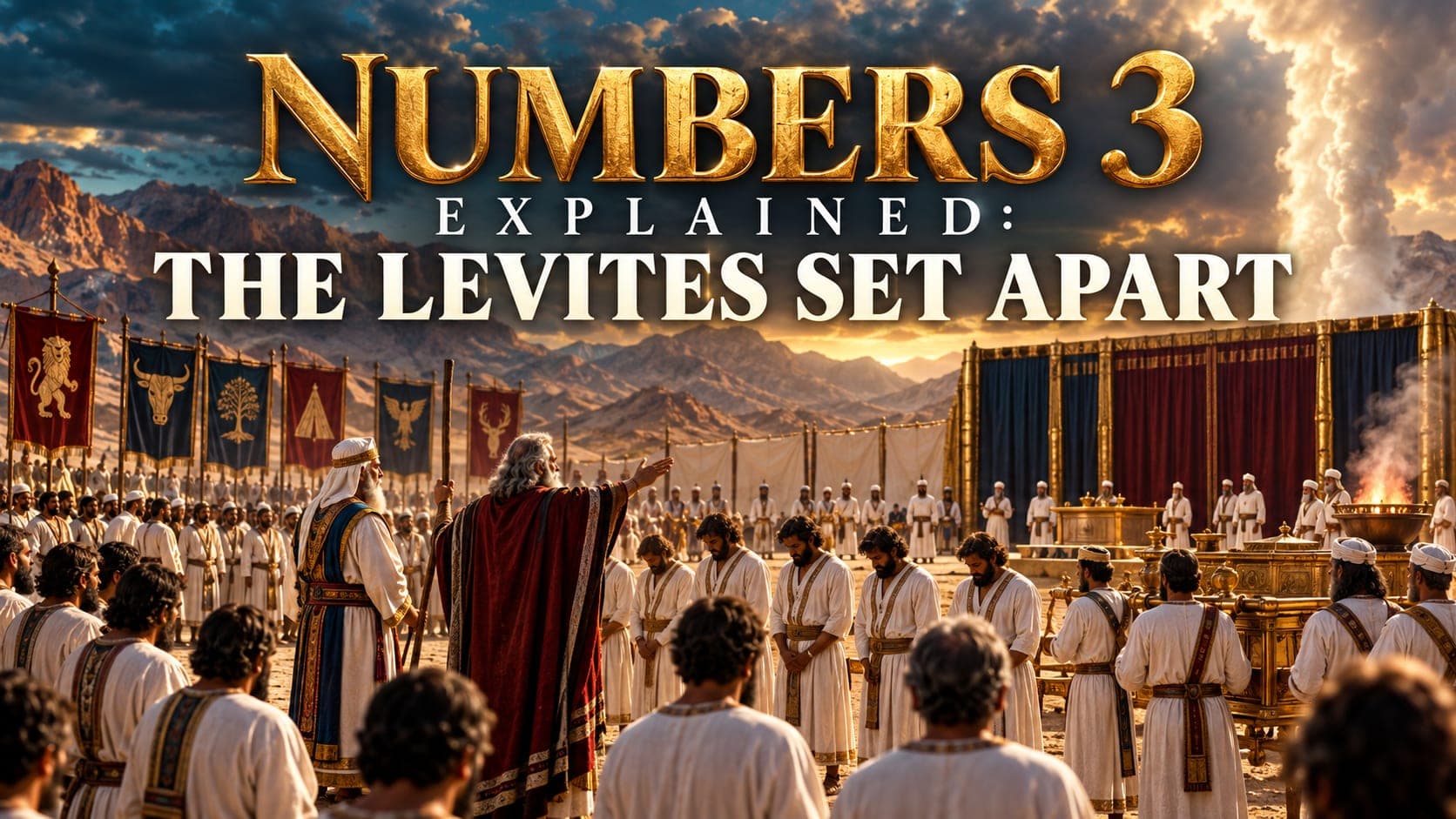
📖 Numbers 3 Explained: The Levites Given in Place of Israel's Firstborn
One priestly family loses two sons in a single verse. One whole tribe gains a job no other tribe will ever hold.
Numbers 3 explained is Moses taking the tribe of Levi and splitting it three ways: who serves the priests, who carries which piece of the tabernacle, and who stands in, legally, for every firstborn son in Israel. None of it is random. Every name in this chapter is attached to a specific object, a specific direction, or a specific debt owed to God.
You already know the Levites camped around the tabernacle. This chapter tells you why, and what each family inside that tribe actually did all day.
- ❓ What happened to two of Aaron's own sons before this chapter even gets going?
- ❓ Why does God claim the Levites as a substitute for something that belongs to every family in Israel?
- ❓ Why does Moses and Aaron's own branch of the family get handed the ark itself?
- ❓ And why does the math in this chapter not quite add up on the page?
📌 God did not just want Levites near the tabernacle. He wanted a specific family assigned to a specific piece of it, with the most dangerous job going to the family Moses and Aaron belonged to themselves.
This walkthrough goes through the chapter in order: the sons Aaron lost, the Levites handed to Aaron for service, the trade God makes for Israel's firstborn, the three family lines of Levi and what each one carried, and the leftover firstborn sons who had to be bought back with silver.
There is more structure packed into this one chapter than a quick read usually catches.
What Happened Just Before This Chapter
Numbers 2 arranged the whole camp around the tabernacle, four camps on four sides, with the Levites and the tabernacle fixed in the exact center of the march. That chapter named the Levites as the group living closest to God's presence, but it never explained who they were, how they got that assignment, or what they actually did once the camp stopped moving.
Numbers 3 answers all of that. It opens with a family tragedy inside the priesthood, then works outward from Aaron's own sons to the whole tribe of Levi, explaining exactly why this one tribe stands between an ordinary Israelite family and the tabernacle at the center of the camp.

Numbers 3 Explained Verse by Verse
1. Two Sons Lost, Two Sons Left (verses 1 to 4)
The chapter opens by naming Aaron's four sons, the men who were supposed to carry the priesthood forward.
"These also are the generations of Aaron and Moses in the day that the LORD spake with Moses in mount Sinai. And these are the names of the sons of Aaron; Nadab the firstborn, and Abihu, Eleazar, and Ithamar."
Verse 3 calls all four of them priests, anointed and consecrated. Verse 4 then explains why only two of them matter from this point forward.
"And Nadab and Abihu died before the LORD, when they offered strange fire before the LORD, in the wilderness of Sinai, and they had no children: and Eleazar and Ithamar ministered in the priest’s office in the sight of Aaron their father."
📌 Numbers 3 opens with a death this book never pauses to explain again, because the first readers already knew it. Leviticus 10 is where it actually happened: fire went out from the LORD and consumed Nadab and Abihu for offering incense He never commanded. This chapter simply assumes you remember that and moves straight to the consequence. The priesthood now runs through Eleazar and Ithamar alone, and it has no children from the other two to fall back on.
⚠️ Notice what this means for everything that follows. The chapter that is about to hand an entire tribe a set of holy duties opens by showing that holy duties, done carelessly, can end a man's life on the spot. Nothing about the assignments coming next is casual.
2. The Levites Handed to Aaron (verses 5 to 10)
With the priesthood now down to two men, God moves immediately to give them help.
"And the LORD spake unto Moses, saying, Bring the tribe of Levi near, and present them before Aaron the priest, that they may minister unto him."
"And thou shalt give the Levites unto Aaron and to his sons: they are wholly given unto him out of the children of Israel."
"Wholly given" is the phrase worth sitting with. The Levites did not volunteer for tabernacle duty the way a modern congregation signs up for a rotation. The whole tribe was handed over, as a unit, to serve two surviving priests and whichever sons came after them.
💡 The job itself was not glamorous. Verses 7 and 8 describe it as keeping charge of the tabernacle and its instruments, which in plain language means guarding, cleaning, carrying, and maintaining. It was service, not spotlight, and the chapter is careful to say so before it says anything else about the Levites.
The same verse that describes their job repeats a warning already familiar from the camp's layout.
"And thou shalt appoint Aaron and his sons, and they shall wait on their priest’s office: and the stranger that cometh nigh shall be put to death."
"Stranger" here does not mean a foreigner off the street. It means anyone, Levite or not, who was not Aaron or one of his sons, reaching into the priest's specific role. Even inside a tribe set apart for holy work, there was still a line only the priests themselves could cross.
3. Taken Instead of the Firstborn (verses 11 to 13)
The chapter now explains the deeper reason the Levites belong to God in the first place, and it reaches back to Egypt.
"And I, behold, I have taken the Levites from among the children of Israel instead of all the firstborn that openeth the matrix among the children of Israel: therefore the Levites shall be mine;"
"Because all the firstborn are mine; for on the day that I smote all the firstborn in the land of Egypt I hallowed unto me all the firstborn in Israel, both man and beast: mine shall they be: I am the LORD."
📌 This is the hinge the whole chapter turns on. The night the LORD struck down Egypt's firstborn and spared Israel's, described back in Exodus 13, He claimed every firstborn son in Israel for Himself as the price of that rescue. That claim never went away. It simply sat unresolved until this chapter, where God trades one whole tribe for every firstborn son scattered across the other twelve.
Without this trade, every single family in Israel would owe God a son in lifelong service. With it, one tribe carries that debt for the entire nation. The Levites were not given a job because they were extra. They were given a job because somebody already owed one, and God chose to collect it from one tribe instead of twelve.
4. The Three Family Lines of Levi (verses 14 to 20)
Before assigning any job, Moses has to count the tribe he is working with, down to every male a month old and older.
"Number the children of Levi after the house of their fathers, by their families: every male from a month old and upward shalt thou number them."
A month old is strikingly young next to the twenty year old cutoff Numbers 1 used for the fighting men of the other twelve tribes. This was never a count of soldiers. It was a count of everyone born into a job, whether he was old enough to carry anything yet or not.
"And these were the sons of Levi by their names; Gershon, and Kohath, and Merari."
Three sons, three family lines, and the chapter is about to split every duty in the tabernacle three ways between them. This same list of three names already appeared generations earlier in Exodus 6, where Levi's own sons are recorded, Kohath among them as the grandfather of Moses and Aaron through his son Amram. The family writing this census, and the family leading it, both trace straight back to Kohath.
5. Each Clan's Camp and Its Cargo (verses 21 to 39)
With the three families named, the chapter counts each one and hands each one a different part of the tabernacle to carry.
"The families of the Gershonites shall pitch behind the tabernacle westward."
Gershon's family, 7,500 strong, camped west and carried the tabernacle's tent, its coverings, and the hangings for the courtyard, the fabric and structure side of the job. Next comes the family with the heaviest responsibility of the three.
"The families of the sons of Kohath shall pitch on the side of the tabernacle southward."
"And their charge shall be the ark, and the table, and the candlestick, and the altars, and the vessels of the sanctuary wherewith they minister, and the hanging, and all the service thereof."
📌 Kohath's family, 8,600 men, carried the ark itself. Not the tent around it, the actual ark of the covenant, along with the table, the lampstand, and the altars. This was the most dangerous assignment in the whole tabernacle, which is exactly why verse 32 puts Eleazar, Aaron's own surviving son, in direct charge over them. Moses and Aaron's own family line did not hand itself the easiest job. It kept the one that could kill a careless man fastest.
The last family takes the heaviest, least glamorous load of the three.
"And under the custody and charge of the sons of Merari shall be the boards of the tabernacle, and the bars thereof, and the pillars thereof, and the sockets thereof, and all the vessels thereof, and all that serveth thereto,"
Merari's family, 6,200 men, camped north and hauled the actual skeleton of the building: the boards, bars, pillars, and sockets that held the whole structure upright. Gershon carried the skin of the tabernacle, Kohath carried its holiest contents, and Merari carried its bones. One final family rounds out the picture.
"But those that encamp before the tabernacle toward the east, even before the tabernacle of the congregation eastward, shall be Moses, and Aaron and his sons, keeping the charge of the sanctuary for the charge of the children of Israel; and the stranger that cometh nigh shall be put to death."
Moses, Aaron, and Aaron's sons camped east of the tabernacle, facing its one gate, the same direction Numbers 2 gave to Judah's camp on the far outer ring. Three Levite families ringed the tabernacle on the other three sides. Nobody approached God's presence from any direction without passing a Levite first.
"All that were numbered of the Levites, which Moses and Aaron numbered at the commandment of the LORD, throughout their families, all the males from a month old and upward, were twenty and two thousand."
6. Redeeming the Extra Firstborn (verses 40 to 51)
The chapter now closes the loop it opened in verse 12, counting the firstborn the Levites are supposed to stand in for.
"And the LORD said unto Moses, Number all the firstborn of the males of the children of Israel from a month old and upward, and take the number of their names."
"And all the firstborn males by the number of names, from a month old and upward, of those that were numbered of them, were twenty and two thousand two hundred and threescore and thirteen."
22,273 firstborn sons against 22,000 Levites leaves 273 firstborn with no Levite to stand in for them. God does not simply let that gap go unpaid.
"Thou shalt even take five shekels apiece by the poll, after the shekel of the sanctuary shalt thou take them: (the shekel is twenty gerahs:)"
"Of the firstborn of the children of Israel took he the money; a thousand three hundred and threescore and five shekels, after the shekel of the sanctuary:"
💡 Run the math yourself and it lines up exactly: 273 firstborn at 5 shekels each comes to 1,365 shekels, the precise figure verse 50 names. Every one of those 273 sons still belonged to God by right. Since there was no spare Levite left to cover him, his family paid silver instead, and that silver went straight to Aaron and his sons.

Hard Questions Numbers 3 Raises
Why trade one tribe for the firstborn of twelve, instead of each family keeping its own son in service? The text does not spell out God's full reasoning, but the practical difference is obvious. One trained, organized tribe serving a single tabernacle works. Thousands of individual firstborn sons, pulled out of twelve different tribes with no shared training or structure, would not. The debt from Exodus 13 still got paid. It just got paid through one tribe instead of scattered across every household in Israel.
Why does the math in verses 22, 28, 34, and 39 not quite add up? Add the three family totals yourself: 7,500 plus 8,600 plus 6,200 comes to 22,300, not the 22,000 verse 39 actually states. This specific gap has been noticed and discussed by Bible teachers for a long time, and the text gives no footnote explaining it. One explanation offered is that the 300 difference represents the firstborn sons already inside the Levites' own families, who could not be counted twice since Levi's own firstborn were already claimed by God along with the rest of the tribe. The redemption math later in the chapter, 273 firstborn at 5 shekels landing on exactly 1,365 shekels, still checks out perfectly against the stated totals, so whatever explains the 300 gap, it does not appear to be a simple copying error in the final numbers used.
Why hand the most dangerous job, the ark itself, to Kohath's family rather than spreading that risk around? The text does not frame this as risk management. It reads instead as Moses and Aaron's own relatives taking the assignment with the least room for error, under their own kinsman Eleazar's direct oversight. Leadership in this chapter looks like carrying the heaviest, most unforgiving load yourself rather than assigning it somewhere safer.
Does this chapter mean God values firstborn sons more than other children today? Numbers 3 is solving a specific debt from a specific night in Egypt, not laying out a permanent rule about birth order. The New Testament picks up the word "firstborn" in a very different direction, calling Jesus Himself the firstborn over all creation and describing the whole church as a gathering of the firstborn. The category outlives the original census, even as the original rule about redeeming an actual firstborn son with silver does not.
Top Verses From Numbers 3
1. Numbers 3:12 and 13
"And I, behold, I have taken the Levites from among the children of Israel instead of all the firstborn that openeth the matrix among the children of Israel: therefore the Levites shall be mine; Because all the firstborn are mine; for on the day that I smote all the firstborn in the land of Egypt I hallowed unto me all the firstborn in Israel, both man and beast: mine shall they be: I am the LORD."
The verse the entire chapter is built on: one tribe taken in trade for a debt every family in Israel owed since the night God spared their firstborn in Egypt.
2. Numbers 3:9
"And thou shalt give the Levites unto Aaron and to his sons: they are wholly given unto him out of the children of Israel."
A whole tribe handed over as one unit, not a volunteer rotation, to serve two surviving priests and whoever came after them.
3. Numbers 3:31
"And their charge shall be the ark, and the table, and the candlestick, and the altars, and the vessels of the sanctuary wherewith they minister, and the hanging, and all the service thereof."
The job Moses and Aaron's own relatives carried: the ark of the covenant itself, the most dangerous cargo in the entire camp.
4. Numbers 3:38
"But those that encamp before the tabernacle toward the east, even before the tabernacle of the congregation eastward, shall be Moses, and Aaron and his sons, keeping the charge of the sanctuary for the charge of the children of Israel; and the stranger that cometh nigh shall be put to death."
Moses and Aaron's family faced the one gate into the tabernacle themselves, standing between an approaching Israelite and God's presence.
5. Numbers 3:50
"Of the firstborn of the children of Israel took he the money; a thousand three hundred and threescore and five shekels, after the shekel of the sanctuary:"
The exact silver paid for the 273 firstborn sons the Levites could not cover, down to a shekel that still adds up correctly today.

Frequently Asked Questions About Numbers 3
What is Numbers 3 about?
Numbers 3 counts the tribe of Levi, assigns its three family lines to specific duties around the tabernacle, and explains that the whole tribe was taken by God as a substitute for every firstborn son in Israel.
Why did Nadab and Abihu die in Numbers 3?
Numbers 3:4 reports their deaths but does not describe them again. That happened earlier in Leviticus 10, where fire from the LORD consumed them for offering incense He had not commanded. This chapter simply explains why only Eleazar and Ithamar remained to carry the priesthood forward.
Why were the Levites given to Aaron instead of serving independently?
Verses 6 through 9 describe the Levites as wholly given to Aaron and his sons, placing the whole tribe under the priesthood's direction rather than letting them operate on their own authority inside the tabernacle.
Why did the Levites take the place of Israel's firstborn?
God had already claimed every firstborn son in Israel the night He spared them in Egypt, recorded in Exodus 13. Numbers 3:12 and 13 settle that old claim by taking one whole tribe in trade for every firstborn scattered across the other twelve.
What were the three families of Levi, and what did each one carry?
Gershon's family carried the tabernacle's tent, coverings, and hangings. Kohath's family carried the ark, the table, the lampstand, and the altars, the holiest objects. Merari's family carried the boards, bars, pillars, and sockets that formed the tabernacle's frame.
Why does the Levite total in Numbers 3 not match the three family counts?
Gershon, Kohath, and Merari add up to 22,300, but verse 39 gives the total as 22,000. The text does not explain the 300 difference. One common explanation is that it represents the Levites' own firstborn sons, already claimed by God along with the rest of their tribe, who were not counted a second time.
Why did Moses and Aaron camp on the east side of the tabernacle?
Verse 38 places Moses, Aaron, and Aaron's sons directly in front of the tabernacle's one gate, facing east, the same side Numbers 2 gave to Judah's outer camp. No one could approach the tabernacle's entrance without passing the priests first.
What happened to firstborn sons the Levites could not cover?
There were 273 more firstborn sons than Levites. Verses 46 through 51 had each of those families pay five shekels per son, 1,365 shekels total, to Aaron and his sons instead of providing a Levite in exchange.
Why were the Levites counted from a month old instead of twenty years old?
Numbers 1 counted fighting men twenty years old and up. Numbers 3 was counting a tribe born into lifelong tabernacle service rather than military age, so every male a month old and older was included from birth.
What does Numbers 3 teach Christians today?
That God settles debts precisely, down to a shekel, and that the heaviest responsibilities in His service were carried by the people closest to Him, not handed off to someone with less to lose.
Final Thoughts
Numbers 3 reads like a staffing chart, but it is really a chapter about an old debt finally getting paid.
📌 A claim from Exodus never expired just because the chapter had moved on. God still owned every firstborn in Israel, and Numbers 3 is Him collecting on that, tribe by tribe, shekel by shekel.
📌 The family closest to the center took the heaviest load, not the lightest one. Kohath's family, Moses and Aaron's own relatives, carried the ark itself, the one object in the whole camp that could not be handled carelessly.
📌 Even the leftover numbers mattered enough to settle in silver. 273 firstborn sons with no Levite to stand in for them were not written off. Someone paid for every single one.
You do not owe God five shekels for a firstborn son. But the same God who tracked this debt down to a single shekel still keeps close track of what you actually owe Him.
So here is your one next step.
Think of one obligation to God you have been treating as optional. Numbers 3 says He never forgot the one His people owed either, and He expected it paid.