📖 Numbers 20 Explained: Moses Strikes the Rock and Loses the Promised Land
A sister dies. A nation runs out of water again. A brother will be dead by the end of the same chapter.
Numbers 20 explained is the chapter where Moses, after forty years of leading this exact camp through this exact complaint, finally breaks. Not with anger at the people only. With one small act of disobedience that costs him and Aaron the one thing they had been walking toward the whole time: the promised land itself.
Maybe you have done something right for years, then slipped once, in a moment nobody would have blamed you for.
- ❓ Why did striking the rock matter, when God told Moses to strike a rock for water once before?
- ❓ Why does Aaron lose the promised land too, when Moses is the one holding the rod?
- ❓ Why does Edom, Israel's own relative, refuse to let them pass through?
- ❓ Why does God still give the water, even after Moses disobeys Him in front of everyone?
📌 God still provides the water Israel needs. He just will not let the man who disobeyed Him publicly be the one to carry them the rest of the way in.
This walkthrough goes through the whole chapter in order: Miriam's death and the water that disappears with her, God's one instruction at the rock, what Moses actually does instead, the verdict both leaders receive, Edom's refusal, and Aaron's death on Mount Hor.
A short chapter carrying two deaths and one verdict that changes everything after it.
What Happened Just Before This Chapter
Numbers 19 gave Israel a law for the one problem nobody in this camp could avoid: contact with death. That law existed because the camp had buried an enormous number of people across three straight chapters of rebellion, judgment, and reorganized priesthood. Before any of that, back in Numbers 14, God had already sentenced the entire generation twenty years old and up, the ones who refused to trust Him at the edge of the land, to die in the wilderness instead of entering it.
Numbers 20 picks up years later, near the very end of that sentence. The wandering is almost finished. The generation under judgment is almost gone. And in this one chapter, for the first time, the two men who had led Israel out of Egypt and through every single one of those years find out the sentence reaches them too.

Numbers 20 Explained Verse by Verse
1. Miriam Dies, and the Water Disappears (verses 1 to 5)
The chapter opens with almost no warning at all.
"Then came the children of Israel, even the whole congregation, into the desert of Zin in the first month: and the people abode in Kadesh; and Miriam died there, and was buried there."
📌 One sentence. No eulogy, no description of what killed her, no mourning period recorded here the way Aaron gets later in this same chapter. Miriam, the sister who watched over baby Moses in a basket on the Nile, who led the women in song after the Red Sea crossing, and who later challenged Moses' authority and was struck with leprosy for it, simply dies at Kadesh and is buried. The text moves on immediately to the next crisis.
And the next crisis follows within the same breath.
"And there was no water for the congregation: and they gathered themselves together against Moses and against Aaron."
"And the people chode with Moses, and spake, saying, Would God that we had died when our brethren died before the LORD!"
"And why have ye brought up the congregation of the LORD into this wilderness, that we and our cattle should die there?"
"And wherefore have ye made us to come up out of Egypt, to bring us in unto this evil place? it is no place of seed, or of figs, or of vines, or of pomegranates; neither is there any water to drink."
💡 This is almost word for word the same complaint Moses heard at Rephidim decades earlier in Exodus 17. Different generation, mostly, since Numbers 14 had already condemned the adults from that earlier story to die along the way. But the complaint has not changed in all those years. No water still means the same accusation: you brought us out here to kill us.
Notice too that this complaint lands right next to a fresh grave. The people are not just thirsty. They are grieving Miriam and thirsty at the same time, and the thirst gets voiced while the grief barely gets a sentence.
2. Moses and Aaron Fall on Their Faces (verse 6)
Decades of this exact complaint, and the two leaders still respond the same way they always have.
"And Moses and Aaron went from the presence of the assembly unto the door of the tabernacle of the congregation, and they fell upon their faces: and the glory of the LORD appeared unto them."
📌 They do not argue back. They do not try to manage the crowd themselves. They go to God. Whatever goes wrong later in this chapter, it does not happen because Moses skipped this step. He brought the problem to the LORD exactly the way he had every other time water, food, or rebellion threatened to tear the camp apart.
And God answers, the same way He always had at this point: His glory appears, and instructions follow.
3. One Instruction: Speak to the Rock (verses 7 and 8)
What God tells Moses to do next is simple, specific, and different from last time.
"And the LORD spake unto Moses, saying, Take the rod, and gather thou the assembly together, thou, and Aaron thy brother, and speak ye unto the rock before their eyes; and it shall give forth his water, and thou shalt bring forth to them water out of the rock: so thou shalt give the congregation and their beasts drink."
📌 Compare this carefully with Exodus 17. At Rephidim, God told Moses, "thou shalt smite the rock, and there shall come water out of it." Striking was the instruction then. Here, decades later, the instruction is to speak to the rock, with the rod simply carried along, gathered with the assembly watching. The method God chooses is not always the same twice, even for what looks like the identical problem.
Moses takes the rod exactly as told, which the text takes care to confirm before anything goes wrong.
"And Moses took the rod from before the LORD, as he commanded him."
4. Moses Strikes the Rock Instead (verses 10 and 11)
The next verse is where the whole chapter turns.
"And Moses and Aaron gathered the congregation together before the rock, and he said unto them, Hear now, ye rebels; must we fetch you water out of this rock?"
⚠️ "Ye rebels" and the sarcastic "must we fetch you water" are Moses' own words, not God's. God never told him to address the people this way, and never told him to speak at all before dealing with the rock. Forty years of hearing the same complaint seems to have finally boiled over, right at the moment he was told to speak to a rock instead of to a crowd.
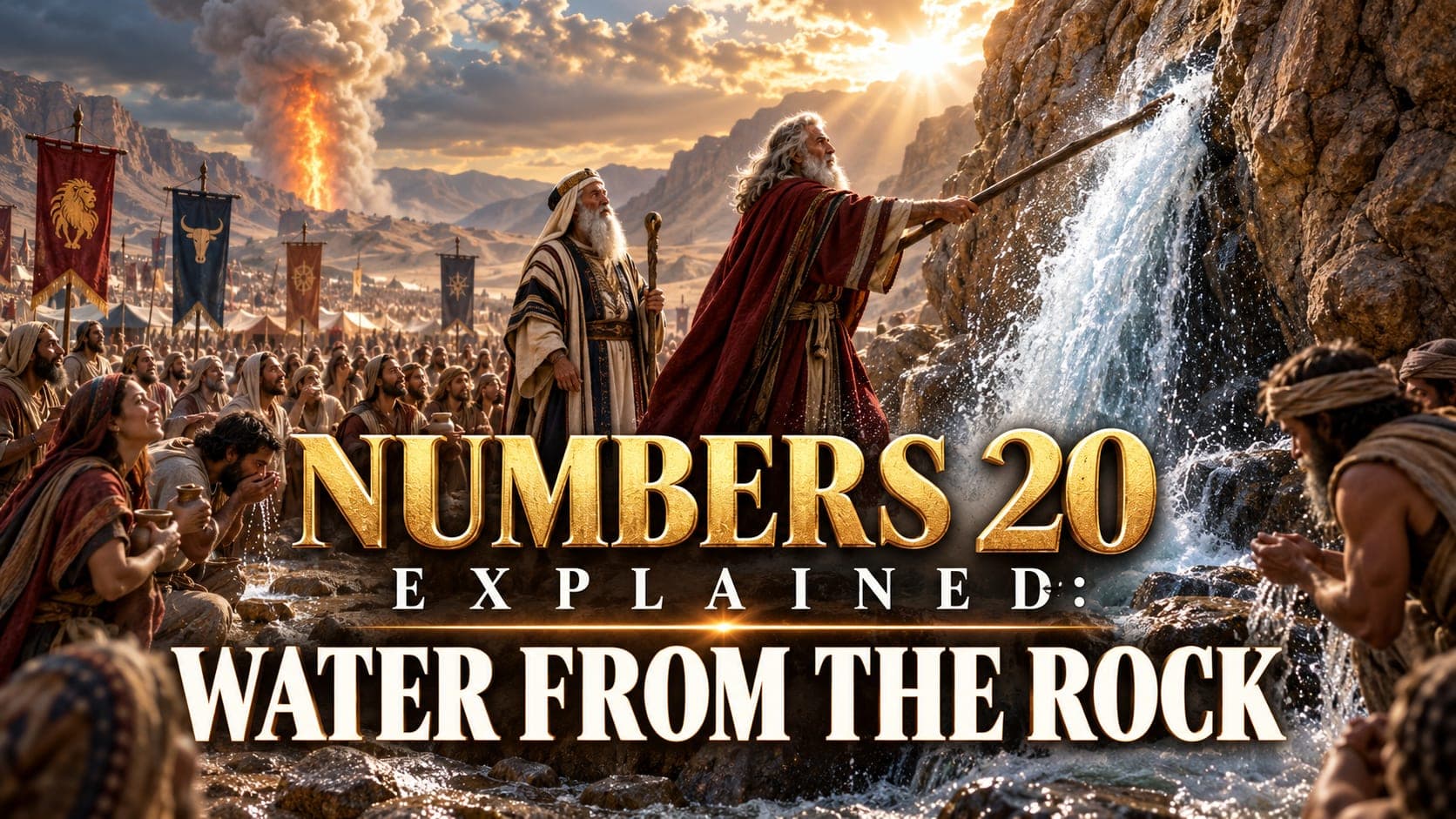
"And Moses lifted up his hand, and with his rod he smote the rock twice: and the water came out abundantly, and the congregation drank, and their beasts also."
📌 Moses does not speak to the rock at all. He strikes it, twice, the way he had at Rephidim, not the way God had just told him to this time. And the water comes anyway, abundantly, enough for the whole congregation and every animal with them. God still provides exactly what the people need, even while the man providing it is disobeying the specific instruction he was just given.
That detail matters for how the rest of the chapter reads. The miracle happening is never the question. Whether Moses obeyed on the way to it is.
5. The Verdict at the Waters of Meribah (verses 12 and 13)
God's response comes immediately, and it is not aimed at the people this time.
"And the LORD spake unto Moses and Aaron, Because ye believed me not, to sanctify me in the eyes of the children of Israel, therefore ye shall not bring this congregation into the land which I have given them."
📌 "Ye," both of them. Aaron never touched the rod and never spoke the sarcastic line, yet the verdict names him right alongside Moses. The chapter does not explain exactly what Aaron did wrong in the moment, only that he stood there as Moses gathered the people and struck the rock, and the verdict holds him jointly responsible as the brother who shared leadership at that rock.
The phrase "believed me not, to sanctify me in the eyes of the children of Israel" names the real offense. Not disbelief that God could provide water. The whole nation was about to drink it. The failure was in how that provision got displayed to a watching crowd, with Moses' own anger and his own method standing in front of it instead of the exact word God had given.
Verse 13 then names the place for what it is.
"This is the water of Meribah; because the children of Israel strove with the LORD, and he was sanctified in them."
💡 Meribah means strife. It is the same name given to the place in Exodus 17, a separate location decades earlier, named for the same reason: Israel striving against the LORD over water. Scripture is comfortable reusing a name for a recurring kind of failure rather than inventing a new one each time.
6. Edom Refuses Israel Passage (verses 14 to 21)
With the verdict given but not yet carried out, Moses turns to the practical matter of getting the nation closer to the land they will still enter, even without him leading them in.
"And Moses sent messengers from Kadesh unto the king of Edom, Thus saith thy brother Israel, Thou knowest all the travail that hath befallen us:"
📌 "Thy brother Israel." The message itself states the relationship plainly: Edom descends from Esau, Jacob's own brother, which makes this request one relative asking another for a simple courtesy, not a stranger asking a stranger. Moses lays out the whole history, Egypt, the cry for help, the angel, and then asks for nothing more than safe passage along the main road.
"Let us pass, I pray thee, through thy country: we will not pass through the fields, or through the vineyards, neither will we drink of the water of the wells: we will go by the king’s high way, we will not turn to the right hand nor to the left, until we have passed thy borders."
Israel even offers to pay for any water their livestock might drink, in verse 19, going out of its way to promise it will cost Edom nothing. Edom's answer does not soften for any of it.
"And he said, Thou shalt not go through. And Edom came out against him with much people, and with a strong hand."
"Thus Edom refused to give Israel passage through his border: wherefore Israel turned away from him."
⚠️ Israel does not force the issue. With an army camped out ready to fight for the road, Israel simply turns away rather than starting a war with a relative over a right of passage. The detour this refusal creates will shape where Aaron dies within the same chapter and where Israel travels for a long stretch afterward.
7. Aaron's Death on Mount Hor (verses 22 to 29)
Turned away from Edom, Israel moves on, and the verdict from the rock finally comes due.
"And the children of Israel, even the whole congregation, journeyed from Kadesh, and came unto mount Hor."
"And the LORD spake unto Moses and Aaron in mount Hor, by the coast of the land of Edom, saying, Aaron shall be gathered unto his people: for he shall not enter into the land which I have given unto the children of Israel, because ye rebelled against my word at the water of Meribah."
📌 God names the exact reason again, by name: the water of Meribah. There is no ambiguity left about why Aaron will die here instead of in the land. It is tied directly, by God's own words, to what happened back at the rock.
What follows is one of the most exposed moments in Aaron's whole life.
"Take Aaron and Eleazar his son, and bring them up unto mount Hor: And strip Aaron of his garments, and put them upon Eleazar his son: and Aaron shall be gathered unto his people, and shall die there."
"And Moses did as the LORD commanded: and they went up into mount Hor in the sight of all the congregation. And Moses stripped Aaron of his garments, and put them upon Eleazar his son; and Aaron died there in the top of the mount: and Moses and Eleazar came down from the mount."
💡 Those priestly garments are the same ones described in detail back in Exodus 28, the breastplate, the robe, the ephod, everything that marked Aaron as high priest. Moses himself removes them with his own hands and dresses Eleazar in them on the same mountain, in full view of the people below, so the transfer of the priesthood happens in the open, at the exact moment of Aaron's death, with no gap and no confusion about who holds the office next.
The chapter ends with the nation's response.
"And when all the congregation saw that Aaron was dead, they mourned for Aaron thirty days, even all the house of Israel."
📌 Thirty days of mourning for the brother who carried this whole camp's sacrifices and sins to the altar for most of their lives. Miriam opened this chapter with a single, quiet sentence. Aaron closes it with a month of grief from the entire house of Israel. The chapter that cost Moses and Aaron the promised land is also the chapter where both of their siblings in ministry, Miriam at the start and Aaron at the end, leave the story for good.

Hard Questions Numbers 20 Raises
Why was striking the rock wrong this time, when God told Moses to strike a rock for water at Rephidim? The text itself draws the distinction. In Exodus 17, God said plainly, "thou shalt smite the rock." Here, in verse 8, God said, "speak ye unto the rock," with the rod only carried along, not swung. The failure was not striking a rock in general. It was ignoring the specific instruction given this specific time, and adding an angry speech to the crowd that God never asked for.
Why did Aaron lose the promised land too, when Moses held the rod and spoke the angry words? Verse 12 addresses both men together, "because ye believed me not," without separating out exactly what Aaron personally did wrong. Scripture does not explain Aaron's individual failure beyond standing beside Moses as a joint leader at that rock. Shared leadership, here, carried shared accountability for how the moment was handled, whether or not every action was Aaron's own hand.
Why did God still provide the water, after Moses disobeyed the exact instruction He had just given? Numbers 20:11 states it plainly: the water came out abundantly regardless. God's commitment to meet the physical need of a thirsty nation and their animals did not depend on Moses getting every detail right first. The discipline for the disobedience came separately, afterward, aimed at the man, not withheld from the people who had done nothing wrong in that moment.
Was Edom wrong to refuse Israel safe passage, given the two nations were relatives? The text records the refusal without passing a verdict on it one way or the other. Israel's own message in verse 14 calls Edom "brother," and Edom still says no and backs it with an army. Numbers 20 simply records what happened and how Israel responded, turning away rather than forcing a fight over the road.
Did Moses ever get to see the land he was barred from entering? Not to enter it, but Deuteronomy records God letting him view it from a distance before he died.
"I pray thee, let me go over, and see the good land that is beyond Jordan, that goodly mountain, and Lebanon."
"But the LORD was wroth with me for your sakes, and would not hear me: and the LORD said unto me, Let it suffice thee; speak no more unto me of this matter. Get thee up into the top of Pisgah, and lift up thine eyes westward, and northward, and southward, and eastward, and behold it with thine eyes: for thou shalt not go over this Jordan."
Moses asked, years after Numbers 20, and God still said no to entering, though He let him see it from Pisgah's peak before he died. The verdict from Meribah stood to the very end, even after Moses himself pleaded against it.
Top Verses From Numbers 20
1. Numbers 20:8
"Take the rod, and gather thou the assembly together, thou, and Aaron thy brother, and speak ye unto the rock before their eyes; and it shall give forth his water, and thou shalt bring forth to them water out of the rock: so thou shalt give the congregation and their beasts drink."
The exact instruction Moses was given, and the exact detail, speaking rather than striking, that the rest of the chapter turns on.
2. Numbers 20:11
"And Moses lifted up his hand, and with his rod he smote the rock twice: and the water came out abundantly, and the congregation drank, and their beasts also."
God's provision still arrives, abundantly, even through an act of disobedience. The miracle and the discipline that follows it are two separate things in this chapter.
3. Numbers 20:12
"And the LORD spake unto Moses and Aaron, Because ye believed me not, to sanctify me in the eyes of the children of Israel, therefore ye shall not bring this congregation into the land which I have given them."
The verdict that ends forty years of leadership in one sentence, naming the failure as a failure to represent God rightly in front of the people watching.
4. Numbers 20:24
"Aaron shall be gathered unto his people: for he shall not enter into the land which I have given unto the children of Israel, because ye rebelled against my word at the water of Meribah."
God names the exact reason for Aaron's death again, by name, removing any doubt about what the water of Meribah actually cost both brothers.
5. 1 Corinthians 10:4
"And did all drink the same spiritual drink: for they drank of that spiritual Rock that followed them: and that Rock was Christ."
Writing centuries later about this same wilderness generation, Paul looks back at the rock that gave Israel water and sees something greater standing behind it.

Frequently Asked Questions About Numbers 20
What is Numbers 20 about?
Numbers 20 covers Miriam's death, Israel's renewed complaint about water at Kadesh, Moses striking the rock instead of speaking to it as God commanded, the verdict that bars both Moses and Aaron from the promised land, Edom's refusal of passage, and Aaron's death on Mount Hor.
Why was Moses not allowed to enter the promised land?
Numbers 20:12 says it was because he did not believe God enough to sanctify Him in front of Israel. In practice, that meant striking the rock in anger and addressing the people with his own words instead of simply speaking to the rock as God had instructed in verse 8.
What is the difference between this rock and the rock in Exodus 17?
Exodus 17 happened decades earlier at Rephidim, where God specifically commanded Moses to strike the rock. Numbers 20 happened at Kadesh, where God instead commanded Moses to speak to the rock. Both places ended up called Meribah, meaning strife, but they are two separate events.
Why did Aaron also get barred from the land if Moses struck the rock?
Numbers 20:12 addresses the verdict to both men together, without detailing Aaron's individual action. As the co-leader standing with Moses at the rock, Aaron shared in the consequence even though the text focuses its description of the disobedience on Moses.
How did Miriam die?
Numbers 20:1 only says she died at Kadesh and was buried there. No cause or age is given, and no mourning period is recorded for her the way thirty days are recorded for Aaron later in the same chapter.
Why did Edom refuse to let Israel pass through, if they were relatives?
Moses' message in verse 14 calls Edom "thy brother Israel," pointing to Esau and Jacob's relationship. Edom still refused and backed the refusal with an armed force, and the text does not explain the reason behind the refusal itself, only that Israel turned away rather than fighting over it.
Why was Aaron stripped of his garments before he died?
Numbers 20:26 and 28 show Moses removing Aaron's priestly garments and placing them on Eleazar, Aaron's son, in full view of the people. It transferred the high priesthood openly and immediately, so there was no gap or confusion about who held the office after Aaron's death.
What does "gathered unto his people" mean?
It is the phrase Numbers 20:24 and 26 use for Aaron's death, the same kind of language Scripture uses elsewhere for a death that joins someone to generations who died before them. It describes the fact of death without any added detail about the experience of dying.
Where is Mount Hor?
Numbers 20:22 and 23 place it at the coast of the land of Edom, reached after Israel left Kadesh. The chapter does not give further geographic detail beyond that it sat on Edom's border.
Does Numbers 20 connect to Jesus?
Numbers 20 itself records only the historical event. Writing later, Paul looks back at the rock that provided Israel's water across their wilderness years and calls it a picture of Christ in 1 Corinthians 10:4, without the Numbers 20 text itself making that claim.
What is the lesson of Numbers 20 for today?
That even decades of faithful leadership do not exempt anyone from one moment of disobedience mattering, and that God's care for the people in front of you and His discipline toward your own failure can both be true at the exact same time.
Final Thoughts
Numbers 20 is quiet about grief and loud about consequence, and both halves matter.
📌 One moment of disobedience can cost what forty years of faithfulness built. Moses led this exact nation through this exact complaint for decades. One angry strike at a rock ended his path into the land he had spent his whole life walking toward.
📌 God's provision and His discipline are not the same thing. The water still came out abundantly for a thirsty nation, even while the man who provided it was disciplined separately for how he provided it.
📌 Shared leadership means shared consequence. Aaron never touched the rod, and the verdict still named him. Standing beside a decision is its own kind of responsibility.
You probably are not striking any rocks this week. But you likely have a moment of real, tired anger sitting close to the surface after doing the right thing for a long time.
So here is your one next step.
Notice the moment your patience is wearing thinnest, and bring that moment to God before you act on it, the way Moses did at the door of the tabernacle, not the way he did at the rock.