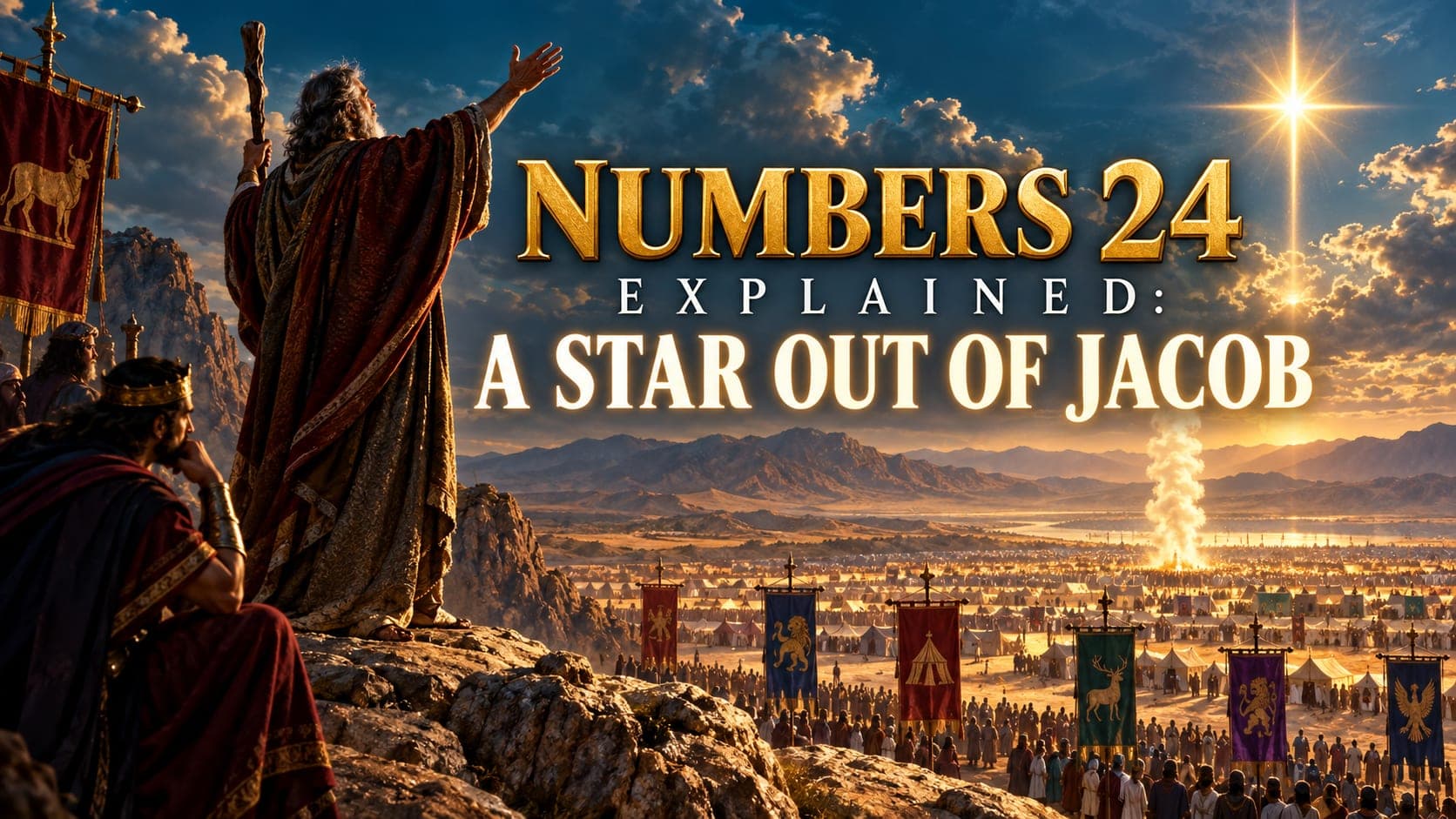
📖 Numbers 24 Explained: A Star Out of Jacob, a Sceptre Out of Israel
No altars this time. No ritual at all. Balaam just looks at Israel, and the words come anyway.
Numbers 24 explained is the chapter where Balaam stops trying to control the outcome and simply lets it happen. Two more oracles pour out of him, the second one reaching past Moab entirely to name a king not yet born and a nation not yet conquered. By the end, the hired prophet is speaking about events centuries away from the hilltop he is standing on.
Maybe you have watched someone keep trying a method that already failed, long after the real issue was never the method.
- ❓ Why does Balaam stop building altars in this chapter?
- ❓ Who is the "Star out of Jacob," and does it really point to Jesus?
- ❓ Why does Balaam suddenly start talking about Amalek and Assyria?
- ❓ How does this chapter end for Balaam and Balak?
📌 The man hired to shrink Israel down to a curse ends this chapter describing a King who will rule far beyond anything Balak could even imagine losing.
This walkthrough goes through the whole chapter in order: Balaam setting the rituals aside, the third oracle over Israel's beauty and strength, Balak's final outburst, the fourth oracle and the Star and Sceptre prophecy inside it, and the four short closing judgments on nations watching from the edges of this story.
A short chapter that reaches further into the future than almost anything else in the book of Numbers.
What Happened Just Before This Chapter
Numbers 23 watched Balak try twice to buy a curse over Israel, moving Balaam to a second mountain when the first oracle came out as a blessing instead. Both times Balaam built seven altars, offered the sacrifices, and came back with words he never controlled. The chapter ended mid ritual, a third set of altars built on Peor, Balak still convinced one more location might finally change the answer.
Numbers 24 opens on that same hillside, animals already offered, Balak still waiting for the curse he paid for. What happens next breaks the pattern the last two chapters just set.

Numbers 24 Explained Verse by Verse
1. No More Enchantments (verses 1 and 2)
Before a single word of this chapter's oracle arrives, Balaam does something new.
"And when Balaam saw that it pleased the LORD to bless Israel, he went not, as at other times, to seek for enchantments, but he set his face toward the wilderness."
📌 Twice already in Numbers 23, Balaam went off alone to a high place, performed a ritual, and waited to see what God would say. This time he does not bother. He already knows the answer will be the same, so he drops the whole act and simply turns to face the camp spread out below him.
What happens instead is described in different language than either earlier oracle.
"And Balaam lifted up his eyes, and he saw Israel abiding in his tents according to their tribes; and the spirit of God came upon him."
💡 Numbers 23 described God putting a word in Balaam's mouth, almost like handing him a script. Here the text says the spirit of God came upon him, the same phrase used elsewhere in Scripture for judges and kings being seized for a specific task. Something has shifted in how this oracle arrives, even though the source has not changed at all.
2. The Third Oracle: "How Goodly Are Thy Tents, O Jacob" (verses 3 to 9)
Balaam opens this oracle by naming himself in the third person, an unusual way to begin.
"And he took up his parable, and said, Balaam the son of Beor hath said, and the man whose eyes are open hath said: He hath said, which heard the words of God, which saw the vision of the Almighty, falling into a trance, but having his eyes open:"
⚠️ "The man whose eyes are open" is a strange line from the same man who could not see an angel standing in his own road one chapter earlier. Balaam describes his own spiritual sight in glowing terms right after the text spent an entire chapter showing his donkey seeing more clearly than he did. The oracle that follows is true. Whether Balaam's own self description is as accurate is a separate question.
Then the actual blessing begins, and it opens with beauty, not battle.
"How goodly are thy tents, O Jacob, and thy tabernacles, O Israel! As the valleys are they spread forth, as gardens by the river's side, as the trees of lign aloes which the LORD hath planted, and as cedar trees beside the waters."
📌 Balak brought Balaam up here to look down at a threat. Balaam looks down and describes a garden. Valleys, river gardens, cedar trees beside water: every image is lush, planted, and flourishing. A camp of wandering tents, from Balaam's vantage point, reads like Eden.
The oracle then turns from beauty to strength.
"He shall pour the water out of his buckets, and his seed shall be in many waters, and his king shall be higher than Agag, and his kingdom shall be exalted."
"God brought him forth out of Egypt; he hath as it were the strength of an unicorn: he shall eat up the nations his enemies, and shall break their bones, and pierce them through with his arrows."
💡 "Agag" shows up here generations before the Agag Saul fights in 1 Samuel 15. Most readers of this text take "Agag" as a royal title the Amalekite kings carried, the way "Pharaoh" named a line of Egyptian rulers rather than one man. "Unicorn" again means a wild ox known for raw strength, the same image Balaam used for Israel one chapter earlier.
"He couched, he lay down as a lion, and as a great lion: who shall stir him up? Blessed is he that blesseth thee, and cursed is he that curseth thee."
📌 The last line of this oracle is almost word for word God's own promise to Abraham generations earlier. Balaam, a Mesopotamian diviner with no covenant stake in Israel, ends up quoting the shape of God's original promise to Abraham back to the very king trying to break it. The lion imagery also echoes Jacob's own blessing over Judah, generations earlier, in Genesis 49.
3. Balak's Fury, and Balaam's Final Answer (verses 10 to 14)
Three blessings in, Balak has heard enough to stop negotiating.
"And Balak's anger was kindled against Balaam, and he smote his hands together: and Balak said unto Balaam, I called thee to curse mine enemies, and, behold, thou hast altogether blessed them these three times."
"Therefore now flee thou to thy place: I thought to promote thee unto great honour; but, lo, the LORD hath kept thee back from honour."
⚠️ Balak's own words accidentally tell the truth about who actually kept Balaam from the reward. He blames "the LORD," not Balaam's own failure or lack of effort. Even a pagan king, furious and humiliated in front of his princes, cannot escape naming the real source of what just happened on his hillside three times.
Balaam does not apologize. He reminds Balak of the warning he gave before any of this started.
"And Balaam said unto Balak, Spake I not also to thy messengers which thou sentest unto me, saying, If Balak would give me his house full of silver and gold, I cannot go beyond the commandment of the LORD, to do either good or bad of mine own mind; but what the LORD saith, that will I speak?"
📌 This is the third time in three chapters Balaam says almost this exact sentence. Balak heard it before the trip, heard it after the first oracle, and hears it again now. The warning was never hidden or softened. Balak simply kept hoping a different setup might land on a different answer anyway.
Then, with nothing left to lose, Balaam offers one more oracle Balak never asked for.
"And now, behold, I go unto my people: come therefore, and I will advertise thee what this people shall do to thy people in the latter days."
💡 Every oracle so far has described Israel as it already is. This one is different. Balaam is about to speak about "the latter days," a future Balak himself will not live to see. Nobody paid for this one. It simply comes.
4. The Fourth Oracle: A Star Out of Jacob (verses 15 to 19)
The fourth oracle opens with the same formula as the third, with one phrase added.
"And he took up his parable, and said, Balaam the son of Beor hath said, and the man whose eyes are open hath said: He hath said, which heard the words of God, and knew the knowledge of the most High, which saw the vision of the Almighty, falling into a trance, but having his eyes open:"
Then comes the verse the whole book of Numbers is remembered for by many readers who have never read the rest of it.
"I shall see him, but not now: I shall behold him, but not nigh: there shall come a Star out of Jacob, and a Sceptre shall rise out of Israel, and shall smite the corners of Moab, and destroy all the children of Sheth."
📌 Balaam says plainly that he is not describing something happening now. He is describing something far off, that he will not personally see up close. A Star and a Sceptre, both royal images, rising out of Jacob and Israel. A sceptre is a king's staff of authority, the same word used generations earlier in Jacob's own blessing over Judah, where "the sceptre shall not depart from Judah."
"The sceptre shall not depart from Judah, nor a lawgiver from between his feet, until Shiloh come; and unto him shall the gathering of the people be."
💡 Most readers of this oracle see it working on two levels. The nearer fulfillment is King David, who did defeat Moab and did strike enemies on Israel's borders, centuries before this verse finished its first job of coming true. Christians have long read a second, further fulfillment reaching past David, since the New Testament itself picks up the exact image of a star marking a king's arrival.
"Saying, Where is he that is born King of the Jews? for we have seen his star in the east, and are come to worship him."
"I Jesus have sent mine angel to testify unto you these things in the churches. I am the root and the offspring of David, and the bright and morning star."
⚠️ Numbers 24 never names Jesus directly, and scholars disagree on exactly how far this one verse was meant to reach. What is not in dispute is the pattern: a star tied to a coming King out of Jacob, picked up again at the literal birth of a King in Bethlehem, and picked up once more at the very end of Revelation, where Jesus Himself claims the title "morning star." Whether Balaam understood the full weight of what he was saying, Scripture keeps returning to his image on purpose.
"And Edom shall be a possession, Seir also shall be a possession for his enemies; and Israel shall do valiantly."
"Out of Jacob shall come he that shall have dominion, and shall destroy him that remaineth of the city."
📌 Moab, Edom, and Seir, three nations standing near this very hillside, all get named as territory someone from Jacob will eventually hold. Balak hired a prophet to shrink one nation down to nothing. Instead he is hearing that his own kingdom, and his neighbors' kingdoms, will one day answer to it.
5. Four Short Judgments on Watching Nations (verses 20 to 24)
Balaam is not finished. Three more short oracles follow, each aimed at a different nation on the edges of this story, none of them requested by anyone.
"And when he looked on Amalek, he took up his parable, and said, Amalek was the first of the nations; but his latter end shall be that he perish for ever."
💡 Amalek had already attacked Israel once, back in Exodus 17, where God swore war against them "from generation to generation." This short oracle confirms that same sentence decades later, long before Saul and David ever fight the nation this verse names.
"And he looked on the Kenites, and took up his parable, and said, Strong is thy dwellingplace, and thou puttest thy nest in a rock."
"Nevertheless the Kenite shall be wasted, until Asshur shall carry thee away captive."
⚠️ The Kenites were generally friendly toward Israel, connected to Moses' own father in law Jethro. Even a people on good terms with Israel are not promised permanent safety here. Their strong, rock built home does not exempt them from the same empires that will eventually sweep through this whole region.
"And he took up his parable, and said, Alas, who shall live when God doeth this!"
"And ships shall come from the coast of Chittim, and shall afflict Asshur, and shall afflict Eber, and he also shall perish for ever."
💡 This is the hardest verse to pin down in the whole chapter, and honest teaching says so plainly instead of guessing with confidence. "Chittim" generally refers to Cyprus and the coastlands of the Mediterranean. "Asshur" is Assyria. "Eber" is the name Genesis 10 traces as an ancestor of the Hebrew people, though scholars are divided on whether this verse means the Hebrews specifically or a wider region associated with that name. What the verse does say clearly, without needing every detail settled, is that even the great powers rising on this horizon will not stand forever either.
6. Two Men Go Their Separate Ways (verse 25)
After four oracles, a talking donkey, an angel with a drawn sword, and a Star and Sceptre prophecy reaching into the far future, the chapter ends in nine plain words.
"And Balaam rose up, and went and returned to his place: and Balak also went his way."
📌 No fanfare, no reconciliation, no final confrontation. Balak paid for a curse and got four blessings plus a prophecy he could not undo. Balaam spoke exactly what God gave him every single time, and still walks off this mountain toward a future later Scripture remembers as a warning, not as an example to follow. Both men simply leave, as if three chapters of failed rituals and unstoppable blessing were already old news.

Hard Questions Numbers 24 Raises
Does the Star out of Jacob prophecy actually point to Jesus? Numbers 24:17 never names a specific person. The text itself is honest about having two layers available: a nearer fulfillment in King David's later conquests over Moab and Edom, and a pattern the New Testament deliberately echoes, the star at Christ's birth in Matthew 2 and the title "bright and morning star" Jesus claims for Himself in Revelation 22:16. Christians read both layers as real without claiming Balaam understood the full reach of his own words.
Why does Balaam stop performing rituals in this chapter? Verse 1 says plainly that he saw it pleased the LORD to bless Israel and simply stopped seeking enchantments as he had the previous two times. The text does not explain his inner reasoning further, only that the method changed while the message from God did not.
Is the Agag named in verse 7 the same Agag Saul fights in 1 Samuel 15? The two events sit generations apart, which makes a single individual unlikely. The common explanation, widely held among readers of this text, is that Agag functioned as a royal title carried by a line of Amalekite kings, similar to how multiple Egyptian rulers were each called Pharaoh.
What do Chittim, Asshur, and Eber mean in verse 24? This is one of the most debated verses in the chapter, and scholars genuinely disagree on its exact scope. Chittim is generally identified with Cyprus or the Mediterranean coastlands; Asshur names Assyria; Eber's identity in this verse is disputed between a reference to the Hebrew people and a wider regional name. No reading changes the verse's basic point, that even rising empires eventually fall.
Why does Balaam bless Israel so thoroughly and still end up remembered as a warning? Every word he speaks across these three chapters comes true and comes from God. Later Scripture, in 2 Peter, Jude, and Numbers 31 itself, remembers him instead for what happens after this chapter closes, when his own counsel helps draw Israel into sin at Baal-peor. Speaking truth accurately is shown here to be a different thing from having a right heart toward the truth spoken.
Top Verses From Numbers 24
1. Numbers 24:17
"I shall see him, but not now: I shall behold him, but not nigh: there shall come a Star out of Jacob, and a Sceptre shall rise out of Israel, and shall smite the corners of Moab, and destroy all the children of Sheth."
The verse this chapter is remembered for. A royal Star and Sceptre rising out of Israel, first fulfilled in David, and echoed again in the star that led wise men to Bethlehem.
2. Numbers 24:9
"He couched, he lay down as a lion, and as a great lion: who shall stir him up? Blessed is he that blesseth thee, and cursed is he that curseth thee."
A hired diviner ends his third oracle quoting God's own ancient promise to Abraham, almost word for word, back to the king paying him to break it.
3. Numbers 24:13
"If Balak would give me his house full of silver and gold, I cannot go beyond the commandment of the LORD, to do either good or bad of mine own mind; but what the LORD saith, that will I speak."
The same claim Balaam has made since before he ever left Pethor, repeated now for the third time, and proven true every single time Balak tested it.
4. Numbers 24:5
"How goodly are thy tents, O Jacob, and thy tabernacles, O Israel!"
A man brought up a mountain to find a weakness to exploit instead describes what he sees as beautiful. Later rabbis built an entire synagogue prayer around this exact line.
5. Numbers 24:20
"Amalek was the first of the nations; but his latter end shall be that he perish for ever."
A short, unsolicited oracle that confirms the oath God already swore against Amalek back in Exodus 17, long before Saul or David ever meet that nation in battle.

Frequently Asked Questions About Numbers 24
What is Numbers 24 about?
Numbers 24 records Balaam's third and fourth oracles over Israel, spoken without any ritual this time, including the Star and Sceptre prophecy, followed by Balak's furious dismissal of him and three short closing judgments on Amalek, the Kenites, and the nations near Assyria.
What does "there shall come a Star out of Jacob" mean?
Numbers 24:17 pictures a coming king under the image of a rising star and sceptre. Most readers see a near fulfillment in King David's later victories over Moab and Edom, and Christians also connect it to the star announcing Jesus' birth in Matthew 2.
Why did Balaam stop building altars in Numbers 24?
Numbers 24:1 says Balaam saw that it pleased the LORD to bless Israel and simply stopped seeking the enchantments he had used in the previous chapter, since the ritual had never actually produced the words he spoke anyway.
Is the Star out of Jacob a prophecy about Jesus?
Numbers 24:17 does not name Jesus directly. Christians have long read it on two levels, a nearer fulfillment in David and a further one picked up by the New Testament's own star imagery in Matthew 2 and the title Jesus claims for Himself in Revelation 22:16.
Who was Agag in Numbers 24:7?
Agag appears here generations before the Agag Saul fights in 1 Samuel 15. The common explanation is that Agag was a royal title carried by a line of Amalekite kings rather than one single ruler.
What does Numbers 24:24 mean by Chittim, Asshur, and Eber?
Chittim is generally understood as Cyprus or the Mediterranean coastlands, and Asshur names Assyria. Eber's meaning here is genuinely disputed among readers, between the Hebrew people and a wider regional name, and the verse does not settle which.
Why does Balaam bless Amalek's enemies but curse Amalek itself?
Numbers 24:20 confirms a judgment already in place since Exodus 17, where God swore war against Amalek for generations after their attack on Israel. This short oracle repeats that same sentence rather than introducing a new one.
How does Numbers 24 end for Balaam and Balak?
Numbers 24:25 ends the whole episode in one plain sentence: Balaam returns home and Balak goes his own way, with no reconciliation or final confrontation after three chapters of failed curses and unstoppable blessing.
Were the Kenites enemies of Israel?
No, the Kenites were generally connected to Israel through Moses' father in law Jethro and were often on friendly terms with them. Numbers 24:21 and 22 still include them in a coming judgment, showing that even a friendly nation was not promised permanent exemption.
Does Numbers 24 prove Balaam was a true prophet?
It proves every word Balaam spoke in this chapter came from God and came true. It does not prove his own heart was right, since Numbers 31, 2 Peter, and Jude all remember him for the sin he later helped cause rather than for the accuracy of these oracles.
Final Thoughts
Numbers 24 closes the Balaam story the same way it has run the whole time, and still manages to say something no earlier chapter said.
📌 The blessing never needed the ritual. The moment Balaam stopped building altars, the words came just as surely as when he had seven of them smoking behind him.
📌 God can speak further than the person speaking realizes. Balaam announced a Star and Sceptre he himself said he would not live to see up close, and Scripture keeps returning to that exact image centuries later.
📌 Accurate words are not the same thing as a right heart. Balaam spoke nothing but truth in three straight chapters, and still walked off this mountain toward the very failure later Scripture remembers him for.
You are probably not waiting on a word from a hired diviner this week. But you may be tempted, like Balak, to think the right ritual, request, or angle could still talk God out of something He has already settled.
So here is your one next step.
Read Numbers 24:17 and ask what in your own life you are still waiting to see up close, when God may already have spoken the outcome plainly, the same way He did on this hillside.