📖 Numbers 22 Explained: Balaam, Balak, and the Donkey That Talked
A terrified king hires a prophet to curse Israel. The prophet agrees to ask God about it, twice.
Numbers 22 explained is the chapter where Israel never lifts a weapon and still faces one of the strangest threats in the whole wilderness story: a man paid to speak a curse over them, stopped along the road by an angel his own donkey can see and he cannot.
Maybe you have said yes to something you already knew the answer to, just to ask again and hope for a different one.
- ❓ Why does God tell Balaam no, then later tell him to go anyway?
- ❓ Why is God angry at Balaam for going, if God just told him he could?
- ❓ How does a donkey end up talking, and why does it see what Balaam cannot?
- ❓ Was Balaam a real prophet of the LORD, or a sorcerer for hire?
📌 God never loses control of this story. The man hired to curse Israel cannot say a word God does not put in his mouth.
This walkthrough goes through the whole chapter in order: Balak's fear and his hired prophet, God's first flat refusal, the second delegation and the permission that follows it, the road, the sword, the talking donkey, and the uneasy meeting between Balak and the man he paid to curse a nation God had already blessed.
A chapter where the real danger was never the curse. It was the man willing to sell it.
What Happened Just Before This Chapter
Numbers 21 ended with Israel finally winning real ground. Sihon, king of the Amorites, and Og, king of Bashan, both marched out against Israel and both lost, handing Israel its first actual territory east of the Jordan. That ground only came within reach because Edom had already refused Israel safe passage one chapter earlier, forcing the detour that brought this camp right up next to Moab's border.
Numbers 22 opens with Israel one short march away from Canaan itself.
"And the children of Israel set forward, and pitched in the plains of Moab on this side Jordan by Jericho."
Two kings already fell in battle the chapter before this one. Moab, camped right next door, watched both defeats happen. This chapter opens with a king who has decided he is not going to risk a third.

Numbers 22 Explained Verse by Verse
1. Balak's Fear, and the Prophet He Hires (verses 2 to 7)
Balak, king of Moab, has watched everything Israel has done so far.
"And Balak the son of Zippor saw all that Israel had done to the Amorites. And Moab was sore afraid of the people, because they were many: and Moab was distressed because of the children of Israel."
📌 Notice what Balak does not do. He does not raise an army and march out the way Sihon and Og just did, and lost. He reaches instead for a different weapon entirely, and brings in a neighboring nation to help him find it. His fear of a nation too numerous to fight echoes the same fear that paralyzed Israel's own spies at the edge of this same land, except this time it is the enemy who freezes first.
"He sent messengers therefore unto Balaam the son of Beor to Pethor, which is by the river of the land of the children of his people, to call him, saying, Behold, there is a people come out from Egypt: behold, they cover the face of the earth, and they abide over against me: Come now therefore, I pray thee, curse me this people; for they are too mighty for me."
Pethor sat near the Euphrates, in Mesopotamia, far north of Moab. Balak is not calling on a local fortune teller. He is paying for the most respected diviner he can reach, a man with enough reputation that a king would send messengers hundreds of miles for him.
⚠️ Balak's own theology, pagan as it is, is half right. "I wot that he whom thou blessest is blessed, and he whom thou cursest is cursed" admits there is real power in Balaam's words. What Balak does not understand yet is whose power that actually is.
The elders of Moab go together with the elders of Midian, "with the rewards of divination in their hand." This was never framed as a request. It was a paid commission, cash up front, for a specific result.
2. God's First Answer: No (verses 8 to 14)
Balaam does not refuse the money outright. He tells the elders to wait.
"And he said unto them, Lodge here this night, and I will bring you word again, as the LORD shall speak unto me: and the princes of Moab abode with Balaam."
💡 A hired diviner from Mesopotamia talking about "the LORD" by His covenant name is already unusual. Balaam clearly knows who Israel's God is, and the text never treats his hearing from God as fake. That is part of what makes this chapter so uncomfortable: a real conversation with the real God, happening to a man for hire.
God does speak to him that night, and the answer could not be clearer.
"And God said unto Balaam, Thou shalt not go with them; thou shalt not curse the people: for they are blessed."
📌 Not "you may struggle to curse them" or "it will not work." God says Israel is already blessed, and tells Balaam plainly not to go at all. Balaam reports this to the princes the next morning, and reports it honestly.
"And Balaam rose up in the morning, and said unto the princes of Balak, Get you into your land: for the LORD refuseth to give me leave to go with you."
So far Balaam has done nothing wrong. He asked, he received a clear no, and he passed it on without softening it. If the chapter ended here, there would be no story left to tell.
3. A Second Delegation, and a Door Balaam Keeps Open (verses 15 to 21)
Balak does not take no for an answer. He raises the offer and the rank of the messengers.
"And Balak sent yet again princes, more, and more honourable than they. And they came to Balaam, and said to him, Thus saith Balak the son of Zippor, Let nothing, I pray thee, hinder thee from coming unto me: For I will promote thee unto very great honour, and I will do whatsoever thou sayest unto me: come therefore, I pray thee, curse me this people."
Balaam's reply, taken on its own, sounds like total integrity.
"And Balaam answered and said unto the servants of Balak, If Balak would give me his house full of silver and gold, I cannot go beyond the word of the LORD my God, to do less or more."
⚠️ Then, in the very next breath, he asks to hear the answer again.
"Now therefore, I pray you, tarry ye also here this night, that I may know what the LORD will say unto me more."
📌 God had already answered this exact question. Balaam already knew the word. Asking again, with a much larger reward now sitting in front of him, is not the posture of a man with no interest in the outcome. It is the posture of a man hoping the second answer lands differently than the first.
This time, God's answer changes shape.
"And God came unto Balaam at night, and said unto him, If the men come to call thee, rise up, and go with them; but yet the word which I shall say unto thee, that shalt thou do."
💡 God permits the trip, on one unbreakable condition: Balaam speaks only what God gives him, nothing else. That condition is not a footnote. It is the entire reason the rest of this story, and the two chapters after it, stays safe for Israel no matter how many times Balak tries to buy a different outcome.
4. The Road, the Sword, and the Donkey That Sees First (verses 21 to 27)
Balaam sets out the next morning with permission in hand. What happens next is strange even by this chapter's standard.
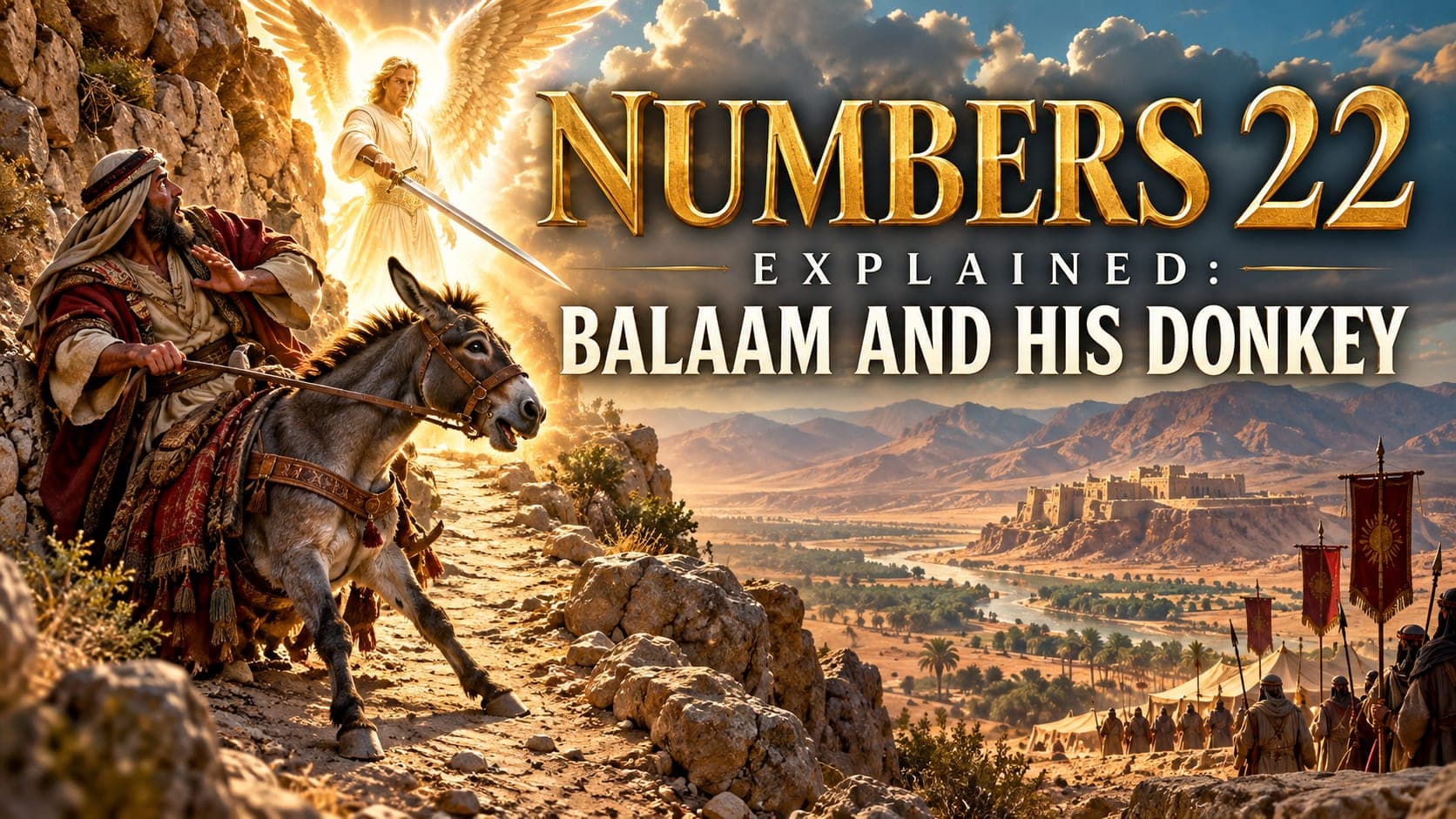
"And Balaam rose up in the morning, and saddled his ass, and went with the princes of Moab. And God's anger was kindled because he went: and the angel of the LORD stood in the way for an adversary against him."
⚠️ God told Balaam he could go, and now God is angry that he went. That is not a contradiction the text tries to hide. Permission and anger sit in the same two verses on purpose. God had already given His full answer at the first no. Allowing Balaam to walk toward the reward he kept angling for was never the same thing as being pleased that he wanted to.
The angel takes a position in the road, sword drawn, and only the donkey notices at first.
"And the ass saw the angel of the LORD standing in the way, and his sword drawn in his hand: and the ass turned aside out of the way, and went into the field: and Balaam smote the ass, to turn her into the way."
"And when the ass saw the angel of the LORD, she thrust herself unto the wall, and crushed Balaam's foot against the wall: and he smote her again."
"And when the ass saw the angel of the LORD, she fell down under Balaam: and Balaam's anger was kindled, and he smote the ass with a staff."
📌 Three times the donkey sees exactly what is in the road. Three times Balaam, the professional seer hired for his insight, sees nothing at all. A man paid to perceive what others cannot is, for the length of this entire scene, less perceptive than the animal underneath him.
5. The Donkey Speaks, and Balaam's Eyes Finally Open (verses 28 to 35)
After the third blow, God does something He has not done anywhere else in this book.
"And the LORD opened the mouth of the ass, and she said unto Balaam, What have I done unto thee, that thou hast smitten me these three times?"
"And Balaam said unto the ass, Because thou hast mocked me: I would there were a sword in mine hand, for now would I kill thee."
💡 Balaam wishes out loud for a sword, never knowing one is already drawn and aimed at him a few feet away. The irony is thick enough that the text does not need to point it out directly.
"And the ass said unto Balaam, Am not I thine ass, upon which thou hast ridden ever since I was thine unto this day? was I ever wont to do so unto thee? And he said, Nay."
A talking donkey gets a full, calm argument from Balaam, who answers her as if this were an ordinary conversation. Only after that exchange does God finally let Balaam see what his animal had seen three separate times.
"Then the LORD opened the eyes of Balaam, and he saw the angel of the LORD standing in the way, and his sword drawn in his hand: and he bowed down his head, and fell flat on his face."
"And the angel of the LORD said unto him, Wherefore hast thou smitten thine ass these three times? behold, I went out to withstand thee, because thy way is perverse before me: And the ass saw me, and turned from me these three times: unless she had turned from me, surely now also I had slain thee, and saved her alive."
📌 "Thy way is perverse before me" is a harsh verdict on a man who, by the letter of what God said in verse 20, had permission to be on this road. God is not angry at Balaam's feet for moving. He is angry at the heart carrying them, still hunting for an angle after already hearing the final word twice. And the donkey, beaten three times for doing exactly the right thing, is the reason Balaam is still alive to hear any of this at all.
Balaam's response, for the first time in the chapter, sounds like real repentance.
"And Balaam said unto the angel of the LORD, I have sinned; for I knew not that thou stoodest in the way against me: now therefore, if it displease thee, I will get me back again."
"And the angel of the LORD said unto Balaam, Go with the men: but only the word that I shall speak unto thee, that thou shalt speak. So Balaam went with the princes of Balak."
💡 The angel repeats the exact same condition God gave at night in verse 20. Nothing about the terms has changed. What changed is Balaam, who now rides toward Moab having just been physically stopped and verbally warned, with no excuse left to misunderstand what is and is not allowed to come out of his mouth.
6. Balak Meets the Prophet He Paid For (verses 36 to 41)
Balak hears Balaam is finally coming and goes out personally to meet him.
"And Balak said unto Balaam, Did I not earnestly send unto thee to call thee? wherefore camest thou not unto me? am I not able indeed to promote thee to honour?"
⚠️ Balak's greeting is impatience, not welcome. He reminds Balaam, before anything else, of the honor he is offering, the same leverage he has used from the very first delegation. Balaam's answer is the one honest thing he has said all chapter, and it sets the terms for everything in the two chapters that follow.
"And Balaam said unto Balak, Lo, I am come unto thee: have I now any power at all to say any thing? the word that God putteth in my mouth, that shall I speak."
Balak offers sacrifices, and the chapter ends with him taking Balaam up to the high places of Baal to look out over the Israelite camp spread below them.
"And it came to pass on the morrow, that Balak took Balaam, and brought him up into the high places of Baal, that thence he might see the utmost part of the people."
📌 A pagan king stands his hired prophet on his own god's high place, pointed at a nation the true God has already called blessed. Every advantage in this scene belongs to Balak: the location, the altars, the money already paid. The chapter ends on that image deliberately, because what happens next shows none of it is enough.

Hard Questions Numbers 22 Raises
Why did God tell Balaam no in verse 12, then tell him to go in verse 20? The text records both answers without softening either one. The most natural reading is that God's first answer was final and complete; nothing about Israel's blessed status changed between the two nights. The second answer grants permission to travel while keeping the actual restriction, cursing Israel, fully intact. God let Balaam go test his own motives against a door that was never really open to the outcome he wanted.
If God allowed Balaam to go, why was God's anger kindled against him for going? Verse 22 places both in the same sentence without explaining the tension away. Scripture elsewhere draws a real distinction between what God permits to happen and what God approves of in someone's heart. Balaam's own repeated attempts to ask the same question again, after an unmistakable first answer, suggest the problem was never his feet on the road. It was what he was still hoping to find at the end of it.
Why did the donkey see the angel and not Balaam, a professional seer? The text does not explain the mechanics of the donkey's sight, only that the LORD specifically opened her eyes to see the angel and later opened her mouth to speak. The irony the chapter leaves standing on its own: the man hired across hundreds of miles for his spiritual perception could not see what his own animal saw three separate times.
Was Balaam a true prophet of the LORD, or a sorcerer for hire? Numbers 22 shows both sides without resolving them into one simple label. He genuinely hears from the LORD, calls Him "the LORD my God," and in the next two chapters will speak only true blessing over Israel exactly as commanded. Yet every time the New Testament mentions him, it treats him as a warning, not an example.
"Which have forsaken the right way, and are gone astray, following the way of Balaam the son of Bosor, who loved the wages of unrighteousness; But was rebuked for his iniquity: the dumb ass speaking with man's voice forbad the madness of the prophet."
"Woe unto them! for they have gone in the way of Cain, and ran greedily after the error of Balaam for reward, and perished in the gainsaying of Core."
Both writers remember him by the reward he kept chasing, not by the accurate words he eventually spoke. That is the same question Scripture keeps asking in different places: wanting money is not itself the sin, but letting it steer what you are willing to say or do is exactly what sank Balaam. Later in Numbers itself, after failing to curse Israel outright, Balaam is tied to the counsel that led Israel into idolatry and immorality with Moab at Baal-peor, and he is killed in the war against Midian that follows. Hearing God correctly, this chapter shows, was never the same thing as having a right heart toward Him.
Top Verses From Numbers 22
1. Numbers 22:12
"And God said unto Balaam, Thou shalt not go with them; thou shalt not curse the people: for they are blessed."
The clearest sentence in the whole chapter. Everything that follows, the second delegation, the road, the sword, only happens because Balaam keeps asking past this answer.
2. Numbers 22:18
"If Balak would give me his house full of silver and gold, I cannot go beyond the word of the LORD my God, to do less or more."
Sounds like total integrity on its own. Read next to what Balaam does one verse later, it sounds more like a man announcing his principles right before testing their edges.
3. Numbers 22:28
"And the LORD opened the mouth of the ass, and she said unto Balaam, What have I done unto thee, that thou hast smitten me these three times?"
The animal underneath the prophet turns out to be the one seeing clearly. Nothing in this chapter humbles Balaam faster than his own donkey asking him a fair question.
4. Numbers 22:32 and 33
"Wherefore hast thou smitten thine ass these three times? behold, I went out to withstand thee, because thy way is perverse before me: And the ass saw me, and turned from me these three times: unless she had turned from me, surely now also I had slain thee, and saved her alive."
The donkey Balaam struck three times is the reason he is still breathing. Mercy, in this chapter, comes wearing an animal's face before it ever comes wearing an angel's.
5. Numbers 22:38
"And Balaam said unto Balak, Lo, I am come unto thee: have I now any power at all to say any thing? the word that God putteth in my mouth, that shall I speak."
The one fully honest line Balaam speaks to Balak's face, and the promise the next two chapters hold him to no matter how many altars Balak builds trying to change the outcome.
Frequently Asked Questions About Numbers 22
What is Numbers 22 about?
Numbers 22 tells how Balak, king of Moab, hires the diviner Balaam to curse Israel, how God first refuses and then allows the trip under strict conditions, and how an angel with a drawn sword and a talking donkey stop Balaam on the road before he ever reaches Moab.
Who was Balaam in the Bible?
Numbers 22:5 places him at Pethor, near the Euphrates in Mesopotamia, far from Moab. He was a diviner respected enough that a king sent messengers hundreds of miles to hire him, and he genuinely heard from the LORD, even while later Scripture remembers him mainly for loving the reward Balak offered.
Why did God tell Balaam he could go, then get angry that he went?
Numbers 22:20 and 22 record both without explaining the tension away. God's permission to travel never reopened the actual restriction given in verse 12. The anger points at Balaam's motive for wanting to go, not at the fact that God had allowed it.
Why did Balaam's donkey start talking?
Numbers 22:28 says plainly that the LORD opened the ass's mouth. The text does not explain the mechanics further, only that God used the one creature Balaam trusted most to confront the one blind spot Balaam could not see in himself.
Was Balaam a good prophet or a false one?
Numbers 22 through 24 shows him speaking only what God gives him, accurately. 2 Peter 2:15 and 16 and Jude 1:11 both remember him instead for loving payment and chasing reward, and Numbers 31:16 later ties him to the counsel that drew Israel into sin at Baal-peor. Accurate words and a right heart are not shown here to be the same thing.
Why did the angel say Balaam's way was perverse, if God had already permitted it?
Numbers 22:32 names the problem as the way being perverse, not the trip itself being forbidden. The rebuke lands on why Balaam wanted to be on that road after already hearing God's answer twice, not on the bare fact that he was traveling.
Did the donkey actually see an angel, or is this a parable?
The text presents it as a real event in the narrative, the same way it presents Sihon and Og's defeat in the previous chapter. Numbers 22:23 through 27 describes the donkey reacting three separate times to something physically in the road before Balaam himself is allowed to see it.
What happened to Balaam later?
Numbers 31:8 records him killed in Israel's war against Midian, after Numbers 31:16 names him as the source of counsel that led Israel into sin with Moab. Revelation 2:14 later calls this pattern "the doctrine of Balaam."
Why did Balak ask Midian's elders to help hire Balaam?
Numbers 22:4 and 7 show the elders of Moab and Midian sending for Balaam together. The text does not explain the alliance beyond the shared threat both nations felt watching Israel approach, a partnership that reappears later in Numbers 25 and 31.
Does Numbers 22 connect anywhere else in the Bible?
Deuteronomy 23:4 and 5 and Joshua 24:9 and 10 both look back on this exact chapter, crediting the LORD with turning Balaam's intended curse into a blessing. Micah 6:5 later tells Israel to remember what happened between Balak and Balaam as proof of the LORD's righteousness.
Final Thoughts
Numbers 22 looks like a story about a curse. It is really a story about a heart that would not take no for an answer.
📌 God's first answer was already the final answer. Everything after verse 12, the second delegation, the bigger offer, the road, the sword, only happened because Balaam kept asking past a word he had already received.
📌 Permission from God is not the same as approval of your motive. God let Balaam travel and was still angry that he went, because the trip itself was never the real issue underneath it.
📌 God can use anything, even a donkey, to stop you before you walk into real danger. The animal Balaam struck three times for doing the right thing is the reason he lived to hear the rebuke at all.
You are probably not being offered a house full of silver to curse anyone this week. But you may already know an answer you have been asking God to repeat, hoping it changes.
So here is your one next step.
Name the answer you already have, and stop asking the question again just because the offer on the table got bigger.