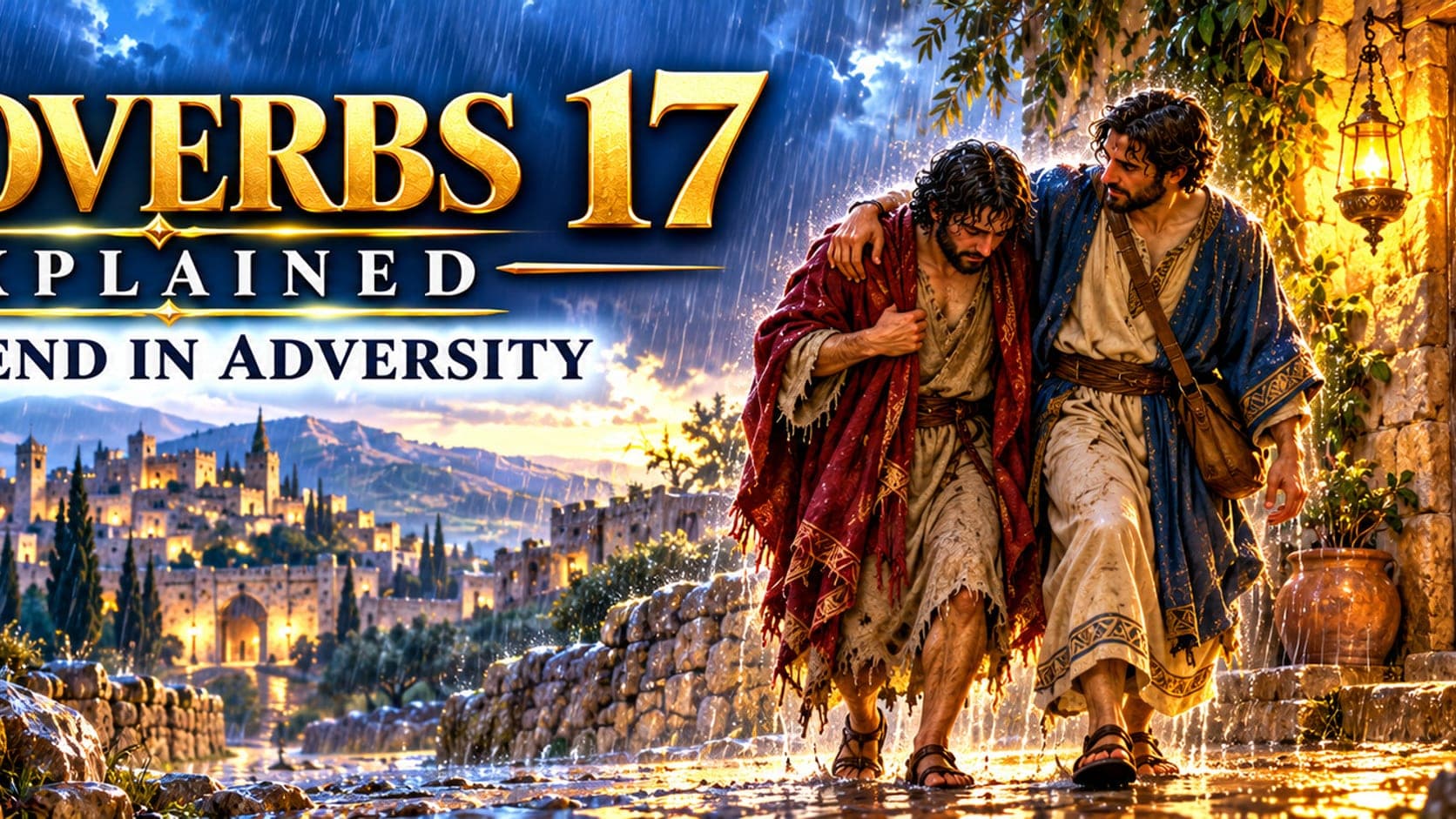
📖 Proverbs 17 Explained: A Dry Morsel and a House Full of Strife
A dry piece of bread, eaten in peace. A table loaded with meat, eaten in the middle of a fight.
Proverbs 17 explained is twenty eight short sayings that keep pricing things against each other this way: a quiet life against a loud one, an honest reproof against a hundred stripes, a merry heart against a bent scale. Nearly every verse asks you to weigh something you normally would not think to weigh.
Maybe you have sat through a nice dinner that nobody at the table actually enjoyed.
- ❓ Does verse 8 mean the Bible approves of bribery?
- ❓ How could a servant end up inheriting ahead of a son?
- ❓ Why does mocking a poor person count as an insult to God himself?
- ❓ What does it actually mean to become surety for someone in verse 18?
📌 The chapter opens by ranking a dry crust above a feast, and it never really stops running that same scale under everything else: words, friendships, money, and children.
This walkthrough goes through all twenty eight verses in the order Solomon set them down, grouped by what each cluster is actually weighing: peace against strife, a careless word against a careful one, foolish risk and real cruelty, a father's grief over a wasted son, a merry heart against a corrupted court, and finally the plain value of a closed mouth.
Read it with a scale in mind. Nearly every verse here is putting something on one.
What Happened Just Before This Chapter
Proverbs 16 closed on a lot cast into someone's lap, with the disposing of it still belonging to the LORD. Proverbs 17 opens on a far smaller scene, with no king, no lot, and no court in sight at all.
"Better is a dry morsel, and quietness therewith, than an house full of sacrifices with strife."
"Sacrifices" here points to a meal, meat from an offering that was shared and eaten with family, the richest kind of dinner this culture had. Verse 1 still ranks a dry, plain crust above it, as long as the crust comes with quiet. The same ranking Proverbs 16:8 already made about money gained the wrong way shows up again here, just moved from a bank account to a dinner table.
Proverbs 17 Explained Verse by Verse
1. A Servant's Reward and a Heart Tested Like Metal (verses 2 and 3)
Verse 1 is already quoted above. The chapter moves straight from a quiet table to a household turned upside down.
"A wise servant shall have rule over a son that causeth shame, and shall have part of the inheritance among the brethren."
📌 Birth order and blood were not the final word in this household. A son who brought shame on the family could actually lose standing to a servant who proved trustworthy, with that servant sharing in what the brothers would normally split alone. The verse is not describing a legal loophole. It is describing a household run on competence and character, not just on who was born first.
"The fining pot is for silver, and the furnace for gold: but the LORD trieth the hearts."
A fining pot held melted silver while the dross, the worthless material mixed in with it, rose to the surface and got skimmed off. A furnace did the same work on gold, at an even higher heat. Verse 3 takes both of those ordinary metalworking tools and points them at something no furnace can actually touch. The LORD does to a person what fire does to ore: He finds out what is real underneath, and no amount of composed behavior on the surface changes what the heat exposes.
2. Liars, Mockers, and a Careless Word (verses 4 to 10)
From a tested heart, the chapter turns to what a heart like that actually says, and listens to.
"A wicked doer giveth heed to false lips; and a liar giveth ear to a naughty tongue."
💡 Dishonest people do not usually get tripped up by dishonest talk. They lean toward it. Verse 4 describes a kind of sorting that happens on its own: a wicked heart finds false lips worth listening to, the same way an honest heart gets uneasy around them.
"Whoso mocketh the poor reproacheth his Maker: and he that is glad at calamities shall not be unpunished."
📌 This is not a new idea in this book. Proverbs 14 already made nearly this exact claim, that mistreating a poor person is an insult aimed at God Himself, since the poor man did not make himself poor without God's knowledge. Verse 5 widens the warning: laughing at someone else's disaster carries the same danger, whether that someone is poor or not.
"Children's children are the crown of old men; and the glory of children are their fathers."
A single plain line about generations, placed right in the middle of warnings about dishonest speech. Grandchildren honor an old man the way a crown honors a king, and a child's own glory, the verse says, is traced back to the father who raised him.
"Excellent speech becometh not a fool: much less do lying lips a prince."
Neither half of this verse is really a compliment. Polished speech sits oddly on a fool, like a tool he was never trained to use. A ruler telling outright lies is worse still, because people in power are trusted with a weight that makes their dishonesty far more costly than anyone else's.
"A gift is as a precious stone in the eyes of him that hath it: whithersoever it turneth, it prospereth."
⚠️ Read on its own, this sounds like Scripture recommending a bribe. It is not. The verse is describing how the person holding the gift sees it, a prized stone that opens doors wherever he carries it, not telling you that treating people this way is right. Proverbs is often simply honest about how the world actually works. This chapter will say something very different about a gift used to twist justice, further down, and the two verses have to be read together. What a gift is actually worth always depends on what it is buying.
"He that covereth a transgression seeketh love; but he that repeateth a matter separateth very friends."
"Covereth" does not mean hiding a crime from the people who need to know about it. It means choosing not to drag someone else's past mistake back into every conversation. Bringing it up again and again, by contrast, is exactly what ends friendships that years of loyalty built.
"A reproof entereth more into a wise man than an hundred stripes into a fool."
📌 One honest sentence does more for a teachable person than a hundred beatings do for someone who refuses to learn. The verse is not measuring pain. It is measuring what actually gets through to a person, and a wise heart lets a single true word in deeper than any amount of force could reach a closed one.
3. Fools, Cruelty, and the Danger of Standing Surety (verses 11 to 18)
The chapter turns to people who go looking for trouble, and the risk of tying yourself to one of them.
"An evil man seeketh only rebellion: therefore a cruel messenger shall be sent against him."
"Let a bear robbed of her whelps meet a man, rather than a fool in his folly."
A mother bear that has just lost her cubs is one of the most dangerous animals a person in that world could meet, unpredictable and willing to attack without warning. Verse 12 says that is still a safer encounter than a fool committed to his own folly, because at least the bear's danger is honest and visible.
"Whoso rewardeth evil for good, evil shall not depart from his house."
"The beginning of strife is as when one letteth out water: therefore leave off contention, before it be meddled with."
💡 Water let out of a dam does not stop where you want it to. Verse 14 pictures a quarrel the same way, small and containable right at the start, and nearly impossible to call back once it has actually broken loose. The wisdom here is in the timing, not the topic. Leaving off contention early is its own quiet form of self control, exercised before the flood actually starts.
"He that justifieth the wicked, and he that condemneth the just, even they both are abomination to the LORD."
These two errors look opposite on the surface, calling a guilty person innocent and calling an innocent person guilty, but the verse treats them as the exact same offense. Both bend a verdict away from the truth, and the LORD names both equally an abomination, not a lesser and a greater one.
"Wherefore is there a price in the hand of a fool to get wisdom, seeing he hath no heart to it?"
Money in a fool's hand cannot buy him wisdom, because the verse says plainly he has no actual desire for it. Wisdom was never for sale in the first place. It has always required a heart willing to receive it, and no amount of money substitutes for that willingness.
"A friend loveth at all times, and a brother is born for adversity."
📌 Two short lines that define loyalty by when it shows up, not by how it feels. A real friend's love does not take a break when things get hard. A brother's role, the verse says, is specifically for adversity, the exact season most relationships quietly thin out.
"A man void of understanding striketh hands, and becometh surety in the presence of his friend."
Striking hands sealed a deal the way a signature does today. Becoming surety meant personally guaranteeing someone else's debt, so that if the borrower could not pay, the guarantor owed the whole thing himself. Proverbs calls that move, taken lightly and in the heat of the moment, a mark of a man who has not thought it through.
4. A Froward Heart and the Grief of a Wasted Son (verses 19 to 21)
Three verses in a row turn from money and friendship to a harder, more personal cost.
"He loveth transgression that loveth strife: and he that exalteth his gate seeketh destruction."
"He that hath a froward heart findeth no good: and he that hath a perverse tongue falleth into mischief."
"Froward" describes a heart bent away from what is right, stubborn and twisted rather than straight. Verse 20 pairs it with a perverse tongue, as if the two always travel together, one shaping the other until trouble becomes a pattern rather than an accident.
"He that begetteth a fool doeth it to his sorrow: and the father of a fool hath no joy."
⚠️ This verse is not a tidy formula blaming every parent for how a child turns out. Proverbs calls a grown person a fool for choices that person keeps making, not for a diagnosis handed to him at birth. What verse 21 names honestly is the grief a parent actually carries watching someone they raised choose that path anyway, a real sorrow the rest of the Bible never pretends is small.
5. A Merry Heart, a Bent Scale, and True Understanding (verses 22 to 26)
From a father's sorrow, the chapter turns to what actually heals a person, and what quietly corrupts a courtroom.
"A merry heart doeth good like a medicine: but a broken spirit drieth the bones."
📌 Long before anyone studied the link between mindset and health, this verse already named it. A cheerful heart works on the body the way medicine does, while a crushed spirit drains something as real as bone marrow. Scripture treats the joy it calls a fruit of the Spirit as something with weight in the body, not just a pleasant feeling in the mind.
"A wicked man taketh a gift out of the bosom to pervert the ways of judgment."
Here is the other side of verse 8. A gift carried openly, that simply opens a door, is one thing. A gift taken secretly, pulled "out of the bosom" where it was hidden, specifically to twist a legal decision, is something else entirely. The difference the whole chapter cares about is never the object changing hands. It is what the hand underneath it is actually trying to buy.
"Wisdom is before him that hath understanding; but the eyes of a fool are in the ends of the earth."
A person with real understanding keeps wisdom right in front of him, close enough to actually use. A fool's eyes, by contrast, wander to the far ends of the earth, chasing distant and distracting things while the plain, near answer sits ignored.
"A foolish son is a grief to his father, and bitterness to her that bare him."
"Also to punish the just is not good, nor to strike princes for equity."
Verse 25 returns to the same grief named in verse 21, now naming the mother's bitterness alongside the father's sorrow. Verse 26 then turns the chapter's justice theme one direction further: punishing an innocent person is already wrong, and striking down a ruler specifically for ruling fairly is its own particular evil, twisting justice against the very people trying to uphold it.
6. The Wisdom of a Closed Mouth (verses 27 and 28)
The chapter ends exactly where it began, measuring something by what it costs, not by how impressive it looks.
"He that hath knowledge spareth his words: and a man of understanding is of an excellent spirit."
"Even a fool, when he holdeth his peace, is counted wise: and he that shutteth his lips is esteemed a man of understanding."
📌 The chapter that opened by praising a dry morsel over a loud feast closes by praising a shut mouth over a clever one. Verse 28 is almost a dare: even a genuine fool can borrow the appearance of wisdom for as long as he stays quiet. Real understanding does not need to prove itself in every room it enters.

Hard Questions Proverbs 17 Raises
Does verse 8 mean the Bible approves of bribery? No. The verse describes how a gift looks to the person holding it, a prized stone that opens doors wherever it travels, without saying that using people this way is right. Verse 23 makes the actual moral claim: a gift taken secretly to twist a legal decision is called wicked. Proverbs often simply tells the truth about how the world works before telling you what to do about it, and the two verses have to be read as a pair.
How could a servant actually end up inheriting ahead of a son, as verse 2 describes? Birth order mattered a great deal in this culture, but it was not the only thing that mattered. A son who disgraced the family could forfeit the trust that inheritance was built on, while a servant who proved faithful could be brought into a kind of standing birth never guaranteed on its own. The verse is less a legal technicality than a statement about what a household actually values once shame enters the picture.
Why does mocking a poor person count as an insult to God himself in verse 5? Because the poor person's situation is not outside God's knowledge or care, so laughing at it treats something God is watching as a joke. Proverbs 14 already made this same connection, which is exactly why Proverbs 17 can state it again so briefly here. It is a settled conviction in this book, not a passing comment.
What does it actually mean to become surety for someone in verse 18? It meant personally guaranteeing a debt that was not originally yours, so that if the borrower defaulted, you owed the whole amount yourself. The verse does not forbid helping someone financially. It warns against doing it on impulse, in front of an audience, without weighing what you are actually putting at risk.
Practical Tips From Proverbs 17
Twenty eight verses, most of them weighing something you can actually check against your own week.
- Choose a quiet dinner over a tense one. Verse 1 ranks peace above a full table. Stop treating conflict as an acceptable price for a bigger gathering.
- Let a single honest word in instead of defending yourself from it. Verse 10 says a wise person lets a reproof enter deeper than a fool ever lets a hundred stripes land.
- Stop a quarrel before it starts, not after it floods. Verse 14 compares strife to water let loose. Walk away from the small disagreement before it becomes the big one.
- Be the kind of friend verse 17 describes. Love that only shows up when things are easy was never the standard. Show up specifically in someone's hard season.
- Think before you guarantee someone else's debt. Verse 18 warns against striking hands in the moment. Take the time a real decision like that deserves.
- Take your own joy seriously as part of your health. Verse 22 calls a merry heart medicine. Do not treat your own discouragement as something to just push through unaddressed.
- Ask what a gift is actually buying before you give or take one. Verses 8 and 23 are not contradicting each other. They are asking you to check the motive underneath the gift.
Top 5 Bible Verses From Proverbs 17
1. Proverbs 17:17
"A friend loveth at all times, and a brother is born for adversity."
Loyalty defined by timing, not emotion. A real friend's love does not take a break the moment life gets difficult.
2. Proverbs 17:22
"A merry heart doeth good like a medicine: but a broken spirit drieth the bones."
A cheerful heart is treated as a real physical good here, not just a pleasant mood, while a crushed spirit is named as something that drains the body itself.
3. Proverbs 17:3
"The fining pot is for silver, and the furnace for gold: but the LORD trieth the hearts."
The same heat that purifies metal is pictured testing a person. Nothing about a calm surface tells you what the heart actually is underneath.
4. Proverbs 17:9
"He that covereth a transgression seeketh love; but he that repeateth a matter separateth very friends."
Choosing not to keep bringing up someone's old failure is named here as an active pursuit of love, not simply letting something slide.
5. Proverbs 17:28
"Even a fool, when he holdeth his peace, is counted wise: and he that shutteth his lips is esteemed a man of understanding."
The chapter's closing dare: even a genuine fool can wear the appearance of wisdom, for as long as he is willing to stay quiet.
Frequently Asked Questions About Proverbs 17
What is Proverbs 17 about?
It continues the book's collection of short, stand alone sayings, mostly weighing one thing against another: peace against strife, an honest word against a careless one, a merry heart against a bent scale, and a quiet life against a loud one.
What does Proverbs 17:1 mean?
It ranks a plain, dry piece of bread eaten in peace above the richest shared meal eaten in the middle of family conflict. Peace, the verse says, is worth more than the fullest table.
Does Proverbs 17:8 say bribery is good?
No. It describes how a gift looks to the person holding it, without endorsing using people this way. Verse 23, later in the same chapter, calls a gift used to pervert justice wicked, so the two verses have to be read together rather than in isolation.
What does "the LORD trieth the hearts" mean in Proverbs 17:3?
It compares God's examination of a person to the way intense heat refines silver and gold, burning away whatever is false. Nothing about a composed surface hides what the heat actually exposes underneath.
What does Proverbs 17:9 mean about covering a transgression?
It means choosing not to keep bringing up someone else's old failure in conversation after conversation. The verse calls that an active pursuit of love, and names repeating the matter instead as something that actively ends close friendships.
What does "a brother is born for adversity" mean in Proverbs 17:17?
It describes the specific purpose of real family loyalty: showing up precisely in the hard season, not only in the easy one. Paired with the first half of the verse, it defines a genuine friend the same way.
What does it mean to become surety in Proverbs 17:18?
It meant personally guaranteeing someone else's debt, so that their failure to pay became your own financial obligation. The verse warns against agreeing to this on impulse, not against ever helping someone financially.
Why does Proverbs 17 talk about grieving over a foolish son?
Verses 21 and 25 both name the real sorrow a parent carries watching a child they raised choose a foolish path. Proverbs calls the son a fool for the choices he keeps making, not as a verdict on the parent's effort.
What does Proverbs 17:22 teach about joy and health?
It treats a cheerful heart as something with real effect on the body, calling it medicine, and names a crushed spirit as something that drains the body the way dried out bones are weakened.
What is the main lesson of Proverbs 17?
That quiet, honest, and loyal almost always outweigh loud, clever, and well timed, whether the subject is a meal, a friendship, a courtroom, or your own mouth, from the dry morsel in verse 1 to the closed lips in verse 28.
Final Thoughts
Proverbs 17 keeps putting ordinary things on a scale most people never think to use.
📌 Peace is worth more than a full table. Verse 1 says so before the chapter has made a single other point.
📌 A real friend's love is proven in the hard season, not the easy one. Verse 17 will not let you call something loyalty that only shows up when it is convenient.
📌 What you say, or refuse to say, outweighs how clever it sounds. Verse 28 closes the chapter by ranking a closed mouth above a sharp one.
So here is your one next step.
Pick the one argument you are currently most tempted to keep going, and leave it off today, before it is meddled with, the way verse 14 describes.
A dry morsel eaten in peace will outlast whatever that argument was actually worth.