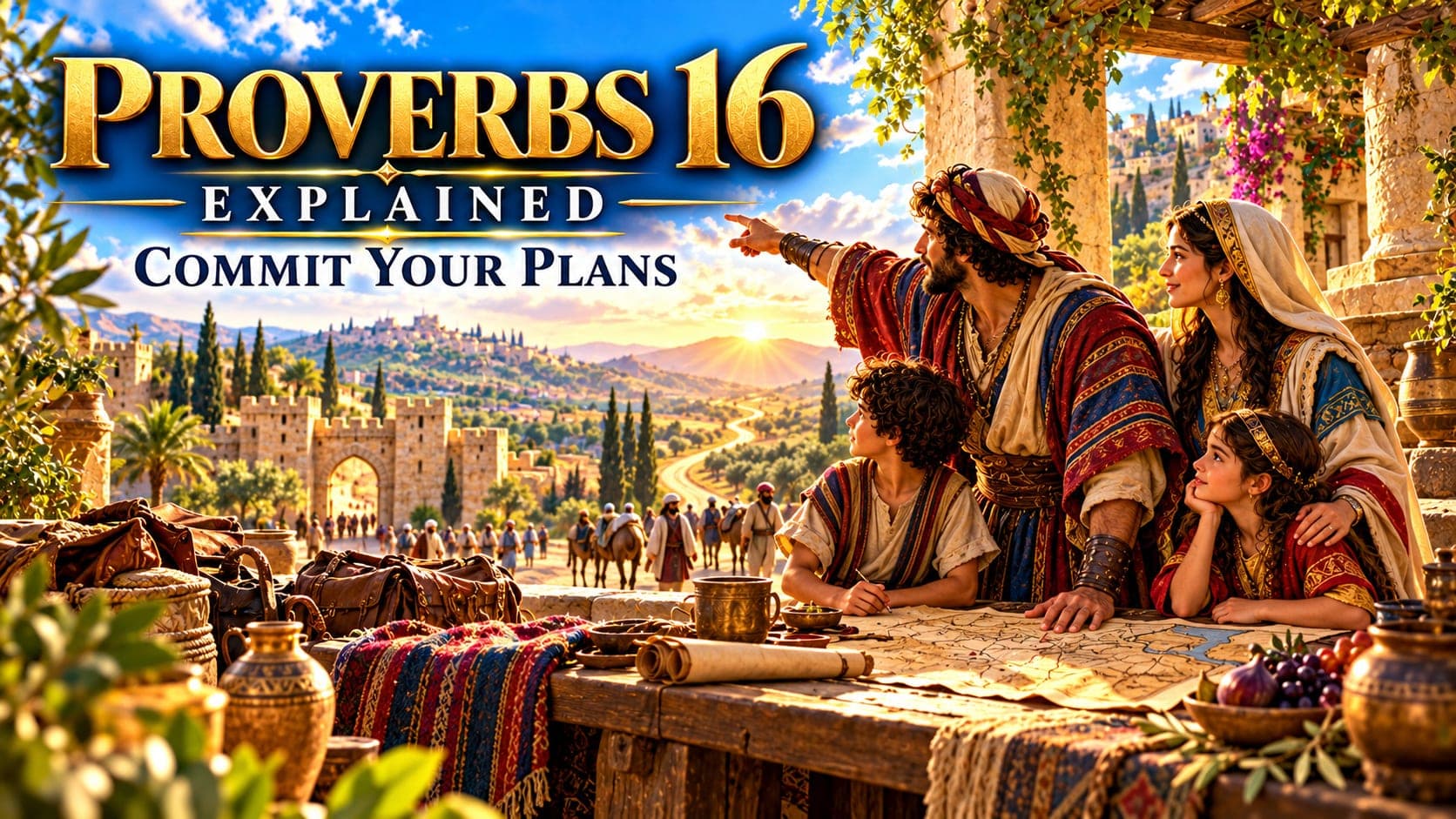
📖 Proverbs 16 Explained: The LORD Who Directs Every Step
You make a plan. You open your mouth to explain it. And somewhere between the plan and the words actually landing, something bigger than you has already stepped in.
Proverbs 16 explained is thirty three verses built almost entirely around that one tension, looked at from a half dozen different angles: kings and their courts, pride and humility, honest words and scheming lips, gray hair and a lot dropped into someone's lap. Every angle lands on the same place.
Maybe you have planned something carefully this year and watched it go somewhere else entirely.
- ❓ Does verse 4 mean God made some people just to be wicked?
- ❓ Why does verse 18 actually say "pride goeth before destruction," not "before a fall"?
- ❓ Why does verse 25 repeat almost exactly what Proverbs 14:12 already said?
- ❓ Is casting a lot in verse 33 the same thing as fortune telling?
📌 The chapter opens with a man's heart making preparations and closes with a lot landing in his lap, and both verses close on the same two words: the LORD.
This walkthrough moves through all thirty three verses in the order Solomon wrote them, following the chapter from a man's own plans, through a king's court, into pride and humility, honest and scheming speech, and finally gray hair and a lot cast into someone's lap.
Slow down here. The whole chapter is quietly making one argument, from a new angle every few verses.
What Happened Just Before This Chapter
Proverbs 15 ended by putting humility ahead of honour, insisting that whatever you hope to receive has to wait behind a lowered head first. Proverbs 16 opens by asking an even bigger question: who is actually running the plans you are so sure are your own.
"The preparations of the heart in man, and the answer of the tongue, is from the LORD."
Whatever you work out quietly in your own heart, Solomon says, the actual words that come out of your mouth already answer to someone else. Planning is real. It is just never the whole story.
Proverbs 16 Explained Verse by Verse
1. The LORD Behind Every Plan (verses 1 to 4)
Verse 1 is already quoted above. The chapter immediately presses the same point from the angle of self judgment.
"All the ways of a man are clean in his own eyes; but the LORD weigheth the spirits."
📌 Feeling clean is not the same thing as being clean. Your own conscience, left to grade itself, will pass almost anything you actually want to do. "Weigheth the spirits" pictures God putting the hidden motive behind an action on a scale, not just inspecting the visible deed.
"Commit thy works unto the LORD, and thy thoughts shall be established."
💡 "Commit" pictures rolling something heavy off your own shoulders onto someone strong enough to actually carry it, the same picture Psalm 37 uses for handing God your path. "Established" means settled and steady, the opposite of a mind that keeps circling back to a decision it already made.
Then comes the hardest line in the chapter.
"The LORD hath made all things for himself: yea, even the wicked for the day of evil."
⚠️ Read fast, this sounds like God manufacturing wicked people on purpose. Read carefully, and the verse is making a narrower claim than that, worth the full treatment it gets further down in Hard Questions.
2. Pride, Mercy, and the Steps the LORD Directs (verses 5 to 9)
The chapter turns from self judgment to a specific sin it keeps circling back to.
"Every one that is proud in heart is an abomination to the LORD: though hand join in hand, he shall not be unpunished. By mercy and truth iniquity is purged: and by the fear of the LORD men depart from evil."
"Hand join in hand" is an old picture for a sealed agreement, people shaking on it, allies locking arms. However many partners the proud man lines up behind him, verse 5 says the outcome does not change. Verse 6 then names what actually clears guilt. Not a clever defense. Mercy and truth, paired with a real fear of the LORD.
"When a man's ways please the LORD, he maketh even his enemies to be at peace with him. Better is a little with righteousness than great revenues without right."
Verse 7 is not a guarantee that every godly person gets along with everyone. It describes a pattern, not a promise with no exceptions: God can soften even hostile relationships when a person's direction actually pleases Him. Verse 8 then takes up a scale this book keeps returning to, how much a pile of money is actually worth once you ask where it came from.
"A man's heart deviseth his way: but the LORD directeth his steps."
📌 This is the verse the whole chapter is really built around. "Deviseth" is active, deliberate thinking. You really do plan your own route. But "directeth" describes someone else actually steering the steps that carry the plan out. Both halves are true at once, and the chapter will not let you collapse either one into the other.
3. A King Who Speaks With Weight (verses 10 to 15)
The chapter narrows from any man's heart to one very specific office.
"A divine sentence is in the lips of the king: his mouth transgresseth not in judgment."
This describes what a king under God was supposed to be, a mouth that ruled under God's own standard of judgment rather than his own appetite. Israel's actual kings did not always live up to it, which is exactly why the next verse grounds fair dealing somewhere more reliable than any human ruler.
"A just weight and balance are the LORD's: all the weights of the bag are his work. It is an abomination to kings to commit wickedness: for the throne is established by righteousness."
A merchant could rig a scale with a lighter weight hidden in his bag. Verse 11 says every honest scale actually belongs to the LORD before it belongs to any trader, which means cheating a customer was never only a business matter. Verse 12 applies the same standard upward: a throne stands on righteousness, not on raw power.
"Righteous lips are the delight of kings; and they love him that speaketh right. The wrath of a king is as messengers of death: but a wise man will pacify it."
💡 Verse 14 is not advice to flatter a dangerous ruler. It is a plain observation about proximity to real power in the ancient world, where a king's anger could move as fast as an executioner, and a wise person learned when and how to speak carefully in a room like that.
"In the light of the king's countenance is life; and his favour is as a cloud of the latter rain."
The latter rain fell in spring, right when crops needed it most to actually ripen into a harvest. A king's favor, pictured this way, was not a pleasant mood. It was the one thing that could make an entire year's work finally pay off.
4. Wisdom Worth More Than Gold, and Pride Before the Fall (verses 16 to 19)
From a king's court the chapter widens back out to anyone weighing what actually matters.
"How much better is it to get wisdom than gold! and to get understanding rather to be chosen than silver! The highway of the upright is to depart from evil: he that keepeth his way preserveth his soul."
Proverbs 9 already called wisdom more valuable than silver. Verse 16 restates it with an exclamation point, while verse 17 turns the comparison into an actual road, a highway built by steadily departing from evil rather than one dramatic exit.
"Pride goeth before destruction, and an haughty spirit before a fall."
📌 Most people quote half of this verse and blend it with the other half. It is not one line about pride before a fall. It is two matched lines: pride leads to destruction, and a haughty spirit leads to a fall, the same warning said twice in slightly different words for emphasis, not a single sentence that got shortened over the years.
"Better it is to be of an humble spirit with the lowly, than to divide the spoil with the proud."
Dividing the spoil pictures the winning side of a battle splitting up the plunder, as good as a windfall gets in that world. The verse still puts a humble life among ordinary people ahead of it, the same ranking verse 8 already made about money gained the wrong way.
5. Words That Heal, and a Way That Ends in Death (verses 20 to 25)
The chapter returns to speech, now weighing what wisdom actually sounds like out loud.
"He that handleth a matter wisely shall find good: and whoso trusteth in the LORD, happy is he. The wise in heart shall be called prudent: and the sweetness of the lips increaseth learning."
"Understanding is a wellspring of life unto him that hath it: but the instruction of fools is folly. The heart of the wise teacheth his mouth, and addeth learning to his lips."
💡 Verse 23 reverses the order most people assume. The mouth does not lead and the heart follow along behind it. The heart does the teaching first, quietly, and the lips only ever say what the heart already worked out.
"Pleasant words are as an honeycomb, sweet to the soul, and health to the bones."
Right after that picture of sweetness, the chapter turns without warning to its sharpest line.
"There is a way that seemeth right unto a man, but the end thereof are the ways of death."
📌 This chapter has spent nine verses proving exactly why this warning is necessary. Verse 9 already told you a man plans his own route while the LORD steers the actual steps. Verse 25 is the danger hiding inside that truth: a route can feel completely settled in your own heart and still run straight into death. Confidence was never proof of direction, this chapter already showed that in verse 2.
6. Secret Schemers and Open Troublemakers (verses 26 to 30)
The chapter turns to people who use their words and their silence to cause harm.
"He that laboureth laboureth for himself; for his mouth craveth it of him. An ungodly man diggeth up evil: and in his lips there is as a burning fire."
Verse 26 is almost comically plain: hunger is what gets most people out of bed and to work. Verse 27 pictures something darker, a man who has to dig for evil the way a laborer digs for anything else, treating cruelty like a job he shows up for.
"A froward man soweth strife: and a whisperer separateth chief friends."
⚠️ "Chief friends" means the closest relationships a person has, not casual acquaintances. A whisperer does not need a public platform to do damage. One quiet word in the right ear can end a friendship years of actual loyalty built.
"A violent man enticeth his neighbour, and leadeth him into the way that is not good. He shutteth his eyes to devise froward things: moving his lips he bringeth evil to pass."
Verse 30 is almost a snapshot: eyes closed, lips moving without sound, a man rehearsing a plan before he ever says it out loud. Scheming, the verse suggests, has a posture you can actually catch if you are watching for it.
7. Gray Hair, a Quiet Victory, and the Lot in the Lap (verses 31 to 33)
The chapter closes with three short, separate sayings that land harder together than alone.
"The hoary head is a crown of glory, if it be found in the way of righteousness."
Gray hair alone is not the crown here. The verse attaches an if to it. Age earns honor only when it was actually spent walking in righteousness, not simply by surviving long enough to turn gray.
"He that is slow to anger is better than the mighty; and he that ruleth his spirit than he that taketh a city."
📌 Taking a city was the loudest kind of victory the ancient world had. This verse ranks something far quieter above it: a person who actually rules his own temper has won a harder battle than an army that just conquered a wall.
"The lot is cast into the lap; but the whole disposing thereof is of the LORD."
📌 The chapter opened with a man's heart preparing something, handed over to the LORD. It closes with a lot landing in someone's lap, handed over to the same LORD in the same two closing words. Thirty one verses of kings, pride, honest scales, and scheming lips, framed on both ends by the one fact none of it ever escapes.
Hard Questions Proverbs 16 Raises
Does verse 4 mean God deliberately made some people to be wicked? The verse does not say God authors wickedness or forces anyone into it. "Made all things for himself" says every created thing ultimately serves God's own purposes, whether it cooperates willingly or not. "Even the wicked for the day of evil" is best read the same way the rest of the Bible talks about judgment: the wicked are not outside God's control, and their own path is already heading toward a day of reckoning God has set. That is a claim about where defiance ends up, not a claim about who made someone defiant in the first place.
Why does verse 25 repeat Proverbs 14:12 almost word for word? The two verses are nearly identical, down to a single word swapped between them, and Proverbs almost never repeats a full line like that. Here the repetition lands somewhere new. It arrives right after verse 9 has already spent the whole chapter building toward the same point from a different direction: you plan, the LORD directs. Verse 25 is what happens to a person who skips past that tension and simply trusts his own plan all the way to the end.
Do verses 9 and 33 mean people do not really make free choices? The chapter never resolves that question philosophically, and it is not trying to. It holds two things together without picking one: real planning, real work, and a real lot actually cast by a real hand, alongside a LORD who directs where all of it lands. Christians have argued for centuries about exactly how human choice and God's control fit together. Proverbs simply refuses to let you use either one as an excuse to stop planning wisely or stop trusting the outcome to someone bigger than you.
Is casting a lot in verse 33 the same thing as fortune telling? No. Scripture condemns divination and sorcery elsewhere as attempts to pry secret knowledge out of false gods. Casting a lot was a different practice entirely, an accepted way of letting God settle a specific decision, used to divide the Promised Land among Israel's tribes and later to choose a replacement apostle in Acts 1. The point was never controlling an unseen future. It was handing a real decision to God and trusting whatever came up.
Practical Tips From Proverbs 16
Thirty three verses, most of them aimed at something you can actually test today.
- Hand your plan to God before you need the outcome to work out. Verse 3 ties a settled mind to committing your work to the LORD first, not after it already goes wrong.
- Do not trust your own verdict on yourself. Verse 2 says your own ways always look clean from the inside. Ask someone outside your own head for a second opinion.
- Notice when confidence is doing the work certainty should be doing. Verse 25 warns that a route can feel completely right and still end badly. Feeling sure is not the same as being right.
- Let your heart teach your mouth before you speak, not after. Verse 23 puts the heart first. Pause before a hard conversation long enough to actually think it through.
- Treat ruling your own temper as a real victory, not a small one. Verse 32 ranks it above conquering a city. Give yourself credit the next time you actually hold it together.
- Bring the decision you cannot reason your way through to God directly. Verse 33 trusted even a lot in someone's lap to the LORD's hand. Your hardest open question is not too small to bring to Him either.
Top 5 Bible Verses From Proverbs 16
1. Proverbs 16:9
"A man's heart deviseth his way: but the LORD directeth his steps."
The verse the rest of the chapter keeps circling back to. Real planning and real divine direction, held together without either one canceling out the other.
2. Proverbs 16:18
"Pride goeth before destruction, and an haughty spirit before a fall."
Two matched warnings, not the single shortened phrase most people quote. Pride and destruction, a haughty spirit and a fall, said twice for weight.
3. Proverbs 16:3
"Commit thy works unto the LORD, and thy thoughts shall be established."
A settled mind is pictured here as the result of handing your plans to God, not the cause of finally being able to.
4. Proverbs 16:32
"He that is slow to anger is better than the mighty; and he that ruleth his spirit than he that taketh a city."
A quiet internal victory ranked above the loudest kind of military conquest the ancient world had to offer.
5. Proverbs 16:33
"The lot is cast into the lap; but the whole disposing thereof is of the LORD."
The chapter's closing line, answering its opening one. Whatever lands in your lap, the disposing of it was never only chance.

Frequently Asked Questions About Proverbs 16
What is Proverbs 16 about?
It continues the book's collection of short, stand alone proverbs, built mostly around one question: how a person's own plans, pride, speech, and choices relate to a LORD who is quietly directing where all of it actually lands.
What does Proverbs 16:9 mean?
It means real planning and real divine direction both happen at once. A person genuinely works out his own route, but the LORD is the one who actually directs the steps that carry it out.
Does Proverbs 16:18 really say "pride comes before a fall"?
Not exactly. The actual verse is two matched lines: pride leads to destruction, and a haughty spirit leads to a fall. The familiar shortened version blends both halves into one sentence that is not quite how Proverbs wrote it.
What does Proverbs 16:3 mean by committing your works to the LORD?
It pictures handing a plan over to God the way you would roll a heavy weight onto someone strong enough to carry it. The settled thoughts the verse promises come after that handoff, not before it.
Does Proverbs 16:4 mean God made some people to be evil?
The verse says everything exists for God's purposes and the wicked are not outside His control, heading toward a day of reckoning He has already set. It does not say He authored their wickedness. That reading would contradict how the rest of Scripture describes the source of sin.
Why does Proverbs 16:25 repeat Proverbs 14:12?
Proverbs rarely repeats a full line, so twice is notable. Here it arrives right after the chapter has spent nine verses building toward the same warning from a new angle, landing the point exactly where a reader is most tempted to trust a plan that merely feels right.
What does "casting a lot" mean in Proverbs 16:33?
It was an accepted ancient practice for settling a specific decision, used to divide territory among Israel's tribes and to choose a replacement apostle in Acts 1. It is different from forbidden divination, which sought secret knowledge from false gods instead of simply trusting a real decision to the true one.
What does Proverbs 16:32 mean about ruling your own spirit?
It ranks self control above military conquest, the most visible kind of victory in the ancient world. Staying slow to anger and actually governing your own temper is called a harder, better win than taking a city by force.
Why does Proverbs 16 talk so much about kings?
Verses 10 through 15 describe what kingship under God was supposed to look like, honest judgment, hatred of wickedness, and favor that could make or break an entire year's work. It sets the standard any leader, not only an ancient king, is measured against.
What is the main lesson of Proverbs 16?
That you are genuinely responsible to plan, work, speak carefully, and master your own temper, while the final direction of all of it still belongs to the LORD, from the heart that prepares something in verse 1 to the lot that lands in a lap in verse 33.
Final Thoughts
Proverbs 16 keeps asking the same question from a new direction every few verses: whose hand is actually on this.
📌 You plan. The LORD directs the steps. Verse 9 will not let you collapse either half of that into the other.
📌 Confidence was never proof of direction. Verse 25 names a road that feels entirely right and still ends in death, right after nine verses already warned you not to trust your own verdict alone.
📌 Ruling your own temper outranks conquering a city. Verse 32 puts a quiet, internal win above the loudest victory the ancient world knew.
So here is your one next step.
Take the one plan you are currently most sure of, and hand it to God out loud today, the way verse 3 describes.
Whatever lands in your lap after that, verse 33 already told you whose hand it is in.