📖 Proverbs 26 Explained: Fools, Sluggards, and Answering Both Ways
A dog eats something it already threw up. A man rolls a stone up a hill knowing it will roll back down on him. Solomon picked ugly pictures on purpose.
Proverbs 26 explained is twenty eight verses almost entirely about one subject, the fool, with a sluggard and a handful of liars and talebearers mixed in along the way. No chapter in the whole book stacks this many comparisons back to back, each one a tiny, vivid picture of what foolishness actually looks like up close.
Maybe you have wondered whether answering a difficult person is even worth the trouble.
- ❓ Why does verse 4 say not to answer a fool, then verse 5 says to answer him?
- ❓ What does the great God rewarding fools and transgressors in verse 10 actually mean?
- ❓ Why does the Bible compare a fool to a dog returning to its own vomit?
- ❓ Is the sluggard's lion in verse 13 a real excuse or a made up one?
📌 Proverbs 26 keeps asking the same question from a dozen different angles: what do you do when the person in front of you will not reason, will not work, and will not tell you the truth?
This walkthrough goes through all twenty eight verses in the order Solomon set them down, grouped by what each cluster pictures: honour that does not belong on a fool, an answer that seems to contradict itself, seven mirrors held up to a fool, a sluggard who fears a lion that is not there, a man who starts fires and calls it a joke, talebearers who keep the fire burning, and a hater's disguise, a pit, and a flattering mouth.
Read it slowly. Solomon is describing a pattern you will recognize.
What Happened Just Before This Chapter
Proverbs 25 ended with a person who has no rule over his own spirit, pictured as a city with its walls torn down. Proverbs 26 picks up that exact kind of person and spends the whole chapter looking at what he actually does once there is nothing left standing between him and whoever he meets.
"As snow in summer, and as rain in harvest, so honour is not seemly for a fool."
Snow in summer and rain at harvest are not just bad weather. They are weather that shows up at exactly the wrong time, out of season, wrecking whatever depended on the season staying normal. Honour given to a fool is the same kind of wrongness, not impossible, just completely out of place.
Proverbs 26 Explained Verse by Verse
1. Honour Unfit for a Fool, and a Rod for His Back (verses 2 and 3)
From a season out of order, the chapter moves to a curse that never finds its target.
"As the bird by wandering, as the swallow by flying, so the curse causeless shall not come."
📌 A bird that just wanders, or a swallow simply flying around, never lands anywhere in particular. An undeserved curse is pictured the same way, all motion and no landing. It is said, it leaves someone's mouth, and then it simply does not arrive where it was aimed.
"A whip for the horse, a bridle for the ass, and a rod for the fool's back."
Three stubborn creatures, three different tools, and none of them is a conversation. A horse needs a whip to move, a donkey needs a bridle to be steered, and a fool, Solomon says bluntly, needs a rod the same way. This is not the chapter's whole view of fools. It is the blunt edge of it, set down before the much more careful verses that follow about whether talking to a fool is even worth attempting.
2. Answering a Fool Both Ways (verses 4 and 5)
Two verses sit side by side, and on the surface they tell you to do opposite things.
"Answer not a fool according to his folly, lest thou also be like unto him. Answer a fool according to his folly, lest he be wise in his own conceit."
⚠️ This is the most quoted pair of verses in the chapter, and it deserves more than a quick read. What each verse is actually guarding against, and how both can be true at once, is covered fully in Hard Questions below.
💡 For now, notice what both verses have in common. Neither one is really about the fool. Both are about what happens to you, becoming like him or letting him think he has won, depending on which danger is closer in the moment.
3. Seven Mirrors Held Up to a Fool (verses 6 to 12)
Having raised the hardest question in the chapter, Solomon spends the next seven verses simply describing what a fool looks like from different angles.
"He that sendeth a message by the hand of a fool cutteth off the feet, and drinketh damage."
📌 Trusting an urgent message to an unreliable person is pictured as self harm. You needed feet to carry it, and you cut your own off by choosing a messenger who cannot be trusted to arrive or repeat it correctly.
"The legs of the lame are not equal: so is a parable in the mouth of fools. As he that bindeth a stone in a sling, so is he that giveth honour to a fool. As a thorn goeth up into the hand of a drunkard, so is a parable in the mouth of fools."
Three images, and the middle one is boxed in by two nearly identical lines about a parable in a fool's mouth. A wise saying only works when the one repeating it understands it, the same way legs only work when they match. In a fool's mouth, true words become as useless as legs that do not match, or as pointless as a thorn gripped by a hand too drunk to feel it. The stone tied into a sling, sitting between those two lines, pictures honour simply thrown at a fool, effort aimed the wrong way entirely.
"The great God that formed all things both rewardeth the fool, and rewardeth transgressors."
❓ This is widely recognized as one of the hardest single verses to translate confidently anywhere in Proverbs. What it is most likely saying, and why even careful readers land in different places on it, is covered in Hard Questions below.
"As a dog returneth to his vomit, so a fool returneth to his folly."
📌 This is the single most famous line in the chapter, and the New Testament quotes it directly. Peter calls it "the true proverb" while describing people who knew the right way and still turned back to what had already made them sick.
"But it is happened unto them according to the true proverb, The dog is turned to his own vomit again; and the sow that was washed to her wallowing in the mire."
💡 Peter is not describing one bad habit. He is describing folly as something physically returned to, the way a dog is pulled back by its own nature to what already made it sick.
"Seest thou a man wise in his own conceit? there is more hope of a fool than of him."
A plain fool at least suspects something is wrong with him. A man certain of his own wisdom has shut that door himself, and Solomon ranks him below the fool on purpose. The same self assessment returns four verses later, one letter sharper, wiser instead of wise, about a very different kind of person.
4. The Sluggard Who Fears a Lion That Is Not There (verses 13 to 16)
From the fool who will not listen, the chapter turns to the sluggard who will not move.
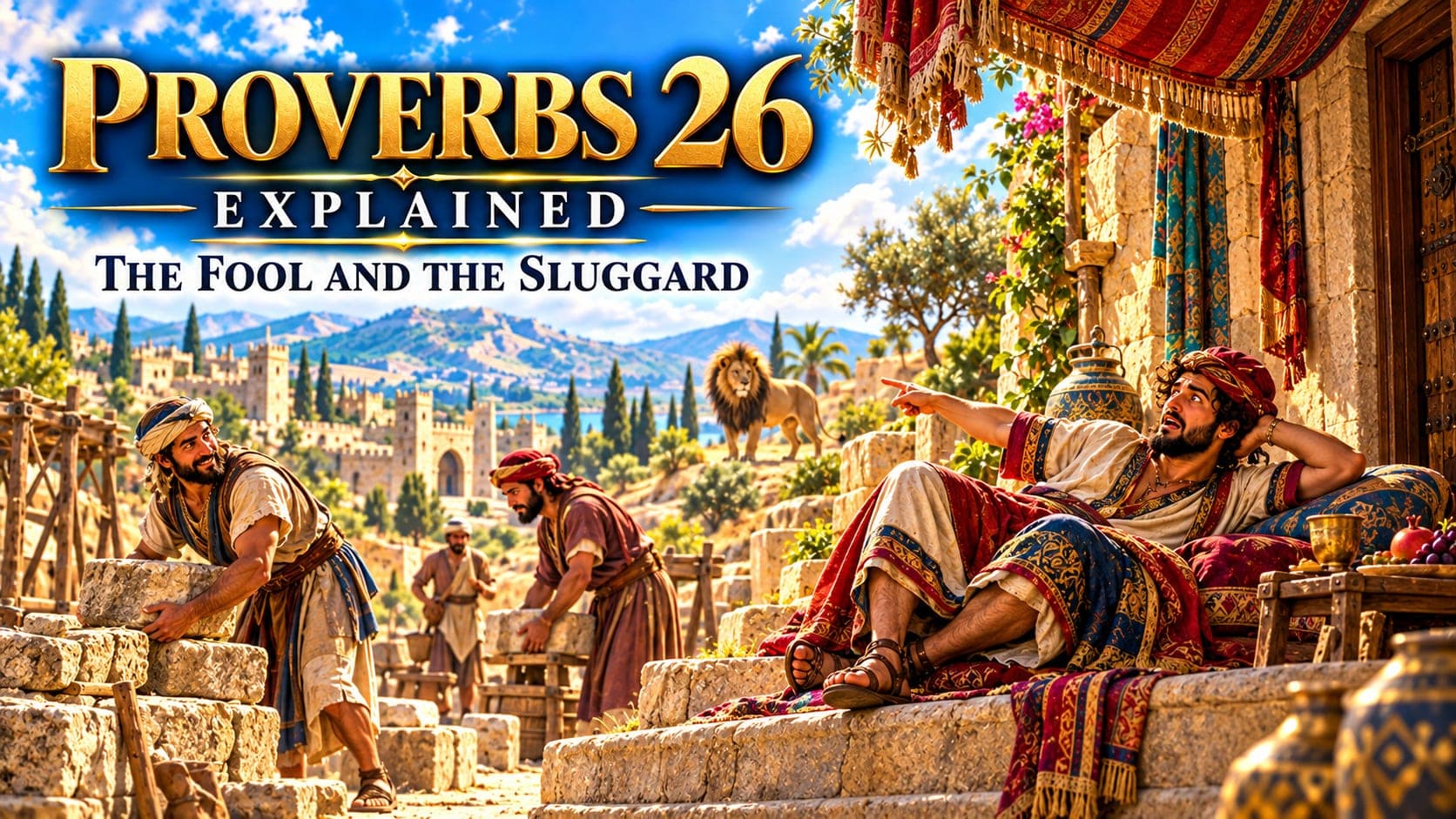
"The slothful man saith, There is a lion in the way; a lion is in the streets."
📌 This is almost the exact same excuse Solomon already recorded in an earlier collection. Proverbs 22 caught the sluggard inventing a lion to avoid going outside at all. Here the lion has multiplied, one in the way and a second in the streets, as if the first excuse needed reinforcement.
"As the door turneth upon his hinges, so doth the slothful upon his bed. The slothful hideth his hand in his bosom; it grieveth him to bring it again to his mouth."
⚠️ A door swings on its hinges without ever going anywhere, exactly the picture of a man turning over in bed. And a hand too tired to finish the short trip from a bowl to his own mouth is not describing weakness. It is a will that has given out over something that should take no effort at all.
"The sluggard is wiser in his own conceit than seven men that can render a reason."
💡 That same self assessment from verse 12 returns here, now attached to a man too lazy to feed himself. Proverbs 6 already sent this same kind of man to watch an ant work without a single overseer standing over it. Here Solomon skips the ant and names the self deception directly: certain he out thinks seven reasonable people while he cannot manage to lift a spoon.
5. Meddling, Firebrands, and the Man Who Was Just Joking (verses 17 to 19)
The chapter moves from a man who will not act to men who act in exactly the wrong direction.
"He that passeth by, and meddleth with strife belonging not to him, is like one that taketh a dog by the ears."
Grabbing a strange dog by the ears does not calm it down. It guarantees you get bitten by a problem that was never reaching for you in the first place. Stepping into someone else's argument uninvited works the same way, turning a fight that had nothing to do with you into one that suddenly does.
"As a mad man who casteth firebrands, arrows, and death, So is the man that deceiveth his neighbour, and saith, Am not I in sport?"
📌 Throwing burning sticks and loosed arrows into a crowd is not a prank by any honest measure, and neither is this. "Am not I in sport" is the oldest cover story for real damage, the claim that words or tricks meant to wound someone do not count as harm simply because the one doing it calls it a joke afterward.
6. Talebearers and the Contentious Man (verses 20 to 23)
From a man playing at deception, the chapter turns to the fuel that keeps real conflict burning.
"Where no wood is, there the fire goeth out: so where there is no talebearer, the strife ceaseth. As coals are to burning coals, and wood to fire; so is a contentious man to kindle strife."
📌 Strife is pictured here as a fire with a fuel supply, not a force that simply exists. Cut off the wood, the gossip and the stirring, and the fire genuinely does go out on its own. It almost never needs to be fought directly. It mostly just needs to be starved.
"The words of a talebearer are as wounds, and they go down into the innermost parts of the belly."
Solomon liked this line enough to write it twice, word for word the same back in Proverbs 18:8. Gossip does not stay on the surface, the way an actual wound does not stay on the skin. It is swallowed and settles somewhere deep, which is why it keeps doing damage long after the conversation that delivered it is over.
"Burning lips and a wicked heart are like a potsherd covered with silver dross."
💡 Silver dross is the waste skimmed off melted silver, and a cheap clay pot coated in it would briefly shine like real metal before anyone noticed the clay underneath. Proverbs 25 already used dross as the waste a silversmith removes to get a usable vessel. Here it disguises one, warm words glazing over a heart that has not actually changed.
7. The Hater's Disguise, the Pit You Dig, and a Flattering Mouth (verses 24 to 28)
The chapter closes by pulling back the glazed surface from the last section to show what is underneath it.
"He that hateth dissembleth with his lips, and layeth up deceit within him; When he speaketh fair, believe him not: for there are seven abominations in his heart. Whose hatred is covered by deceit, his wickedness shall be shewed before the whole congregation."
📌 Seven abominations is not a literal count to go looking for. It is Hebrew shorthand for a hatred that is thorough, a whole stockpile rather than a single grudge. Verse 26 promises the disguise does not hold forever. Deceit covering hatred is still shown in full view of everyone eventually, not hidden permanently just because it was well managed for a while.
"Whoso diggeth a pit shall fall therein: and he that rolleth a stone, it will return upon him."
Both images describe effort that eventually works against the person making it. A pit dug to trap someone else has to go somewhere, and a stone pushed toward someone else has gravity working against it the whole way. Neither picture needs God to step in directly. The trap and the stone simply behave the way traps and stones behave.
"A lying tongue hateth those that are afflicted by it; and a flattering mouth worketh ruin."
⚠️ The chapter ends on a hard pairing. A lie does not land on someone by accident, the lying tongue is described as actually hating the person it damages. And flattery, which sounds like the opposite of a lie, is placed right beside it, working the exact same kind of ruin through a much softer door.

Hard Questions Proverbs 26 Raises
Do Proverbs 26:4 and 5 contradict each other? Only if you read them as one rule instead of two separate warnings. Verse 4 warns against trading insult for insult, since that actually makes you like the fool. Verse 5 warns against silence that lets a fool walk away thinking no one could answer him, more confident in his own foolishness than before. Both agree on the goal, keeping a fool from winning either way. They simply name two different ways he can win, and which danger is closer in the moment decides which verse applies.
What does "the great God that formed all things both rewardeth the fool, and rewardeth transgressors" mean in Proverbs 26:10? Honest answer: this is one of the most difficult single verses in the whole book to translate with confidence, and careful readers of the Hebrew do not all land in the same place on it. Read the way the King James words it, the verse says God, as the one who formed everyone, ultimately deals with both the fool and the transgressor, a statement that no one escapes answering to Him in the end. Other translations render the underlying Hebrew differently, closer to random, reckless harm done by whoever carelessly puts a fool or a stranger into a role he is not equipped for. What stays true either way is the point sitting right beside it: putting a fool somewhere he does not belong, whether that is honour in verse 8 or responsibility here, tends to end badly for someone.
Does Proverbs 26:2 mean a curse never has any power, even when it is deserved? The verse specifically names a curse that is causeless, without real grounds behind it, not curses in general. The picture is a bird or a swallow simply flying around without ever settling anywhere, which is the point: words spoken against someone who has not actually done anything to deserve them do not carry the weight the speaker imagines. The verse offers no comment on a true, deserved warning of consequences, which Proverbs elsewhere treats very differently from an empty insult thrown at someone for no reason.
Practical Tips From Proverbs 26
Twenty eight verses, most of them describing a pattern you can catch in your own week.
- Ask which danger is closer before you answer a difficult person. Verses 4 and 5 are not opposites. Decide whether silence or engagement is more likely to feed their foolishness right now.
- Do not send your most important message through an unreliable person. Verse 6 calls that self harm, not bad luck. Choose the messenger as carefully as the message.
- Notice when you are more certain than you are correct. Verse 12 ranks a man wise in his own conceit below an honest fool. Being sure of yourself is not the same thing as being right.
- Name your own invented lion. Verse 13 is an excuse, not a real danger. Ask what task you are avoiding behind a threat that only exists in your head.
- Stay out of a fight that was never reaching for you. Verse 17 compares uninvited meddling to grabbing a strange dog by the ears. Let it pass you by instead.
- Starve strife instead of fighting it directly. Verses 20 and 21 picture conflict as a fire that needs fuel. Stop feeding it with talk and it tends to go out on its own.
- Watch for flattery doing the same damage as an outright lie. Verse 28 puts them side by side on purpose. A compliment that is not true is still working against you.
Top 5 Bible Verses From Proverbs 26
1. Proverbs 26:4 and 5
"Answer not a fool according to his folly, lest thou also be like unto him. Answer a fool according to his folly, lest he be wise in his own conceit."
A contradiction only if you miss that these two verses guard against two different dangers rather than give one rule.
2. Proverbs 26:11
"As a dog returneth to his vomit, so a fool returneth to his folly."
Quoted directly in 2 Peter 2:22 as "the true proverb," this is the single most recognized line in the chapter, describing folly as something returned to, not a one time mistake.
3. Proverbs 26:12
"Seest thou a man wise in his own conceit? there is more hope of a fool than of him."
A sharper warning than it first sounds. A fool at least suspects something is wrong. Certainty in your own wisdom closes that door yourself.
4. Proverbs 26:20 and 21
"Where no wood is, there the fire goeth out: so where there is no talebearer, the strife ceaseth. As coals are to burning coals, and wood to fire; so is a contentious man to kindle strife."
Strife treated as a fire with a fuel supply rather than a force of its own. Cut off the talk that feeds it and it tends to burn itself out.
5. Proverbs 26:28
"A lying tongue hateth those that are afflicted by it; and a flattering mouth worketh ruin."
The chapter's closing line puts flattery right beside an outright lie, two doors into the same kind of damage.

Frequently Asked Questions About Proverbs 26
What is Proverbs 26 about?
A chapter built almost entirely from short comparisons describing fools, with a sluggard who invents excuses not to work and a run of verses near the end about talebearers, liars, and flatterers.
Why does Proverbs 26 say both to answer and not answer a fool?
Verses 4 and 5 guard against two different outcomes, not one contradictory rule. Trading insults with a fool drags you down to his level. Staying silent can leave him more confident in his own foolishness. Which danger is closer decides which verse to apply.
What does "a dog returns to its vomit" mean in the Bible?
It pictures folly as something a fool keeps physically going back to, not one bad decision. 2 Peter 2:22 quotes this exact line as "the true proverb" to describe people who knew better and returned anyway to what had already harmed them.
Who was the sluggard in Proverbs 26?
Not one historical person. He is a recurring character type in Proverbs, used here to show a man who invents a lion in the street to avoid going outside and is too lazy to lift food to his own mouth, all while believing he is wiser than seven reasonable men.
What does Proverbs 26:10 mean about God rewarding the fool and the transgressor?
This is genuinely one of the hardest verses in Proverbs to translate with confidence. The King James reading points to God, as the one who formed everyone, being the one every person ultimately answers to, fool and deliberate wrongdoer alike. Other translations render the Hebrew differently, so hold this one with some humility about exactly what it originally meant.
Why does Proverbs 26 compare a fool's words to a thorn in a drunkard's hand?
A drunk man gripping a thorn cannot feel how it is hurting him. A fool repeating a wise saying holds true words the same way, with no grasp of what they mean or how to use them.
Does an undeserved curse really have no power, according to Proverbs 26:2?
The verse specifically describes a causeless curse, one without real grounds, pictured as a bird that never lands anywhere. It says nothing about curses or warnings in general, only ones aimed at someone who did nothing to deserve them.
Why does Proverbs 26:22 repeat Proverbs 18:8 word for word?
Solomon returns to the same image, a talebearer's words landing like wounds that sink into the innermost parts of the body, in both places. Repeating a saying exactly made sure a point this important did not get lost among hundreds of shorter ones.
What does "diggeth a pit shall fall therein" mean in Proverbs 26:27?
It describes harm aimed at someone else landing back on the person who planned it, the way gravity pulls a pushed stone back down on whoever pushed it. Neither picture requires anyone to step in and punish the schemer. The trap simply behaves like a trap.
What is the main lesson of Proverbs 26?
That foolishness, laziness, and deceit are not abstract flaws. Solomon pictures each one in sharp, physical detail, a dog, a door, a thorn, a pit, so the reader recognizes the pattern in real life and knows what to do when it shows up in someone standing right in front of them.
Final Thoughts
Proverbs 26 does not argue with fools. It just holds up mirror after mirror until the pattern is impossible to miss.
📌 Answering a fool is not one rule, it is a judgment call. Verses 4 and 5 ask which danger is closer, becoming like him or leaving him unchallenged, not which verse wins.
📌 Folly keeps returning on its own, the same way a dog returns to its vomit. Verse 11 is quoted directly in the New Testament because the pattern never really changed.
📌 Strife needs fuel, and you control whether you supply it. Verses 20 and 21 picture conflict as a fire that goes out on its own once the talk feeding it stops.
So here is your one next step.
Find the one excuse you have been treating like a real lion, and name it honestly today.
Solomon never asks you to defeat every fool in this chapter. He only asks you not to become one.