📖 Proverbs 25 Explained: Apples of Gold and a City Without Walls
A servant stands in a king's court with something to say, and has to decide exactly how much and exactly how carefully to say it.
Proverbs 25 explained is twenty eight verses about weight. The weight a word carries when it lands at the right moment. The weight dross adds to silver before someone bothers to remove it. The weight of an enemy's hunger when you are the one holding the bread.
Maybe you have said something true at exactly the wrong moment, or held your tongue and later wished you had not.
- ❓ Who were the men of Hezekiah copying out Solomon's proverbs in verse 1?
- ❓ Does verse 2 mean God hides the truth from people?
- ❓ What does it actually mean to heap coals of fire on your enemy's head?
- ❓ Why does the brawling woman from Proverbs 21 show up again in verse 24?
📌 Proverbs 25 cares less about rules than about timing and restraint: when to speak, when to search a matter out, when to hold back, when to feed the very person who hurt you.
This walkthrough goes through all twenty eight verses in the order Solomon set them down, grouped by what each cluster is actually weighing: a king's court against the dross removed from silver, a hasty lawsuit against a secret kept, words that land well against a false gift, too much honey against a false witness, an enemy fed against an angry countenance, and finally a troubled fountain against a city with no walls left standing.
Read it slowly. More than one of these verses is about something you are weighing right now without realizing it.
What Happened Just Before This Chapter
Proverbs 24 closed Solomon's first collection of sayings with a ruined field and a man who kept choosing a little more sleep. Proverbs 25 opens a second collection entirely, and says so plainly in its very first verse.
"These are also proverbs of Solomon, which the men of Hezekiah king of Judah copied out."
Hezekiah ruled Judah generations after Solomon, and his reign is remembered in 2 Chronicles for pulling the nation back toward the LORD after a long slide into idolatry. Part of that work, this verse tells us, included preserving sayings of Solomon that had apparently been scattered or kept only informally until then.
💡 That one sentence is a small window into how parts of the Bible reached you at all. Someone, generations later, cared enough to copy it out so it would not be lost.
Proverbs 25 Explained Verse by Verse
1. A King's Court Worth Trusting (verses 2 to 7)
Having named where this collection came from, Solomon turns straight to the people with the most power to misuse it, kings and whoever stands close to them.
"It is the glory of God to conceal a thing: but the honour of kings is to search out a matter. The heaven for height, and the earth for depth, and the heart of kings is unsearchable."
📌 God's glory and a king's honour are pictured here as two different jobs, not competing ones. God is great enough to hold mystery without needing to explain Himself. A king is not. His job is to investigate, weigh evidence, and get to the bottom of a matter, because an unsearched case left to sit is a case somebody is already abusing.
"Take away the dross from the silver, and there shall come forth a vessel for the finer. Take away the wicked from before the king, and his throne shall be established in righteousness."
Dross is the waste that rises to the surface when silver is heated, and a silversmith cannot finish a usable vessel until it is skimmed off. Verse 5 applies the same picture to government: a throne is not established by adding good advisers. It is established by removing the wicked ones already standing too close to it.
"Put not forth thyself in the presence of the king, and stand not in the place of great men: For better it is that it be said unto thee, Come up hither; than that thou shouldest be put lower in the presence of the prince whom thine eyes have seen."
⚠️ Centuries later, Jesus tells a parable that reads almost like a commentary on these two verses, about a man who seats himself at the highest place at a wedding and gets publicly moved down, instead of taking a lower seat and possibly being invited up.
"When thou art bidden of any man to a wedding, sit not down in the highest room; lest a more honourable man than thou be bidden of him; And he that bade thee and him come and say to thee, Give this man place; and thou begin with shame to take the lowest room. But when thou art bidden, go and sit down in the lowest room; that when he that bade thee cometh, he may say unto thee, Friend, go up higher: then shalt thou have worship in the presence of them that sit at meat with thee. For whosoever exalteth himself shall be abased; and he that humbleth himself shall be exalted."
💡 Solomon is not teaching false modesty as a strategy for getting ahead. He is naming a simple fact about dignity: dignity handed to you by someone else holds up. Dignity you grab for yourself in a room full of people who outrank you usually does not.
2. Settling a Dispute Without Betraying a Secret (verses 8 to 10)
From the king's court, the chapter moves down to an ordinary disagreement between neighbours.
"Go not forth hastily to strive, lest thou know not what to do in the end thereof, when thy neighbour hath put thee to shame."
Going to court, or into a public argument, before thinking through how it ends is the actual warning here. Verse 8 is less about avoiding conflict altogether and more about avoiding conflict you have not actually thought all the way through.
"Debate thy cause with thy neighbour himself; and discover not a secret to another: Lest he that heareth it put thee to shame, and thine infamy turn not away."
📌 Settle it with the person directly, and do not use someone else's private business as ammunition. A secret told to win an argument does not stay contained to that argument. Verse 10 says plainly that the damage to your own reputation, once that kind of trust is broken, does not simply go away afterward.
3. Words That Land Well, and a Gift That Is Not What It Claims (verses 11 to 15)
The chapter settles into its longest run of images about speech, each one sized to a specific situation.
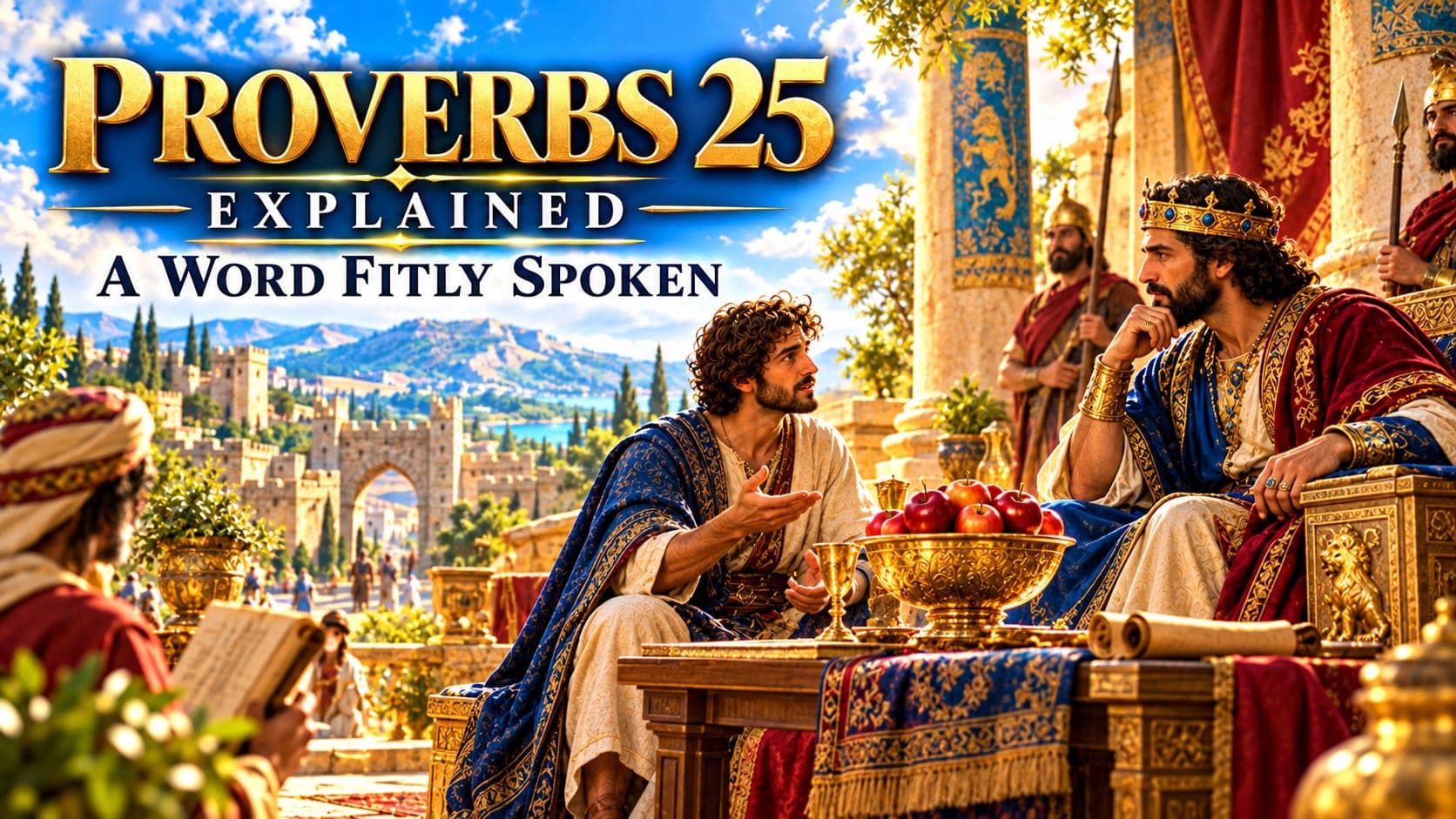
"A word fitly spoken is like apples of gold in pictures of silver."
📌 Fitly spoken means timed and shaped for the moment, not just technically true. Apples of gold set inside silver carvings would have been a strikingly valuable piece of art in Solomon's world, and that is exactly the value this verse puts on one well placed sentence.
"As an earring of gold, and an ornament of fine gold, so is a wise reprover upon an obedient ear. As the cold of snow in the time of harvest, so is a faithful messenger to them that send him: for he refresheth the soul of his masters."
A wise reprover is compared to jewelry, not a weapon, because correction aimed at an ear actually willing to listen becomes something valuable to the person receiving it. A faithful messenger gets an even more physical comparison, the relief of cold snow arriving in the heat of harvest, a comfort his masters did not expect but badly needed.
"Whoso boasteth himself of a false gift is like clouds and wind without rain. By long forbearing is a prince persuaded, and a soft tongue breaketh the bone."
⚠️ A false gift, something promised or boasted about that never actually arrives, is compared to clouds that look like rain and deliver none. Verse 15 then pairs patience with softness on purpose: a soft tongue is not a weak one. It is strong enough to break something as hard as bone, slowly, through the same long forbearing Paul later calls a fruit of the Spirit, not a personality trait some people simply happen to have.
4. Too Much Honey, and the Weight of a False Witness (verses 16 to 20)
Solomon pivots from speech that helps to appetites and habits that quietly damage the people closest to you.
"Hast thou found honey? eat so much as is sufficient for thee, lest thou be filled therewith, and vomit it. Withdraw thy foot from thy neighbour's house; lest he be weary of thee, and so hate thee."
💡 Two warnings against too much of a good thing, back to back. Honey eaten past the point of satisfaction turns on you, and a welcome at a neighbour's house wears out the same way if you do not know when to leave. Neither honey nor welcome is the problem. Timing and measure are.
"A man that beareth false witness against his neighbour is a maul, and a sword, and a sharp arrow. Confidence in an unfaithful man in time of trouble is like a broken tooth, and a foot out of joint."
📌 False testimony is not described as merely dishonest here. It is described as a club, a blade, and an arrow in the very same verse. An unfaithful man trusted in a crisis is just as useless, like leaning on a broken tooth or walking on a joint that will not hold your weight exactly when you need it to.
"As he that taketh away a garment in cold weather, and as vinegar upon nitre, so is he that singeth songs to an heavy heart."
Taking someone's coat in cold weather, or pouring vinegar on soda just to watch it fizz, are both pointless cruelties dressed up as something else. Singing cheerful songs at someone carrying real grief lands in the same category, entertainment aimed at a moment that called for something else entirely.
5. Feeding Your Enemy, and the Anger That Drives Away Gossip (verses 21 to 24)
The chapter reaches its best known verses, and its hardest to actually practice.
"If thine enemy be hungry, give him bread to eat; and if he be thirsty, give him water to drink: For thou shalt heap coals of fire upon his head, and the LORD shall reward thee."
📌 This is not advice about enemies in general. It is a command about one specific enemy who is hungry or thirsty right now, and within your power to help. Hundreds of years later, Paul quotes this exact verse almost word for word in Romans, right after telling believers not to take revenge themselves.
"Dearly beloved, avenge not yourselves, but rather give place unto wrath: for it is written, Vengeance is mine; I will repay, saith the Lord. Therefore if thine enemy hunger, feed him; if he thirst, give him drink: for in so doing thou shalt heap coals of fire on his head. Be not overcome of evil, but overcome evil with good."
❓ Whether those coals mean kindness or punishment is explored further in Hard Questions below. Paul's own use of the verse, right next to "overcome evil with good," is the strongest clue to which one Solomon meant.
"The north wind driveth away rain: so doth an angry countenance a backbiting tongue. It is better to dwell in the corner of the housetop, than with a brawling woman and in a wide house."
A confrontational face is compared to a north wind strong enough to push rain clouds away, the same way it stops a backbiting tongue in its tracks. And the brawling woman makes her third appearance in Proverbs, after two earlier mentions in the same book. Solomon is not running out of material. He is making sure this particular danger to a household gets heard more than once.
6. Good News From Far Away, and a City With No Walls Left (verses 25 to 28)
The chapter closes with four pictures that each ask what happens when something gives way.
"As cold waters to a thirsty soul, so is good news from a far country. A righteous man falling down before the wicked is as a troubled fountain, and a corrupt spring."
News from far away, in a world with no fast way to send it, could mean months of not knowing whether someone you loved was even alive. Good news landing after that wait is compared to water for a soul that has been thirsty a long time. Right beside it sits a harder image: a righteous man who collapses in front of the wicked does not only hurt himself. He muddies a fountain other people were counting on for something clean.
"It is not good to eat much honey: so for men to search their own glory is not glory. He that hath no rule over his own spirit is like a city that is broken down, and without walls."
📌 The chapter ends exactly where it began, with a warning against too much of something that looks good in smaller amounts. Searching out your own glory is paired with eating too much honey, both good things that stop being good past a certain point. And the final verse pictures a person with no self control as a city stripped of its walls, wide open to anything that wants to walk in.

Hard Questions Proverbs 25 Raises
Does heaping coals of fire on your enemy's head in Proverbs 25:21 and 22 mean kindness or punishment? The text itself does not explain the picture, which is part of why it has been read both ways. The strongest clue sits outside this chapter. Paul quotes these two verses almost word for word in Romans 12:20, right after commanding believers not to avenge themselves, and right before summing up his point as "overcome evil with good" in the next verse. That placement favors kindness that produces real conviction in the other person, a burning awareness of being met with good instead of the payback they expected, rather than a wish for your enemy to suffer. Nothing in either passage asks you to feed your enemy hoping it harms him. Both ask you to feed him instead of harming him yourself.
Does "the glory of God to conceal a thing" in Proverbs 25:2 mean God hides the truth from people? Concealing and deceiving are not the same action. The verse contrasts two different jobs, not two different levels of honesty. A king cannot do his job without searching out evidence, because governing requires answers. God's greatness shows up differently, in a mystery He is not obligated to resolve for anyone. Scripture elsewhere calls some things "the secret things" that belong to God alone, a statement about His sufficiency, not His honesty.
What does "a troubled fountain, and a corrupt spring" mean in Proverbs 25:26? A fountain and a spring were a community's water supply, not a private convenience. The image says a righteous person who collapses under pressure from the wicked does not fail quietly or alone. People who were drawing strength, example, or trust from that person's steadiness now find the water they depended on stirred up and unsafe, which is why a respected person's moral collapse is treated elsewhere in Scripture as a public injury, not only a private failure.
Practical Tips From Proverbs 25
Twenty eight verses, most of them pointing at something you can check against your own week.
- Time your words, not just make them true. Verse 11 praises timing as much as honesty. A true thing said at the wrong moment can still do the wrong kind of damage.
- Remove the dross before you build. Verses 4 and 5 put cleaning out what is wrong before adding what is right. Check what needs removing in your own life before adding another good habit on top of it.
- Debate the actual person, not everyone around them. Verse 9 asks you to go directly to whoever you have a dispute with, instead of building your case with other people first.
- Feed the enemy who is actually hungry. Verse 21 is specific, not theoretical. If there is a real need in front of you, meeting it matters more than how you feel about the person.
- Watch for the brawling pattern in your own home. Verse 24 is the third time Proverbs names this exact danger. Something repeated three times in one book is worth taking seriously.
- Know when a good thing has become too much. Verses 16 and 27 both measure honey the same way, enough against excessive. Ask the same question about anything you are currently enjoying without any limit at all.
- Guard the wall, not only the gate. Verse 28 pictures a person with no self control as a city with no wall at all, not one weak spot. Building that wall is slow work, done before the attack comes, not during it.
Top 4 Bible Verses From Proverbs 25
1. Proverbs 25:11
"A word fitly spoken is like apples of gold in pictures of silver."
The value Solomon puts on a single well timed sentence is about as high as his metaphors get, treated as a piece of fine art rather than just a fact delivered on schedule.
2. Proverbs 25:21 and 22
"If thine enemy be hungry, give him bread to eat; and if he be thirsty, give him water to drink: For thou shalt heap coals of fire upon his head, and the LORD shall reward thee."
Paul later builds an instruction for the whole church on this exact verse, turning Solomon's word about one enemy into a pattern for how evil gets answered at all.
3. Proverbs 25:26
"A righteous man falling down before the wicked is as a troubled fountain, and a corrupt spring."
A warning that a good person's failure is never only personal. Other people were drinking from that fountain.
4. Proverbs 25:28
"He that hath no rule over his own spirit is like a city that is broken down, and without walls."
Proverbs 16:32 already called ruling your own spirit better than conquering a city by force. This verse shows exactly what happens to the city that has nobody ruling it.

Frequently Asked Questions About Proverbs 25
What is Proverbs 25 about?
It opens a second collection of Solomon's proverbs, preserved generations later by King Hezekiah's men. It moves through advice for a king's court, careful speech, patience, feeding a hungry enemy, and a closing warning about a person with no self control.
Who were "the men of Hezekiah" in Proverbs 25:1?
Scripture does not name them individually. They were scribes or officials serving during King Hezekiah's reign, remembered in 2 Chronicles for helping restore proper worship in Judah, credited here with copying out and preserving sayings of Solomon that might otherwise have been lost.
What does "the glory of God to conceal a thing" mean in Proverbs 25:2?
It contrasts two different jobs rather than accusing God of hiding the truth dishonestly. A king must search out a matter to govern well. God's greatness is shown in mystery He is not obligated to resolve, which is a statement about His sufficiency, not His honesty.
What does "apples of gold in pictures of silver" mean in Proverbs 25:11?
It pictures a costly, carefully made piece of art, fruit shaped gold set into a silver carving. Solomon is saying a word spoken at exactly the right moment carries that same rare value, not just correctness but timing that makes it worth something.
What does it mean to heap coals of fire on someone's head in Proverbs 25:21 and 22?
Most read it as the burning conviction kindness produces in someone who expected payback instead, not a wish for harm. Paul quotes the verse in Romans 12:20 right next to "overcome evil with good," which favors kindness that changes a heart over kindness meant to injure one.
Why does Proverbs 25:24 repeat the brawling woman saying from Proverbs 21?
Solomon already warned about this twice in Proverbs 21, in verse 9 and again in verse 19. Repeating it a third time here is not filler. A danger named three times in one book is a danger Solomon clearly wanted heard more than once.
What does "a troubled fountain, and a corrupt spring" mean in Proverbs 25:26?
A fountain and a spring supplied an entire community, not one household. The image says a righteous person's collapse under pressure muddies something other people were relying on, making their failure a shared loss and not only a private one.
What does "no rule over his own spirit" mean in Proverbs 25:28?
It describes someone with no internal restraint, compared to a city whose walls have been torn down, defenseless against anything that wants in. Proverbs 16:32 states the positive version of the same point, that ruling your own spirit is harder and more valuable than conquering a city by force.
Why does eating too much honey appear twice in Proverbs 25?
Verse 16 and verse 27 both use honey the same way, something genuinely good that turns against you past a certain amount. Solomon frames it as a pattern, applying the same warning first to a simple appetite and then to the far more dangerous appetite for your own glory.
Final Thoughts
Proverbs 25 keeps testing the same thing from different angles: what happens when something is held back just long enough, and what happens when it is not.
📌 Timing turns a true thing into a valuable one. Verse 11 does not ask whether a word is correct. It asks whether it was fitly spoken, shaped for the moment it landed in.
📌 Kindness toward an enemy is a command, not a mood. Verse 21 does not wait for you to feel generous. Paul later builds a whole instruction for the church on these two verses alone.
📌 A wall only works before the attack, not during it. Verse 28 pictures the cost of self control ignored too long, a city with nothing left standing between it and whatever wants to walk in.
So here is your one next step.
Find the one place this week where a word, a wait, or a wall needs to go up before you need it to.
Solomon's court is long gone, but the test running through this chapter is still open.