📖 Proverbs 28 Explained: Bold as a Lion and Covering vs Confessing Sin
Nobody is chasing him. He runs anyway.
Proverbs 28 explained opens with a man fleeing a threat that does not exist, and spends the next twenty seven verses explaining why. This chapter is Solomon at his most political and most personal in the same breath, moving between kings and courts one moment and a son robbing his own parents the next.
Maybe you already know the feeling of running from nothing.
- ❓ Why does guilt make people afraid of things that are not actually there?
- ❓ How can a poor man oppress the poor, when verse 3 names him specifically?
- ❓ What does it actually take to get mercy for a sin you have been hiding?
- ❓ Why is trusting your own heart called foolish in verse 26?
📌 Proverbs 28 keeps circling back to one test: what a person does once no one is watching, in power, in poverty, in guilt, and in a moment they could easily hide.
This walkthrough goes through all twenty eight verses in the order Solomon set them down, grouped by what each cluster is weighing: a guilty flight against an unstable land, the poor who walk uprightly against gain without integrity, hidden sin against confessed sin, blood guilt against the rush to get rich, favoritism against robbing your own parents, and finally pride against the trust that actually holds a person up.
Read it slowly. Several of these verses describe exactly what you do when no one is looking.
What Happened Just Before This Chapter
Proverbs 27 ended on a working farm, a father telling his son to know the real state of his flocks instead of assuming today's wealth would simply last. Proverbs 28 opens by asking what a person is actually made of underneath, starting with the one thing a guilty conscience cannot fake.
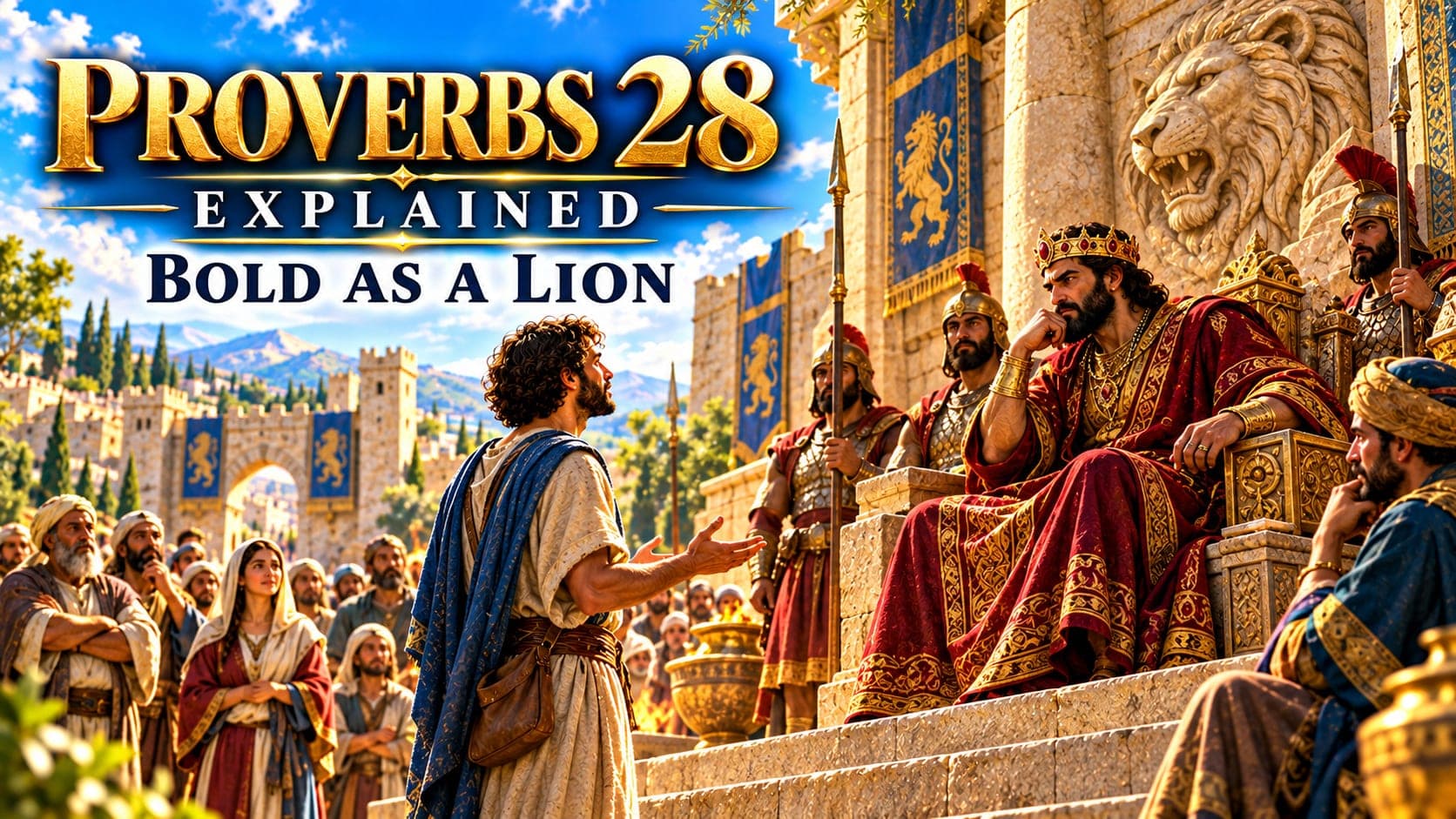
"The wicked flee when no man pursueth: but the righteous are bold as a lion."
Nothing in the verse says anyone is actually chasing the wicked man. He supplies the threat himself, out of a conscience that already knows what it has done. The righteous need no threat removed to stand still. They were never running from one.
Proverbs 28 Explained Verse by Verse
1. Guilty Flight, a Land in Turmoil, and Two Kinds of Understanding (verses 2 to 5)
From one man's fear, Solomon widens the lens to a whole nation.
"For the transgression of a land many are the princes thereof: but by a man of understanding and knowledge the state thereof shall be prolonged."
📌 A nation that keeps burning through rulers is not unlucky. It is usually sick. Instability at the top is pictured here as a symptom of transgression further down, not a random run of bad leadership. One leader with real understanding does more to hold a nation steady than any number of replacements chosen in a hurry.
"A poor man that oppresseth the poor is like a sweeping rain which leaveth no food."
A sweeping rain sounds like exactly what a farmer wants, until it is too hard and too fast to actually soak into the ground. It floods instead of feeding anything. Solomon pictures a poor man turned oppressor the same way, someone who should understand scarcity firsthand and uses that same understanding to squeeze people even harder than a rich man ever would. There is more on the exact wording of this verse in Hard Questions below.
"They that forsake the law praise the wicked: but such as keep the law contend with them. Evil men understand not judgment: but they that seek the LORD understand all things."
💡 Praising the wicked is not a separate sin from forsaking the law. It is what forsaking the law looks like out loud. Someone who has already walked away from the standard has nothing left to measure wrongdoing against, so applause and judgment start to sound alike.
2. The Poor Who Walk Uprightly, and Gain Without Integrity (verses 6 to 11)
Solomon narrows from the nation back down to one household and one choice at a time.
"Better is the poor that walketh in his uprightness, than he that is perverse in his ways, though he be rich."
"Whoso keepeth the law is a wise son: but he that is a companion of riotous men shameth his father."
📌 Verse 6 is not comforting the poor with a consolation prize. It ranks uprightness above wealth directly, the same comparison Solomon keeps making throughout this book, so that a reader who only has one of the two never mistakes which one actually matters more.
"He that by usury and unjust gain increaseth his substance, he shall gather it for him that will pity the poor."
Money taken through usury or unjust gain does not stay with the person who took it. Solomon says plainly that it eventually ends up in the hands of someone who actually cares about the poor, as if wealth gathered dishonestly cannot help but change owners in the end.
"He that turneth away his ear from hearing the law, even his prayer shall be abomination."
⚠️ This is one of the harder lines in the chapter to sit with. It is not saying prayer itself is wrong. It is saying a person who has deliberately stopped listening to God cannot expect God to keep listening to him, a warning David makes almost the same point about generations earlier in the Psalms.
"Whoso causeth the righteous to go astray in an evil way, he shall fall himself into his own pit: but the upright shall have good things in possession."
"The rich man is wise in his own conceit; but the poor that hath understanding searcheth him out."
Wealth and wisdom are kept firmly apart in verse 11. A rich man's own confidence in himself is not treated as proof of anything, and a poor man with real understanding is pictured as able to see straight through it.
3. Hidden Sin, Confessed Sin, and the Ruler Who Oppresses (verses 12 to 16)
The chapter reaches its clearest statement yet about what actually happens to sin left unaddressed.
"When righteous men do rejoice, there is great glory: but when the wicked rise, a man is hidden."
"He that covereth his sins shall not prosper: but whoso confesseth and forsaketh them shall have mercy."
📌 Mercy in this verse is not free of a cost. It has two conditions attached, confessing and forsaking. Admitting a sin without actually leaving it is not what verse 13 describes, and neither is quietly changing behavior while never naming what was wrong. David lived out exactly this contrast centuries earlier, describing what covering sin did to him before he finally stopped.
"When I kept silence, my bones waxed old through my roaring all the day long. For day and night thy hand was heavy upon me: my moisture is turned into the drought of summer. ... I acknowledged my sin unto thee, and mine iniquity have I not hid. I said, I will confess my transgressions unto the LORD; and thou forgavest the iniquity of my sin."
💡 David's body wore down under the weight of a sin he was still covering. The relief did not come from the sin disappearing on its own. It came the moment he stopped hiding it, exactly the pattern Proverbs 28:13 puts into one short proverb.
"Happy is the man that feareth alway: but he that hardeneth his heart shall fall into mischief."
The fear named here is not nervousness. It is staying soft enough toward God to actually notice when something is wrong, the opposite of the hardened heart in the same verse that no longer registers a warning at all.
"As a roaring lion, and a ranging bear; so is a wicked ruler over the poor people. The prince that wanteth understanding is also a great oppressor: but he that hateth covetousness shall prolong his days."
A lion and a bear are both predators a poor family in Solomon's world genuinely feared, and a ruler who preys on the people under him gets compared to both at once. The cure named in verse 16 is specific. It is not more cleverness. It is hating covetousness, refusing the exact appetite that turns a ruler into a predator in the first place.
4. Blood Guilt, Diligent Work, and the Rush to Get Rich (verses 17 to 20)
From a predator in power, the chapter turns to a predator who has already struck.
"A man that doeth violence to the blood of any person shall flee to the pit; let no man stay him."
📌 "Let no man stay him" is an instruction aimed at everyone else in the verse, not just the killer. Do not shelter this person or slow down the consequence catching up to him. Scripture elsewhere protects a person who kills by accident, but it never extends that same protection to someone guilty of deliberate violence against another life.
"Whoso sheddeth man's blood, by man shall his blood be shed: for in the image of God made he man."
That principle goes back to the very first covenant after the flood. A human life is treated as too valuable, carrying God's own image, for deliberate bloodshed to simply be absorbed and forgotten by the people around it.
"Whoso walketh uprightly shall be saved: but he that is perverse in his ways shall fall at once."
"He that tilleth his land shall have plenty of bread: but he that followeth after vain persons shall have poverty enough."
Tilling land is slow, repeated, unglamorous work, and Solomon pairs it with plenty. Chasing after vain persons, people with nothing real to offer, gets paired with poverty, not because ambition is the problem but because the wrong company wastes the effort a field would have rewarded.
"A faithful man shall abound with blessings: but he that maketh haste to be rich shall not be innocent."
⚠️ Making haste to be rich is not condemned here for the wealth itself. It is condemned because of what the hurry almost always costs on the way there. Faithful, steady gain and rushed gain are placed on opposite ends of the same verse on purpose.
5. Favoritism, Greed, and Robbing Your Own Parents (verses 21 to 24)
Solomon zooms in further, from a career built in a hurry to specific small compromises.
"To have respect of persons is not good: for for a piece of bread that man will transgress."
📌 The verse names something small on purpose. Favoritism does not usually get bought with a fortune. Solomon says a piece of bread is sometimes enough to make a person show partiality they know is wrong, which is exactly why the warning matters, the price of compromise is often cheaper than people expect.
"He that hasteth to be rich hath an evil eye, and considereth not that poverty shall come upon him."
An evil eye here describes greed sharp enough to see every opportunity and nothing else, including the very real chance that the shortcut ends in poverty instead of the wealth it promised. Wanting money is not the sin Scripture condemns; the blindness this verse describes is.
"He that rebuketh a man afterwards shall find more favour than he that flattereth with the tongue."
"Whoso robbeth his father or his mother, and saith, It is no transgression; the same is the companion of a destroyer."
💡 Verse 24 is not describing a stranger. It names theft from the two people a child owes the most honor to, and then names the exact excuse that makes it possible, deciding out loud that it is no transgression. Solomon does not call that excuse careless. He calls the person who makes it a companion of a destroyer, grouped with people actively tearing something down.
6. Pride, Trust, and the Righteous Who Increase (verses 25 to 28)
The chapter closes exactly where it started, with the difference between what holds a person up and what does not.
"He that is of a proud heart stirreth up strife: but he that putteth his trust in the LORD shall be made fat."
"He that trusteth in his own heart is a fool: but whoso walketh wisely, he shall be delivered."
📌 Verse 26 is not a vague warning against confidence. It names one specific source as unreliable, your own heart. Proverbs 3 already told Solomon's son to trust the LORD with all his heart and lean not on his own understanding. This verse states the same choice from the other direction, calling the opposite choice foolishness in so many words.
"He that giveth unto the poor shall not lack: but he that hideth his eyes shall have many a curse."
"When the wicked rise, men hide themselves: but when they perish, the righteous increase."
The final verse closes a loop the chapter opened twice already. Verse 1 showed the wicked fleeing from nothing. Verse 12 showed a man hidden when the wicked rise. Verse 28 repeats that same hiding, then adds the ending neither of the earlier verses gave: when the wicked actually fall, it is the righteous who increase, not simply survive.

Hard Questions Proverbs 28 Raises
How can a poor man oppress the poor in Proverbs 28:3? The KJV reading names the oppressor as poor, and the picture still works as written: someone who has felt scarcity firsthand can use that same familiarity to extract more from people at his own level, with no cushion of distance to soften it. Readers should also know this verse sits on a well known textual question. Two Hebrew words spelled almost identically can mean either "poor" or "ruler," which is why some other translations render this verse as a ruler oppressing the poor instead. Either reading lands on the same warning Solomon repeats elsewhere in this chapter: power used against people who have little is condemned no matter who is holding it.
What does "for the transgression of a land many are the princes thereof" mean in Proverbs 28:2? It describes instability at the top as a symptom rather than bad luck, a nation cycling through rulers because something underneath is already broken. The verse does not name a specific king or kingdom. It states a pattern: real understanding in one leader steadies a nation far more than replacing leadership again and again ever can.
Does Proverbs 28:17 mean a murderer should never receive any mercy? The verse specifically targets a man guilty of deliberate violence against another life and instructs against helping him escape the consequence, not against all mercy everywhere. Scripture elsewhere draws a clear line between accidental killing, which it treats with real protection, and deliberate bloodshed, which it never extends that same protection to. Genesis 9:6 explains why the line is drawn so firmly: a human life carries God's own image, which is also why this is one of the few places in the chapter where "let no man stay him" is addressed to everyone else, not only the guilty man himself.
Practical Tips From Proverbs 28
Twenty eight verses, most of them asking what you actually do once no one is watching.
- Ask what you are actually running from. Verse 1 names fear with no real cause behind it. A guilty conscience invents threats that bold obedience never needs to invent.
- Confess and forsake, not just one or the other. Verse 13 attaches mercy to both. Naming the sin without leaving it, or quietly changing without ever naming it, is not what this verse describes.
- Watch for the cheap price of compromise. Verse 21 names a piece of bread, not a fortune, as enough to buy favoritism. Notice how small the bribe usually is before you take it.
- Check your own heart before you trust it fully. Verse 26 calls self trust foolish on its own, without wisdom and without the LORD checking it.
- Give before you are asked twice. Verse 27 pairs giving to the poor with not lacking, and hiding your eyes with a curse you brought on yourself.
- Build steady, not fast. Verse 20 puts a faithful, patient gain against a hurried one, and only one of them is called innocent.
- Remember the ending, not just the middle. Verse 28 does not stop at the righteous surviving the wicked. It says they increase once the wicked actually fall.
Top 5 Bible Verses From Proverbs 28
1. Proverbs 28:1
"The wicked flee when no man pursueth: but the righteous are bold as a lion."
The chapter's opening contrast, and the one it returns to twice more before it ends: a guilty conscience invents threats that a clear one never has to.
2. Proverbs 28:13
"He that covereth his sins shall not prosper: but whoso confesseth and forsaketh them shall have mercy."
Mercy with two conditions attached, confessing and forsaking, matching almost exactly what David describes living through in Psalm 32.
3. Proverbs 28:26
"He that trusteth in his own heart is a fool: but whoso walketh wisely, he shall be delivered."
A direct answer to anyone tempted to treat their own gut feeling as the final word on a decision.
4. Proverbs 28:9
"He that turneth away his ear from hearing the law, even his prayer shall be abomination."
A hard warning that deliberately ignoring God's word and expecting Him to still listen to your prayers do not sit well together.
5. Proverbs 28:28
"When the wicked rise, men hide themselves: but when they perish, the righteous increase."
The chapter's closing line, promising more than survival for whoever stays faithful through the hiding.
Frequently Asked Questions About Proverbs 28
What is Proverbs 28 about?
A chapter weighing what a person does without anyone watching, moving between a guilty conscience, political instability, hidden versus confessed sin, blood guilt, greed, and a closing promise that the righteous outlast the wicked.
Why do the wicked flee when no one is chasing them in Proverbs 28:1?
Their own guilt supplies the threat. The verse never says anyone is actually pursuing them, which is exactly the point, a guilty conscience invents danger that a clear one never has to.
What does "a poor man that oppresseth the poor" mean in Proverbs 28:3?
It pictures someone who has felt scarcity himself using that same understanding to squeeze people at his own level even harder. Some translations render this as a ruler rather than a poor man, a well known textual question explained more fully in Hard Questions above.
Why does a land have many princes when it sins, according to Proverbs 28:2?
Instability at the top is treated as a symptom of deeper transgression, not bad luck. One leader with real understanding and knowledge is said to prolong a nation's stability far more than cycling through rulers ever can.
What does it take to get mercy for sin in Proverbs 28:13?
Two things, confessing it and forsaking it, not one without the other. Covering sin is named as the path that does not prosper, and Psalm 32 shows David living through both sides of that exact contrast.
Does Proverbs 28:17 forbid showing mercy to a murderer?
It instructs against helping a man guilty of deliberate bloodshed escape consequence, not against mercy in general. Scripture draws a firm line elsewhere between accidental killing and intentional violence, protecting the first while never extending that protection to the second.
Is wanting to get rich a sin according to Proverbs 28:20 and 22?
Neither verse condemns wealth itself. Both condemn the hurry, a faithful and patient gain is called innocent, while a rushed one is tied to an evil eye too focused on opportunity to notice the poverty it can lead to instead.
What does "trusteth in his own heart is a fool" mean in Proverbs 28:26?
It names your own heart specifically as an unreliable final authority. Proverbs 3 already told Solomon's son to trust the LORD rather than lean on his own understanding, and this verse calls the opposite choice foolishness outright.
Why does Proverbs 28:24 call someone who robs their parents a companion of a destroyer?
Because the excuse matters as much as the theft. The verse describes someone deciding out loud that taking from his own father or mother is no transgression, and Solomon groups that kind of self justification with people actively tearing something down.
What is the main lesson of Proverbs 28?
That character shows up most clearly in the moments no one is checking, a guilty flight, a hidden sin, a small bribe, a rushed shortcut, and that trusting the LORD instead of your own heart is what actually holds a person steady through all of them.
Final Thoughts
Proverbs 28 keeps testing the same thing from a dozen different angles: what a person does when there is no audience.
📌 A guilty conscience invents its own danger. Verse 1 opens the chapter with fear that has no real cause, and verse 28 closes it with the hiding that same guilt still produces at the very end.
📌 Mercy has two conditions, not one. Verse 13 asks for confessing and forsaking together, exactly what Psalm 32 shows actually working out in one man's life.
📌 Your own heart is not the final word. Verse 26 calls self trust foolishness by name, and ranks it below the trust that actually holds a person up.
So here is your one next step.
Name the one thing you have been covering instead of confessing, and bring it into the open today.
Solomon already told you what waits on the other side of that honesty. Mercy, not exposure.