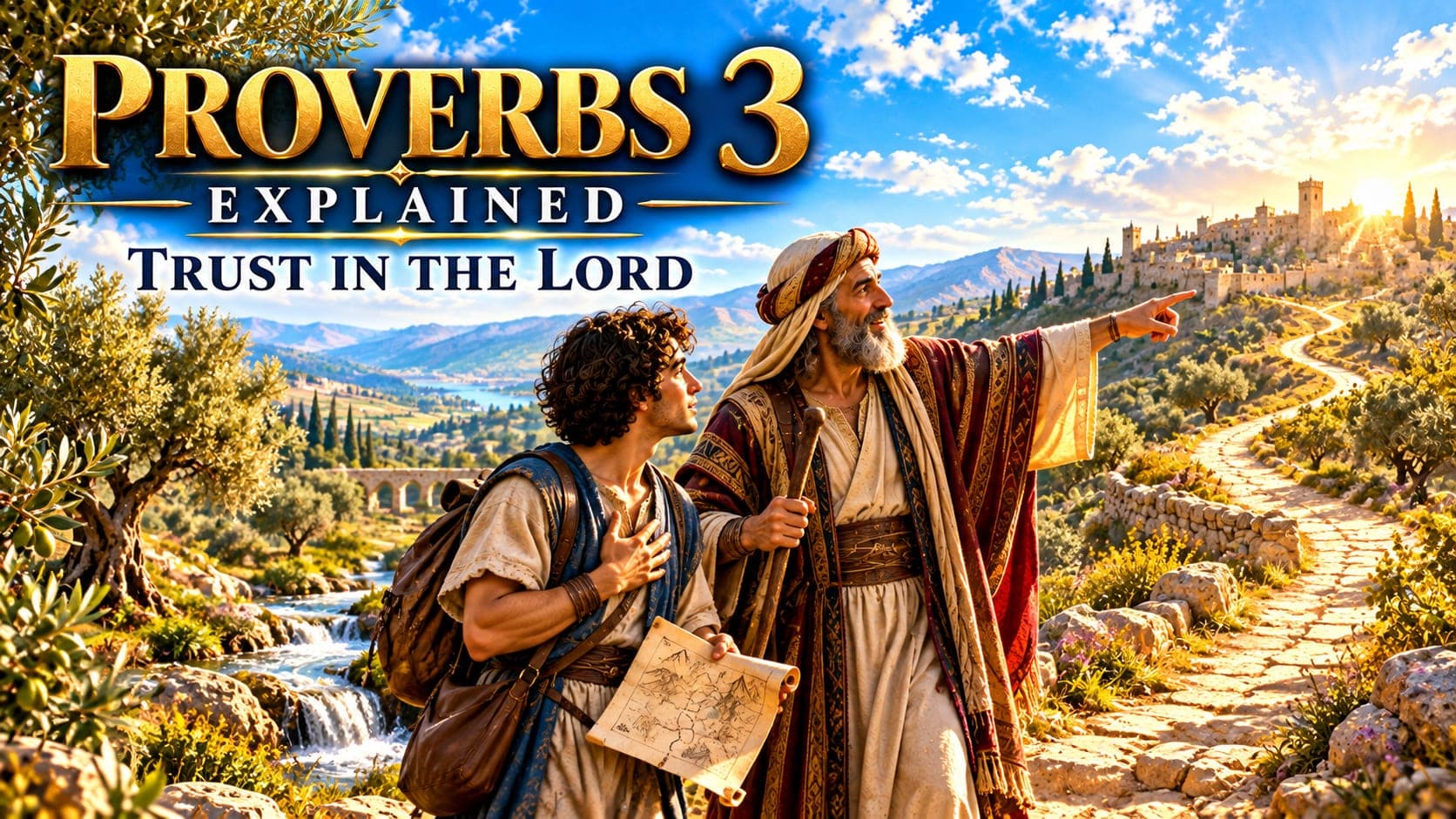
📖 Proverbs 3 Explained: Trust the LORD With All Your Heart
Two verses from this chapter get quoted more than almost anywhere else in Scripture.
The other thirty three barely get read at all.
Proverbs 3 explained is Solomon moving from the search for wisdom in chapter 2 to what a life shaped by that wisdom actually looks like day to day: how you hold your loyalty, how you handle money, how you take correction, and how you treat the neighbor standing right in front of you.
You have probably said verse 5 out loud without ever reading verse 27.
- ❓ What does it actually mean to trust God and not lean on your own understanding?
- ❓ Does honoring God with your money guarantee He will make you rich?
- ❓ Is God's discipline the same thing as punishment?
- ❓ Why does a chapter about wisdom end with instructions about neighbors and grudges?
📌 Proverbs 3 is not two famous verses surrounded by filler. It is one connected picture of a wise life, and the famous verses only make sense next to the rest of it.
This walkthrough goes through the chapter in order: the loyalty Solomon asks for first, the trust that follows, what honoring God with money and taking His discipline actually require, why wisdom is worth more than jewelry, and the neighbor ethics that close the chapter out.
Read past the verse you already know. The rest of the chapter explains what it costs.
What Happened Just Before This Chapter
Proverbs 2 ended with a promise: wisdom keeps the upright in the land and roots out the wicked from it. It told his son what wisdom protects him from.
Proverbs 3 answers the question chapter 2 leaves open. If wisdom is worth searching for like buried silver, what does a son actually do with it once he has it? This chapter is the answer, laid out as nine short commands, each one followed by a reason to obey it.
📌 Proverbs 2 named what wisdom rescues you from. Proverbs 3 names what wisdom asks of you in return.
Proverbs 3 Explained Verse by Verse
1. Loyalty and Truth Written on the Heart (verses 1 to 4)
Solomon opens with the same address he used in chapter 2, then makes his first request.
"My son, forget not my law; but let thine heart keep my commandments: For length of days, and long life, and peace, shall they add to thee."
The command is simple. Do not forget. But notice what backs it up. Solomon does not say obey because obedience is its own reward. He names a result: length of days, and peace. Wisdom in Proverbs is never presented as duty for duty's sake. It is presented as the path that actually leads somewhere good.
Then he names two specific qualities to hold onto.
"Let not mercy and truth forsake thee: bind them about thy neck; write them upon the table of thine heart: So shalt thou find favour and good understanding in the sight of God and man."
Mercy here means loyal love, the kind that keeps a promise even when keeping it is inconvenient. Truth means faithfulness, being the same person in private that you are in public. Solomon pictures both as jewelry, bound about the neck, and as an inscription, written on the heart itself.
📌 A necklace can be seen by everyone. A heart written on can only be checked by you and God. Solomon wants both: a loyalty that shows and a truthfulness that holds up when nobody is watching.
2. Trust the LORD, Not Your Own Understanding (verses 5 to 8)
Then comes the verse most people already know, whether they know the rest of the chapter or not.
"Trust in the LORD with all thine heart; and lean not unto thine own understanding. In all thy ways acknowledge him, and he shall direct thy paths."
Trust here is a whole heart word, not a half measure kept in reserve in case God does not come through. Lean not unto thine own understanding does not mean stop thinking. It means stop treating your own read of a situation as the final word, especially when it runs against what God has already said. The son who searched hard for wisdom in chapter 2 is now told that the wisdom he finds still bows to the God who gave it.
Solomon does not leave trust as a feeling. He names what it looks like next.
"Be not wise in thine own eyes: fear the LORD, and depart from evil. It shall be health to thy navel, and marrow to thy bones."
📌 Being wise in your own eyes is the exact opposite of trusting the LORD, even though both can look like confidence from the outside. Real trust fears God and turns from evil. The false version trusts its own judgment and calls that faith.
3. Honor God With What You Have (verses 9 and 10)
Trust moves from the abstract straight into the wallet.
"Honour the LORD with thy substance, and with the firstfruits of all thine increase: So shall thy barns be filled with plenty, and thy presses shall burst out with new wine."
Firstfruits means the first portion of the harvest, offered before you know how the rest of the year will turn out. Giving from what is left over costs nothing. Giving from the first part is an actual statement of trust, made before the outcome is known.
💡 Whether you feel free to give or feel like you cannot afford to often comes down to what you already believe about money in the first place. Wanting provision is not the problem this verse is correcting. Where you put God in the order is.
4. Discipline Is Proof You Are Loved (verses 11 and 12)
Solomon turns from blessing straight into something much harder to hear.
"My son, despise not the chastening of the LORD; neither be weary of his correction: For whom the LORD loveth he correcteth; even as a father the son in whom he delighteth."
Chastening means training through correction, the way a father shapes a son he actually cares about, not the way he would treat a stranger's mistake. Solomon places two opposite dangers side by side: despising correction, treating it as an insult to shrug off, and growing weary of it, giving up under its weight. Both miss what the correction is for.
📌 The proof in this verse runs backward from how most people read it. Correction is not evidence that God has pulled away from you. It is named here as evidence that He has not. The New Testament book of Hebrews quotes this exact promise to Christians going through real hardship, for the same reason Solomon gave it here.
⚠️ That does not mean every hard season is God correcting a specific sin. Not all suffering works that simply, but this verse is Solomon's answer to a son who is tempted to read God's silence during hardship as absence.
5. Wisdom Is Worth More Than Rubies (verses 13 to 20)
Solomon stops giving commands for a moment and simply praises wisdom itself.
"Happy is the man that findeth wisdom, and the man that getteth understanding. For the merchandise of it is better than the merchandise of silver, and the gain thereof than fine gold. She is more precious than rubies: and all the things thou canst desire are not to be compared unto her."
Three separate comparisons in three verses: silver, gold, rubies. Solomon is not picking one image and moving on. He is running through every measure of value his son would recognize and saying wisdom outranks every single one of them.
"Length of days is in her right hand; and in her left hand riches and honour. Her ways are ways of pleasantness, and all her paths are peace. She is a tree of life to them that lay hold upon her: and happy is every one that retaineth her."
📌 Wisdom is called a tree of life here, the same phrase used for the actual tree in Eden that humanity lost access to after the fall. Solomon is telling his son that what was fenced off in Genesis is, in a real sense, offered back through wisdom. Not the literal tree, but the life it represented.
Then Solomon widens the picture from one son's life to the whole world.
"The LORD by wisdom hath founded the earth; by understanding hath he established the heavens. By his knowledge the depths are broken up, and the clouds drop down the dew."
The same wisdom Solomon has been describing as a personal treasure is also the wisdom God used to build creation itself. The son searching for wisdom in his own small life is reaching for the same quality that holds the sky and the sea in place.
6. Sleep Without Fear (verses 21 to 26)
Solomon brings the picture back down to one ordinary night.
"My son, let not them depart from thine eyes: keep sound wisdom and discretion: So shall they be life unto thy soul, and grace to thy neck. Then shalt thou walk in thy way safely, and thy foot shall not stumble."
"When thou liest down, thou shalt not be afraid: yea, thou shalt lie down, and thy sleep shall be sweet."
💡 Sweet sleep is not promised because nothing bad will ever happen. It is promised because a life kept by wisdom has less to lie awake fighting with itself over, fewer secrets to guard and fewer schemes to keep straight.
"Be not afraid of sudden fear, neither of the desolation of the wicked, when it cometh. For the LORD shall be thy confidence, and shall keep thy foot from being taken."
Sudden fear is not a hint that trouble will never come. It is a promise about where confidence rests when it does. Fear that shows up without warning is exactly what this verse addresses, not by promising it will never knock, but by naming who holds your foot steady when it does.
7. How Wisdom Treats Your Neighbor (verses 27 to 35)
The chapter's final section leaves theology behind and gets specific about people close to you.
"Withhold not good from them to whom it is due, when it is in the power of thine hand to do it. Say not unto thy neighbour, Go, and come again, and to morrow I will give; when thou hast it by thee."
📌 Delaying a good you are already able to do is treated here as withholding it. Solomon does not let his son off the hook by calling it a plan to help later. If the help is possible today, tomorrow is a form of refusal.
"Devise not evil against thy neighbour, seeing he dwelleth securely by thee. Strive not with a man without cause, if he have done thee no harm."
"Envy thou not the oppressor, and choose none of his ways. For the froward is abomination to the LORD: but his secret is with the righteous."
Envy thou not the oppressor is aimed at a specific temptation: watching someone get ahead by cutting corners or hurting people, and wanting their results without wanting their methods. Solomon calls that a trap, not a shortcut worth admiring.
"The curse of the LORD is in the house of the wicked: but he blesseth the habitation of the just. Surely he scorneth the scorners: but he giveth grace unto the lowly."
"The wise shall inherit glory: but shame shall be the promotion of fools."
📌 Verse 34 is quoted twice more in the New Testament, both times to make the same point: God opposes pride and gives grace to the humble. Solomon closes the chapter on the same idea he opened it with. A humble, loyal, trusting life ends in honor. A proud, self reliant one does not, no matter how it looks in the meantime.
Hard Questions Proverbs 3 Raises
Does verse 9 and 10 promise that giving to God will always make you wealthy? The text states a real, ordinary connection between honoring God with firstfruits and having barns filled with plenty, inside an agricultural covenant setting. It is a description of God's normal generosity toward a heart that trusts Him with money first, not a guaranteed formula that works the same way every single time for every believer everywhere, since Scripture elsewhere shows faithful people who gave and still suffered real want.
Is God's discipline in verses 11 and 12 the same thing as punishment for sin? Chastening in this verse is corrective, aimed at shaping character, not purely punitive in the sense of paying back a debt. A father who loves his son corrects him precisely because he is invested in who that son becomes, which is the comparison Solomon draws directly.
Does "lean not unto thine own understanding" mean Christians should not think for themselves? No. Solomon himself spent his whole life observing, reasoning, and writing down conclusions, which this very book is proof of. The warning is against treating your own conclusions as the final authority when they conflict with what God has already made clear, not against thinking at all.
Does "be not afraid of sudden fear" in verse 25 mean bad things will never happen to someone who trusts God? The verse names the desolation of the wicked as something that does come, which assumes real trouble is possible. What it promises is confidence and a kept foot in the middle of that trouble, not an exemption from ever facing it.
Is humility in verse 34 just a technique for getting God's favor? Read that way, it turns humility into another form of pride, humbling yourself in order to get something. Solomon presents it as simple honesty about your actual position before God, not a strategy, and the grace that follows is God's response to truth, not a prize for good technique.
Top 5 Bible Verses From Proverbs 3
1. Proverbs 3:5 and 6
"Trust in the LORD with all thine heart; and lean not unto thine own understanding. In all thy ways acknowledge him, and he shall direct thy paths."
The most quoted verse in the whole book of Proverbs. A whole hearted trust that refuses to treat your own read of a situation as the final word.
2. Proverbs 3:11 and 12
"My son, despise not the chastening of the LORD; neither be weary of his correction: For whom the LORD loveth he correcteth; even as a father the son in whom he delighteth."
Correction reframed as evidence of love rather than evidence of abandonment. The New Testament book of Hebrews quotes this exact promise word for word to Christians facing real hardship.
3. Proverbs 3:15
"She is more precious than rubies: and all the things thou canst desire are not to be compared unto her."
One line from a three verse run comparing wisdom to silver, gold, and rubies. Nothing you could name outranks it.
4. Proverbs 3:24
"When thou liest down, thou shalt not be afraid: yea, thou shalt lie down, and thy sleep shall be sweet."
Sweet sleep as the fruit of a life with fewer secrets to guard, not a promise that nothing hard will ever happen.
5. Proverbs 3:34
"Surely he scorneth the scorners: but he giveth grace unto the lowly."
Quoted twice more in the New Testament. God's stance toward pride and toward humility has not moved between Solomon's day and now.

Frequently Asked Questions About Proverbs 3
What does Proverbs 3 mean?
It is Solomon describing what a life shaped by wisdom looks like in practice: loyal and truthful, trusting God over your own judgment, honoring Him with money, accepting His correction, valuing wisdom above wealth, resting without fear, and treating your neighbor fairly.
What does Proverbs 3:5 to 6 mean?
It calls for trusting God completely rather than treating your own understanding as the final authority, and promises that acknowledging Him in every area of life results in Him directing your path, even when that path is not visible in advance.
Why do Christians quote "trust in the Lord with all thine heart" so often?
It compresses a whole way of living into two sentences: total trust in God, and the humility to stop relying only on your own reasoning. Its promise about direction speaks directly to seasons of uncertainty, which is a large part of why it gets repeated so often.
Does Proverbs 3:9 and 10 promise financial prosperity for tithing?
It describes God's normal generosity toward firstfruits giving inside an agricultural covenant setting, not a guaranteed transaction that works identically for every believer. Scripture elsewhere shows faithful givers who still faced real financial hardship.
What does Proverbs 3:11 and 12 teach about God's discipline?
It teaches that God corrects the people He loves the way an invested father corrects a son, meaning discipline is evidence of relationship rather than evidence of rejection.
Why is wisdom compared to rubies and gold in Proverbs 3?
Solomon runs through the most valuable things his son would recognize, silver, gold, and rubies, to say wisdom outranks all of them, including the promise of length of days, riches, and honor that comes with it.
Does Proverbs 3:25 mean bad things will never happen to someone who trusts God?
No. The verse assumes real trouble is possible and promises confidence and a kept foot in the middle of it, not an exemption from ever facing hardship.
Where else does the Bible quote Proverbs 3?
Hebrews quotes the promise about the LORD's chastening from verses 11 and 12 directly to Christians enduring hardship. Verse 34, about God giving grace to the humble, is quoted again later in the New Testament, making the same point about pride and humility both times.
Final Thoughts
Proverbs 3 is not two famous verses. It is a whole shape for a life.
📌 Trust is not a feeling you wait for. It is a decision to stop treating your own understanding as final. Verses 5 and 6 only make sense next to the loyalty and honesty Solomon asked for first.
📌 Correction and blessing come from the same loving hand. Verses 9 through 12 put honoring God with money and accepting His discipline right next to each other on purpose.
📌 Wisdom was never meant to stay private. The chapter that opens on trusting God ends on withholding no good thing from your neighbor.
So here is your one next step.
Pick one person you can help today without waiting until tomorrow, and do not say "come again" when today is possible.