📖 Proverbs 29 Explained: A Hardened Neck, Good Kings, and a People Without Vision
He was corrected. Then corrected again. Then again.
And every time, his neck got a little stiffer.
Proverbs 29 explained opens with one of the heaviest warnings in the whole book: a person reproved again and again who keeps refusing to bend does not simply stay where he is. He gets destroyed, and the verse adds a word that should stop you cold, without remedy. This is the last chapter of the collection Hezekiah's men copied out starting at chapter 25, and Solomon closes it with twenty seven verses weighing correction, kingship, raising a child, and the difference between fearing people and trusting the LORD.
Maybe you already know what a stiff neck feels like from the inside.
- ❓ What does "destroyed, and that without remedy" actually mean in verse 1?
- ❓ Does "where there is no vision, the people perish" mean you need a personal vision for your life?
- ❓ Why does Solomon talk about kings so much in this one chapter?
- ❓ Is verse 21 really saying it is bad to be kind to the people under you?
📌 Proverbs 29 keeps testing the same moment: what happens the next time you are corrected, led, or afraid, after you already know better.
This walkthrough goes through all twenty seven verses in the order Solomon set them down, grouped by what each cluster is weighing: a hardened neck against a nation's mood, flattery and snares against the wise who turn away wrath, a fool's loose tongue against a king who judges the poor fairly, raising a child against a people with no vision, and anger and pride against the fear of man versus trust in the LORD.
Read it slowly. More than one of these verses is asking how you respond the second or third time, not just the first.
What Happened Just Before This Chapter
Proverbs 28 closed with the wicked hiding and the righteous increasing once they finally fell. Proverbs 29 is the last chapter of that same collection, the proverbs of Solomon that the men of King Hezekiah copied out, and it closes the section by asking what happens to a person who is warned about that same wickedness and simply will not change.
"He, that being often reproved hardeneth his neck, shall suddenly be destroyed, and that without remedy."
Notice the word often. This is not a man who heard one hard word and ignored it. He has been reproved again and again, and every time he has hardened his neck a little further, the way an animal stiffens against a yoke it refuses to wear.
Proverbs 29 Explained Verse by Verse
1. A Hardened Neck, a Nation's Mood, and a Son Who Wastes It (verses 2 to 4)
From one stiff necked man, Solomon widens out to what that same refusal looks like at the top of a whole nation.
"When the righteous are in authority, the people rejoice: but when the wicked beareth rule, the people mourn."
📌 The mood of a whole population is tied directly to the character of whoever leads it. Solomon does not say the people simply disagree with wicked rule. He says they mourn, a grief word, not a complaint word.
"Whoso loveth wisdom rejoiceth his father: but he that keepeth company with harlots spendeth his substance."
The same household can produce either result. A son who loves wisdom hands his father joy. A son who keeps company with harlots hands away his own inheritance, piece by piece, until there is nothing left to spend.
"The king by judgment establisheth the land: but he that receiveth gifts overthroweth it."
💡 Only one letter separates these two kings in the verse, judgment against gifts, but the outcomes are opposites. A king who rules by honest judgment builds something that lasts. A king who can be bought overthrows the very land he was given to protect.
2. Flattery, Snares, and the Wise Who Turn Away Wrath (verses 5 to 8)
Solomon moves from kings and sons to the quieter traps that catch ordinary people.
"A man that flattereth his neighbour spreadeth a net for his feet."
"In the transgression of an evil man there is a snare: but the righteous doth sing and rejoice."
📌 A flattering mouth is pictured as a hunter, not a friend. The net is spread for the other man's feet, not his own, which is exactly why it works. Nobody walks willingly into a trap they can see. And the evil man's own transgression turns out to be the snare waiting underneath him, while the righteous keep walking in a kind of freedom that sings.
"The righteous considereth the cause of the poor: but the wicked regardeth not to know it."
The wicked man's failure here is not cruelty exactly. It is refusal to even find out. He regardeth not to know it, choosing ignorance on purpose because knowing would cost him something.
"Scornful men bring a city into a snare: but wise men turn away wrath."
One scornful voice can drag a whole city into trouble, while a single wise voice, offered at the right moment, can turn real anger away before it ever lands.
3. A Fool's Loose Tongue, and a King Who Judges the Poor Fairly (verses 9 to 14)
Solomon turns from the city to the exhausting experience of actually dealing with a fool up close.
"If a wise man contendeth with a foolish man, whether he rage or laugh, there is no rest."
📌 Notice Solomon names both reactions a fool might give you, raging or laughing, and says neither one brings peace. There is no version of arguing with a fool that ends quietly.
"The bloodthirsty hate the upright: but the just seek his soul."
"A fool uttereth all his mind: but a wise man keepeth it in till afterwards."
💡 The difference is not how much either man knows. It is timing. A fool empties his whole mind the moment he feels it. A wise man holds the same thought until later, when saying it will actually help instead of just releasing pressure.
"If a ruler hearken to lies, all his servants are wicked."
⚠️ Corruption at the top does not stay at the top. A ruler who rewards lies trains every servant under him that lying is how you get ahead, until the whole court has learned the same lesson he taught by listening.
"The poor and the deceitful man meet together: the LORD lighteneth both their eyes."
Solomon already said something close to this earlier in the book.
"The rich and poor meet together: the LORD is the maker of them all."
📌 Neither verse is talking about money at all in the end. Both say that sight itself, the ability to see and reason and wake up another day, is a gift the LORD hands out regardless of a man's wealth or his honesty. No one, rich, poor, honest, or deceitful, has a claim on that gift that the next man does not also have.
"The king that faithfully judgeth the poor, his throne shall be established for ever."
This is the third king verse in the chapter, and it names the specific test. Not how a king treats powerful people who can repay him. How he judges the poor, who cannot.
4. Raising a Child, and a People With No Vision (verses 15 to 21)
From a king's court, Solomon turns to the one place every one of his readers actually has authority, their own home.
"The rod and reproof give wisdom: but a child left to himself bringeth his mother to shame."
📌 Notice the verse pairs two things together, the rod and reproof, not the rod alone. Proverbs 22 already said foolishness is bound up in a child's heart, and correction is what drives it out. The real warning here is the other half of the verse. A child simply left alone, with no correction at all, is the one who actually ends in shame.
"When the wicked are multiplied, transgression increaseth: but the righteous shall see their fall."
"Correct thy son, and he shall give thee rest; yea, he shall give delight unto thy soul."
Verse 15 was a warning. Verse 17 is a promise aimed at the same parent. Correction costs something now, but Solomon says the payoff is rest and delight later, not more conflict.
"Where there is no vision, the people perish: but he that keepeth the law, happy is he."
❓ This is almost certainly the most quoted line in the whole chapter, and also the most misquoted. What vision actually means here, and why the second half of the verse is the real key to it, is covered fully in Hard Questions below.
"A servant will not be corrected by words: for though he understand he will not answer."
"Seest thou a man that is hasty in his words? there is more hope of a fool than of him."
💡 Verse 19 describes a servant who understands perfectly well and still will not answer, which is worse than not understanding at all. Verse 20 ranks a man too hasty in his words below an actual fool, because at least a fool might eventually learn.
"He that delicately bringeth up his servant from a child shall have him become his son at the length."
⚠️ This verse sounds like a tender ending until you notice it sits right next to two verses about servants who refuse correction. What Solomon is actually warning against here is explained more fully in Hard Questions below.
5. Anger, Pride, and the Fear of Man Versus Trust in the LORD (verses 22 to 27)
The chapter closes with the choice underneath everything that came before it.
"An angry man stirreth up strife, and a furious man aboundeth in transgression."
"A man's pride shall bring him low: but honour shall uphold the humble in spirit."
📌 Pride and humility are pictured moving in opposite directions on purpose. Proverbs 16 already said pride goes before destruction, and here the same pride is simply said to bring a man low. Humility is not pictured as weakness. It is the posture honour actually holds up.
"Whoso is partner with a thief hateth his own soul: he heareth cursing, and bewrayeth it not."
Staying silent about a theft you witnessed is not neutral here. The partner hears the curse laid on whoever stole, and his own silence pulls that curse partway onto himself.
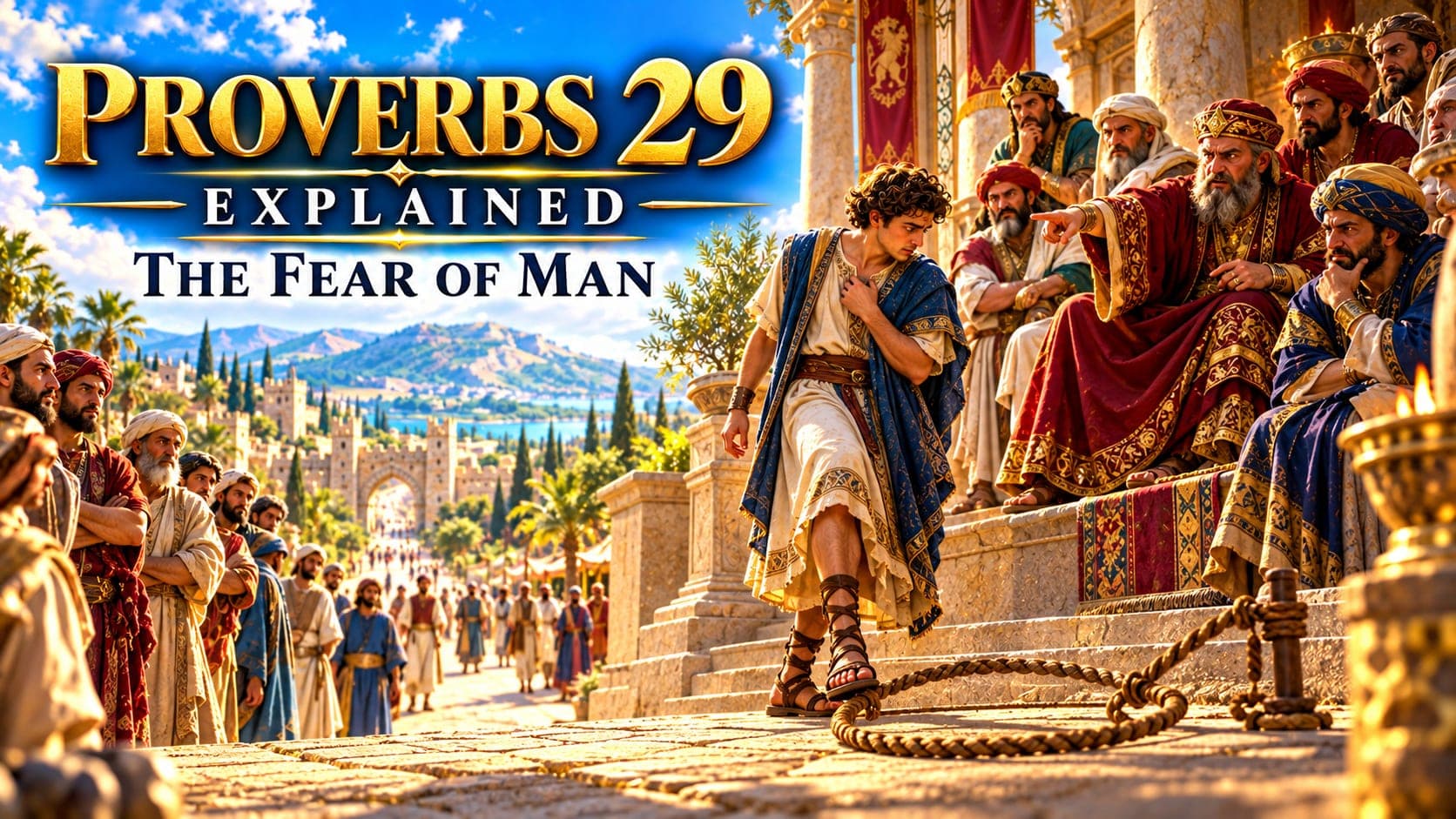
"The fear of man bringeth a snare: but whoso putteth his trust in the LORD shall be safe."
📌 This verse names the same picture Solomon used back in verse 5, a snare, but the thing doing the trapping has changed. There, a flatterer's mouth was the net. Here, your own fear of what people think is the net. The cure is identical to what Solomon already told his son to do with his whole heart in Proverbs 3, trust the LORD instead of leaning on whatever everyone else thinks of you.
"Many seek the ruler's favour; but every man's judgment cometh from the LORD."
A crowd chases the ruler's favor because it looks like where the power sits. Solomon says the real verdict on any man was never the ruler's to give. It comes from the LORD.
"An unjust man is an abomination to the just: and he that is upright in the way is abomination to the wicked."
The chapter ends without one side winning the other over. Each side finds the other genuinely intolerable, and Solomon does not pretend that gap will simply close on its own.

Hard Questions Proverbs 29 Raises
What does "where there is no vision, the people perish" mean in Proverbs 29:18? This verse is quoted constantly in business and self help contexts to mean every person or organization needs a personal goal or mission statement. That is not what the Hebrew word behind vision means here. It is the same word used for prophetic revelation, God actually speaking to His people, the kind of vision named in 1 Samuel 3:1, which says plainly "the word of the LORD was precious in those days; there was no open vision." Read that way, Proverbs 29:18 is saying a people who stop receiving God's word fall into chaos, which fits the second half of the verse perfectly: "he that keepeth the law, happy is he." The vision in question is God's revealed word, not a personal ambition you set for yourself.
Does Proverbs 29:21 mean it is wrong to be kind to someone who works for you? Read next to verse 19 and verse 20, both about servants who refuse to respond to correction, verse 21 is not praising gentleness for its own sake. "Delicately bringeth up" describes raising a servant with no boundaries at all from childhood, and the result named is not a healthy relationship. It is a servant who eventually acts as if he has a son's standing and authority he was never actually given, with none of a son's accountability to go with it. The warning is against indulgence with no correction attached, the same danger verse 15 already named in a parent's own home.
Does Proverbs 29:1 mean God gives up on someone the moment they ignore one warning? The verse specifically says often reproved, not once reproved, and the word remedy points back to a real moment in Israel's history. 2 Chronicles 36:15 and 16 describes God sending messengers to His people "rising up betimes," meaning early and repeatedly, before finally saying the nation's wrongdoing reached the point of "no remedy." Patience came first, for generations. The hardened neck in Proverbs 29:1 describes what happens after correction has already been offered and refused again and again, not a single mistake punished without warning.
Practical Tips From Proverbs 29
Twenty seven verses, most of them testing what you do the second or third time around.
- Notice when correction stops landing. Verse 1 describes a slow process, not one bad moment. Ask whether you have softened toward correction this year or hardened against it.
- Watch what your company is actually costing you. Verse 3 names wasted substance, not just wasted time, as the price of the wrong friendships.
- Hold your words until they can actually help. Verse 11 ranks a wise man by his timing, not by how much he knows.
- Pair correction with reproof, not one without the other. Verse 15 warns against a child left entirely alone just as much as it praises the rod.
- Measure a leader, including yourself, by how the powerless are treated. Verse 14 names a king's treatment of the poor as the real test of his throne.
- Trade the fear of man for trust in the LORD. Verse 25 calls one a snare and the other safety, using the same picture from two different angles.
- Let humility hold you up instead of pride. Verse 23 puts both in the same sentence on purpose, one bringing low, the other upholding.
Top 5 Bible Verses From Proverbs 29
1. Proverbs 29:1
"He, that being often reproved hardeneth his neck, shall suddenly be destroyed, and that without remedy."
The chapter's opening warning, and the heaviest one in it: repeated correction refused does not leave a person standing still. It ends somewhere.
2. Proverbs 29:18
"Where there is no vision, the people perish: but he that keepeth the law, happy is he."
One of the most quoted lines in Proverbs, and usually quoted without its own second half, which names the real subject as God's law, not a personal ambition.
3. Proverbs 29:25
"The fear of man bringeth a snare: but whoso putteth his trust in the LORD shall be safe."
A direct trade offered in one verse: hand your fear of what people think to the LORD instead, and safety replaces the snare.
4. Proverbs 29:15
"The rod and reproof give wisdom: but a child left to himself bringeth his mother to shame."
Correction and neglect are placed side by side, and only one of them is named as the path to actual shame.
5. Proverbs 29:23
"A man's pride shall bring him low: but honour shall uphold the humble in spirit."
Pride and humility sent in opposite directions in the same breath, one pulling down, the other held up by honour itself.

Frequently Asked Questions About Proverbs 29
What is Proverbs 29 about?
The last chapter in the collection Hezekiah's men copied out, weighing a hardened refusal of correction, kings who rule justly or take bribes, raising a child, and the choice between fearing people and trusting the LORD.
What does "he that being often reproved hardeneth his neck" mean?
It describes someone corrected repeatedly who keeps refusing to change, growing more resistant with each warning rather than less. Proverbs 29:1 says that pattern, left unbroken, ends in destruction with no remedy left.
What does "where there is no vision, the people perish" mean in Proverbs 29:18?
It refers to prophetic revelation, God actually speaking to His people, the same sense used in 1 Samuel 3:1. A people cut off from God's word fall into chaos, while the verse's second half names keeping the law as the real source of happiness.
Does Proverbs 29:18 mean I need a personal vision for my life?
Not in the way the verse is usually quoted. The Hebrew word points to revelation from God, not a personal goal or mission statement, which is a popular modern reading rather than what Solomon originally meant.
What does Proverbs 29:21 mean about bringing up a servant delicately?
Read beside the two verses just before it about servants who refuse correction, it warns against raising someone under your authority with no boundaries at all, since the result is a person who later assumes a standing he was never actually given.
Why does Proverbs 29 talk so much about kings?
Four separate verses weigh a ruler's character, because Solomon treats leadership as a magnified version of everyone else's choices. A nation's mood, stability, and justice toward the poor all trace back to who sits over it and how he judges.
What does "the fear of man bringeth a snare" mean in Proverbs 29:25?
It names the worry over what other people think as a trap, the same picture Solomon used for a flatterer's net earlier in the chapter. Trusting the LORD instead is offered as the way out of that same snare.
What does "the rod and reproof give wisdom" mean in Proverbs 29:15?
It pairs correction with reproof as the two things that actually build wisdom in a child, and warns that the opposite extreme, leaving a child entirely alone with no correction at all, is what truly brings shame.
Why does Proverbs 29:23 say pride brings a man low?
Pride and humility are placed in the same sentence moving opposite directions. Solomon already said pride goes before destruction in Proverbs 16, and here names humility, not confidence or status, as what honour actually upholds.
What is the main lesson of Proverbs 29?
That the second and third response to correction matters as much as the first, whether you are the one being corrected, the one raising a child, or the one leading others, and that trusting the LORD rather than fearing people is what keeps any of those responses steady.
Final Thoughts
Proverbs 29 is not asking whether you have ever been wrong. It is asking what you do the next time someone tells you so.
📌 A hardened neck does not happen in one moment. Verse 1 describes a pattern of repeated correction refused, and 2 Chronicles 36 shows exactly how long God's patience runs before that pattern reaches its end.
📌 Vision, properly read, points to God's word, not your own ambition. Verse 18 was never about a personal goal. It is about what happens to a people who stop listening to what God has actually said.
📌 Fear of man and trust in the LORD cannot both hold the same spot. Verse 25 names one a snare and the other safety, and leaves no third option in between.
So here is your one next step.
Think of the last correction you were given, and ask honestly whether your neck softened or hardened in response.
Verse 1 already told you which one ends without remedy.