📖 Proverbs 31 Explained: King Lemuel and the Virtuous Woman
The book of Proverbs closes with two voices, and neither one is Solomon.
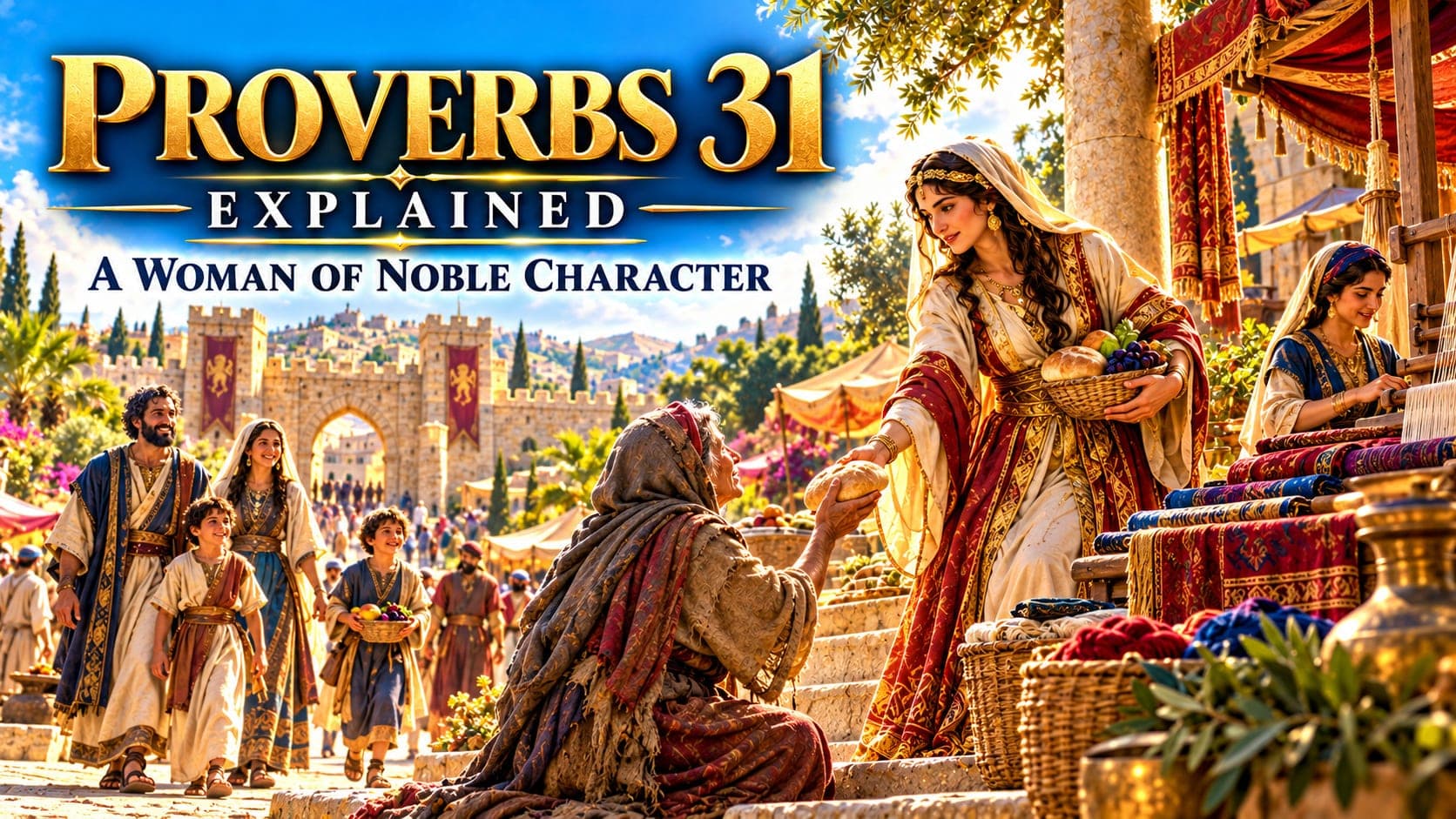
Proverbs 31 explained is the last chapter in the book, and it splits cleanly into two halves. The first nine verses are a mother's warning to her son the king, about women, wine, and the people he is responsible to protect. The last twenty two verses are a poem, built letter by letter through the Hebrew alphabet, describing a woman whose hands never seem to stop moving from before sunrise until after dark.
Maybe you have only ever heard the second half quoted, usually out of context.
- ❓ Who was King Lemuel, and why does nobody else in the Bible mention him?
- ❓ Why does his mother warn him about women right after naming him her son?
- ❓ Is the virtuous woman poem a job description every wife is expected to match?
- ❓ Why does the whole book of Proverbs end on a woman instead of a king?
📌 Proverbs 31 ends the book the same way it opened. Fear of the LORD, not status or beauty, is what the whole thing was pointing toward all along.
This walkthrough goes through all thirty one verses in the order they were written: a mother's warning about weakness in a king, her call to speak for people who cannot speak for themselves, then verse by verse through the poem, a household run by one woman's hands, her strength and her generosity, her reputation and her business sense, and finally the reward named at the very end.
Read it slowly. This chapter has more edges to it than the quotes usually printed on a wall.
What Happened Just Before This Chapter
Proverbs 30 closed with Agur, a voice named nowhere else in Scripture, confessing how little he actually knew and then teaching anyway. Proverbs 31 opens with a second unknown voice carrying the same pattern, except this time the teacher is a mother and the student is her own son, a king.
"The words of king Lemuel, the prophecy that his mother taught him."
Like Agur, nothing else in the Bible names Lemuel. The word translated prophecy here is the same Hebrew word, massa, that Proverbs 30:1 could just as easily be read as a place name, Massa. Some scholars connect both Agur and Lemuel to that same reading, outside Israel entirely. Scripture never settles which reading is correct, so this chapter opens the same way the last one did, with a teacher whose full identity stays just out of reach.
Proverbs 31 Explained Verse by Verse
1. A Mother's Warning About Women and Wine (verses 2 to 7)
Lemuel's mother does not open gently.
"What, my son? and what, the son of my womb? and what, the son of my vows? Give not thy strength unto women, nor thy ways to that which destroyeth kings."
📌 Three times in one breath she calls him her son, before she says a single word of instruction. That repetition is not padding. It is a mother reminding a king, who answers to no one else on earth, that she still has the standing to speak plainly to him.
Her first warning is not about marriage. It is about letting illicit relationships drain a king's strength and judgment, the exact failure that brought down more than one king in Israel's own history. Her second warning follows the same logic from a different angle.
"It is not for kings, O Lemuel, it is not for kings to drink wine; nor for princes strong drink: Lest they drink, and forget the law, and pervert the judgment of any of the afflicted."
💡 Notice the reasoning. Wine is not condemned as evil in itself. It is condemned here because of what it does to a king's judgment, and specifically because of who pays for that lapse. Not the king. The afflicted, the people with no other court of appeal but him.
"Give strong drink unto him that is ready to perish, and wine unto those that be of heavy hearts. Let him drink, and forget his poverty, and remember his misery no more."
The same substance that ruins a king's judgment can genuinely ease a dying man's pain. Lemuel's mother is not handing out a universal rule about alcohol. She is teaching her son to ask who holds the power in the room, and to judge his own use of it by what it costs the people underneath him, not by what feels fine to him personally.
2. Speak for Those Who Cannot Speak for Themselves (verses 8 and 9)
From what to avoid, she turns to what a king is actually for.
"Open thy mouth for the dumb in the cause of all such as are appointed to destruction. Open thy mouth, judge righteously, and plead the cause of the poor and needy."
📌 Open thy mouth is said twice in two verses. A king who stays silent while the powerless go unheard has failed at the one job his mother actually cares about. This is the hinge of the whole chapter. Everything before it warns Lemuel away from using his position for himself. Everything after it describes a woman who spends her own strength the opposite way, for her household and for people who have nothing to offer her back.
3. Who Can Find a Virtuous Woman? (verses 10 to 12)
Verse 10 begins a different kind of writing entirely. In the original Hebrew, each of the next twenty two verses opens with the next letter of the Hebrew alphabet in order, aleph through tav. Twenty two letters, twenty two verses, running from here through the end of the chapter. Nothing about that structure survives translation, but it tells you this was composed carefully, as something meant to be memorized whole, not assembled from loose sayings.
"Who can find a virtuous woman? for her price is far above rubies."
The Hebrew word behind rubies, peninim, is genuinely uncertain. Some reputable translations render it pearls or precious stones instead. Whichever stone is meant, the comparison is deliberately open ended. Nothing with a price tag actually reaches what this woman is worth.
"The heart of her husband doth safely trust in her, so that he shall have no need of spoil. She will do him good and not evil all the days of her life."
💡 Before the poem describes a single thing she does, it names what her husband receives from simply trusting her. Safety. The rest of the chapter is evidence for why that trust holds, not the reason for it.
4. A Household Run by Her Hands (verses 13 to 19)
The poem now moves at the pace of an actual day, and her hands appear in almost every line of it.
"She seeketh wool, and flax, and worketh willingly with her hands. She is like the merchants' ships; she bringeth her food from afar."
"She riseth also while it is yet night, and giveth meat to her household, and a portion to her maidens."
📌 Willingly is the word to catch in verse 13. Nothing here reads like forced labor or quiet resentment. She also has her own household staff, her maidens, and provides for them before anyone has asked her to. Her reach, like a trading ship, goes well beyond her own four walls.
"She considereth a field, and buyeth it: with the fruit of her hands she planteth a vineyard."
She is not simply managing what she was given. She evaluates a field, buys it with resources she herself produced, and plants a vineyard on it. This is an owner making decisions, not a worker waiting for instructions.
"She girdeth her loins with strength, and strengtheneth her arms."
"She perceiveth that her merchandise is good: her candle goeth not out by night. She layeth her hands to the spindle, and her hands hold the distaff."
⚠️ Her candle not going out by night is not a complaint about exhaustion. In a poem built to praise her, it names stamina as one more thing worth admiring, alongside her trading sense and her physical strength.
5. Generosity, Readiness, and a Husband's Reputation (verses 20 to 23)
From her own work, the poem turns outward to who benefits from it.
"She stretcheth out her hand to the poor; yea, she reacheth forth her hands to the needy."
📌 The same hands that spin flax and plant vineyards also reach toward people who have nothing to give back. Her industry was never only for her own household's benefit.
"She is not afraid of the snow for her household: for all her household are clothed with scarlet. She maketh herself coverings of tapestry; her clothing is silk and purple."
Her lack of fear is not confidence without a cause. It is the direct result of work already done. Her household is warm because she already made sure of it, long before the weather turned.
"Her husband is known in the gates, when he sitteth among the elders of the land."
💡 This is the one verse in the whole poem where the camera turns briefly to him. Her work frees him to sit among the elders with a settled household behind him, rather than a house in disorder pulling at his attention.
6. Business Sense, Wise Speech, and No Bread of Idleness (verses 24 to 27)
The poem widens again, from a household secure to an enterprise that reaches the open market.
"She maketh fine linen, and selleth it; and delivereth girdles unto the merchant."
"Strength and honour are her clothing; and she shall rejoice in time to come."
📌 Verse 25 pairs strength with honour as what she wears, right after verses 21 and 22 described her literal clothing. The poem is making a quiet trade. Scarlet and silk clothe her household. Strength and honour clothe her.
"She openeth her mouth with wisdom; and in her tongue is the law of kindness."
Her mouth opens here the same way Lemuel was told to open his back in verse 8 and 9, though for a different purpose. His was commanded to speak up for the powerless. Hers speaks wisdom paired with kindness as simply who she already is.
"She looketh well to the ways of her household, and eateth not the bread of idleness."
❓ Bread of idleness is the exact opposite of everything verses 13 through 24 just described. The poem spends an entire alphabet proving this line true before it ever states it directly.
7. Her Reward, and the Fear That Outlasts Beauty (verses 28 to 31)
The poem closes by finally naming what all of this earns her.
"Her children arise up, and call her blessed; her husband also, and he praiseth her. Many daughters have done virtuously, but thou excellest them all."
📌 The two people closest to her are the ones who speak first. Not a crowd, not a reputation spreading through the city. Her own children and her own husband, the people with the clearest view of what her life actually cost her, are the ones who call her blessed.
"Favour is deceitful, and beauty is vain: but a woman that feareth the LORD, she shall be praised."
This is the line the whole poem has been building toward, and it is also the line that connects Proverbs 31 all the way back to the fear of the LORD Solomon told his son to build his whole life on. Every virtue listed in verses 13 through 27 is real, and every one of them is still ranked below this one. Fear of the LORD is not one trait on her list. It is named here as the trait the entire list was quietly resting on.
"Give her of the fruit of her hands; and let her own works praise her in the gates."
The very last verse of the book of Proverbs ends on the gates, the same public place where her husband was known among the elders back in verse 23. Her own works, not someone else's description of her, are what finally speak for her there.
Hard Questions Proverbs 31 Raises
Is the virtuous woman a literal to do list every wife is supposed to match? Scripture does treat her as a real kind of woman, not only a symbol. Ruth is called by the same Hebrew phrase, eshet chayil, translated virtuous woman, when Boaz describes her.
"And now, my daughter, fear not; I will do to thee all that thou requirest: for all the city of my people doth know that thou art a virtuous woman."
Ruth earned that same title through loyalty and hard work, long before anyone wrote a poem about her. At the same time, the poem was written as one sweeping portrait covering a lifetime, a household, a business, and a reputation built over years, not a checklist to complete in any single season. Reading it as a daily performance review misses the point of a poem written to be admired as a whole.
Why does Lemuel's mother warn him about women right after calling him her son three times? The warning in verse 3 is not aimed at marriage or at women generally. It targets letting illicit relationships drain the strength and judgment a king needs to rule well, the same failure that cost more than one king in Israel's history his kingdom's stability. A mother who just spent three phrases establishing her right to speak plainly to her son is using that standing to name his greatest vocational risk before it happens, not to condemn women as a category.
Was Lemuel actually Solomon under another name? Some readers connect the two because Solomon famously let foreign wives and alliances pull his own heart away from the LORD late in his reign, which would make this warning read like a mother's word that came true. Scripture never makes that identification directly, and the massa reading discussed above, which points to a kingdom outside Israel, cuts against it just as strongly. Both views stay in circulation among Bible teachers, and neither can be proven from the text alone.
Why does a book about wisdom end with a detailed poem about a woman's work instead of more proverbs? Proverbs 9 already pictured wisdom herself as a woman building a house and setting a table, and Proverbs opened by warning a young man away from a very different kind of woman, one who flatters and destroys. Proverbs 31 closes the same book with a woman who builds instead of destroys, works instead of flatters, and is praised for fearing the LORD rather than for her appearance. The book that began with warnings about the wrong kind of woman ends by describing the right kind in full.
Practical Tips From Proverbs 31
Thirty one verses, closing out the whole book of Proverbs.
- Ask who pays when you misuse your position. Verse 5 warns a king against anything that makes him forget the afflicted. Whatever authority you hold, notice who actually bears the cost when you use it carelessly.
- Open your mouth for people who cannot speak for themselves. Verse 9 names this as the real job of anyone with influence, not an optional extra on top of it.
- Work willingly, not resentfully. Verse 13 names her attitude before it names a single task. The same work done two different ways is not the same work.
- Prepare before the hard season arrives. Verse 21's fearlessness toward snow comes entirely from work already finished, not from luck.
- Give before someone has to ask you twice. Verse 20 shows generosity woven into an already full life, not squeezed in as an afterthought.
- Let your own work speak instead of your own words. Verse 31 lets her works praise her in the gates. Consider how much of your own reputation rests on talking about yourself instead of simply doing the thing.
- Put fear of the LORD ahead of favour and beauty. Verse 30 ranks it above both on purpose. Ask which one you are actually chasing hardest this week.
Top 5 Bible Verses From Proverbs 31
1. Proverbs 31:30
"Favour is deceitful, and beauty is vain: but a woman that feareth the LORD, she shall be praised."
The verse the whole poem was building toward, ranking fear of the LORD above every other quality just described, including every one that came before it in the chapter.
2. Proverbs 31:10
"Who can find a virtuous woman? for her price is far above rubies."
The opening line of a twenty two verse acrostic poem, naming a worth no price tag actually reaches before the poem describes a single thing she does.
3. Proverbs 31:8 and 9
"Open thy mouth for the dumb in the cause of all such as are appointed to destruction. Open thy mouth, judge righteously, and plead the cause of the poor and needy."
A mother's charge to her son the king, said twice for emphasis: real authority exists to speak for people who have no voice of their own.
4. Proverbs 31:28
"Her children arise up, and call her blessed; her husband also, and he praiseth her."
The people with the clearest view of what her life actually cost her are the first ones to call her blessed, before the poem even reaches its closing verse.
5. Proverbs 31:25
"Strength and honour are her clothing; and she shall rejoice in time to come."
A quiet trade the poem makes on purpose: scarlet and silk clothe her household, while strength and honour are named as what actually clothes her.

Frequently Asked Questions About Proverbs 31
What is Proverbs 31 about?
The closing chapter of Proverbs, split into a mother's warning to her son King Lemuel about women, wine, and justice for the powerless, followed by a twenty two verse poem praising a woman whose strength, business sense, and generosity run from before dawn until after dark.
Who was King Lemuel in the Bible?
A king named only in Proverbs 31:1, taught by his own mother. Nothing else in Scripture mentions him, and his exact identity, including whether Massa in verse 1 names a place rather than describing a prophecy, remains uncertain.
Was King Lemuel the same person as Solomon?
It is possible but never confirmed. Some connect the warning about women to Solomon's own later struggle with foreign wives, while the massa reading points toward a king outside Israel instead. Scripture leaves the question open.
Is Proverbs 31 a checklist for what every wife should do?
Not in the way it often gets used. It is a single sweeping poem covering a lifetime of work, business, and reputation, built as an acrostic through the Hebrew alphabet to be admired as a whole rather than graded against day by day.
Who was the virtuous woman in Proverbs 31?
The poem never names her. The same Hebrew phrase used to describe her, eshet chayil, is also used for Ruth in Ruth 3:11, showing Scripture applies the title to a real, identifiable woman elsewhere, not only to an idealized figure.
Why does Proverbs 31:10 say her price is above rubies?
The Hebrew word behind rubies is genuinely uncertain, and some translations render it pearls instead. Either way, the comparison is left deliberately open, since nothing with a price tag actually reaches what she is worth.
What does "give not thy strength unto women" mean in Proverbs 31:3?
It warns against letting illicit relationships drain a king's strength and judgment, not against marriage itself. The very same chapter spends its second half honoring one woman at length, which rules out reading verse 3 as a warning against women in general.
Why does a mother teach a king instead of a father?
Proverbs opened in chapter 1 by telling a son to keep both his father's instruction and his mother's law. Proverbs 31 closes the book by finally showing that second teacher at work in full, carrying just as much authority as the father did at the start.
What is the main lesson of Proverbs 31?
That real authority, whether a king's or a household's, is proven by how it is spent on behalf of other people, and that every strength described in the chapter still ranks below the one thing that actually earns lasting praise: fearing the LORD.
How does Proverbs 31 connect to the rest of the book?
Proverbs opened by warning a young man away from a woman who flatters and destroys, and by calling fear of the LORD the beginning of all knowledge. Proverbs 31 closes the same book with a woman who builds instead of destroys, praised in the end for that exact same fear of the LORD.
Final Thoughts
Proverbs 31 closes the book by naming, in full detail, what the first thirty chapters only described in pieces.
📌 Authority is proven by who it protects. Lemuel's mother did not measure a good king by his comfort. She measured him by whether the afflicted and the needy had someone willing to open his mouth for them.
📌 A full life does not need to apologize for its strength. The woman in this poem works, trades, plants, gives, and speaks wisdom, and the poem praises every bit of it without ever treating her as tired or put upon.
📌 Everything in this chapter still bows to one line. Favour fades and beauty is vain, but fear of the LORD is what the whole book has been pointing to since its very first chapter.
So here is your one next step.
Name one way you could open your mouth this week for someone who cannot speak up for themselves.
That is the job Lemuel's mother actually handed him, and it is still waiting for you too.