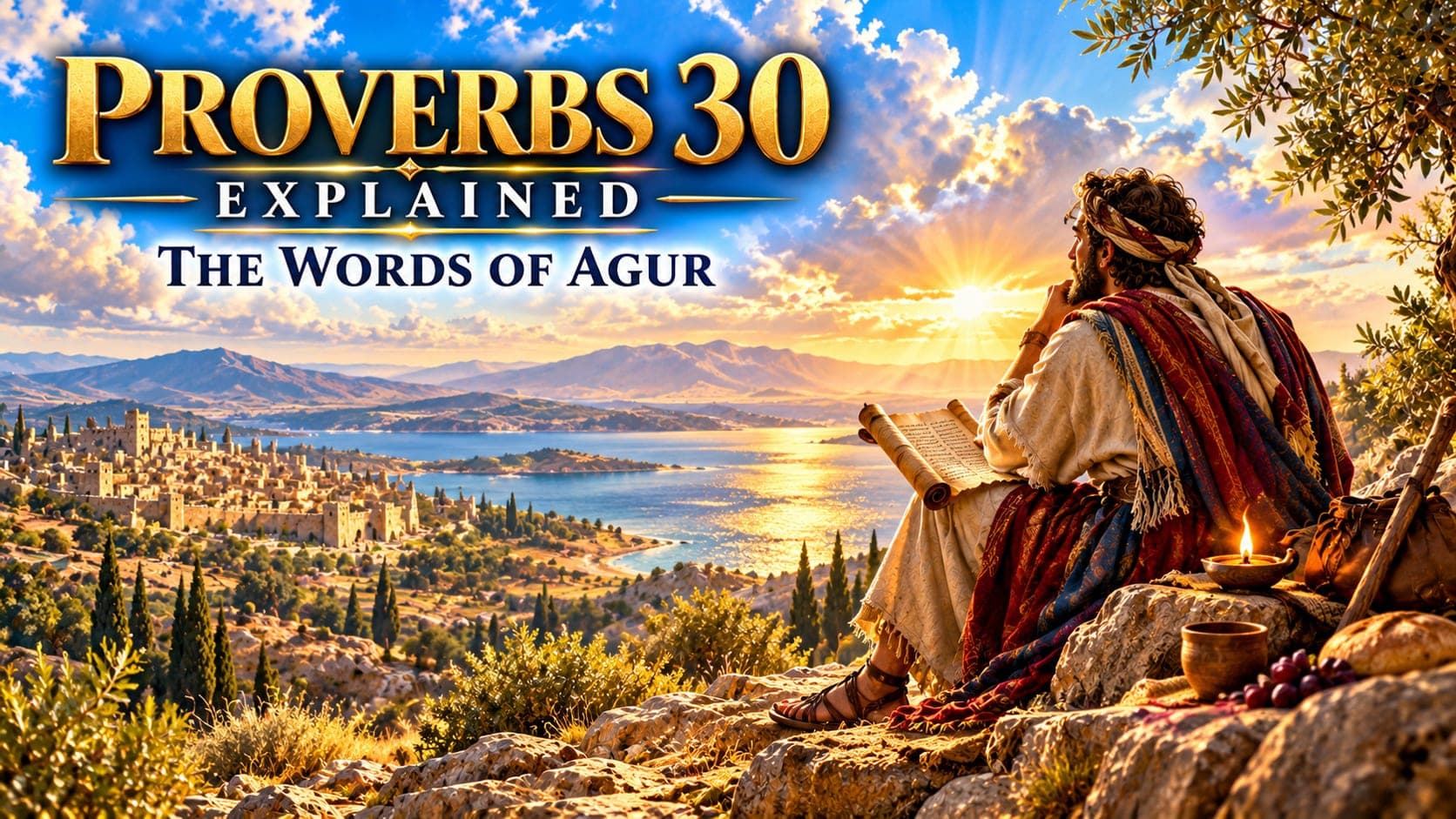
📖 Proverbs 30 Explained: Agur's Confession and Four Things Too Wonderful
A new voice opens this chapter, and the first thing he does is call himself stupid.
Proverbs 30 explained is unlike anything in the book so far. Solomon steps aside, and a man named Agur takes over for thirty three verses that read almost nothing like a typical proverb. There is a confession of ignorance, a short prayer, and then riddle after riddle built on a pattern you will see again and again: three things, then a fourth.
Maybe you have never actually read this far into Proverbs.
- ❓ Who was Agur, and why does nobody else in the Bible mention him?
- ❓ Why does he ask God for neither poverty nor riches?
- ❓ What is "the way of a man with a maid," and why is it listed next to an eagle and a ship?
- ❓ Why does a verse about a mocking eye end with ravens and eagles?
📌 Proverbs 30 keeps circling one honest admission: there is more about God, about yourself, and about the world than you will ever fully explain.
This walkthrough goes through all thirty three verses in the order Agur set them down, grouped by what each cluster is weighing: a confession of not knowing against a prayer for the right amount, four generations gone wrong against four things never satisfied, an eye that mocks a parent against four mysteries too wonderful to trace, four small creatures wiser than their size against four things stately in their going, and a closing warning about the wrath a person stirs up on purpose.
Read it slowly. This is one of the strangest chapters in the whole Bible, and one of the most honest.
What Happened Just Before This Chapter
Proverbs 29 closed Hezekiah's collection with a hardened neck, a king who judges the poor fairly, and the fear of man set against trust in the LORD. Proverbs 30 opens a brand new section with a brand new voice, and the very first thing that voice does is admit he has none of Solomon's confidence.
"The words of Agur the son of Jakeh, even the prophecy: the man spake unto Ithiel, even unto Ithiel and Ucal,"
Nothing else in Scripture names Agur or Jakeh. This single verse is everything the Bible tells us about who he was, which is one reason this chapter reads so differently from the thirty that came before it.
Proverbs 30 Explained Verse by Verse
1. A New Voice Confesses He Does Not Know (verses 2 to 4)
Agur does not open with wisdom. He opens with the opposite.
"Surely I am more brutish than any man, and have not the understanding of a man. I neither learned wisdom, nor have the knowledge of the holy."
📌 Every other teacher in Proverbs opens by telling you to listen to him. Agur opens by telling you not to expect too much. Brutish means animal like, lacking the reasoning a person should have. That is a strange way to start a chapter of wisdom literature, unless the point is exactly that.
"Who hath ascended up into heaven, or descended? who hath gathered the wind in his fists? who hath bound the waters in a garment? who hath established all the ends of the earth? what is his name, and what is his son's name, if thou canst tell?"
Four impossible questions in a row. No human has climbed to heaven and back, caught the wind by hand, or wrapped the oceans in cloth like a bundle. God asks Job a long string of the same kind of question centuries earlier in the same part of the Bible.
"Where wast thou when I laid the foundations of the earth? declare, if thou hast understanding. Who hath laid the measures thereof, if thou knowest? or who hath stretched the line upon it?"
💡 Agur is not just being modest. He is pointing at the size of the gap between what God knows and what any man can claim to know, the same gap Job had to stand inside and admit he could not close.
2. A Pure Word, and a Prayer for the Right Amount (verses 5 to 9)
Having admitted what he does not know, Agur says what he is sure of.
"Every word of God is pure: he is a shield unto them that put their trust in him. Add thou not unto his words, lest he reprove thee, and thou be found a liar."
📌 Agur cannot explain how God measured the oceans, but he is certain God's word can be trusted exactly as it was given. Proverbs 3 already told Solomon's son to trust the LORD with all his heart. Agur narrows that same trust down to the words themselves, and warns against tampering with them in either direction. The last book of the Bible closes with almost the identical warning.
"For I testify unto every man that heareth the words of the prophecy of this book, If any man shall add unto these things, God shall add unto him the plagues that are written in this book: And if any man shall take away from the words of the book of this prophecy, God shall take away his part out of the book of life, and out of the holy city, and from the things which are written in this book."
The Bible opens and closes with the same guardrail standing on either side of it. Nobody gets to pad it or trim it to fit what they would rather it said.
"Two things have I required of thee; deny me them not before I die: Remove far from me vanity and lies: give me neither poverty nor riches; feed me with food convenient for me:"
"Lest I be full, and deny thee, and say, Who is the LORD? or lest I be poor, and steal, and take the name of my God in vain."
⚠️ This is one of the most specific prayers in the whole Bible, and it asks for the middle, not the top. Wanting provision is never the sin Scripture condemns. Agur names exactly what both extremes do to a person's relationship with God: too much and you forget you need Him, too little and you are tempted to steal and drag His name into it. He is not asking to avoid hardship. He is asking to avoid the specific temptation each extreme produces.
3. Do Not Accuse a Servant, and Four Generations Gone Wrong (verses 10 to 14)
From his own prayer, Agur turns outward to how people treat each other and themselves.
"Accuse not a servant unto his master, lest he curse thee, and thou be found guilty."
A single warning against using your position to cause trouble for someone with less power than you, and then four verses describing exactly the kind of person who does.
"There is a generation that curseth their father, and doth not bless their mother. There is a generation that are pure in their own eyes, and yet is not washed from their filthiness."
"There is a generation, O how lofty are their eyes! and their eyelids are lifted up. There is a generation, whose teeth are as swords, and their jaw teeth as knives, to devour the poor from off the earth, and the needy from among men."
📌 Four sentences, each one starting the same way, "there is a generation," and each one naming a different rot. Disrespect toward parents, a filthy conscience mistaken for a clean one, pride that lifts the eyes, and greed sharp enough to be called teeth that devour the poor. Agur is not describing four separate groups of people. He is describing four ways the same corruption shows up.
4. Never Satisfied, and an Eye That Mocks a Parent (verses 15 to 17)
Here the chapter's famous pattern begins in full: three things, then a fourth.
"The horseleach hath two daughters, crying, Give, give. There are three things that are never satisfied, yea, four things say not, It is enough:"
"The grave; and the barren womb; the earth that is not filled with water; and the fire that saith not, It is enough."
💡 The horseleach is a bloodsucking creature whose two daughters, give and give, name the appetite before the list of four even starts. Death, an empty womb, dry ground, and fire all share the same trait. None of them ever says enough, no matter how much they are given.
"The eye that mocketh at his father, and despiseth to obey his mother, the ravens of the valley shall pick it out, and the young eagles shall eat it."
⚠️ This is one of the hardest lines in the chapter, and it is covered fully in Hard Questions below. For now, notice where Agur places it. Right after four things that are never satisfied comes a single verse about contempt for the two people who first fed and raised him. The placement is not an accident.
5. Four Mysteries Too Wonderful to Trace, and Four Things the Earth Cannot Bear (verses 18 to 23)
The same three then four pattern returns, now aimed at things that leave no visible trace.
"There be three things which are too wonderful for me, yea, four which I know not: The way of an eagle in the air; the way of a serpent upon a rock; the way of a ship in the midst of the sea; and the way of a man with a maid."
📌 Each of the first three leaves nothing behind to prove it happened. No eagle leaves footprints in the sky, no serpent leaves a trail on bare rock, no ship leaves a permanent mark on open water. The fourth belongs in Hard Questions below, since it is the one readers ask about most.
"Such is the way of an adulterous woman; she eateth, and wipeth her mouth, and saith, I have done no wickedness."
This verse answers its own question immediately. An adulterous woman leaves no visible trace either, and uses exactly that absence of evidence to deny any wrongdoing at all.
"For three things the earth is disquieted, and for four which it cannot bear: For a servant when he reigneth; and a fool when he is filled with meat;"
"For an odious woman when she is married; and an handmaid that is heir to her mistress."
Each of these four shares one thing in common. Someone is suddenly handed a position or a fullness they were never shaped to carry, and the sudden weight is what the earth cannot settle under, not the person themselves.
6. Four Small Creatures Wiser Than Their Size (verses 24 to 28)
The pattern shifts from warning to admiration, and from people to creatures.
"There be four things which are little upon the earth, but they are exceeding wise: The ants are a people not strong, yet they prepare their meat in the summer; The conies are but a feeble folk, yet make they their houses in the rocks;"
"The locusts have no king, yet go they forth all of them by bands; The spider taketh hold with her hands, and is in kings' palaces."
📌 None of these four creatures are impressive. All four are wise. Ants have no strength but plan ahead. Conies, a kind of rock rabbit, have no power but find a safe home anyway. Locusts have no king but still move together without confusion. A spider has no size at all but still reaches rooms a palace guard could never enter. Agur is not praising talent here. He is praising the wisdom of working with exactly what you have instead of waiting for more.
7. Four Things Stately in Their Going, and a Warning Against Forcing Wrath (verses 29 to 33)
The final list turns from small and wise to large and dignified, before the chapter closes with one plain warning.
"There be three things which go well, yea, four are comely in going: A lion which is strongest among beasts, and turneth not away for any; A greyhound; an he goat also; and a king, against whom there is no rising up."
A lion that backs away from nothing, a swift hunting dog, a he goat leading its herd, and a king secure enough that no one dares rise against him. All four carry themselves the same way, with a confidence that does not need to check over its shoulder.
"If thou hast done foolishly in lifting up thyself, or if thou hast thought evil, lay thine hand upon thy mouth."
💡 Right after four pictures of confident, dignified strength, Agur adds the correction a proud reader actually needs. If that confidence has curdled into foolish self exaltation or an evil plan, the right response is not more boldness. It is silence.
"Surely the churning of milk bringeth forth butter, and the wringing of the nose bringeth forth blood: so the forcing of wrath bringeth forth strife."
The chapter ends on cause and effect, not a blessing or a curse. Churn milk long enough and butter is the only possible result. Twist a nose hard enough and blood is the only possible result. Force wrath, push and provoke until anger finally boils over, and strife is the only possible result. Learning to hold that pressure before it is forced is exactly what the rest of Proverbs keeps calling self control.

Hard Questions Proverbs 30 Raises
Who was Agur, and was he even an Israelite? Proverbs 30:1 is the only verse in the Bible that names him, calling him "the son of Jakeh" and labeling his words "even the prophecy." That last word translates a Hebrew term, massa, that can also be read as a place name. Some translations render the phrase "Agur son of Jakeh, of Massa" instead, pointing to a region or tribe descended from Ishmael named in Genesis 25:14, rather than a description of his message as a prophecy. Proverbs 31:1 uses the exact same word for King Lemuel right after this chapter, which is part of why some scholars think both men may have come from outside Israel. The Bible does not settle the question either way, so both readings stay in circulation among translators today.
Who are Ithiel and Ucal in Proverbs 30:1? The King James translates the end of verse 1 as two names, Ithiel and Ucal, the men Agur is apparently speaking to. The Hebrew behind those words is difficult enough that other translations read the same letters as a sentence instead of two names, something closer to "I am weary, God, I am weary, God, and worn out." Both readings come from the same unpointed Hebrew consonants, and reputable translations split between them. Either way, the sense of the opening verse does not change much: a man admitting exhaustion and limitation before he says anything else.
Does "add not unto his words" in Proverbs 30:6 mean the Bible should never be explained or translated? No. The warning targets adding to God's actual words as if they were His own, claiming a new revelation or rule carries the same authority Scripture does. Explaining what a passage means, which is what this very article is doing, is different from inventing new words and presenting them as God's. Revelation 22:18 and 19 repeats the same warning at the other end of the Bible, aimed at the same danger, not at teaching or translation.
What does "the way of a man with a maid" mean in Proverbs 30:19? It sits in a list with an eagle in the air, a serpent on a rock, and a ship at sea, each one a movement that leaves no mark anyone can trace afterward. Agur is describing the pull of attraction between a man and a woman the same way, a real force that leaves no visible footprint the way a wound or a theft would. Verse 20 immediately contrasts that mystery with an adulterous woman, who abuses the very fact that her sin also leaves nothing anyone can see, which is the point Agur is actually making.
Why does Proverbs 30:17 say ravens and eagles will deal with an eye that mocks a parent? The verse uses the fate of an unburied corpse, picked apart by scavenging birds in the open field, as the picture of what contempt for parents ultimately earns. This is graphic because the offense was treated with real severity under the law given at Sinai.
"And he that curseth his father, or his mother, shall surely be put to death."
Proverbs 30:17 is not introducing a new punishment. It is reminding a reader how seriously God already treated the honor due to a father and a mother, and painting what contempt for them looks like carried all the way to its end.
Practical Tips From Proverbs 30
Thirty three verses from a man who starts by admitting he does not know everything.
- Let what you do not know humble you, not silence you. Agur names his own limits in verse 2 and 3, then keeps teaching anyway. Admitting limits is not the same as having nothing worth saying.
- Treat God's word as finished, not a draft. Verse 6 warns against adding to it. Read it for what it says before deciding what you wish it said.
- Pray for the middle, not just the extremes. Verse 8 asks for neither poverty nor riches on purpose, naming the specific temptation each extreme actually produces.
- Watch what you say about your parents. Verse 17 treats contempt for a father or mother as far more serious than most people assume today.
- Work with what you actually have. Verses 24 to 28 praise small creatures for using limited strength wisely, not for becoming something bigger than they are.
- Catch pride before it curdles into evil. Verse 32 tells a man who has lifted himself up foolishly to put a hand over his mouth, not to double down.
- Stop forcing the pressure before it becomes strife. Verse 33 says forced wrath produces strife the same way a twisted nose produces blood, every time, without exception.
Top 5 Bible Verses From Proverbs 30
1. Proverbs 30:5
"Every word of God is pure: he is a shield unto them that put their trust in him."
Agur's one certainty in a chapter full of mysteries he cannot solve: God's word holds, and it shields anyone who actually leans on it.
2. Proverbs 30:8 and 9
"Remove far from me vanity and lies: give me neither poverty nor riches; feed me with food convenient for me: Lest I be full, and deny thee, and say, Who is the LORD? or lest I be poor, and steal, and take the name of my God in vain."
One of the most specific prayers in Scripture, naming the exact danger of too much and the exact danger of too little, and asking to be spared both.
3. Proverbs 30:17
"The eye that mocketh at his father, and despiseth to obey his mother, the ravens of the valley shall pick it out, and the young eagles shall eat it."
One of the hardest lines in the chapter, using an unburied body as the picture of what contempt for parents earns under a law that treated the offense with real severity.
4. Proverbs 30:25
"The ants are a people not strong, yet they prepare their meat in the summer;"
A small creature with no real strength, praised purely for planning ahead with what little it has.
5. Proverbs 30:33
"Surely the churning of milk bringeth forth butter, and the wringing of the nose bringeth forth blood: so the forcing of wrath bringeth forth strife."
The chapter's closing cause and effect: force anger far enough, and strife is not a possibility. It is a certainty.
Frequently Asked Questions About Proverbs 30
What is Proverbs 30 about?
A chapter credited to Agur, not Solomon, built around confessing the limits of human knowledge and a series of numbered riddles, three things then a fourth, covering appetite, family, mystery, wisdom found in small creatures, and a final warning against forcing anger into strife.
Who was Agur in the Bible?
A wisdom teacher named only once, in Proverbs 30:1, as "the son of Jakeh." Nothing else in Scripture mentions him, and his identity beyond this chapter is genuinely unknown.
Was Agur an Israelite?
It is uncertain. The Hebrew word some translations read as "the prophecy" in verse 1 can also be read as the place name Massa, which some scholars connect to a tribe descended from Ishmael. Scripture does not resolve the question either way.
Who are Ithiel and Ucal in Proverbs 30:1?
The King James reads them as two men Agur addressed. The underlying Hebrew is difficult enough that other translations read the same letters as a sentence about weariness instead of two proper names, and reliable translations differ on which reading is correct.
What does "every word of God is pure" mean in Proverbs 30:5?
It states that Scripture can be fully trusted exactly as given, with nothing false mixed into it, and that trusting it functions as real protection for the person who leans on it.
What does "add not unto his words" mean in Proverbs 30:6?
It warns against presenting your own ideas as if they carried God's own authority. Revelation 22:18 and 19 repeats the same warning at the close of the Bible, aimed at the same danger rather than at explaining or teaching Scripture.
Why does Agur ask for neither poverty nor riches in Proverbs 30:8?
He names a specific temptation attached to each extreme: wealth tempting a person to forget God entirely, and poverty tempting a person toward theft and dishonoring God's name. The prayer asks to be spared both temptations, not wealth itself.
What does "the way of a man with a maid" mean in Proverbs 30:19?
It is grouped with an eagle, a serpent, and a ship, each a real movement that leaves no visible trace behind it. Agur describes the pull between a man and a woman the same way, then contrasts it with an adulterous woman in the next verse who abuses that same lack of a visible trace.
What is the main lesson of Proverbs 30?
That real wisdom starts by admitting how much you do not know, trusts God's word exactly as it was given, and pays attention to the small, patient creatures and the forced, sudden angers that reveal far more about a person than their size or their title ever could.
Final Thoughts
Proverbs 30 does not act like the rest of the book, and that is exactly what makes it worth slowing down for.
📌 Admitting what you do not know is not weakness. Agur opens by calling himself brutish, then spends thirty one more verses teaching anyway. Humility and wisdom were never opposites.
📌 God's word does not need your additions. Verse 6 and Revelation 22 guard the same boundary from opposite ends of Scripture, because the temptation to improve on God's own words never really goes away.
📌 Small and patient beats large and sudden, almost every time. An ant planning ahead gets praised. Forced wrath, pushed past its limit, only ever produces strife.
So here is your one next step.
Name one thing about God, yourself, or your circumstances that you honestly do not fully understand.
Agur did not let that honesty stop him from trusting God's word anyway. Let it do the same for you.