📖 Proverbs 9 Explained: Wisdom and Folly Both Call to You
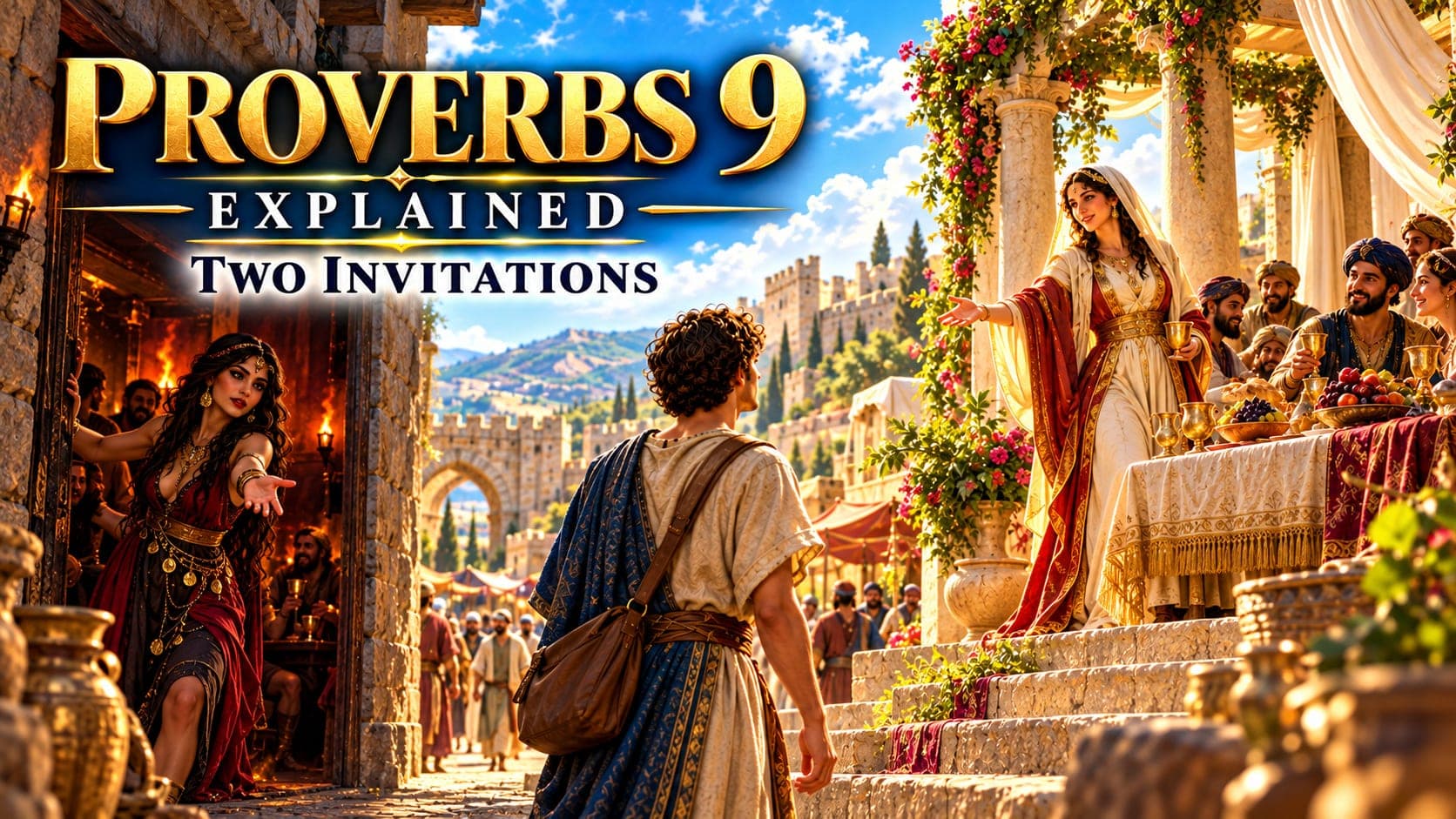
Two women. Two houses. Two invitations that sound almost exactly alike.
Proverbs 9 explained is the shortest chapter in this opening section of the book, only eighteen verses, and it closes the whole run of fatherly speeches that began back in Proverbs 1. It does that by staging one final scene. Wisdom has built a house and set a table. Folly sits at her own door and copies Wisdom's exact words to lure the same crowd.
Maybe you have noticed that temptation rarely announces itself as temptation.
- ❓ What are the seven pillars of wisdom's house?
- ❓ Why does the chapter warn against correcting a scorner?
- ❓ Who is the "foolish woman," and is she a real person?
- ❓ Why does stolen water taste sweeter than water you already own?
📌 Wisdom and Folly use almost the same sentence to call out to the same people. The only way to tell them apart is to know what is actually on the table.
This walkthrough goes through the whole chapter in order: the feast Wisdom spent real cost preparing, the short lesson on who can actually be corrected, and the doorstep where Folly offers a meal she never had to earn.
Read it slowly. Both invitations in this chapter are still open right now.
What Happened Just Before This Chapter
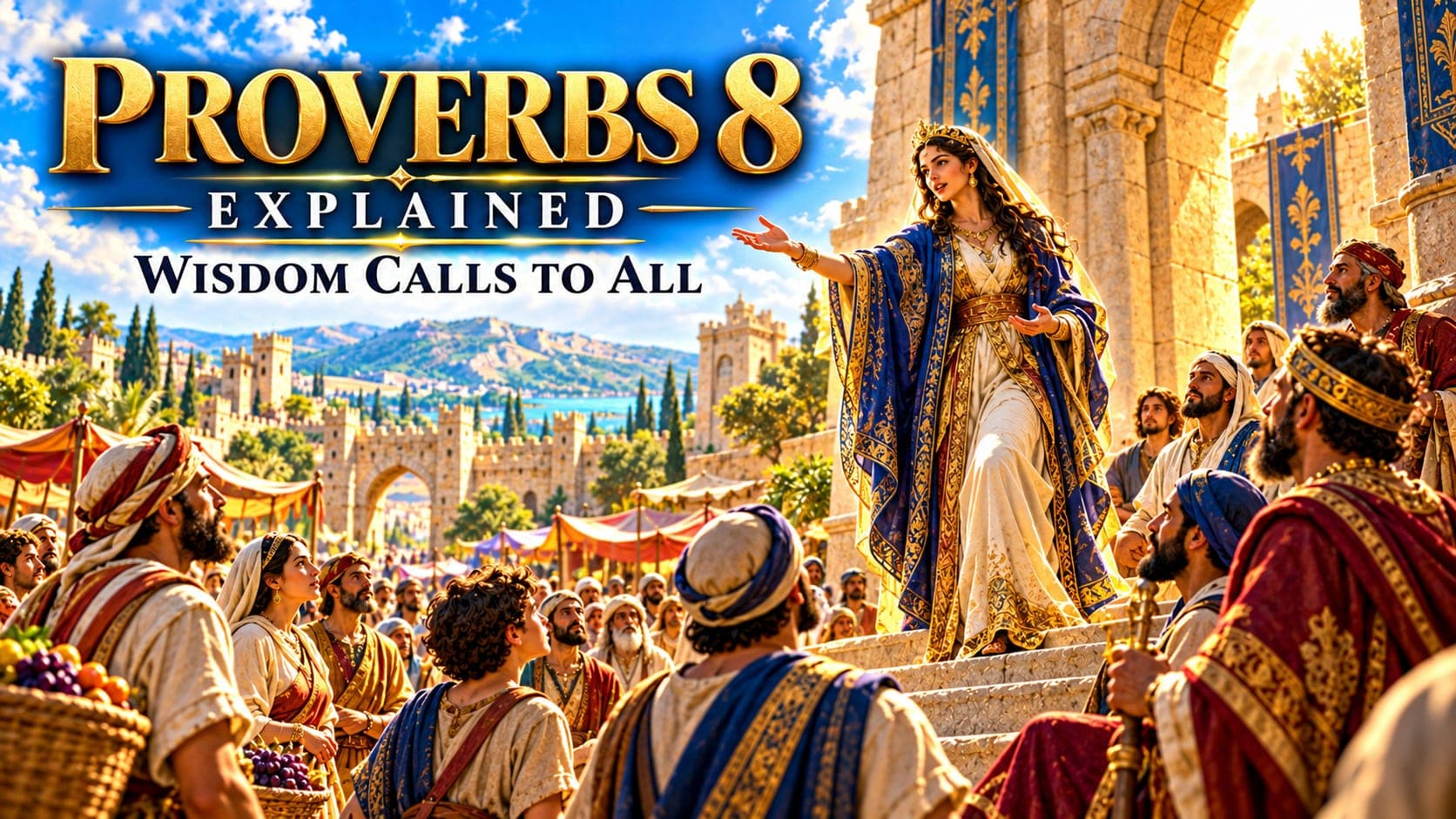
Proverbs 8 ended with wisdom shouting from the city gates in broad daylight, closing her speech on a plain choice: find her and find life, or hate her and love death. That was wisdom speaking about herself in the abstract, describing her worth and her age before the world existed.
Proverbs 9 turns that description into a scene. Wisdom stops talking about what she offers and actually sets the table. And for the first time in the book, the danger Solomon has been warning about since Proverbs 2 gets the same treatment. Folly is no longer just a path that leads somewhere bad. She is a woman with her own house, sitting at her own door, competing for the exact same guests.
📌 Chapter 8 ended with a choice stated in words. Chapter 9 ends it with two open doors standing side by side.
Proverbs 9 Explained Verse by Verse
1. Wisdom Builds a House and Spreads a Feast (verses 1 to 6)
The chapter opens with Wisdom doing actual work, not just speaking.
"Wisdom hath builded her house, she hath hewn out her seven pillars: She hath killed her beasts; she hath mingled her wine; she hath also furnished her table."
Notice every verb. Builded. Hewn. Killed. Mingled. Furnished. Five separate actions, each one costly, each one finished before a single guest arrives. Scripture never explains what the seven pillars specifically stand for, and any precise list of what each pillar represents is guesswork added long after the text. What the number does communicate, the way it does elsewhere in Scripture, is completeness. This is not a shack. It is a finished, solid house built to last.
📌 Wisdom does not invite anyone over before the work is done. The feast is real because the cost was already paid by the time the invitation goes out.
"She hath sent forth her maidens: she crieth upon the highest places of the city, Whoso is simple, let him turn in hither: as for him that wanteth understanding, she saith to him, Come, eat of my bread, and drink of the wine which I have mingled."
She sends servants out and calls from the highest points in the city herself, the same public, impossible to miss places described in the last chapter. Her target audience is named directly: the simple, the one who lacks understanding. Not people who have already arrived. People who still need the meal she is offering.
"Forsake the foolish, and live; and go in the way of understanding."
💡 The invitation is not just to a meal. It is to a complete change of direction. "Forsake" means walk away from entirely, not sample cautiously while keeping one foot on the old road. Wisdom offers life in exchange for an actual departure, not a visit.
2. Reprove the Wise, Not the Scorner (verses 7 to 9)
Before the chapter turns to its second woman, Solomon drops in a short, standalone lesson about correction itself.
"He that reproveth a scorner getteth to himself shame: and he that rebuketh a wicked man getteth himself a blot. Reprove not a scorner, lest he hate thee: rebuke a wise man, and he will love thee."
📌 The same words, correction and rebuke, produce opposite results depending entirely on who receives them. A scorner has already decided he is right. Tell him he is wrong and he does not reconsider. He turns on the person who told him.
A wise man is wise precisely because he has not made that decision about himself. He still assumes he has more to learn, so a correction lands as help instead of attack.
"Give instruction to a wise man, and he will be yet wiser: teach a just man, and he will increase in learning."
Wisdom, in this single verse, is shown to be self multiplying. Teach it to someone who already has some, and it grows rather than simply fills a container. That is not true of the scorner in verse 7, who stays exactly where he started no matter what is said to him.
3. The Fear of the LORD Is the Beginning of Wisdom (verses 10 to 12)
Solomon states the foundation underneath everything the book has said so far.
"The fear of the LORD is the beginning of wisdom: and the knowledge of the holy is understanding."
📌 This is the closest Proverbs comes to restating its own opening line. Proverbs 1:7 opened the book by calling the fear of the LORD the beginning of knowledge. Nine chapters later, almost the same sentence closes this whole opening section, this time naming wisdom instead of knowledge. The two verses act like bookends around everything in between.
"For by me thy days shall be multiplied, and the years of thy life shall be increased. If thou be wise, thou shalt be wise for thyself: but if thou scornest, thou alone shalt bear it."
💡 Verse 12 removes every excuse. Wisdom benefits you. Scorn costs you. Neither can be transferred to someone else or blamed on someone else. Solomon is not describing peer pressure or inherited consequences here. He is describing a decision that settles on the one who makes it, nobody standing beside him included.
4. Folly Takes the Same Seat (verses 13 to 15)
The chapter now introduces its second woman, described in far fewer words than it took to introduce Wisdom.
"A foolish woman is clamorous: she is simple, and knoweth nothing. For she sitteth at the door of her house, on a seat in the high places of the city,"
📌 Wisdom "builded" her house. Folly only "sitteth" at a door. Five verbs described five acts of labor for Wisdom in verses 1 and 2. Folly gets one verb, and it is not building anything. She takes a seat in the same high places Wisdom and her servants already occupy in verses 3 and 14, borrowing the location without doing any of the work that earned it.
Calling her "clamorous" and someone who "knoweth nothing" matches the exact language this book has used for the dangerous woman since Proverbs 7, restless, loud, never settled in one place for long.
"To call passengers who go right on their ways:"
Her targets are not people already wandering toward trouble. They are people going right on their own ways, minding their own business, until she calls out to interrupt them.
5. Stolen Water, and Guests Who Are Already Dead (verses 16 to 18)
Here is the detail that makes this chapter so sharp. Folly does not invent her own pitch. She borrows Wisdom's.
"Whoso is simple, let him turn in hither: and as for him that wanteth understanding, she saith to him, Stolen waters are sweet, and bread eaten in secret is pleasant."
📌 Compare verse 16 to verse 4. The opening line of Folly's call is almost word for word Wisdom's opening line. She is not competing with a different message. She is using the same words aimed at the same undecided person, and counting on him not to notice until it is too late to matter.
Then the menu changes completely. Wisdom offered bread and wine she killed, mingled, and furnished at her own cost. Folly offers water that was never hers to give and bread eaten only because no one is watching. Nothing on her table cost her anything. Everything on it costs the guest.
💡 The appeal of "stolen" is not the water itself. It is the secrecy. The same pull drew Eve toward a fruit that was "pleasant to the eyes, and a tree to be desired to make one wise" in Genesis 3. In both scenes, what is forbidden is dressed up as more desirable than what is freely offered right next to it.
"But he knoweth not that the dead are there; and that her guests are in the depths of hell."
⚠️ "Hell" here translates the Hebrew word for Sheol, the realm of the dead, not the New Testament picture of final judgment. The point is not a theological claim about eternity. It is a plain warning about where this particular table already sits. Folly's earlier guests did not wander off afterward. They are already dead, still seated, and the new guest walking in has no idea he just joined them.
The book's entire opening section, nine chapters of a father pleading with his son, ends on that single image. Two women, two nearly identical invitations, and only one of them tells the truth about what is actually being served.
Hard Questions Proverbs 9 Raises
What do the seven pillars of wisdom's house actually represent? Scripture does not say. Later traditions have proposed specific lists, liberal arts, spiritual gifts, and others, but none of these come from the text of Proverbs 9 itself. The safest reading is the plainest one: seven pictures a complete, well built house, not a coded list waiting to be decoded.
Isn't it dishonest to avoid correcting a scorner, even if he will not listen? Verse 8 does not forbid ever telling the truth to a scorner. It warns that formal correction aimed at changing him will provoke hatred rather than change, because he has already decided he is right. The verse is describing what actually happens, not commanding permanent silence toward every difficult person.
Does verse 12, "thou alone shalt bear it," mean other people are never affected by someone's foolishness? No. Plenty of other passages in Scripture, including earlier in this book, describe how one person's folly harms a whole household or city. Verse 12 is making a narrower point about personal accountability before God: wisdom's reward and scorn's consequence cannot be handed off to someone else, even while others may still feel the ripple effects.
Is the "foolish woman" in verses 13 to 18 a real woman, or only a symbol? The structure of the chapter, built as a direct counterpart to Wisdom personified as a woman, points toward literary personification rather than one specific historical person. That said, the danger she represents, the real individuals who draw others toward secrecy and ruin, is treated throughout Proverbs as entirely real, whatever form it takes.
Why does Folly copy Wisdom's exact words in verse 16? The text does not explain her motive, but the effect is clear. A counterfeit works by resembling the real thing as closely as possible. The chapter is showing, not just telling, how close a false invitation can sound to a true one.
Practical Tips From Proverbs 9
Eighteen verses, two tables, and real decisions you can make before you sit down at either one.
- Check who paid for what you are being offered. Verses 2 and 17 draw the real line. Wisdom's table cost her something before you ever arrived. Folly's table costs you after you sit down.
- Notice when an invitation sounds suspiciously familiar. Verse 16 copies verse 4 almost word for word. Something that sounds exactly like wisdom is worth a second look at what is actually on the table, not just the words used to describe it.
- Ask whether you still want correction, or only agreement. Verses 7 and 8 describe two very different reactions to being told you are wrong. Which one describes you right now is worth answering honestly.
- Let instruction change you, not just inform you. Verse 9 says a wise man who is taught becomes wiser still. Treat what you already know as a floor to build on, not a finish line.
- Remember the fear of the LORD is a beginning, not an extra step. Verse 10 places it first, the same place Proverbs 1 put it nine chapters earlier. Nothing else in this book works as a substitute starting point.
- Be suspicious of secrecy itself, not just the specific sin. Verse 17 names the appeal directly: stolen and secret, not merely the water. Ask what it means if something only feels good because nobody can see it.
- Remember the ownership of your decision. Verse 12 will not let you hand wisdom's reward or scorn's cost to anyone else. Decide today knowing you are the one who keeps whichever you choose.
Top 5 Bible Verses From Proverbs 9
1. Proverbs 9:10
"The fear of the LORD is the beginning of wisdom: and the knowledge of the holy is understanding."
The near echo of the book's opening line, closing the nine chapter introduction on the same foundation it started with.
2. Proverbs 9:1 and 2
"Wisdom hath builded her house, she hath hewn out her seven pillars: She hath killed her beasts; she hath mingled her wine; she hath also furnished her table."
Five deliberate acts of labor, all finished before a single guest is invited in.
3. Proverbs 9:8
"Reprove not a scorner, lest he hate thee: rebuke a wise man, and he will love thee."
The same correction, aimed at two different hearts, producing two opposite results.
4. Proverbs 9:17
"Stolen waters are sweet, and bread eaten in secret is pleasant."
Folly's entire pitch in one line: the appeal is the secrecy itself, not what is actually being eaten or drunk.
5. Proverbs 9:18
"But he knoweth not that the dead are there; and that her guests are in the depths of hell."
The chapter's final warning: the danger was never only ahead of Folly's guests. It was already seated at her table.
Frequently Asked Questions About Proverbs 9
What is Proverbs 9 about?
It closes the book's opening section with two competing invitations: Wisdom, who built a house and prepared a costly feast, and Folly, who sits at her own door offering a copy of Wisdom's invitation with nothing real behind it.
What do the seven pillars of wisdom's house mean?
Scripture never explains the specific meaning. The number most likely signals a complete, solidly built structure rather than a coded list of seven particular things, and any more specific identification is tradition, not text.
Who is the foolish woman in Proverbs 9?
She is Folly personified as a woman, built as the direct counterpart to Wisdom personified earlier in the same chapter. She represents the same danger Proverbs has warned about since chapter 2, now given her own house and her own voice.
Why shouldn't you correct a scorner?
Not because correction is wrong, but because verse 7 says it backfires. A scorner has already decided he is right, so rebuking him produces hatred toward the one correcting him rather than change in him.
What does "the fear of the LORD is the beginning of wisdom" mean?
It means genuine reverence for God is the starting point every other kind of wisdom depends on, not one lesson among many. Proverbs 1:7 opens the book on nearly the same line, and Proverbs 9:10 closes the opening section on it again.
What does "stolen waters are sweet" mean?
It describes how secrecy itself, not the thing being hidden, is what makes wrongdoing feel appealing. Something taken in secret can feel more desirable than the same thing offered openly, even when nothing about it actually changed.
What does "the depths of hell" mean in Proverbs 9:18?
It translates the Hebrew word for Sheol, the realm of the dead, describing where Folly's earlier guests already are, rather than making a direct statement about final judgment in the New Testament sense.
How does Proverbs 9 end the opening section of the book?
Proverbs 1 through 9 are extended speeches from a father to his son. Starting in Proverbs 10, the book shifts into short, standalone sayings. Chapter 9 closes the speeches with one final scene instead of one final argument, leaving the choice between the two houses as the last word before the sayings begin.
How does Proverbs 9 connect to Genesis 3?
Both scenes dress up something forbidden as more desirable than what is already freely available. Eve saw fruit "pleasant to the eyes" and desired "to make one wise." Folly offers water that is sweet only because it is stolen. Neither temptation works by looking obviously dangerous.
Why does Folly use almost the same words as Wisdom?
Verse 16 repeats verse 4 almost exactly. The repetition shows, rather than simply states, how closely a false invitation can imitate a true one, which is exactly why the chapter insists on checking what is actually on the table instead of only listening to the words used to describe it.
Final Thoughts
Proverbs 9 does not end the book's opening appeal with another warning. It ends it with a choice between two tables.
📌 Real wisdom costs something before it ever invites you in. Every verb in verses 1 and 2 describes work finished ahead of time, not a meal thrown together to look good for the moment.
📌 A counterfeit invitation can sound almost identical to the real one. Checking what is actually being served matters more than how familiar the words sound on the way in.
📌 Wisdom's reward and folly's cost both belong to you alone. Verse 12 will not let either one be transferred to someone standing nearby.
So here is your one next step.
Look at whatever invitation is in front of you this week and ask what it actually cost the one offering it, the way verses 2 and 17 force you to ask.
That one question tells you faster than anything else which table you are really sitting at.