📖 What Is a Holy Day of Obligation? Catholic Meaning and Requirements
You open the parish bulletin and see it in bold letters. Holy day of obligation. Mass times listed for a random Tuesday.
Maybe you grew up Catholic and never once asked what that phrase actually means, only that missing it felt like it mattered more than missing an ordinary Sunday.
Maybe you are dating or married into a Catholic family, and you want to understand the rule before you accidentally shrug it off in front of your mother in law.
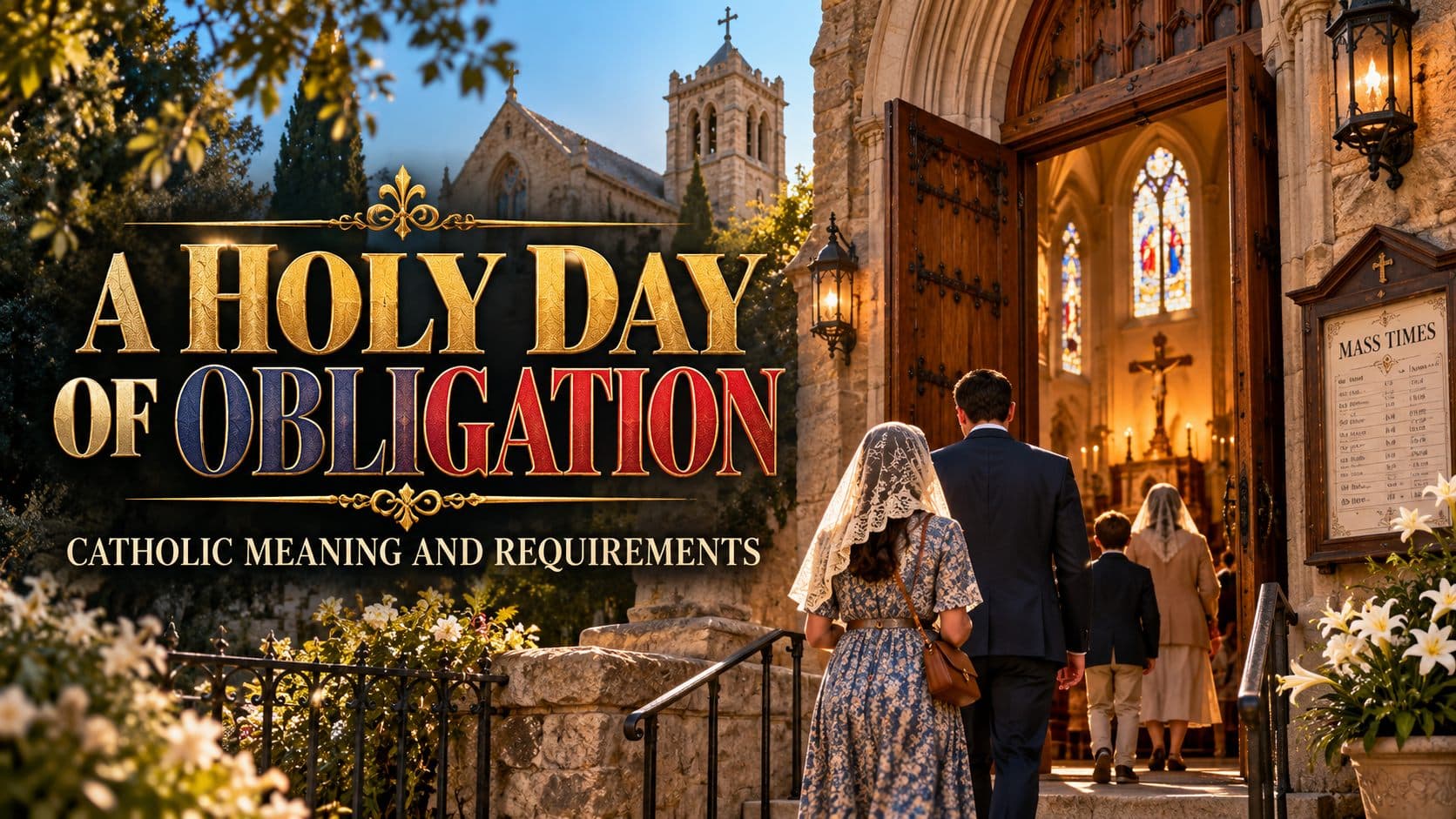
📌 Here is the plain answer. A holy day of obligation is a specific date, set by church law, when Catholics are bound to attend Mass the same way they are bound to attend on a Sunday, because the day commemorates something the church considers too important to leave optional.
That is the short version. The longer version involves a Vatican law code, a list that changes from country to country, and a real debate happening in the church right now about what counts when one of these days lands on a Saturday or a Monday.
This guide walks through where the obligation actually comes from, which days carry it in the United States, what counts as fulfilling it, what happens if you cannot make it, and how Protestant Christians understand the same question of required worship very differently.
Every historical and legal claim below links back to a named source, so you can go check it yourself.
Why This Matters for Your Faith
It is easy to hear the word obligation and feel your shoulders tighten. Another rule. Another box to check.
⚠️ That reaction misses what the rule is actually protecting. Long before any pope wrote a word of canon law, God had already built rest and gathered worship into the rhythm of His people on purpose.
"Remember the sabbath day, to keep it holy. Six days shalt thou labour, and do all thy work: But the seventh day is the sabbath of the LORD thy God: in it thou shalt not do any work, thou, nor thy son, nor thy daughter, thy manservant, nor thy maidservant, nor thy cattle, nor thy stranger that is within thy gates:"
📌 The commandment was never really about the calendar. It was about a God who knew His people would drift toward treating every day the same, worship included, if nobody drew a line and said this day is set apart.
Scripture shows God doing the same thing again later, naming specific appointed times as holy convocations He expected His people to actually show up for.
"Speak unto the children of Israel, and say unto them, Concerning the feasts of the LORD, which ye shall proclaim to be holy convocations, even these are my feasts."
💡 Whatever you make of the Catholic Church's specific list, the underlying instinct is not a Catholic invention. God has always cared that His people gather, on days He names, not only on days convenient to them.
That is the real stakes here. Not whether you can recite six dates from memory, but whether your own walk with God still has any day in it that you treat as genuinely set apart.

What a Holy Day of Obligation Actually Is
1. The Plain Definition, Straight From Church Law
Start with where the obligation is actually written down. The Catholic Church's Code of Canon Law, the body of church legislation published by the Vatican, lays it out in Canon 1247.
Canon 1247 states it this way: "On Sundays and other holy days of obligation, the faithful are obliged to participate in the Mass. Moreover, they are to abstain from those works and affairs which hinder the worship to be rendered to God, the joy proper to the Lord's day, or the suitable relaxation of mind and body."
📌 Two obligations sit inside that one sentence. Go to Mass, and do not fill the day with work that crowds out worship and rest. A holy day of obligation is simply a Sunday rule applied to a weekday, attached to an event the church considers central enough to deserve its own date on the calendar.
The Catechism of the Catholic Church, the church's official summary of its teaching, folds this into what it calls the precepts of the Church, a short list of minimum obligations every Catholic is expected to keep. The first precept states it directly: you shall attend Mass on Sundays and holy days of obligation. A later precept narrows the focus to the holy days themselves, describing them as completing the Sunday observance through the feasts that honor the Lord, the Virgin Mary, and the saints.
2. Where the Universal List Comes From
Canon 1246 names the days the whole worldwide church is meant to keep, on top of every Sunday, which the same canon calls the primordial holy day of obligation.
Canon 1246 §1 names them plainly: "The following days must also be observed: the Nativity of our Lord Jesus Christ, the Epiphany, the Ascension, the Body and Blood of Christ, Holy Mary the Mother of God, her Immaculate Conception, her Assumption, Saint Joseph, Saint Peter and Saint Paul the Apostles, and All Saints."
Ten days, in theory, everywhere the Catholic Church exists. But the very next paragraph of the same canon hands local bishops real authority over that list: "With the prior approval of the Apostolic See, however, the conference of bishops can suppress some of the holy days of obligation or transfer them to a Sunday."
📌 That one sentence is why the list you grew up with might not match a Catholic friend's from another country. Rome sets the ceiling. Each national bishops' conference, with Rome's approval, decides how much of it their own country actually keeps as obligatory.
3. Which Holy Days Americans Actually Keep
The bishops of the United States used that authority years ago. Out of the ten days on Rome's universal list, American Catholics are bound to six, not counting every Sunday itself:
- 🟢 January 1, the Solemnity of Mary, Mother of God
- 🟢 The Ascension of the Lord (celebrated on a Thursday or a Sunday, depending on the province)
- 🟢 August 15, the Assumption of the Blessed Virgin Mary
- 🟢 November 1, All Saints' Day
- 🟢 December 8, the Immaculate Conception
- 🟢 December 25, Christmas
Epiphany, Corpus Christi, Saint Joseph, and the feast of Peter and Paul stay on Rome's universal list, but American bishops moved them to the nearest Sunday rather than keeping them as separate obligatory weekdays, which is exactly the authority Canon 1246 §2 gives a national conference.
Ascension carries its own small wrinkle. In 1999, the U.S. bishops' conference let each ecclesiastical province decide for itself whether to keep the traditional Thursday, forty days after Easter, or move the feast to the following Sunday, the same transfer Canon 1246 §2 allows with the Apostolic See's approval. That is why a Catholic in one American state might keep Ascension on a Thursday while a Catholic two states over keeps it the Sunday after.
4. The Rule for Saturdays and Mondays, and Why It Is Suddenly Uncertain
Here the picture gets genuinely complicated, and a good guide has to say so rather than flatten it into a tidy answer.
For years, American Catholics followed a norm the U.S. bishops adopted for three of those six days. Catholic Answers, a Catholic apologetics publisher, quotes the rule directly:
"Whenever January 1, the solemnity of Mary, Mother of God, or August 15, the solemnity of the Assumption, or November 1, the solemnity of All Saints, falls on a Saturday or on a Monday, the precept to attend Mass is abrogated." In plain English, abrogated means lifted. If one of those three days landed on a Saturday or a Monday, American Catholics were simply not bound to go.
⚠️ That settled rule is no longer so settled. In September 2024, the Vatican's Dicastery for Legislative Texts sent a letter to a U.S. bishop stating that these feasts, in the dicastery's words, remain always days of obligation even when transferred, and that a feast moved to a different day must still be observed as a day of obligation on the day it lands on. The National Catholic Register reported that American dioceses responded differently to the very same date that December. When the Immaculate Conception fell on Sunday, December 8, 2024, and the feast moved to Monday the 9th, Boston, Atlanta, Denver, and several other dioceses treated that Monday as obligatory, while Galveston-Houston and Tulsa granted a dispensation instead.
📌 What that means for you is simple even if the church politics are not. Do not assume the old Saturday or Monday exception still applies everywhere. Check your own diocese's bulletin or website before a holy day that falls on either of those days, because the answer in 2026 can genuinely differ from parish to parish while this question works itself out at the highest levels of the church.
5. What Actually Counts as Fulfilling the Obligation
The law is more flexible than most people assume about exactly when you have to show up.
Canon 1248 §1 says: "A person who assists at a Mass celebrated anywhere in a Catholic rite either on the feast day itself or in the evening of the preceding day satisfies the obligation of participating in the Mass."
That is the same rule that makes a Christmas Eve Vigil Mass count toward the Christmas obligation, the same way a Saturday evening Mass already counts toward the Sunday one. The church's reasoning for starting a feast the evening before goes all the way back to the ancient Jewish pattern of beginning a day at sunset rather than at midnight.
And the law never pretends every Catholic can always get to church. A serious reason, such as illness, caring for a young child, dangerous weather, or a genuine lack of access to Mass, excuses the obligation. The principle underneath that exception is an old one in church law, sometimes summarized as nobody is bound to the impossible. A pastor or bishop can also grant a formal dispensation ahead of a specific day.
6. Why Protestants Reject the Idea of a Binding Church Calendar
💡 Explain this fairly, because Bible Buddy has both Catholic and Protestant readers. Catholic teaching holds that the church, through the authority it believes Christ gave it, can bind the conscience of believers to a specific calendar of worship beyond Sunday itself. Most Protestant traditions reject that claim outright, and they ground the rejection in Scripture, not mere preference.
Paul wrote directly to a church being pressured to keep a religious calendar as a matter of obligation.
"Let no man therefore judge you in meat, or in drink, or in respect of an holyday, or of the new moon, or of the sabbath days: Which are a shadow of things to come; but the body is of Christ."
Protestant theology generally reads this passage as closing the door on any church authority that tries to add required holy days on top of what Scripture itself commands. In that view, no pastor, denomination, or council gets to bind a Christian's conscience the way a Mass obligation claims to.
That does not make regular worship optional in Protestant teaching. The writer of Hebrews gives the positive command most Protestants point to instead.
"Not forsaking the assembling of ourselves together, as the manner of some is; but exhorting one another: and so much the more, as ye see the day approaching."
⚠️ Never present one side of this as simply the Christian answer. A Catholic reads a holy day of obligation as the church exercising real, Christ given authority over how believers worship. A Protestant reads the exact same calendar as a human addition to a command Scripture already gave freely, not as something owed. Both readers love the same Lord's Day. They disagree, honestly and on biblical grounds, about who gets to add to it. Whether church attendance itself is required for salvation is a related question worth its own separate answer.
7. Where This Fits in the Wider Church Calendar
A holy day of obligation is not a calendar of its own. It sits inside the much larger liturgical calendar the whole Catholic Church follows, a yearly cycle of seasons and feasts that the USCCB's own guide to the liturgical year ranks by importance. Solemnities, like Christmas and Easter, sit at the top of that ranking. Feasts come next, and memorials, which honor a particular saint on an ordinary day, rank below that.
Most solemnities are not holy days of obligation. Easter itself, oddly enough, does not need to be, because it always falls on a Sunday, which already carries the obligation on its own. Obligation is really only an issue on the solemnities that happen to fall on a weekday, which is exactly why the list stays short.
Practical Tips for Keeping a Holy Day Well
Whether you are Catholic yourself or just trying to understand a Catholic family member's calendar, here is how to actually use what you just read.
- Check your own diocese before assuming the old rules still apply. Given the 2024 Vatican clarification, do not guess about a Saturday or Monday holy day. Look at your parish bulletin or diocesan website for that specific date.
- Use the evening Mass if the day itself is impossible. Canon 1248 makes this a real option, not a loophole. A Vigil Mass the evening before counts.
- Do not let obligation become the whole point. The rule exists to protect worship, not to replace the reason for it. Walk in actually wanting to be there, the way Exodus 20 frames the Sabbath as a gift before it is a command.
- If you have a serious reason to miss, do not carry needless guilt. Illness, caring for a baby, or real danger genuinely excuses the obligation. The law itself says so.
- Learn what each day on the list actually celebrates. A date means more once you know the event behind it, whether that is Mary's motherhood, the Ascension, or every saint in heaven at once.
- If you are Protestant, resist treating the Catholic practice as empty ritual. You can disagree with the obligation and still recognize the underlying instinct, that some days deserve to be set apart on purpose, as a shared and biblical one.
- Build your own rhythm of set apart worship, obligation or not. Hebrews 10:25 is a command every Christian shares, whatever your tradition says about which specific days carry it.
Top 5 Bible Verses About Set Apart Worship
Scripture never uses the phrase holy day of obligation, but these five verses carry the whole idea of why any day of worship gets set apart at all.
1. Exodus 20:8 to 10
"Remember the sabbath day, to keep it holy. Six days shalt thou labour, and do all thy work: But the seventh day is the sabbath of the LORD thy God: in it thou shalt not do any work, thou, nor thy son, nor thy daughter, thy manservant, nor thy maidservant, nor thy cattle, nor thy stranger that is within thy gates:"
This is the oldest command behind the whole idea of a set apart worship day. Long before any church calendar existed, God had already decided that one day in seven belonged to Him in a way the other six did not.
2. Leviticus 23:2 and 3
"Speak unto the children of Israel, and say unto them, Concerning the feasts of the LORD, which ye shall proclaim to be holy convocations, even these are my feasts. Six days shall work be done: but the seventh day is the sabbath of rest, an holy convocation; ye shall do no work therein: it is the sabbath of the LORD in all your dwellings."
God names specific feast days here and calls them His own, not just Israel's custom. That pattern, specific appointed days claimed by God Himself, is the root every later Christian holy day calendar is a descendant of, however loosely.
3. Luke 4:16
"And he came to Nazareth, where he had been brought up: and, as his custom was, he went into the synagogue on the sabbath day, and stood up for to read."
Jesus Himself kept a custom of set apart worship, not as a chore, but as a pattern He had built His life around. If the Son of God thought regular, specific gathered worship was worth His own habit, that settles more than any single rule about Saturdays and Mondays ever could.
4. Acts 2:42 and 46
"And they continued stedfastly in the apostles' doctrine and fellowship, and in breaking of bread, and in prayers... And they, continuing daily with one accord in the temple, and breaking bread from house to house, did eat their meat with gladness and singleness of heart,"
The earliest church did not wait for canon law to tell them to gather. They showed up daily, out of gladness, before any obligation was ever written down. Every later rule about required worship is trying to protect something the first Christians did freely.
5. Hebrews 10:24 and 25
"And let us consider one another to provoke unto love and to good works: Not forsaking the assembling of ourselves together, as the manner of some is; but exhorting one another: and so much the more, as ye see the day approaching."
Whatever you believe about a specific obligatory calendar, every Christian tradition agrees on this command. Do not drift away from gathered worship. That is the verse worth carrying out of this whole guide, Catholic or Protestant.

Frequently Asked Questions About Holy Days of Obligation
What is a holy day of obligation in the Catholic Church?
It is a specific date, set by canon law, when Catholics are required to attend Mass the same way they are required to on a Sunday. The Code of Canon Law lists ten such days worldwide, and each country's bishops decide how many of them their own Catholics keep.
How many holy days of obligation are there in the United States?
Six, not counting every Sunday itself: January 1, the Ascension, August 15, November 1, December 8, and December 25. American bishops moved the other four days on Rome's universal list to the nearest Sunday instead.
What happens if I miss a holy day of obligation?
Missing Mass on a holy day without a serious reason is considered a sin in Catholic teaching, the same as deliberately skipping a Sunday Mass. A serious reason, such as illness or genuine danger, excuses the obligation entirely, and a priest can also grant a dispensation.
Does going to a Vigil Mass the evening before count?
Yes. Canon 1248 allows a Mass attended on the evening before a holy day to fulfill that day's obligation, the same rule that lets a Saturday evening Mass count toward Sunday.
Is the obligation lifted when a holy day falls on a Saturday or Monday?
That used to be the settled American rule for January 1, August 15, and November 1. A 2024 letter from a Vatican dicastery has put that exception in real doubt, and American dioceses responded differently to the same date that same year. Check your own diocese rather than assume the old rule still holds.
Why do Protestants not keep holy days of obligation?
Most Protestant traditions reject the idea that any church authority can bind a believer's conscience to a calendar beyond what Scripture itself commands. Colossians 2:16 is the verse most often cited for that position. Protestants still take Hebrews 10:25's command to gather seriously, just without a binding list of specific extra days.
Is Christmas always a holy day of obligation?
Yes. Christmas is one of the ten days on the Catholic Church's universal list and one of the six the United States keeps, regardless of what day of the week it falls on.
Can a holy day of obligation move to a different date?
Sometimes. The Ascension can be kept on its traditional Thursday or moved to the following Sunday, depending on the province, under permission the USCCB received from the Holy See in 1999. Several other days on Rome's list are kept in the United States only on the nearest Sunday rather than as a separate weekday.
Who decides which days are holy days of obligation?
The Vatican sets the universal list in the Code of Canon Law. Each country's conference of bishops can then suppress some of those days or move them to a Sunday, but only with the Holy See's prior approval.
Is skipping a holy day of obligation the same as skipping Sunday Mass?
In terms of the obligation itself, yes. Canon 1247 places Sundays and holy days of obligation under the exact same requirement to participate in the Mass.
Final Thoughts
A holy day of obligation is not a trick question on a bulletin. It is the Catholic Church drawing a line around a handful of days it considers too important to let slip past unnoticed, backed by a law code, a Catechism, and a tradition stretching back to the Sabbath itself.
📌 Six dates, one rule, and right now, one genuinely open question about Saturdays and Mondays that even the church's own dioceses have not fully settled yet.
If you are Catholic, know your own diocese's current answer rather than relying on what your grandmother told you growing up. If you are Protestant, you can disagree with the binding rule and still share the deeper conviction underneath it, that some days deserve more than a glance on your way to something else.
Either way, Hebrews 10:25 is not waiting on a church calendar to be true. Do not forsake the assembling of yourselves together. That command belongs to every reader of this guide, obligation or not.
📚 Sources
Every claim in this article traces back to one of these. All links checked 30 October 2026.
- Code of Canon Law, Canons 1246 to 1248
The Holy See (Vatican)
The source for the universal list of ten holy days, the authority given to bishops' conferences to suppress or transfer them, the Mass and rest obligation, and the rule allowing a Vigil Mass the evening before to fulfill the obligation.
- Catechism of the Catholic Church, the Precepts of the Church
The Holy See (Vatican)
The source for paragraphs 2042 and 2043 on the first and fourth precepts of the Church, requiring Mass on Sundays and holy days of obligation.
- Why Is January 1 Sometimes a Holy Day of Obligation and Sometimes Not?
Catholic Answers
The source for the exact wording of the USCCB norm abrogating the Mass obligation on January 1, August 15, and November 1 when they fall on a Saturday or Monday.
- Vatican: Holy Days of Obligation Not Dispensed If Transferred to a Monday
National Catholic Register (CNA) · 2024
The source for the September 2024 Vatican dicastery letter, the Immaculate Conception's move from Sunday December 8 to Monday December 9, 2024, and the differing responses among American dioceses.
- Is Tomorrow a Holy Day of Obligation? It Depends on Where You Live
National Catholic Register (CNA)
The source for the 1999 decision letting each U.S. ecclesiastical province choose between keeping the Ascension on Thursday or moving it to the following Sunday.
- Liturgical Year & Calendar
United States Conference of Catholic Bishops (USCCB)
The source for the ranking of solemnities, feasts, and memorials in the Catholic liturgical calendar.