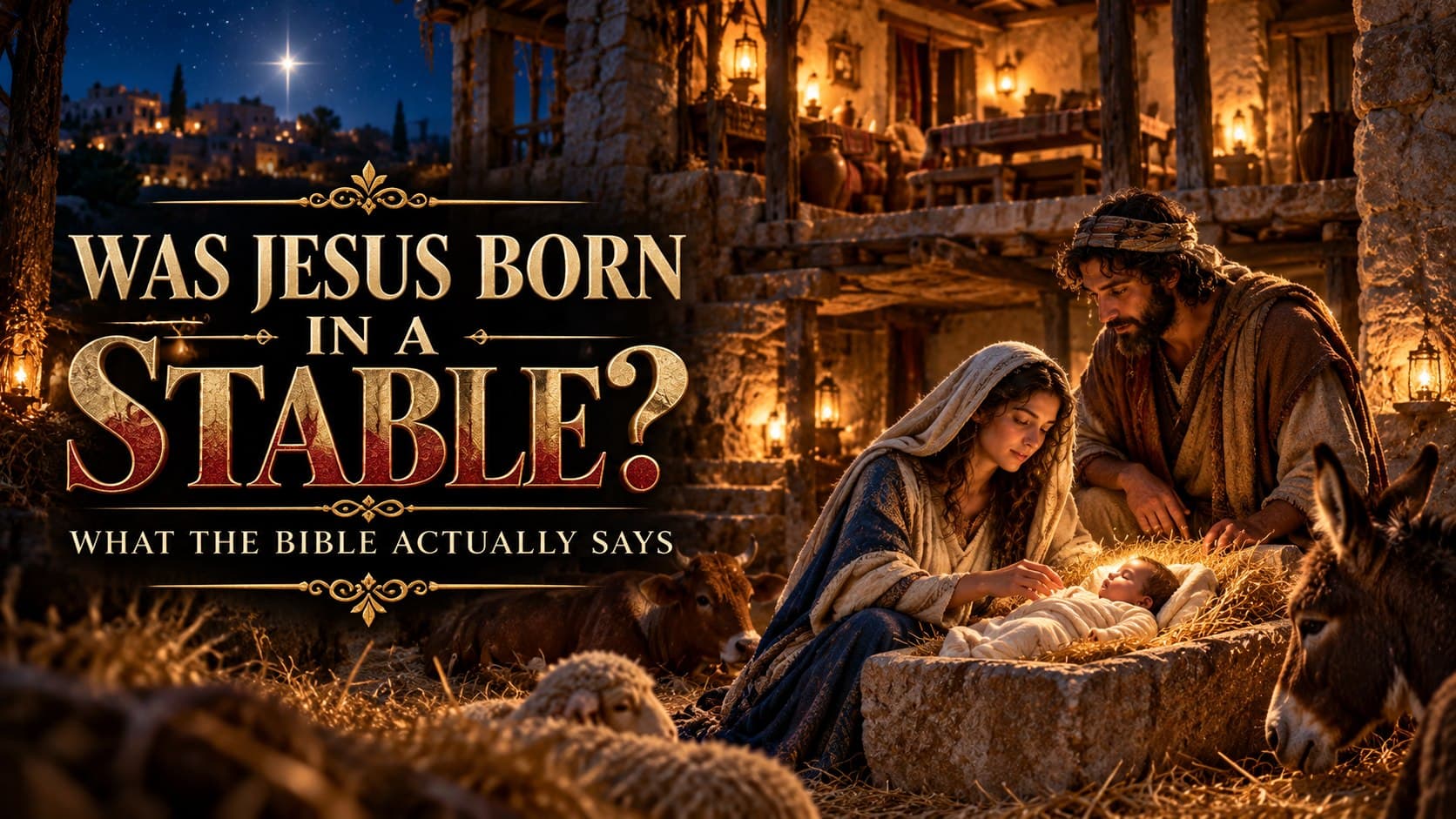
📖 Was Jesus Born in a Stable? What the Bible Actually Says
Every nativity set sold in a Christmas aisle tells you the same story.
A little wooden shed. A roof full of holes. Straw on the floor, an ox on one side, a donkey on the other.
📌 So here is the plain answer up front. The Bible never says Jesus was born in a stable. Luke says He was laid in a manger because there was no room in the inn, and that is all the detail the text gives you. Everything else, the wooden shed, the ox, the donkey, comes from later tradition, art, and nativity plays, not from Matthew or Luke.
That does not mean the familiar picture is pure invention, though. It is more interesting than that.
This guide walks through what Luke 2:7 actually says in the Greek behind it, the ancient cave tradition that is centuries older than the wooden shed on your mantel, how a real building in Bethlehem came to mark the spot, and why Catholic and Protestant Christians have ended up in slightly different places on a question the Bible itself never fully settles.
Every historical claim below links back to a named source, so you can go check it yourself.
Why This Matters for Your Faith
It is easy to wave this off as trivia. Who cares if it was a stable or a cave or a cousin's spare room. The baby still got born.
⚠️ But this question is really a question about how you read your own Bible. Most of us absorbed the stable, the ox, and the donkey from cards and carols years before we ever read Luke 2 for ourselves. Once you notice that gap, a harder question follows. What else do I believe about Scripture that actually came from a greeting card?
That is not a reason to distrust the Bible. It is a reason to go back and read it slower than the picture on the card ever let you. We asked a similar question about where Christmas traditions actually come from, and the answer there is the same shape as this one. Some of what we assume is tradition layered on top of Scripture, not Scripture itself.
💡 Clearing the tradition away does not shrink the story. Whether the room was a cave cut into limestone or a stable built of wood, the point Luke is actually making stands untouched. The Son of God arrived somewhere nobody had prepared for Him.

What the Bible Actually Says About Where Jesus Was Born
1. The One Verse That Started the Whole Question
Everything about the stable, the cave, and the family home argument comes down to one short sentence.
"And she brought forth her firstborn son, and wrapped him in swaddling clothes, and laid him in a manger; because there was no room for them in the inn."
Read it again and count what is actually there.
- 📌 A manger, a feeding trough for animals.
- 📌 No room in the inn.
- 📌 Nothing else.
No stable. No barn. No ox, no donkey, no innkeeper turning anyone away at a door. Luke mentions the manger again when the angel gives the shepherds their sign, and again when they arrive, and he never once adds a building to go with it.
"And this shall be a sign unto you; Ye shall find the babe wrapped in swaddling clothes, lying in a manger."
⚠️ A manger tells you something was used to feed animals. It does not tell you what kind of room it was standing in. That gap is exactly where centuries of guessing, and some real history, have filled in the rest.
2. The Greek Word Behind "No Room in the Inn"
The word King James translators rendered "inn" in Luke 2:7 is the Greek word kataluma. That single word is doing more work than most readers ever notice.
Scholar Ian Paul, writing on his biblical studies site Psephizo, points out that Luke uses kataluma one other place in his own gospel, and it is not a commercial inn at all. It is the room where Jesus eats the Last Supper.
"And ye shall say unto the goodman of the house, The Master saith unto thee, Where is the guestchamber, where I shall eat the passover with my disciples?"
Guestchamber there is the same Greek word, kataluma, translated differently by the same King James translators because the context is plainly a private home.
Here is what makes this more than wordplay. Luke knew a completely different Greek word for a commercial inn, pandocheion, a word that means a place where any traveler could pay for a bed. He uses it in the parable of the Good Samaritan.
"And went to him, and bound up his wounds, pouring in oil and wine, and set him on his own beast, and brought him to an inn, and took care of him."
💡 Luke had the word for a commercial inn available, and chose not to use it in Luke 2:7. Drawing on decades of research into first century Palestinian village life, scholar Kenneth Bailey argued that Joseph, returning to his own ancestral town as a descendant of David, would have been taken in by relatives, not left to find a roadside inn. The guest room, the kataluma, was already full of other family gathered for the census. So the couple stayed in the main room of the house instead.
Village homes in that period commonly had a lower section where animals were brought in at night, with hollowed out mangers built right into the floor. On this reading, Jesus was not born in a separate building at all. He was born in the main room of a crowded family home, in the part of the house the animals used, because every other space was already taken by relatives.
❓ So does that settle it? Not quite. The kataluma argument is persuasive to a growing number of scholars, but it is one reading of a short sentence, not a universally accepted fact, and it still leaves the oldest Christian tradition about this question unexplained.
3. The Cave Tradition Is Older Than the Stable
Long before anyone painted a wooden shed, the earliest Christian writers outside the Bible were already saying something different. Not a stable. A cave.
Justin Martyr, writing his Dialogue with Trypho around the middle of the second century, less than a hundred years after Luke's gospel, describes the birth this way.
"But when the Child was born in Bethlehem, since Joseph could not find a lodging in that village, he took up his quarters in a certain cave near the village; and while they were there Mary brought forth the Christ and placed Him in a manger, and here the Magi who came from Arabia found Him."
📌 Justin is not quoting Luke. He is telling you what Christians in his own area already believed about the physical location, a century before anyone had a reason to invent a stable.
Roughly a century after Justin, the Christian scholar Origen of Alexandria wrote around AD 248 that believers near Bethlehem could point to an actual cave as the birthplace, and that the tradition was already well established among them by his own day. Judea's soft limestone hillsides made caves common, and local farmers regularly used them exactly the way a modern farmer would use a barn, to shelter and feed livestock.
A cave stable and a wooden stable serve the same purpose. They are not the same image. And the written record is clear about which one actually goes back to the earliest centuries of the church.
4. How a Cave in Bethlehem Became a Church
Tradition did not stay a story people told. It became a building you can still visit today.
According to the historical account on Wikipedia's Church of the Nativity entry, Constantine's mother, Helena, identified the site during her visit to the Holy Land in 325 and 326, and construction on the first basilica over the cave began the same year under the oversight of Bishop Makarios of Jerusalem. That first church was dedicated on 31 May 339, and a pilgrim passing through Bethlehem in 333 recorded that it was already in use.
That building did not last forever. The same record states it was burned during a Samaritan revolt in the sixth century, probably in the year 529. The emperor Justinian then rebuilt it on a larger scale, and it is substantially Justinian's basilica, not Constantine's original, that still stands in Bethlehem today. The Church of the Nativity and its surrounding pilgrimage route were named a UNESCO World Heritage Site in 2012.
✅ Underneath the altar of that church is a grotto Christians have venerated as the birthplace for roughly eighteen centuries, longer than almost any other specific site connected to Jesus' life on earth. Thousands of Christians still travel to Bethlehem every Christmas Eve for exactly this reason.
5. Even the First Nativity Scene Was Staged in a Cave
Here is the detail that surprises most people, Catholic and Protestant alike.
Francis of Assisi is credited with staging the first reenactment of the nativity, at the Italian village of Greccio in December 1223. According to the account republished by the National Catholic Register, drawn from Thomas of Celano, Francis' own first biographer, Francis asked his friend Giovanni Velita to prepare the scene two weeks beforehand. What Giovanni prepared, on Francis' instructions, was a cave with live animals and a hay filled manger, set among the rocky crags outside the town.
📌 The man usually credited with inventing the modern nativity scene chose a cave, not a wooden shed. The freestanding wooden stable so familiar from Christmas cards came later, through centuries of European art and local nativity customs that this record does not trace in detail. What it does trace clearly is that the earliest reenactment on record followed the ancient cave tradition, not the barn most of us grew up picturing.
6. What the Catholic Church Teaches, and Where Protestants Land
Catholic teaching leans heavily on that ancient, continuous tradition. The Church of the Nativity's grotto is treated as the actual, physical site, not a symbolic stand in, and Catholic writers and popes have preached from that image for generations. Pope John Paul II's 1978 Christmas homily, cited by the Catholic outlet Our Sunday Visitor, describes the birth happening "in abandonment and extreme poverty, in the cave stable outside the town," language that assumes the cave as settled fact.
Our Sunday Visitor's own reporting is careful to note one more thing worth being honest about. An early apocryphal writing called the Protoevangelium of James also describes a cave birth, but that book was never accepted into the Bible's canon by any major church, and it should not be cited as if it carries the same weight as Luke or Justin Martyr's earlier testimony.
Protestant writers, by and large, hold the specific location more loosely. Many evangelical scholars have welcomed Kenneth Bailey's kataluma argument precisely because it does not require any claim about one specific cave in Bethlehem at all, only about the kind of room Luke's word actually describes. The more common Protestant instinct is to say plainly that Luke does not tell you the building, so confidence about any specific site, cave or otherwise, outruns the actual text.
💡 Both instincts are protecting something real. The Catholic tradition protects the conviction that an actual event happened in an actual, locatable place, and the record of pilgrims visiting one site for eighteen centuries is not nothing. The Protestant caution protects something just as real: never dressing a plausible tradition up as something Scripture itself states. You can respect the first without pretending Luke settles the second.

Established and Unsettled
✅ What is established
- Luke 2:7 never uses the word stable. It states that Jesus was laid in a manger because there was no room in the kataluma, the Greek word also used for the guest room of a private home in Luke 22:11.
- Justin Martyr's Dialogue with Trypho, written around the middle of the second century, already describes the birth happening in a cave near Bethlehem, roughly a century before any record of a wooden stable.
- Origen of Alexandria, writing around AD 248, said local Christians could already point to the cave as the birthplace.
- The Church of the Nativity in Bethlehem was first built over that cave under Constantine, dedicated in 339, destroyed in a sixth century fire, and rebuilt by Justinian in a form that largely survives today.
- Francis of Assisi's first nativity reenactment at Greccio in December 1223, recorded by his biographer Thomas of Celano, was staged in a cave, not a freestanding stable.
⚠️ What is still uncertain
- Whether Jesus was actually born in that specific Bethlehem cave, in the ground floor of a crowded family home as Kenneth Bailey's kataluma argument proposes, or somewhere else entirely. Luke's own wording does not decide between these.
- Whether the kataluma was full because of relatives gathered for the census, as Bailey argues, or for some other reason Luke simply does not state.
- Exactly when and where the now familiar image of a freestanding wooden stable with an ox and a donkey took shape in Western art. It is clearly later than the cave tradition, but this article found no reliable source pinning down its first appearance, so no specific date or origin is claimed here.
Practical Tips for Thinking About This Well
Whichever way you land on the stable question, here is how to hold it with both honesty and reverence.
- Read Luke 2 before you repeat anyone's theory about it. Twenty verses, a few minutes, and you will immediately notice how little the text actually claims about the building.
- Separate what Scripture says from what tradition adds. Both can be worth keeping. They are just not the same kind of claim, and treating a tradition as if it were a Bible verse is where most Christmas arguments online actually start.
- Give the cave tradition its due weight. Eighteen centuries of continuous testimony, starting within living memory of the apostles, is not nothing, even if it is not Scripture itself.
- Do not let a nativity set become a theology exam. The wooden stable in your living room is a devotional object, not a historical claim your faith depends on.
- Keep the actual point in view. Whatever the building was, Paul says the Son of God emptied Himself and took on the lowest possible form. That is the claim worth building your faith on, not the floor plan.
- Say "we don't know for certain" without embarrassment. Scripture is fully trustworthy on everything it actually states. It simply does not state everything we have assumed it does.
Top Bible Verses About Where Jesus Was Born
1. Luke 2:7
"And she brought forth her firstborn son, and wrapped him in swaddling clothes, and laid him in a manger; because there was no room for them in the inn."
Every argument in this article traces back to this one verse. It names a manger and a lack of room. It never names a building, which is exactly why centuries of Christians have filled in the rest.
2. Luke 2:12
"And this shall be a sign unto you; Ye shall find the babe wrapped in swaddling clothes, lying in a manger."
The angel gives the shepherds the manger as the identifying sign, not a building. That tells you the manger, not the architecture around it, was the detail God considered worth naming.
3. Luke 22:11
"And ye shall say unto the goodman of the house, The Master saith unto thee, Where is the guestchamber, where I shall eat the passover with my disciples?"
The same Greek word translated "inn" in Luke 2:7 is translated "guestchamber" here, and here it clearly means a room in a private home. That gap between two English words hiding one Greek word is the whole engine of the kataluma argument.
4. Luke 10:34
"And went to him, and bound up his wounds, pouring in oil and wine, and set him on his own beast, and brought him to an inn, and took care of him."
This is Luke's word for a commercial inn, pandocheion, used in the Good Samaritan parable. Luke clearly knew this word. He simply did not reach for it in Luke 2:7.
5. Philippians 2:6 to 8
"Who, being in the form of God, thought it not robbery to be equal with God: But made himself of no reputation, and took upon him the form of a servant, and was made in the likeness of men: And being found in fashion as a man, he humbled himself, and became obedient unto death, even the death of the cross."
This is the verse that actually settles what matters. Paul never mentions a stable, a cave, or a manger here. He names the real scandal of Christmas, that God emptied Himself into the lowest possible human condition, whatever room that turned out to be.

Frequently Asked Questions About Where Jesus Was Born
Was Jesus really born in a stable?
The Bible never uses the word stable. Luke 2:7 says He was laid in a manger because there was no room in the inn. The earliest Christian writers describe a cave used to shelter animals, which served the same purpose as a stable without being a separate wooden building.
What does kataluma actually mean?
Kataluma is the Greek word translated "inn" in Luke 2:7. Luke uses the same word for a private guest room in Luke 22:11, which has led scholars like Kenneth Bailey to argue it means a family's guest room rather than a commercial inn.
Were there animals at the birth of Jesus?
None are named in Matthew or Luke. The presence of a manger implies animals were kept nearby, but the ox and donkey familiar from nativity scenes come from later Christian art and tradition, not from the gospel text itself.
Was Jesus born in a cave?
It is possible, and it is the oldest specific tradition on record. Justin Martyr described a cave birth around the middle of the second century, and the Church of the Nativity in Bethlehem has marked a cave as the birthplace since the fourth century. The Bible itself does not state this directly.
Why do Catholics believe Jesus was born in a cave?
Because an unbroken tradition, going back to the second century writings of Justin Martyr and continuing through a church built over the site in the fourth century, has pointed to one specific cave in Bethlehem. Catholic teaching treats that continuous witness as meaningful historical evidence, even though it is not a claim Scripture states outright.
Why do some Protestants say Jesus was born in a house instead?
Mostly because of the kataluma argument. If the Greek word Luke used for "inn" actually means a private guest room, then Joseph and Mary were likely staying with relatives in Bethlehem, and the birth happened in the main room of that crowded home rather than in any separate shelter.
When did the Church of the Nativity get built?
Construction began in 325 or 326 under Emperor Constantine, after his mother Helena identified the site, and the first building was dedicated in 339. It was destroyed by fire, probably in 529, and rebuilt by Emperor Justinian in the form that largely still stands today.
Who made the first nativity scene?
Francis of Assisi is credited with the first reenactment, staged at Greccio, Italy, in December 1223. According to his biographer Thomas of Celano, Francis asked for the scene to be set in a cave with live animals, not a wooden stable.
Does it matter whether it was a stable, a cave, or a house?
Not for your faith. Philippians 2 says Christ emptied Himself and took on the lowest human form, and that claim stands no matter which room He was actually born in. The building is a historical question. The humility is the theological one, and Scripture answers that question directly.
Is the ox and donkey in the nativity scene in the Bible?
No. Neither Matthew nor Luke mentions an ox or a donkey at the birth. They entered Christian art and tradition separately, and no Gospel writer names any animal present in the room.
Final Thoughts
Strip the question down and three things are left standing.
📌 The Bible is more restrained than the nativity set. Luke gives you a manger and a lack of room. He never gives you a stable.
📌 The cave tradition is real history, not a new theory. It is older than the wooden shed by well over a thousand years, attested by Christian writers within living memory of the apostles.
📌 Where Catholics and Protestants differ is about confidence in a specific site, not about the night itself. Both sides agree on what the moment meant. They simply weigh an old, unbroken tradition differently.
You do not need to settle the floor plan to take something real from this story. The whole first Christmas was full of details nobody had planned for, and the room God was born into, whatever shape it actually was, was never the point. The point is that He came anyway. Carry that one thing with you this season, more than any detail about the building.
📚 Sources
Every claim in this article traces back to one of these. All links checked 1 November 2026.
- Dialogue with Trypho, Chapter 78
Justin Martyr, New Advent · c. 155 to 160
The earliest named source for the cave tradition, written within about a century of Luke's gospel.
- Church of the Nativity
Wikipedia
The source for Origen's c. AD 248 testimony, Constantine and Helena's basilica dedicated in 339, the sixth century fire, and Justinian's rebuilding.
- Jesus was not born in a stable
Ian Paul, Psephizo
The source for the kataluma versus pandocheion Greek word argument and Kenneth Bailey's research into first century Palestinian village life.
- Was Jesus Really Born in a Stable?
Our Sunday Visitor
The source for the cave used as stable in Judean limestone country, and the note that the apocryphal Protoevangelium of James is not part of the biblical canon.
- Was Jesus Born in a Cave or Stable?
EWTN
The source for Pope John Paul II's 1978 Christmas homily describing the birth in a 'cave stable.'
- St. Francis and the Story of the First Nativity Scene
National Catholic Register / CNA
The source for Francis of Assisi's December 1223 reenactment at Greccio, drawn from his biographer Thomas of Celano, staged in a cave.