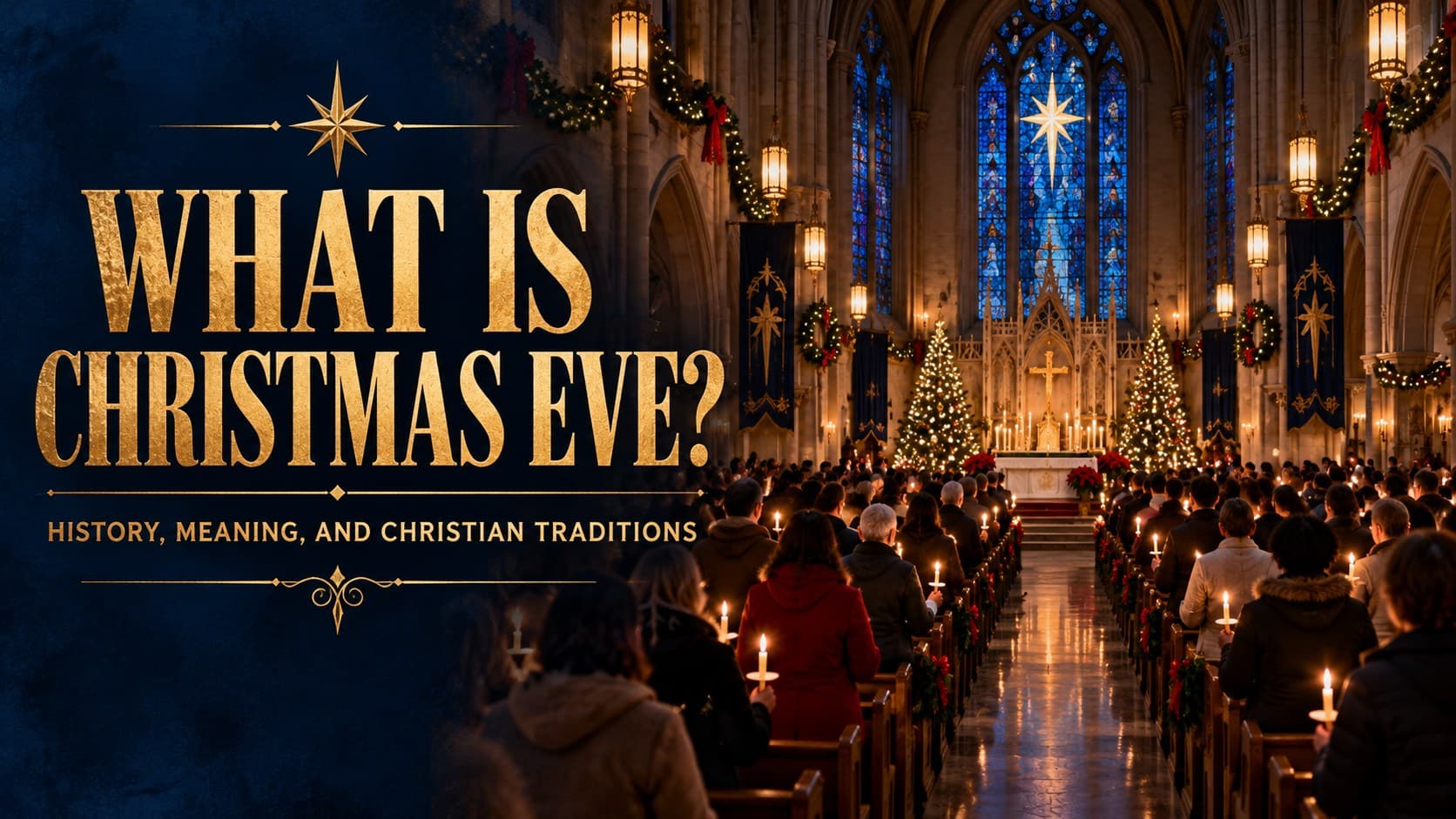
📖 What Is Christmas Eve? History, Meaning, and Christian Traditions
The lights are up. The food is cooking. Somewhere a church bell is already ringing.
And you are asking a simple question most people never actually answer. What is Christmas Eve, really, and why does it feel bigger than just the day before a holiday?
📌 Here is the plain answer. Christmas Eve is the evening and night of December 24, the vigil of Christ's birth. For most of Christian history it has carried its own weight, separate from Christmas Day itself, built around waiting through the dark for a light that is about to arrive.
Maybe you grew up going to a candlelight service every December 24 and never asked why that night, specifically, gets its own service at all.
Maybe your family opens presents that evening instead of the next morning, and you assumed that was just a modern habit with no history behind it.
This guide walks through where the name and the timing actually come from, what the Bible says about the night Jesus was born, why the Catholic Church keeps up to four separate Christmas Masses starting on this one evening, how Lutherans, Anglicans, and other Protestants mark the night differently, and what families from Germany to Poland to the Philippines actually do on December 24.
Every historical and liturgical claim below links back to a named source, so you can check it yourself.
Why This Matters for Your Faith
It is easy to let December 24 become nothing but prep work. The last errand run. The dish that still needs to go in the oven. The suitcase that still is not packed.
⚠️ That is exactly the kind of night Christmas Eve was never meant to be. For almost two thousand years, Christians have treated this evening as a vigil, a deliberate stretch of watching and waiting, not a countdown to get through.
Scripture is full of nights like that.
"My soul waiteth for the Lord more than they that watch for the morning: I say, more than they that watch for the morning."
📌 That is the posture Christmas Eve is built around. Not frantic preparation, but watchful hope. The shepherds were not rushing anywhere when the news reached them. They were simply doing their job in the dark, and heaven interrupted them.
💡 If your own Christmas Eve feels rushed and loud, that is not a failure on your part. It just means the night has been handed over to logistics instead of to watching. You can take some of it back.
What Christmas Eve Actually Celebrates
1. Christmas Eve Is the Vigil of the Nativity, Not Just a Countdown
Start with the plain mechanics. Christmas Eve is the evening or the full day of December 24, the day directly before Christmas. Wikipedia's entry on the day records its proper liturgical name in the Western church as the Vigil of the Nativity, with Christmas Vigil and Christmas Evening used as other common names.
That word vigil matters. The United States Conference of Catholic Bishops describes the Vigil Mass of the Nativity as the Mass used on the evening of December 24, and in the structure of the church calendar, that evening is still technically the last day of Advent, not the first moment of Christmas itself.
📌 So Christmas Eve sits on a hinge. It carries Advent's waiting all the way to the edge of midnight, and only then turns into the feast it has been pointing toward for four weeks.
2. Why the Day Begins at Sunset, Not Sunrise
If you have ever wondered why a day named Christmas Eve gets treated almost like its own separate holiday instead of just the hours before Christmas, the answer is older than Christianity itself.
Wikipedia's article on Christmas Eve ties the evening starting point to the Jewish practice of beginning a liturgical day at sunset rather than at midnight, a pattern that goes straight back to the creation account and still shapes how the whole church year is built.
"And the evening and the morning were the first day."
Evening comes before morning in that verse, on purpose. The early church inherited that rhythm, which is why a feast day's celebration can begin the evening before it on the calendar. Names for this night in other languages carry the same idea. The German Heilige Nacht and the Spanish Nochebuena both mean, more or less, the holy or good night, pointing at the night itself as the center of the day rather than an afterthought to it.
3. What the Bible Actually Says Happened That Night
Strip away every custom built on top of this night and the Bible itself gives a short, plain account, the same one covered in full in what the Bible says about the birth of Jesus. Luke records a young couple traveling to Bethlehem for a Roman census, with nowhere proper to stay.
"And she brought forth her firstborn son, and wrapped him in swaddling clothes, and laid him in a manger; because there was no room for them in the inn."
No palace. No announcement to anyone important. Just a feeding trough standing in for a crib. Then, outside town, ordinary working men got the first word of what had just happened.
"And there were in the same country shepherds abiding in the field, keeping watch over their flock by night."
"And the angel said unto them, Fear not: for, behold, I bring you good tidings of great joy, which shall be to all people. For unto you is born this day in the city of David a Saviour, which is Christ the Lord."
📌 Notice who heard it first. Not priests. Not officials. Shepherds, working the night shift. Luke placing the announcement at night, to men who were already awake and watching their flock, is the whole reason Christians have treated this particular night as sacred rather than only the daylight hours that followed it.
A detail worth saying plainly: the Bible never actually states the calendar date of Jesus' birth, and it does not pin the hour to midnight either. The night setting for the shepherds is in the text. The exact clock time our traditions attach to it is not. The full case for and against December 25 as the actual date is its own question, separate from what this guide covers.
4. Where the Tradition of a Midnight Service Comes From
A midnight service on Christmas Eve feels timeless, but its own history is traceable, and it did not appear all at once.
Wikipedia's article on Midnight Mass points to Egeria, a pilgrim who traveled to the Holy Land around the year 381, as an early source describing Christians in Jerusalem keeping a midnight vigil at Bethlehem, followed by a torchlight procession back to Jerusalem that arrived around dawn.
⚠️ The next step in the story is reported with less certainty, and a good guide says so. The same article states the custom reached Rome under Pope Sixtus III, who held office from 432 to 440 and is credited with adding a midnight Mass at the Basilica of St. Mary Major. Take that Rome date as the tradition's approximate arrival point in the West, not a precisely documented hour.
By the twelfth century, according to the same source, the right to celebrate three separate Masses on Christmas, at midnight, at dawn, and during the day, had spread from being a privilege reserved to the Pope to something ordinary priests could do everywhere. A fourth, the Vigil Mass on the evening of December 24 itself, rounds out what the Catholic Church offers today.
5. How Catholics Keep the Night Today
Walk into a Catholic parish on December 24 and you will likely find a choice of Masses, not just one. The USCCB's own liturgical calendar material names the Vigil Mass as the one celebrated on the evening of December 24, which can come before or after the church's First Vespers for Christmas.
Many parishes also hold the traditional Mass at Midnight, even if, as Wikipedia notes, it is increasingly scheduled earlier for practical reasons, sometimes as early as seven o'clock. The Vatican itself moved its own Christmas Eve Mass to ten in the evening starting in 2009.
Christmas is a holy day of obligation in the Catholic Church, meaning Catholics are expected to attend Mass, and canon law allows a Mass the evening before the feast to fulfill that obligation, which is part of why the Vigil Mass carries real weight and not just atmosphere. A Catholic reader unsure which Mass counts in a tricky year, such as one where Christmas falls near a Sunday, should ask their own parish rather than guess.
6. How Protestants and Orthodox Christians Mark the Same Night
💡 Christmas Eve is not only a Catholic night. Wikipedia's article on the day describes Lutheran congregations keeping Christmas Eve Eucharist services, Christmas Vespers, and candlelight services as settled parts of their own tradition, not a copy of someone else's.
Anglican and Methodist churches commonly hold a midnight or late evening Communion service, and the Church of Scotland keeps its own watchnight service just before midnight. The famous Festival of Nine Lessons and Carols, broadcast from King's College, Cambridge, grew out of this same evening pattern.
Eastern Orthodox Christians approach the night differently again. Wikipedia describes the Byzantine Rite name for Christmas Eve as Paramony, meaning preparation, the final and strictest day of the Nativity Fast. Rather than a midnight Mass, Orthodox parishes commonly hold an All Night Vigil, and the service is deliberately built to echo the language of Good Friday, tying the arrival of Christ in the manger to His death and resurrection rather than keeping the two separate.
⚠️ None of this means every Christian tradition keeps the exact same night the same way. Many Baptist, nondenominational, and evangelical congregations hold a simple candlelight service and treat the rest of the practice as optional, which is just as faithful a choice as a full midnight liturgy.
7. Christmas Eve Around the World
Step outside church altogether and December 24 is, in a lot of countries, the actual center of the holiday, not a warm up act for the 25th.
In Germany, Wikipedia's article notes that the Christmas tree is usually put up on the afternoon of the 24th itself, and the Christkind is said to bring the presents that same evening, after a simple Heiligabend meal, often something ordinary like sausages with potato salad, with the bigger roast goose or duck saved for Christmas Day.
Across Denmark, Norway, Sweden, and Finland, presents are opened on the evening of December 24 rather than the next morning, and figures like Sweden's Jultomten or Finland's Joulupukki are said to visit in person that night.
In Italy, the same article describes a long standing custom that the Christmas Eve meal should avoid meat, which is the root of the Feast of the Seven Fishes kept by many Sicilian and Italian American families. Poland's Wigilia supper traditionally sets twelve meatless dishes and includes sharing an oplatek wafer as a gesture of family reconciliation.
Spain keeps Nochebuena, the good night, with Midnight Mass known there as Misa de Gallo, the Rooster's Mass. The Philippines keeps its own Misa de Gallo and a Christmas Eve feast called Noche Buena, a name carried directly from Spanish colonial history.
✅ None of these are competing versions of the right way to keep the night. Every one of them is the same basic instinct, a family meal and a church service wrapped around the same waiting, dressed in whatever language and food a particular culture already had.
Practical Tips for Keeping Christmas Eve Well
You do not need to adopt a new country's customs to let this night mean more than errands.
- Read Luke 2 out loud before anything else happens that night. Not a summary of it, the actual text. Let the plain words land before the wrapping paper does.
- Protect one quiet stretch of the evening on purpose. A vigil was never meant to be nonstop noise. Even twenty minutes of a dimmed room and a candle can restore some of what the night is actually for.
- Go to a service if your schedule allows it. Whether that is a Vigil Mass, a candlelight service, or a watchnight gathering, something changes when the waiting is shared with other people instead of carried alone.
- Pray Psalm 130:6 before you sleep. Ask God to make your own waiting look less like anxious scrolling and more like the shepherds' patient watch.
- Learn one real custom from outside your own tradition. Now you know a Polish family shares a wafer and a Spanish family calls Midnight Mass the Rooster's Mass. Ask a friend from a different background what their family does.
- Let the shepherds' order of events shape yours. They were already doing ordinary, faithful work when the news reached them. You do not have to feel spiritually ready for this night to still matter.
Top 5 Bible Verses About Christmas Eve
Scripture never uses the phrase Christmas Eve, but these five verses carry the whole weight of the night.
1. Luke 2:10 and 11
"And the angel said unto them, Fear not: for, behold, I bring you good tidings of great joy, which shall be to all people. For unto you is born this day in the city of David a Saviour, which is Christ the Lord."
This is the announcement itself, delivered at night to men who had no idea anything was about to change. "Good tidings of great joy" was never meant to stay locked inside that one field. It is still the actual content of what this night celebrates.
2. Luke 2:7
"And she brought forth her firstborn son, and wrapped him in swaddling clothes, and laid him in a manger; because there was no room for them in the inn."
No ceremony. No warning. Just a tired young mother and a feeding trough. Whatever your own Christmas Eve looks like this year, it almost certainly has more comfort in it than the first one did.
3. Isaiah 9:2
"The people that walked in darkness have seen a great light: they that dwell in the land of the shadow of death, upon them hath the light shined."
Written centuries before Bethlehem, this verse is why a night service on Christmas Eve so often centers on candles and darkness giving way to light. The imagery is not decoration invented later. It is the prophecy itself.
4. John 1:14
"And the Word was made flesh, and dwelt among us, (and we beheld his glory, the glory as of the only begotten of the Father,) full of grace and truth."
John skips the manger entirely and goes straight to what it means. The eternal Word did not visit humanity from a safe distance. He moved in. Christmas Eve is the hinge moment that verse is describing.
5. Titus 2:11 to 13
"For the grace of God that bringeth salvation hath appeared to all men, Teaching us that, denying ungodliness and worldly lusts, we should live soberly, righteously, and godly, in this present world; Looking for that blessed hope, and the glorious appearing of the great God and our Saviour Jesus Christ;"
This passage looks two directions at once, exactly the way the whole night does. It celebrates grace that has already appeared, in a manger, and it keeps one eye forward, looking for the same Christ's return. That double focus is why Christmas Eve has always carried both joy and genuine watchfulness together.

Frequently Asked Questions About Christmas Eve
What is Christmas Eve and why is it celebrated?
Christmas Eve is the evening and night of December 24, kept as the vigil of Christ's birth. It is celebrated because the earliest Christian day began at sunset, so the feast of the Nativity properly starts the evening before, and because Luke's Gospel places the first announcement of Jesus' birth to shepherds at night.
Is Christmas Eve a religious holiday?
Yes, in the Western church it is formally the Vigil of the Nativity, counted as the final day of Advent. Catholic, Lutheran, Anglican, Methodist, and many other traditions hold a specific church service on this night, separate from any service held on Christmas Day itself.
Why do Catholics go to Mass on Christmas Eve instead of Christmas Day?
Many go to both. The Catholic Church offers a Vigil Mass on the evening of December 24 and a traditional Mass at Midnight, in addition to Masses at dawn and during the day on December 25. Attending the Vigil Mass can fulfill the Christmas holy day obligation, which is part of why the evening Mass draws such large crowds.
Where does the tradition of Midnight Mass come from?
The earliest recorded account comes from a pilgrim named Egeria, who described a midnight vigil in Bethlehem around the year 381. The custom reached Rome under Pope Sixtus III in the fifth century, and by the twelfth century the practice of multiple Christmas Masses had spread from a papal privilege to ordinary parishes everywhere.
Was Jesus actually born at midnight?
The Bible does not say. Luke 2 places the shepherds in the fields at night when the angel appeared, but it never states a specific hour, and it never gives a calendar date either. Midnight is a tradition built around the night setting in the text, not a detail the text itself supplies.
Do Protestants celebrate Christmas Eve?
Yes. Lutheran, Anglican, Methodist, and many other Protestant churches hold their own Christmas Eve services, often a candlelight Eucharist, Vespers, or a watchnight service. Some evangelical and nondenominational congregations hold a simpler candlelight gathering, and others leave the evening entirely to family rather than church.
How do Eastern Orthodox Christians observe Christmas Eve?
Orthodox Christians call it Paramony, meaning preparation, and keep it as the strictest day of the Nativity Fast. Rather than a midnight Mass, many parishes hold an All Night Vigil, with language deliberately echoing the Good Friday service to connect Christ's birth to His death and resurrection.
Why do some countries open presents on Christmas Eve instead of Christmas Day?
In Germany and across Scandinavia, the main family celebration, including gifts, traditionally happens on the evening of December 24, with Christmas Day reserved for a quieter second meal. This reflects the same evening centered pattern that shaped the church calendar, carried into family custom.
What is the Feast of the Seven Fishes?
It is an Italian and Italian American Christmas Eve tradition built around a long standing custom of avoiding meat on the night of the 24th. Families serve several seafood dishes instead, historically following a day of fasting ahead of the feast.
Is Christmas Eve the same thing as Christmas?
No. In the structure of the church calendar, Christmas Eve is technically the last day of Advent, not the first day of Christmas. Christmas Day itself, December 25, is when the twelve day Christmas season formally begins, even though the family celebration in many cultures peaks the night before.
Final Thoughts
Christmas Eve did not become a global night of candles, carols, and family meals by accident. It grew out of a simple, ancient instinct, that the night before a feast deserves its own watching, the same way the shepherds were already watching when the sky split open.
📌 Whatever service you attend, whatever dish lands on your table tonight, remember what Luke actually wrote down. No crowd. No warning. Just ordinary people doing ordinary work, and heaven breaking into the middle of it.
You do not have to get the whole night theologically perfect. The shepherds did not plan for any of it either. What Christmas itself actually celebrates starts right here, in this one vigil night.
So tonight, before the house gets loud, take five minutes. Read the announcement the shepherds heard. Let it be good news to you too, the same way it was to them.
📚 Sources
Every claim in this article traces back to one of these. All links checked 29 October 2026.
- Christmas Eve
Wikipedia
The source for the Vigil of the Nativity name, the sunset opening of the liturgical day, Lutheran and Anglican Christmas Eve service traditions, the Byzantine Rite Paramony fast, and the German, Scandinavian, Italian, Polish, and Spanish customs described above.
- Midnight Mass
Wikipedia
The source for Egeria's fourth century account, Pope Sixtus III and the Basilica of St. Mary Major, the twelfth century spread of the three Christmas Masses, and the Vatican's 2009 shift to a 10pm Mass.
- Liturgical Year & Calendar
United States Conference of Catholic Bishops (USCCB)
The source for the Vigil Mass being celebrated on the evening of December 24 and Christmas Eve's place as the close of Advent in the Catholic calendar.
- Dec. 25, Jan. 1 are holy days of obligation
Catholic Review (Archdiocese of Baltimore) · 2023
The source for Christmas as a holy day of obligation and for an evening Mass on December 24 counting toward that obligation.