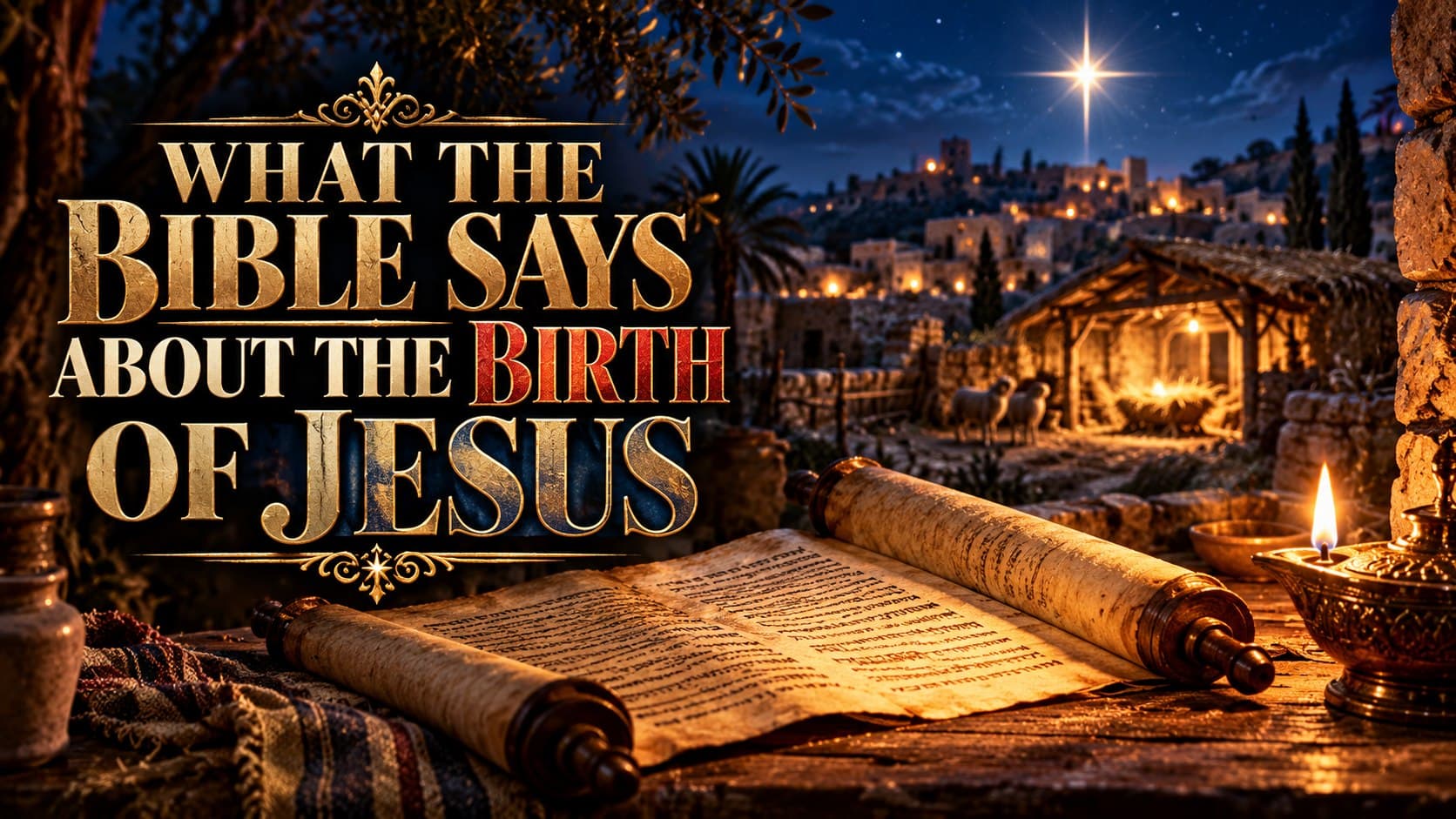
📖 What Does the Bible Say About the Birth of Jesus?
You have seen the birth of Jesus a hundred times before you ever opened a Bible.
A manger scene on a church lawn. A kids' pageant with a bathrobe shepherd and a plastic lamb. A card with snow falling on a stable that never once snowed in Bethlehem.
Somewhere in all that, the actual story gets flattened into a single soft image, and the wise men and the shepherds end up standing in the same scene even though Scripture never puts them there together.
📌 What the Bible actually says about the birth of Jesus is stranger, more specific, and more dangerous than the version on your mantel. It involves a teenage girl visited by an angel, a man deciding whether to quietly divorce his pregnant fiancee, a government census that moved a family a hundred miles, and a king frightened enough by a baby to murder children over him.
This guide walks through what Luke and Matthew actually wrote, in the order they wrote it. The prophecy that came centuries early. The angel's words to Mary. Joseph's part in the story, which gets skipped more than it should. The night in Bethlehem itself. The wise men, the star, and the king who wanted them both dead.
Get your Bible, or your Bible Buddy app, and open to Luke 1. Let's read it slowly.
Why This Matters for Your Faith
It would be easy to treat the birth of Jesus as the warm part before the real teaching starts.
⚠️ But the birth of Jesus is not the introduction to the gospel. It is the first act of it.
Christianity stands or falls on one claim that gets made in these opening chapters. God did not send advice. God did not send an angel with a message and leave. God became a human being, with a real birth date and a real mother, inside a real political mess under a real Roman census.
That claim has a name. Theologians call it the incarnation, and Christmas itself exists because the Church decided this claim was worth building a whole season around.
If the virgin birth is not true, then Jesus is just a man, however wise. If it is true, then the baby in the manger is also the God who spoke the stars into place, and nothing about how you read the rest of His life stays the same.
The world is fine with Jesus as a moral teacher. It has no category for God putting on flesh and being laid in a feeding trough for animals. That gap is exactly where faith has to stand.
What the Bible Actually Says About the Birth of Jesus
1. Promised Centuries Before It Happened
The story of Jesus' birth does not open in a Gospel. It opens in the Old Testament, hundreds of years earlier.
📌 Isaiah told the king of Judah about a coming sign long before Mary was born.
"Therefore the Lord himself shall give you a sign; Behold, a virgin shall conceive, and bear a son, and shall call his name Immanuel."
Immanuel means God with us. Matthew will quote this exact verse once the baby actually arrives.
A different prophet named the town centuries before anyone born there mattered to history.
"But thou, Bethlehem Ephratah, though thou be little among the thousands of Judah, yet out of thee shall he come forth unto me that is to be ruler in Israel; whose goings forth have been from of old, from everlasting."
A small town. Not Jerusalem, where the kings lived. Bethlehem, where David had once herded sheep.
💡 Neither prophet lived to see it fulfilled. That is the point. The Bible says this birth was not improvised. It was planned long before Mary ever said yes.
2. The Angel's Announcement to Mary
Luke tells the story from inside a teenage girl's house in Nazareth.
An angel named Gabriel shows up with no warning and says the thing every pregnant unmarried girl dreads hearing, except from the opposite direction.
"And the angel said unto her, Fear not, Mary: for thou hast found favour with God. And, behold, thou shalt conceive in thy womb, and bring forth a son, and shalt call his name JESUS."
Mary asks the obvious question. She is not married yet. How can this happen.
"And the angel answered and said unto her, The Holy Ghost shall come upon thee, and the power of the Highest shall overshadow thee: therefore also that holy thing which shall be born of thee shall be called the Son of God."
📌 This is the verse the whole doctrine of the virgin birth rests on. Not a man. The Holy Spirit. A miracle, not an affair, and Luke writes it that plainly.
Mary says yes to a pregnancy that could get her stoned under the law of her own town, to a story no one would believe, and to a future she did not choose. That yes cost her something real, long before any wise men showed up with gifts.
3. Joseph's Part in the Story
Matthew tells the same months from Joseph's side, and his part gets skipped more than it should.
"Now the birth of Jesus Christ was on this wise: When as his mother Mary was espoused to Joseph, before they came together, she was found with child of the Holy Ghost."
Espoused meant legally bound, closer to married than engaged in our terms. A pregnancy now looked, to everyone in town, like betrayal.
"Then Joseph her husband, being a just man, and not willing to make her a publick example, was minded to put her away privily."
⚠️ Joseph planned to end it quietly rather than destroy her publicly. That is a just man's response to what looked, from where he stood, like real betrayal. Then an angel interrupts his plan too.
"But while he thought on these things, behold, the angel of the LORD appeared unto him in a dream, saying, Joseph, thou son of David, fear not to take unto thee Mary thy wife: for that which is conceived in her is of the Holy Ghost. And she shall bring forth a son, and thou shalt call his name JESUS: for he shall save his people from their sins."
Jesus means the Lord saves. The name was not picked for sound. It was picked for what He came to do.
Matthew then quotes Isaiah directly, tying the whole event back to that seven hundred year old promise.
"Behold, a virgin shall be with child, and shall bring forth a son, and they shall call his name Emmanuel, which being interpreted is, God with us."
Joseph wakes up and does exactly what the angel said. No argument recorded. He takes Mary as his wife and raises a son who is not biologically his.
📌 Faith, for Joseph, looked like obedience with no explanation offered to the neighbors.
4. The Night in Bethlehem
Luke is the Gospel writer who tells you why a pregnant woman near full term was traveling at all.
"And it came to pass in those days, that there went out a decree from Caesar Augustus, that all the world should be taxed."
"And Joseph also went up from Galilee, out of the city of Nazareth, into Judaea, unto the city of David, which is called Bethlehem; (because he was of the house and lineage of David:) To be taxed with Mary his espoused wife, being great with child."
A Roman emperor orders a count of his empire for his own purposes, and it lands Joseph and Mary exactly where Micah said the ruler would be born, a hundred miles from home, on foot or by donkey.
"And so it was, that, while they were there, the days were accomplished that she should be delivered. And she brought forth her firstborn son, and wrapped him in swaddling clothes, and laid him in a manger; because there was no room for them in the inn."
📌 Notice what the text actually says, and what it does not. It says manger, a feeding trough for animals. It never once says stable, cave, or barn. Those details come from later tradition filling in a reasonable guess, not from Luke's own words.
Wherever it happened, the King of the universe's first bed was built for livestock. That detail is not an accident of poverty. It is the whole theme of the incarnation in one image.
Shepherds nearby get the news first, not priests, not officials.
"And the angel said unto them, Fear not: for, behold, I bring you good tidings of great joy, which shall be to all people. For unto you is born this day in the city of David a Saviour, which is Christ the Lord."
"And suddenly there was with the angel a multitude of the heavenly host praising God, and saying, Glory to God in the highest, and on earth peace, good will toward men."
💡 Shepherds were low on the social ladder of their day, not trusted as witnesses in a court. God sends His biggest announcement of the ages to the people with the least status to receive it.
5. The Wise Men and the King Who Wanted Them Both Dead
Matthew, not Luke, tells the story everyone pictures beside the manger, and it almost certainly did not happen the same night.
"Now when Jesus was born in Bethlehem of Judaea in the days of Herod the king, behold, there came wise men from the east to Jerusalem, Saying, Where is he that is born King of the Jews? for we have seen his star in the east, and are come to worship him."
Matthew calls them wise men, not kings, and never gives a number. The Bible does not say there were three of them. That count came later, probably from the three gifts, and the Church remembers this visit on its own feast day, Epiphany.
Herod, frightened by rival talk of a king, sends the wise men to Bethlehem under cover of wanting to worship too. The star leads them to a house, not a stable.
"And when they were come into the house, they saw the young child with Mary his mother, and fell down, and worshipped him: and when they had opened their treasures, they presented unto him gifts; gold, and frankincense, and myrrh."
📌 A house, and a young child, not an infant in a manger. Put beside Herod's next order, that detail matters.
"Then Herod, when he saw that he was mocked of the wise men, was exceeding wroth, and sent forth, and slew all the children that were in Bethlehem, and in all the coasts thereof, from two years old and under, according to the time which he had diligently enquired of the wise men."
⚠️ Herod killing children up to two years old tells you the wise men likely arrived sometime after the birth, not at it. Warned in a dream, Joseph takes his family to Egypt before the soldiers come, fulfilling yet another old prophecy about God calling His son out of Egypt.
6. What Simeon and Anna Recognized in a Temple Courtyard
Before any of that, Luke records a quieter scene. Mary and Joseph bring the baby to the temple for the ordinary rites every Jewish family kept.
An old man named Simeon, who had spent years waiting for God to keep His promises, takes the baby in his arms.
"Lord, now lettest thou thy servant depart in peace, according to thy word: For mine eyes have seen thy salvation, Which thou hast prepared before the face of all people; A light to lighten the Gentiles, and the glory of thy people Israel."
An elderly prophetess named Anna is there too, and she does not keep quiet about it either.
"And she coming in that instant gave thanks likewise unto the Lord, and spake of him to all them that looked for redemption in Jerusalem."
💡 Two elderly people in a temple courtyard see what Herod, with all his soldiers, could not. Recognizing Jesus was never about having power. It was always about having waited for Him honestly.
7. Why Matthew and Luke Tell It So Differently
If you have ever noticed that Matthew and Luke read like two different stories, you were not imagining it.
Matthew opens with a genealogy running through Joseph and David's royal line, then tells the birth from Joseph's side: his doubt, the angel's dream, the wise men, Herod's rage, the flight to Egypt. The United States Conference of Catholic Bishops' own Bible commentary notes that Matthew likely reworked an older genealogy to present Jesus as the climax of Israel's whole history, heir of Abraham and David.
Luke tells almost none of that. No wise men, no Herod, no Egypt. Instead he gives the census, the shepherds, the circumcision, and the temple scene with Simeon and Anna, with Mary, not Joseph, at the emotional center.
📌 These are not contradictory reports of one event. They are two witnesses choosing what to include. Put together, Luke covers the months before the birth and Matthew covers roughly the two years after it, which is exactly why a single Christmas card showing shepherds and wise men kneeling at the same manger flattens two different scenes into one.
Practical Tips for Reading the Birth of Jesus
Knowing the story is not the same as letting it change anything. Here are seven ways to actually sit with it.
- Read Luke 1 and 2 in one sitting. Not a verse here and there around December 25. The whole narrative, start to finish, the way Luke actually wrote it.
- Then read Matthew 1 and 2 separately. Resist the urge to blend them in your head. Let each writer tell his own version before you combine them.
- Say Mary's yes out loud as your own prayer. "Let it be unto me according to thy word." Ask God for the courage to say it about whatever He is asking of you right now.
- Notice who God tells first. Shepherds, not officials. Where in your own life do you assume you are too ordinary for God to speak to you directly?
- Picture the manger honestly. Not a clean postcard. A feeding trough, in a town with no room for a poor couple. Let that humility sit uncomfortably for a minute.
- Read it with a child this year. Explaining the angel, the star, and the manger out loud tends to slow a familiar story back down to its original size.
- Let the ending matter, not just the beginning. The manger only means something because of where this same Jesus ended up, on a cross and then out of a tomb. This birth was always headed somewhere specific.
Top 5 Bible Verses About the Birth of Jesus
If you only carry five verses with you from this whole story, make them these five.
1. Isaiah 7:14
"Therefore the Lord himself shall give you a sign; Behold, a virgin shall conceive, and bear a son, and shall call his name Immanuel."
This is the promise that waited longer than any other verse on this list, hundreds of years before Bethlehem.
Immanuel is not just a name. It is a claim: God is not watching from a distance anymore. God is with us, specifically.
Every other verse here is that one word, Immanuel, finally becoming a person you can hold.
2. Luke 1:35
"And the angel answered and said unto her, The Holy Ghost shall come upon thee, and the power of the Highest shall overshadow thee: therefore also that holy thing which shall be born of thee shall be called the Son of God."
This is the verse the entire doctrine of the virgin birth is built on. Not symbolic language. A direct answer to Mary's direct question.
The Holy Spirit, not a man, is named as the cause. That is why Christians have confessed for two thousand years that Jesus has no human father.
Whatever else you believe about this story, start here. This is where the miracle is actually stated, not implied.
3. Matthew 1:21
"And she shall bring forth a son, and thou shalt call his name JESUS: for he shall save his people from their sins."
The angel does not just name the baby. He explains the name before the baby takes his first breath.
Jesus, from a Hebrew name meaning the Lord saves, is not a pretty sound picked off a list. It is a mission statement.
Whatever this child would grow up to do, saving people from their sins was always the headline, not a later addition to the story.
4. Luke 2:11
"For unto you is born this day in the city of David a Saviour, which is Christ the Lord."
Three titles land on one infant in a single sentence. Saviour. Christ, meaning the anointed king promised for centuries. Lord, a word Luke's readers used for God Himself.
And notice who it is said to. Not the religious leaders in Jerusalem. Shepherds, working the night shift, with mud still on their sandals.
Good news this large was never meant to wait for the right audience.
5. John 1:14
"And the Word was made flesh, and dwelt among us, (and we beheld his glory, the glory as of the only begotten of the Father,) full of grace and truth."
John does not tell you about shepherds or a census. He steps back and tells you what actually happened in theological terms.
The Word, present with God since before time, was made flesh. Put on a body. Moved into the neighborhood, as the phrase is sometimes translated.
Every manger, every angel, every census in Luke and Matthew is this one verse, happening in real time, in a real town, to real people.
Frequently Asked Questions About the Birth of Jesus
What does the Bible actually say about how Jesus was born?
Luke 1 and 2 and Matthew 1 and 2 are the only two accounts. Together they describe Mary conceiving by the Holy Spirit while still a virgin, Joseph choosing to marry her after an angel's dream, the family traveling to Bethlehem for a Roman census, and Jesus being born there and laid in a manger because there was no room at the inn.
Was Jesus actually born in a stable?
Luke never uses the word stable. He says Jesus was laid in a manger, a feeding trough, because there was no room in the inn. Whether that manger sat in an attached animal shelter, a cave used for livestock, or a lower room of a crowded house is a detail tradition filled in, not something either Gospel states directly.
Did the wise men and the shepherds visit Jesus on the same night?
No, even though nativity scenes almost always show it that way. The shepherds come the same night, to a baby in a manger. The wise men arrive later, Matthew says to a house, to a "young child," and Herod's later order to kill boys up to two years old suggests real time had passed.
How many wise men were there?
Matthew never gives a number. The tradition of three comes from the three gifts named, gold, frankincense, and myrrh, not from a headcount in the text. Matthew also never calls them kings. He calls them wise men, a term for scholars who studied the stars.
Why was Jesus born in Bethlehem instead of Nazareth?
Mary and Joseph lived in Nazareth, but a census ordered by Caesar Augustus required Joseph to register in his ancestral town, Bethlehem, because he was descended from David. That government order put the family exactly where the prophet Micah had said the ruler of Israel would come from, centuries earlier.
What does Immanuel mean, and why does it matter?
Immanuel means God with us. Isaiah used it as the name of a promised sign seven hundred years before Jesus, and Matthew quotes it directly once Jesus is born. The name is the whole claim of Christmas compressed into two words: God did not stay distant.
Why do Matthew and Luke tell such different stories?
Matthew writes from Joseph's side, with the wise men, Herod, and the flight to Egypt, to present Jesus as heir to David's throne. Luke writes from Mary's side, with the census, the shepherds, and the temple scene, to show salvation reaching the overlooked. They are two complementary accounts of different parts of the story, not two contradictory reports of one night.
What happened to the children Herod killed?
Matthew records that Herod, enraged at being outwitted by the wise men, ordered the killing of every boy two years old and under in Bethlehem and the surrounding area. Joseph had already been warned in a dream and had taken Mary and Jesus to Egypt before the soldiers arrived. The Church later remembered these children as the Holy Innocents.
Do Catholics and Protestants agree on the virgin birth?
Yes, on the core claim. The Catechism of the Catholic Church teaches that Jesus was conceived solely by the Holy Spirit in Mary's womb, and the Heidelberg Catechism, a historic Reformed confession, teaches the same thing in its own words, that Christ took on human nature "of the flesh and blood of the virgin Mary, by the operation of the Holy Ghost." The traditions differ on later questions about Mary, not on this one.
Why does any of this matter if I already believe in Jesus?
Because the birth is where the Bible states, plainly, what kind of Savior you actually have. Not a philosophy. Not a legend. A real baby, in a real census, under a real king willing to kill to stop Him. Knowing the details sharpens the claim instead of softening it into a Christmas card.
Final Thoughts
Strip away the pageant costumes and the snow that never fell, and the actual story still holds.
📌 A virgin conceived by the Holy Spirit, exactly as Isaiah said she would. A baby was born in Bethlehem, exactly as Micah said He would be. Shepherds heard it first. Wise men traveled toward it later. A king tried to kill it and failed.
Every detail in Luke and Matthew is pointing at the same claim John states directly. The Word was made flesh. God, with skin on, laid in a feeding trough because there was no room anywhere better.
That is either the most important thing that has ever happened, or it is nothing. The Bible does not leave room for it to be a nice story in between.
Advent exists to help you wait for this story on purpose instead of rushing past it, and the whole church calendar keeps circling back to it every year for a reason.
So here is one next step. Open Luke 2 tonight, read it slowly as if for the first time, and let the ordinary details, a census, a stable animal's feeding trough, a shift of tired shepherds, remind you that God's biggest move in history did not arrive looking impressive.
It arrived looking like nothing. And it changed everything.
📚 Sources
Every claim in this article traces back to one of these. All links checked 27 October 2026.
- Why Did the Word Become Flesh?
Catechism of the Catholic Church, The Holy See
Paragraphs 456 to 460, the Church's teaching on why the Son of God took on human flesh and was born as Jesus.
- Conceived by the Power of the Holy Spirit and Born of the Virgin Mary
Catechism of the Catholic Church, The Holy See
Paragraphs 496 to 498, on the virginal conception of Jesus and how the Gospels present it.
- The Heidelberg Catechism
Christian Classics Ethereal Library (ccel.org)
Lord's Day 14, Questions 35 and 36, a historic Reformed confession's teaching on Christ's conception by the Holy Spirit and birth to the virgin Mary.
- Matthew, Chapter 1
New American Bible, United States Conference of Catholic Bishops (bible.usccb.org)
The USCCB's own Bible commentary on Matthew's genealogy and its purpose of presenting Jesus as heir to Abraham and David.