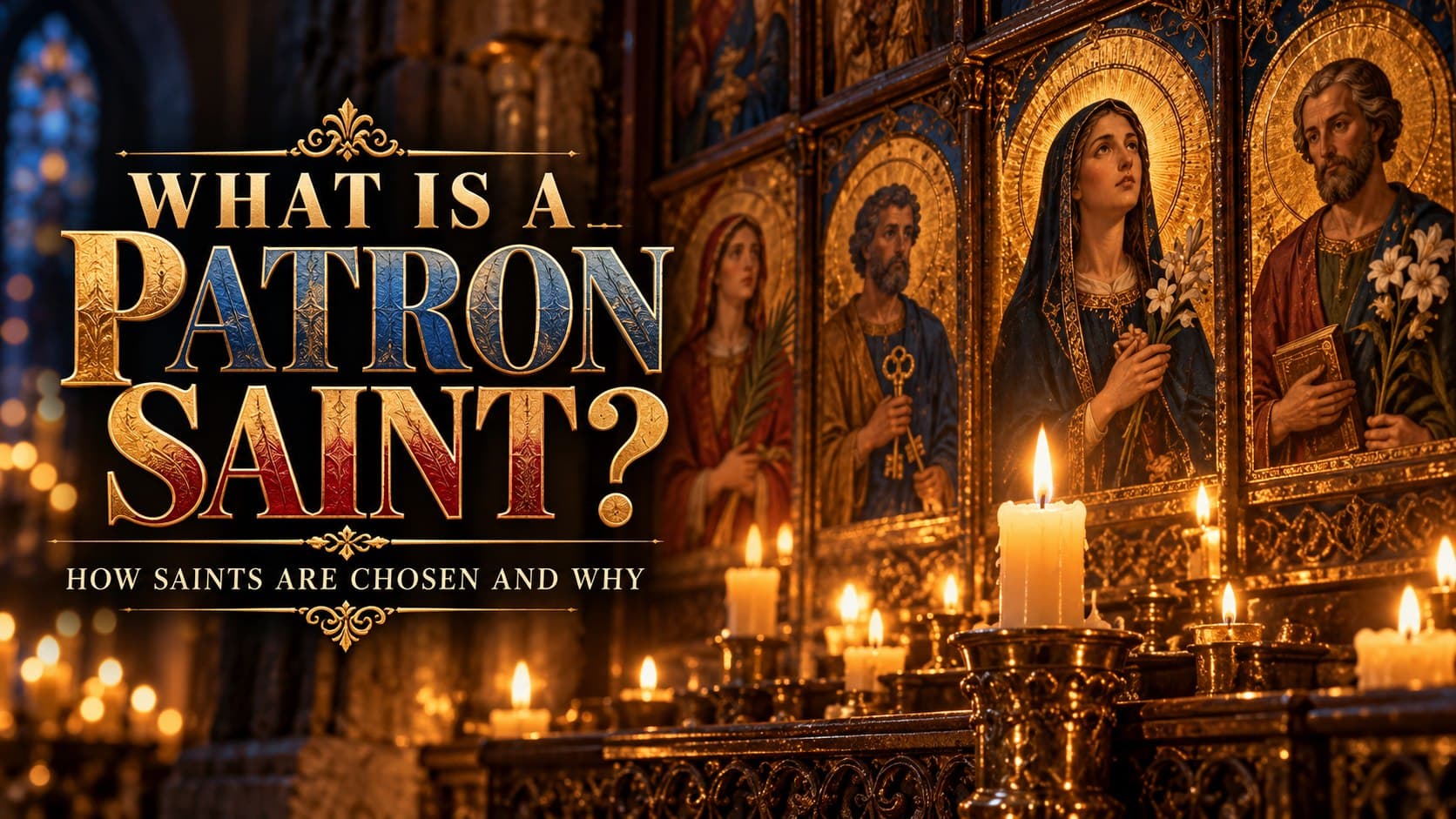
📖 What Is a Patron Saint? How Saints Are Chosen and Why
Somebody at work jokes that a coworker must be the patron saint of lost car keys. A friend wears a little medal around her neck and tells you it is Saint Christopher, for safe travel. A city you visited last summer turned out to be named after a saint nobody ever explained to you.
The phrase gets used constantly, usually half as a joke and half seriously. Almost nobody who says it could tell you who actually decides it, or whether anyone decides it at all.
📌 Here is the straight answer. A patron saint is a saint a Christian, a group, a trade, a city, or a nation looks to as a particular model of faith and a particular intercessor, because of some real connection between that saint's life and the person or place involved. Some patronages are formally ratified in Rome. Far more of them grew up the ordinary way, through centuries of people simply asking one saint rather than another.
This guide walks through both paths. The actual rule Rome uses when it names an official patron, how an everyday Catholic ends up with a personal one, the belief underneath the whole practice, and where Protestants read the same Bible and land somewhere else entirely.
Every historical and doctrinal claim below links back to a named source you can check for yourself.
Why This Matters for Your Faith
It is easy to file this under trivia. A fun fact for a pub quiz, not something that touches how you actually follow Jesus.
⚠️ But look at what is really being asked every time someone names a patron. Who do I look to when I need strength for this specific thing. Whose life actually shows me how to carry what I am carrying right now.
That is not a small question. It is the same question behind every hero you ever quietly measured yourself against, every mentor you wished you had, every verse you keep coming back to because someone in it feels like you.
Scripture answers that question with a command, not a suggestion.
"Remember them which have the rule over you, who have spoken unto you the word of God: whose faith follow, considering the end of their conversation."
Look closely at the verb. Not admire. Not remember fondly. Follow.
Whether you pray to a saint or simply study one, as an apostle, a martyr, or any other follower of Christ, the instinct behind a patron saint is a biblical one. You were never meant to walk this out with no examples in front of you.

What a Patron Saint Actually Is
1. The Idea Starts With a Real Connection, Not a Random Draw
Britannica's own entry defines a patron saint plainly: a saint to whose protection and intercession a person, a society, a church, or a place is dedicated. It adds the one detail that actually explains the whole system.
The choice is almost never random. Britannica says it usually rests on some real or presumed relationship between the saint and whoever claims them. Patrick became Ireland's patron because he brought the gospel there himself. Scotland looks to Andrew the apostle through a much older medieval claim to his relics.
That pattern holds everywhere the practice shows up. A trade, an illness, a city, a cause. Somewhere in the saint's own story is the reason.
2. Rome Has an Actual Rule for the Official Kind
Official patrons, the kind named for a diocese, a country, or a whole profession, go through an actual process, and it has not always worked the same way.
Aleteia reports that in 1630 Pope Urban VIII decided to regulate the naming of patron saints. The Catholic Encyclopedia, hosted on Catholic Answers, dates a further decree of his to March 23, 1638, setting rules for choosing patrons of churches, cities, and countries, while leaving the older, already established patrons in place.
📌 One requirement has stayed constant since. The Catholic Encyclopedia states that both a patron and a church's titular saint must have the rank of a canonized saint. A person can be deeply loved and still not qualify to be named an official patron until the Church has formally recognized them.
Aleteia adds that this duty, once held by a different Vatican office, now belongs to the Congregation for the Causes of Saints, which still ratifies new patronages today.
3. Most Patronages Were Never Decreed From Rome at All
Here is the part that surprises people. Aleteia is direct about it. Alongside the official system, popular devotion has produced its own patronages since the Middle Ages, with no decree involved.
Guilds picked saints connected to their own trade, the way bakers looked to Saint Honoratus. Other patronages grew out of a single famous story, the way Saint Anthony of Padua became the one people ask about a lost item, after an account of him recovering a stolen psalter.
💡 The two tracks feed each other. Aleteia puts it this way: Church institution and popular piety feed off each other. Sometimes Rome proposes a patron to the faithful. Just as often, ordinary devotion names one first, and the Church studies it only later.
The Catholic Encyclopedia's own list of reasons behind a patronage reads less like law and more like a family story: a relic kept in a town, a saint who preached there, a saint who died there, or simply the devotion of whoever founded the parish in the first place. Local devotion to a figure like Martin of Tours grew the same way, long before any Roman office weighed in.
4. The Belief Underneath Is the Communion of Saints
None of this makes sense to a Catholic reader without one more piece. The Catholic Encyclopedia states the doctrine plainly: the underlying doctrine of patrons is the communion of saints, the bond of spiritual union between God's servants on earth, in heaven, and in purgatory.
On that belief, a saint in heaven is not gone. He or she is still part of the same family, still able to carry a prayer to God on someone else's behalf. John describes something very like this picture in Revelation.
"And when he had taken the book, the four beasts and four and twenty elders fell down before the Lamb, having every one of them harps, and golden vials full of odours, which are the prayers of saints."
The Catechism of the Catholic Church builds the same idea into the sacrament of Baptism itself. Paragraph 2156, read on the Vatican's own site, says a baptismal name often belongs to a saint, a disciple who has lived a life of exemplary fidelity to the Lord, and that the patron saint provides a model of charity, with the assurance of that saint's intercession.
That connects directly to the difference between All Saints Day and All Souls Day, two days built on the same conviction that the family of faith does not end at a graveside.
5. Where Protestants Read the Same Bible Differently
A large share of Christians, across many Protestant traditions, do not adopt the patron saint system at all, and it is worth hearing why plainly rather than dismissing it.
The apologetics site GotQuestions lays out the common Protestant case. It argues the Bible uses the word saint for every believer, not for a smaller class of the especially holy. Paul addresses an ordinary, imperfect congregation with that very word.
"Unto the church of God which is at Corinth, to them that are sanctified in Christ Jesus, called to be saints, with all that in every place call upon the name of Jesus Christ our Lord, both theirs and ours:"
From there, GotQuestions argues that no believer, who is already a saint by that definition, needs another saint to get God's attention, because Scripture tells every Christian to go to God directly.
"Let us therefore come boldly unto the throne of grace, that we may obtain mercy, and find grace to help in time of need."
Many Protestants also point to Paul's language about Christ as the one who stands between God and humanity.
"For there is one God, and one mediator between God and men, the man Christ Jesus;"
📌 Say this plainly, because it is not the same claim on either side. Catholic teaching does not treat a saint's intercession as a rival mediator alongside Christ. Many Protestant readers hear even that framing as too close to the line 1 Timothy 2:5 draws. Neither side's answer is simply the Christian answer. They are two honest readings of the same verses, and the wider split between Catholic and Protestant church calendars runs on the exact same disagreement.
What both sides keep, worth noticing, is Hebrews 13:7's instinct to look at a faithful life and let it shape your own. They simply disagree on whether that life can also hear your prayer.

Practical Tips for Thinking About Patron Saints Well
You do not need to settle every doctrinal question to let this topic shape you for good. Here are seven ways to do that.
- Learn the real story before you repeat the patronage. A fact like patron of travelers or patron of bakers is far more meaningful once you know the actual life behind it, not just the label.
- Separate the official from the popular. Knowing which patronages came through Rome's own process and which grew from centuries of ordinary devotion will keep you from treating every claim as equally settled.
- If you are Catholic, look up your own baptismal or confirmation saint. Read their actual story, not just their feast day. The Catechism calls that saint a model, not a mascot.
- If you are Protestant, you can still read these lives. You can let a saint's faith instruct you, the way Hebrews 13:7 asks, without praying to them, if that is where your conscience lands.
- Watch for legend dressed up as history. Several famous patronages, like Saint Anthony and lost items, rest on a story, not a document. Enjoy the story. Just know which one it is.
- Let a patron point you back to Christ, not past Him. Whatever your tradition, the purpose of any human example is to make you want to follow Jesus more closely, not less.
- Talk about this with someone from a different tradition. A respectful conversation about why Catholics and Protestants land differently here will teach you more than any single article can.
Top Bible Verses Behind the Idea of a Patron Saint
None of these verses mention the word patron. They do not need to. Together they are the raw material both sides of this discussion are actually arguing over.
1. Hebrews 13:7
"Remember them which have the rule over you, who have spoken unto you the word of God: whose faith follow, considering the end of their conversation."
This verse is the real engine behind the whole patron saint instinct, whichever side of the debate you land on. Scripture commands you to study how a faithful life actually ended, and let that shape your own.
2. 1 Corinthians 11:1
"Be ye followers of me, even as I also am of Christ."
Paul says this about himself, not about a saint centuries removed from his readers. It is the same logic a patron saint runs on, scaled down to one ordinary leader asking a church to copy his own imitation of Jesus.
3. Philippians 1:1
"Paul and Timotheus, the servants of Jesus Christ, to all the saints in Christ Jesus which are at Philippi, with the bishops and deacons:"
Notice who gets the word saints here. A whole ordinary congregation, most of them still very much alive. This is the verse Protestant readers return to most often when they argue the word was never meant for a small, especially holy class of Christian.
4. James 5:16
"Confess your faults one to another, and pray one for another, that ye may be healed. The effectual fervent prayer of a righteous man availeth much."
Every Christian agrees this verse is true. The honest disagreement is only about whether a righteous man already in heaven can still pray that prayer for you. Settle that question and you have settled most of the patron saint debate.
5. 2 Timothy 4:7 and 8
"I have fought a good fight, I have finished my course, I have kept the faith: Henceforth there is laid up for me a crown of righteousness, which the Lord, the righteous judge, shall give me at that day: and not to me only, but unto all them also that love his appearing."
This is Paul, near execution, describing his own finished race. Every patron saint, official or popular, is ultimately someone the Church believes finished exactly this kind of race well enough to be worth remembering by name.

Frequently Asked Questions About Patron Saints
What is a patron saint in simple terms?
A patron saint is a saint a person, group, trade, city, or country looks to as a model of faith and an intercessor, usually because of a real connection between that saint's life and the one claiming them. Some of these pairings are formally recognized by Rome. Most grew up through ordinary devotion over many centuries.
How is a patron saint officially chosen?
For an official patron of a diocese, nation, or cause, the request goes through the Vatican's Congregation for the Causes of Saints, which ratifies the choice under rules that trace back to Pope Urban VIII in the early 1600s. Many other patronages were never submitted this way at all and simply grew from popular devotion.
Does a patron saint have to be canonized?
For an official patronage, yes. The Catholic Encyclopedia states that a patron must have the rank of a canonized saint, the same standard required of a church's titular saint. A figure can be widely loved and still fall short of qualifying as an official patron until that formal recognition happens.
Who is the patron saint of lost things?
Saint Anthony of Padua holds that patronage, based on a widely told account of him recovering a stolen psalter after praying for its return. It is a good example of how a single memorable story, rather than a Vatican decree, can hand a saint a patronage that sticks for centuries.
Can one saint be the patron of more than one thing?
Yes, easily. A single saint can be claimed by a trade, a city, a disease, and a nation all at once, depending on which part of their story different people connected with over the centuries. There is no rule limiting a saint to one patronage.
How do I find my own patron saint?
Many Catholics start with their baptismal or confirmation name, since the Catechism ties that name to a saint who serves as a model and intercessor. Others choose by shared vocation, a shared struggle, or simply a saint's story that moved them. There is no single required method outside the formal, official patronages.
Do Protestants believe in patron saints?
Most Protestant traditions do not practice this. Sites like GotQuestions argue the New Testament calls every believer a saint and that Scripture gives believers direct access to God, which they read as leaving no biblical basis for a separate class of intercessor saints. Not every Protestant tradition treats the question identically, but the patron system itself stays a Catholic and Orthodox practice.
Is asking a patron saint for help the same as praying to God?
Catholic teaching draws a clear line between the two. A request made to a saint is understood as asking that saint to pray to God on your behalf, the same way you might ask a friend to pray for you, not as worship directed at the saint. Many Protestants remain unconvinced that the distinction holds once a saint is no longer living, which is the heart of the disagreement.
Who decides a country's patron saint?
A national patronage is typically ratified through the same Vatican process as any other official patron, often after a petition from the country's own bishops. Some national patrons, like Patrick for Ireland or Andrew for Scotland, trace back so far into local tradition that they were already assumed long before any formal decree caught up with the devotion.
Final Thoughts
Strip away the joking use of the phrase, and three things remain true.
📌 A patron saint is never a random pairing. Every real patronage traces back to some actual connection between a saint's life and the person or place claiming them.
📌 Two tracks run side by side. A smaller number of patronages are formally ratified in Rome. Far more grew up through ordinary devotion, one generation handing the practice to the next.
📌 The real disagreement is not about history. Catholics and Protestants mostly agree on who these people were. They disagree on whether a life finished well enough to be remembered can still carry today's prayer to God.
Wherever you land on that last question, Hebrews 13:7 still asks something of you directly. Remember a faithful life. Study how it ended. Let it move you to follow Christ the way that life did.
That instruction was never locked inside one tradition. It is yours to obey starting today.
📚 Sources
Every claim in this article traces back to one of these. All links checked 5 November 2026.
- Patron Saints
Catholic Encyclopedia (1913), via Catholic Answers · 1913
The source for the origins of patronage, Urban VIII's 1638 decree, the requirement that a patron be a canonized saint, and the communion of saints as the doctrine underneath the practice.
- Who decides how patron saints get assigned
Aleteia · 2024
The source for Urban VIII's 1630 decision to regulate patron saints, the role of the Congregation for the Causes of Saints today, and the Saint Honoratus and Saint Anthony of Padua examples of popular, non official patronages.
- Patron saint
Encyclopaedia Britannica
The source for the definition of a patron saint and the basis for how a saint and a person or place are paired, including the example of Patrick and Ireland.
- Catechism of the Catholic Church, Paragraph 2156
The Holy See
The source for the Church's own teaching that a baptismal patron saint provides a model of charity along with the assurance of that saint's intercession.
- Patron Saints
GotQuestions.org
The source for the Protestant case against the patron saint system, including its reading of 1 Corinthians 1:2 and Hebrews 4:16.