📖 Who Was Saint Martin of Tours? The Meaning of St. Martin's Day
You have probably seen the picture even if you never learned the name.
Kids walking through a dark street in Germany or Austria, each one holding a paper lantern, singing as they go.
That picture exists because of one decision a Roman soldier made at a city gate, almost seventeen hundred years ago.
📌 A freezing beggar had nothing. A young soldier had one cloak. He cut it in half and gave away the warmer part, and the Church never stopped telling the story.
Most people who hang a lantern on St. Martin's Day could not tell you who he actually was.
This is the real story of Saint Martin of Tours. The soldier, the cloak, the bishop who did not want the job, and why a German boy born in 1483 ended up named after him.
Let's start with who he actually was.
Who Saint Martin of Tours Was
Martin was born around 316, in Sabaria, a Roman town in what is now Hungary.
His father was a Roman army officer, and the household was not Christian.
Martin was drawn to Christianity early anyway, and became a catechumen, someone preparing for baptism, as a boy.
📌 He did not get a say in his first career. Roman law required the sons of veteran soldiers to serve, and Martin was enrolled in the army at around fifteen.
Almost everything we know about him comes from one book.
A friend named Sulpicius Severus wrote the Life of Martin while Martin was still alive, finishing it only a couple of years before Martin died in 397.
⚠️ Be honest about what that book is. It is a devoted friend writing to honor a man he admired, not a neutral court record. The core events line up across other ancient sources, but some of the details carry the shine a biography written by an admirer always carries.
Now here is how his story actually goes.

The Life of Saint Martin of Tours
1. A Soldier Before He Was a Saint
Martin's regiment was eventually posted to Amiens, in Gaul, modern day France.
Sulpicius Severus says Martin lived more like a monk than a soldier the whole time he served, giving away much of his pay and caring for the sick in his unit.
💡 He was already living like a Christian years before he was baptized as one.
Then came the day everyone remembers him for.
2. The Cloak at the Gates of Amiens
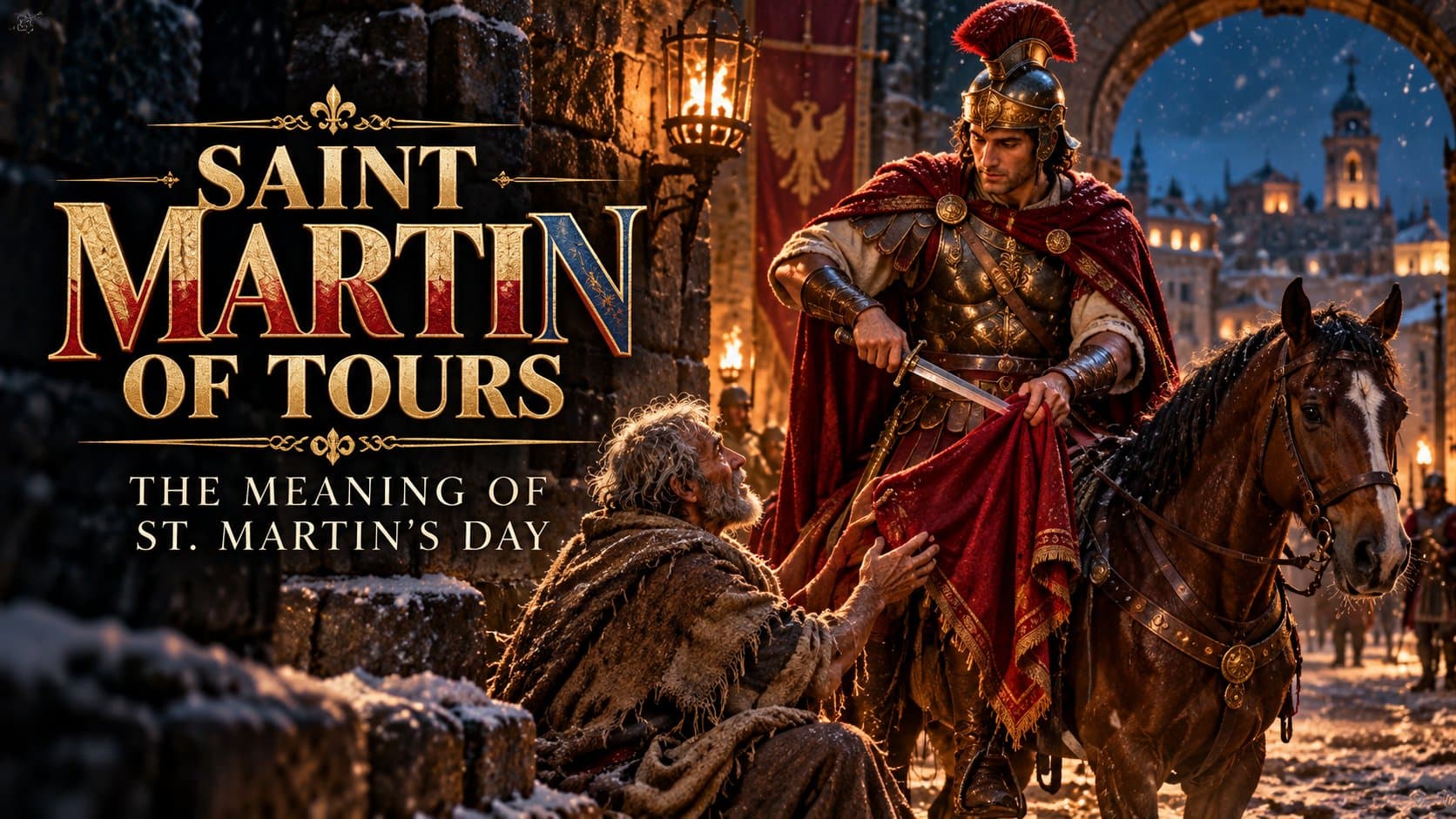
It was a brutally cold winter, and people were freezing to death in the streets.
At the city gate, Martin passed a beggar, half naked, shivering, and no one else had stopped to help him.
Martin had already given away most of what he owned. All he had left on his own back was his soldier's cloak.
He drew his sword, cut the cloak in two, and handed half to the man.
📌 He did not give what was left over. He gave half of the only warm thing he had, and kept walking in the other half.
"Naked, and ye clothed me: I was sick, and ye visited me: I was in prison, and ye came unto me."
That night, Sulpicius Severus says, Martin saw Christ in a dream, wearing the half cloak he had given away.
Christ turned to the angels around him and said, in the biography's words, that Martin, "as yet only a catechumen," had clothed him with that garment.
💡 The beggar was not a stranger to be helped and forgotten. Christ identified Himself with the man in the cold.
According to the same account, Martin asked for baptism as soon as he could get to a church after that.
⚠️ No exact date survives for the baptism itself. What survives is the order of events: the gift came first, and the baptism followed it.
He is not the only bishop the Church remembers mostly for what he gave away quietly. Saint Nicholas, centuries later, gave away gold the same way, through a window instead of a sword cut, but for the same reason.
3. Leaving the Army to Serve Christ
Martin stayed in the army a few more years as a baptized Christian.
Then, before a battle against invading tribes, Emperor Julian handed out a bonus to his soldiers. Martin refused his share.
"I have served you as a soldier," he reportedly told Julian. "Let me now serve Christ."
"Thou therefore endure hardness, as a good soldier of Jesus Christ. No man that warreth entangleth himself with the affairs of this life; that he may please him who hath chosen him to be a soldier."
Julian accused him of cowardice. Martin offered to walk into the next battle unarmed, to prove it was not fear talking.
He was thrown in a cell for it. A truce ended the fighting before the offer was tested, and Martin was released and let go from the army.
📌 He did not leave the fight because it got hard. He left because he had decided which army he actually belonged to.
4. Exile, Hilary, and the First Monastery in Gaul
A free man, Martin went to Poitiers to study under Hilary, the city's bishop and a respected defender of orthodox teaching about Christ.
Hilary ordained him a deacon. Soon after, Martin ran into the same fight Hilary was already in: Arian bishops who denied that Christ was fully God were pushing orthodox Christians out of their positions, Martin among them.
He was publicly whipped and driven out of more than one town for it.
Hilary himself was exiled to the eastern empire. Martin waited it out on a small island off the coast of Italy until an imperial order let Hilary come home in 360.
Martin followed him back to Poitiers the next year.
📌 Hilary gave him a plot of remote land nearby. Other men who wanted the same kind of life started showing up and settling around him.
That settlement grew into the community now called Ligugé, and historians generally treat it as the earliest monastery founded on Gallic soil.
Martin stayed there roughly ten years, walking out into the countryside to preach.
5. Dragged Into Being Bishop
Around 371, the bishop of Tours died, and the people of the city wanted Martin to take his place.
Martin did not want it. He liked his quiet, hidden life at Ligugé.
So the people tricked him. A local man named Rusticius begged Martin to come and pray over his sick wife. Once Martin reached the city, a crowd was waiting to make him bishop whether he agreed or not.
Some neighboring bishops objected, saying his plain, unwashed appearance made him look unfit for the office. The crowd overruled them anyway.
"For whosoever exalteth himself shall be abased; and he that humbleth himself shall be exalted."
⚠️ A much loved detail belongs here, with one honest caveat attached. Popular legend says Martin hid in a goose shed to dodge the appointment, and that the geese gave him away with their honking.
That specific story does not appear in Sulpicius Severus's account, Martin's earliest and closest biography. It shows up centuries later in European folk tradition, long after his death, and it is the reason geese became tied to his feast day at all.
📌 The reluctance is well documented. The goose shed is a story people kept telling anyway, because it was too good to let go of.
Once he was bishop, Martin refused to live like one. He set up a small hermitage across the river from Tours, and other men gathered there with him. That settlement became the monastery of Marmoutier.
Martin is one of thousands of men and women the Church has honored this way, the same company All Saints' Day sets aside a whole feast to remember.
6. Tearing Down Idols, Then Dying Facing Heaven
Rural Gaul outside the cities was still largely pagan when Martin became bishop. Sulpicius Severus describes him traveling out into the countryside on foot, by donkey, or by boat, and preaching there himself.
The same account credits him with pulling down shrines and cutting sacred trees villagers worshipped, which earned him the later title Apostle of Gaul.
"For they themselves shew of us what manner of entering in we had unto you, and how ye turned to God from idols to serve the living and true God."
⚠️ Those stories come entirely from his own biographer, so read them as the Church's memory of a missionary bishop, not as an outside eyewitness report, the same caution worth keeping on hand any time a tidy story about old paganism gets repeated as settled fact.
Martin also used what influence he had to spare lives, including pleading with the emperor's court at Trier for condemned prisoners.
He opposed the execution of a man named Priscillian over doctrine he disagreed with, arguing that a church court, not an executioner, was the right place to settle it. He lost that argument, and Priscillian was put to death anyway.
Years later, worn down and ill, Martin traveled to settle a dispute among his own clergy at a town called Candes. He never made it home.
He asked to lie on the bare ground, on ashes, instead of a bed, saying it was not fitting for a Christian to die any other way.
"For to me to live is Christ, and to die is gain."
He died on November 8, 397, at around eighty one years old.
📌 His body was carried to Tours and buried three days later, on November 11, which is why that date, not the day he died, became his feast.

Lessons From Saint Martin's Life
1. Give what is actually in your hand
Martin did not have a spare cloak sitting at home. He had one, on his own back, in the cold.
He cut it instead of waiting for a better moment to give something whole.
❓ What is the one thing you keep waiting to have more of before you give any of it?
2. A real calling will cost you the life you already built
Martin had years invested in the army before he walked away from it.
⚠️ Serving Christ is rarely free. It usually costs the thing you already have standing.
3. You cannot outrun the work God keeps putting in front of you
Martin wanted to stay hidden at Ligugé. The people of Tours would not let him.
He spent the rest of his life doing the job he never asked for, and doing it well.
📌 Not wanting a responsibility has never once been proof that it is not yours.
4. Keep your eyes forward, especially at the end
Martin spent his last conscious hours making sure nothing softened his view of what was coming.
💡 He did not fear death. He arranged his final hours around facing it directly.
Key Verses From Saint Martin's Story
1. Matthew 25:36
"Naked, and ye clothed me: I was sick, and ye visited me: I was in prison, and ye came unto me."
Jesus names clothing the naked as something done directly to Him, not merely for Him.
📌 Martin's cloak at Amiens is this verse, acted out three centuries later at a city gate in Gaul.
2. 2 Timothy 2:3 to 4
"Thou therefore endure hardness, as a good soldier of Jesus Christ. No man that warreth entangleth himself with the affairs of this life; that he may please him who hath chosen him to be a soldier."
Paul is writing to Timothy, not about Martin, centuries earlier.
💡 Martin simply traded one army's entanglements for the other soldier's calling Paul describes here.
3. 1 Thessalonians 1:9
"For they themselves shew of us what manner of entering in we had unto you, and how ye turned to God from idols to serve the living and true God."
Paul is describing the Thessalonians turning from idols. It was already the normal shape of conversion long before Martin preached in rural Gaul.
⚠️ Whatever the exact details, Martin's whole ministry was aimed at exactly this turn, village by village.
4. Philippians 1:21
"For to me to live is Christ, and to die is gain."
Paul wrote this from a Roman prison, uncertain whether he would live or die.
📌 Martin, asking to lie on ashes so nothing would dull his view of heaven, died saying the same thing without a single word.

Frequently Asked Questions About Saint Martin of Tours
Was Saint Martin of Tours a real person?
Yes. He is a documented fourth century Roman soldier who became bishop of Tours, in what is now France, and the broad outline of his life is attested by his contemporary biographer Sulpicius Severus and later church historians. Some individual stories about him carry more legend than the core events do.
When is St. Martin's Day?
November 11 every year, the day Martin was buried in Tours three days after his death on November 8, 397. Western Christians have marked that date since at least the early Middle Ages.
Why do people eat goose on St. Martin's Day?
The most repeated explanation ties it to the legend of geese exposing Martin's hiding place when he tried to avoid becoming bishop. A second, more practical explanation is that November was once rent and tax day in much of medieval Europe, and a fattened goose was a common way to pay the bill. Both traditions likely fed each other over time.
Did Saint Martin really cut his cloak in half?
This is the best attested story about him, recorded by his own biographer while people who had known Martin were still alive. It is treated as historical, not legend, in nearly every account of his life.
Is the story about Saint Martin hiding from geese true?
Almost certainly not as history. It does not appear in Sulpicius Severus's account written near Martin's own lifetime, and it surfaces only much later in European folk tradition. What is documented is that Martin genuinely did not want to become bishop and had to be tricked into going to Tours at all.
Why is Martin Luther named after Saint Martin of Tours?
Luther was born on November 10, 1483, and baptized the next day, November 11, which was St. Martin's feast day. Naming a child after the saint whose feast fell near his birth was common practice at the time, which is how the future reformer ended up sharing a name with a fourth century Catholic bishop, something the story of Reformation Day picks up more than a thousand years later.
What is Saint Martin of Tours the patron saint of?
Catholic tradition names him patron of France, along with soldiers, the poor, and several trades connected to his cloak, including tailors. France has kept him as a national patron since the Middle Ages.
Did Saint Martin really destroy pagan temples?
His biographer Sulpicius Severus says so directly, describing shrines pulled down and sacred trees cut across the Gallic countryside. Since the only detailed source is a biography written to honor him, read the specific episodes as the Church's memory of an aggressive rural missionary campaign, not as a neutral outside record.
How did Saint Martin of Tours die?
He died of natural causes at Candes, a town where he had traveled to settle a dispute among his clergy, on November 8, 397, at roughly eighty one. He reportedly asked to be laid on ashes rather than a bed in his final hours.
Do Protestants celebrate St. Martin's Day?
Some do, as a cultural and historical observance rather than a day of prayer to a saint. German and Scandinavian Lutherans in particular keep the lantern walks and the goose dinner, partly because the date is tied to Martin Luther's own name. Many other Protestants, especially those wary of venerating saints at all, do not mark the day, and Scripture leaves the choice to each believer's own conscience.
Final Thoughts
Strip away the goose, the lantern, even the slight shine a loving biographer puts on his hero, and one decision still stands underneath everything else.
📌 A freezing man needed a coat. A soldier had exactly one. He did not wait for a better moment or a bigger gift. He cut it in half.
Everything else in Martin's life, the army he left, the bishopric he tried to dodge, the shrines he tore down, the way he chose to die, grew out of that same instinct: give what is actually yours to give, right now, even when it only covers half the need.
That instinct is also why his feast day, centuries ago, marked the start of a forty day fast leading into Christmas, before the Church shortened it into the four weeks of Advent you keep today.
You probably will not meet a beggar at a city gate this week. You will meet someone who needs exactly what you already have in your hand. 📌 That is the whole assignment St. Martin's Day actually leaves you with.
📚 Sources
Every claim in this article traces back to one of these. All links checked 28 October 2026.
- St. Martin of Tours
John J. a Becket, The Catholic Encyclopedia (1911), New Advent
The source for Martin's birth around 316 in Sabaria, his father's rank, the chronology with Hilary of Poitiers, the 371 to 372 election at Tours, his consecration on July 4, and the death date debate between 397 and 400.
- St. Martin of Tours
EWTN
The source for the cloak and beggar story at Amiens, the vision of Christ that followed, the confrontation with Emperor Julian, the founding of Ligugé and Marmoutier, the destruction of pagan shrines, the Priscillian affair, and his death at Candes on November 8.
- Saint of the Day, 11 November: Saint Martin of Tours
Vatican News
The Vatican's own listing confirming November 11 as the day Martin is commemorated, and the title Apostle of Gaul.
- Mårtensgås (The Legend and History of St. Martin's Goose)
Nordiska museet (Nordic Museum, Sweden)
The source for the goose shed legend as later folklore, and the documented history of eating goose on St. Martin's Day in medieval and early modern Europe.
- November 10, 1483
Stephen Nichols, 5 Minutes in Church History, Ligonier Ministries
The source for Martin Luther's birth on November 10, 1483, his baptism the next day, and his name coming from St. Martin's feast day.
- St. Martin's Day: The Feast That Began the Fast
Building Catholic Culture
The source for Bishop Perpetuus of Tours establishing a pre-Christmas fast beginning on St. Martin's feast day, and that period later shortening into the four weeks of Advent.