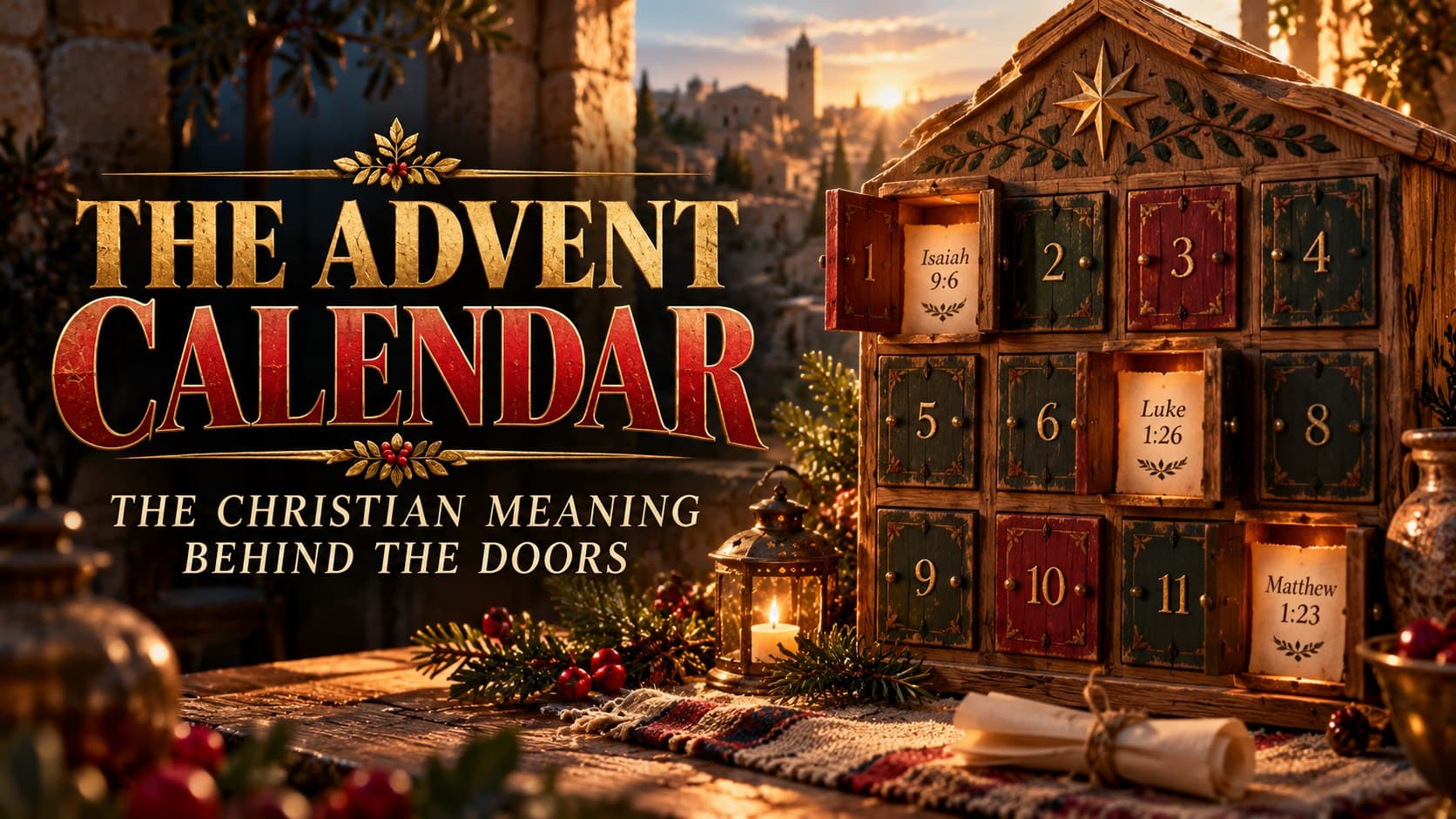
📖 What Is an Advent Calendar? The Christian Meaning Behind the Doors
Every December you opened one tiny cardboard door. One chocolate. One number closer to Christmas morning. Nobody ever sat you down and told you why there were exactly twenty four doors, or why the whole thing was called an Advent calendar in the first place.
Now the calendars are bigger business than ever. Beauty products, coffee, candles, whiskey, dog treats. The word Advent still sits on the box. Almost nothing inside explains what that word is actually naming.
📌 Here is the plain answer. An Advent calendar counts down the days of Advent, the season the church has kept for over fifteen centuries to prepare for Christ's birth and to watch for His promised return. The familiar door calendar is young by comparison, built out of a German candle tradition and printed for the first time in 1908. The candy is new. The waiting it tracks is ancient.
This guide walks through where Advent itself comes from, the real history behind the door calendar, how a devotional habit turned into a shelf product, and how Catholics and Protestants have each kept the season differently.
Every historical claim below links back to a named source you can check for yourself.
Why This Matters for Your Faith
It is easy to treat the calendar as pure novelty. A countdown toward presents, nothing more spiritual than a kitchen timer.
⚠️ But look at what counting down actually trains you to do. It teaches you to wait on purpose, one day at a time, for something you cannot rush and cannot control. That is not a skill modern life teaches you anywhere else.
Scripture names that exact posture, long before any calendar existed.
"For the vision is yet for an appointed time, but at the end it shall speak, and not lie: though it tarry, wait for it; because it will surely come, it will not tarry."
💡 That is the real engine behind Advent. God made a promise. His people waited on it, generation after generation, long after it seemed like it would never arrive. A door calendar, whatever it is made of, is a small, physical way of practicing that same patience. The chocolate is not the point. The waiting is.

Where the Advent Calendar Actually Comes From
1. Advent Was a Season Centuries Before It Was a Calendar
Before any door or chocolate existed, Advent was already a season on the church calendar. The National Trust's own account of the tradition notes that Christians have observed Advent as a period of fasting, prayer, and preparation before Christmas since at least the fifth century.
Encyclopaedia Britannica explains the name itself comes from the Latin adventus, meaning coming. The season looks in two directions at once. It prepares for the anniversary of Jesus' birth, and it prepares Christians to watch for His promised return at the end of time, a pairing the United States Conference of Catholic Bishops states plainly on its own Advent page.
📌 So the calendar was never really counting down to presents. Long before Gerhard Lang printed a single door, Christians were already marking these same weeks as a season of watching. You can read more about exactly when that season begins each year.
2. A Candle a Day: the German Habit Behind the Calendar
The door calendar you know grew out of a much simpler habit. The National Trust traces the earliest counting customs to nineteenth century Germany, among Protestant households who would burn a candle for each day of Advent, a practice it notes is still kept in some homes and churches today.
One particular candle habit became famous enough to shape everything that followed. Hamburg's own tourism board records that in 1839, Johann Hinrich Wichern, a Lutheran pastor who had founded a children's home called the Rauhes Haus after seeing the poverty of Hamburg's young people, lit the first Advent wreath under the ceiling of his prayer room.
It was built from a wooden wheel roughly the size of a cartwheel. Red candles marked the ordinary days, white candles marked the Sundays of Advent, and one more was lit each day until Christmas Eve. The number of red candles varied from year to year, between eighteen and twenty four depending on how early Advent fell.
💡 That is the direct ancestor of two different things you already know. The four candle Advent wreath still lit in many churches today is a scaled down version of Wichern's original, reduced for home living rooms once the habit spread beyond his own mission. And the same basic idea, one marker lit or opened each day, is exactly what a door calendar still does.
3. Gerhard Lang Puts a Door on It in 1908
The door calendar itself has its own, much more personal origin story. The National Trust tells the most widely repeated version of it. As a boy in Germany in the late 1800s, Gerhard Lang's mother taped a small sweet to a piece of cardboard for each day of Advent, giving him something to look forward to every morning while he waited for Christmas.
Lang never forgot it. As an adult he founded a printing company with a friend named Reichhold, and together, inspired by his mother's cardboard and sweets, they printed what is considered the first Advent calendar in 1908.
⚠️ Treat the finer details here carefully. No single, fully documented inventor of the Advent calendar exists. Some accounts describe Lang's mother using candies, others describe small pictures, and sources even differ on the spelling of his first name. What is well attested is the shape of the story and the 1908 date for the first printed version. Lang and Reichhold's own company closed in the 1930s, but by then the calendar had already caught the public's imagination, and it never really let go.
4. From Devotional Habit to Shelf Product
Britannica's own entry is direct about where the modern version has ended up. Advent calendars today are usually a secular holiday tradition, even though they originate from Christian customs meant to prepare people spiritually for Christmas.
Britannica lists exactly how far that drift has gone. Adults can now count down the days with calendars built around beauty products, gourmet foods, beverages, jewelry, or fitness gear. None of that existed in Lang's cardboard and sweets.
📌 None of this makes the calendar fake or wrong. A countdown toward Christmas is a good thing to keep, whatever fills the doors. It simply means the religious meaning behind the format is no longer carried automatically. If you want it kept, you have to choose a calendar, or a habit, that actually keeps it.
5. Scripture Still Hides Behind Some of the Doors
Plenty of Christian families never let the devotional side disappear. The best known example is the Jesse Tree, a tradition that pairs a daily Scripture reading with a small ornament, moving from Genesis through to the nativity over the course of Advent, as Christianity.com describes it.
The name comes directly from one verse, read on the day the tree itself is introduced.
"And there shall come forth a rod out of the stem of Jesse, and a Branch shall grow out of his roots:"
Jesse was David's father, and this Branch is the promised King growing out of that family line. Both Catholic and Protestant families use the Jesse Tree, which makes it a useful reminder that a Scripture based calendar was never limited to one side of the church. The format, twenty four or twenty five markers counting down to Christmas, can carry a verse just as easily as it carries a chocolate.
Where Catholics and Protestants Keep This Differently
The Advent calendar itself is not a doctrinal flashpoint. No church teaches that you must use one, or that using one is wrong. The real difference sits one level up, in how formally each tradition keeps the season the calendar is named after.
In the Catholic Church, Advent is a fixed part of the liturgical year, with its own readings, its own violet vestments, and its own rose colored pause on Gaudete Sunday. A parish keeps Advent whether or not a single household in its pews owns a door calendar. Other liturgical traditions, including many Lutheran, Anglican, and Methodist churches, keep a similarly structured Advent season of their own, close to what Wichern and his fellow German Protestants were already observing in the 1830s.
Many evangelical and nondenominational Protestant churches, by contrast, do not follow a fixed liturgical calendar at all. Advent, as a formally marked season, is simply not part of how they structure the year. That has not stopped families in those same churches from embracing the door calendar itself as a home tradition, often completely apart from any liturgical framing. The wider split between Catholic and Protestant church calendars runs on this same pattern: a fixed, church wide calendar on one side, and a much more varied, household led practice on the other.
📌 Neither side owns the calendar. It was born among German Protestants, printed by a Protestant printer, and is kept today by Catholic and Protestant families alike, each filling the doors with whatever best fits how they already keep the season.

Practical Tips for Keeping Advent Well This Year
You do not need to throw out the chocolate to take this further. Here are seven ways to do that.
- Pick one calendar that actually names Jesus. It does not have to replace the fun one. A second, smaller calendar with a verse behind each door keeps the original meaning in the house.
- Try a Jesse Tree this year. Read one short passage each day, from Genesis toward the nativity, and hang one ornament to mark it. It costs nothing but a little planning.
- Say out loud what the countdown is actually for. Before opening the door, name it. Not just Christmas morning, but the day God kept His promise.
- Let your kids ask the question nobody asked you. Tell them plainly why there are twenty four doors and where the whole habit came from. Curiosity answered well sticks.
- Use a slow day to practice Habakkuk 2:3 on purpose. Pick one thing in your life you are genuinely still waiting on God for, and bring it to Him honestly each morning this Advent.
- Know the difference between the season and the product. A calendar you bought at a shop is not Advent itself. It is, at best, a small daily reminder that the season exists.
- Carry the habit past December 25. If counting down to a promise fulfilled meant something to you, let it shape how you wait on the promises God has not fulfilled yet either.
Top Bible Verses Behind the Idea of Advent
None of these verses mention a calendar. Together they are the actual season the calendar is named after.
1. Habakkuk 2:3
"For the vision is yet for an appointed time, but at the end it shall speak, and not lie: though it tarry, wait for it; because it will surely come, it will not tarry."
Written centuries before Jesus, this verse names the exact posture Advent asks of you. The promise has not arrived yet. Wait for it anyway, because it is coming.
2. Isaiah 9:6
"For unto us a child is born, unto us a son is given: and the government shall be upon his shoulder: and his name shall be called Wonderful, Counsellor, The mighty God, The everlasting Father, The Prince of Peace."
This is the promise Advent counts down toward. A child, named centuries before His birth, carrying titles no ordinary child could ever earn.
3. Luke 2:10 and 11
"And the angel said unto them, Fear not: for, behold, I bring you good tidings of great joy, which shall be to all people. For unto you is born this day in the city of David a Saviour, which is Christ the Lord."
This is the last door. Every candle Wichern lit and every sweet Lang's mother taped to cardboard was, at bottom, pointed at this one announcement.
4. Mark 13:33
"Take ye heed, watch and pray: for ye know not when the time is."
Advent does not only look backward to a birth already recorded. It also looks forward to a return with no announced date, and this verse names exactly how you are meant to wait for that one too.
5. Titus 2:13
"Looking for that blessed hope, and the glorious appearing of the great God and our Saviour Jesus Christ;"
Paul calls that second waiting a blessed hope, not a burden. The same countdown that marks your calendar toward Christmas can mark your whole life toward this.
Frequently Asked Questions About Advent Calendars
What is an Advent calendar?
An Advent calendar is a calendar with one marker, usually a door, for each day of the Advent season leading up to Christmas. It grew out of nineteenth century German traditions of lighting a candle each day, and the first printed door calendar was produced in 1908.
Why do Advent calendars have twenty four doors?
Most commercial calendars run from December 1 through December 24, Christmas Eve, which gives twenty four days to mark. The actual church season of Advent does not always match that exactly, since it begins on a Sunday that moves from year to year rather than on a fixed date.
Who invented the Advent calendar?
No single documented inventor exists. The most widely repeated origin credits a German printer named Gerhard Lang, who printed the first known door calendar in 1908, inspired by a childhood memory of his mother taping sweets to cardboard for him each day of Advent.
Is an Advent calendar religious or secular?
Both, depending on which one you buy. Britannica describes most modern calendars as a secular tradition that originated from Christian customs, which is why a calendar full of chocolate and one full of daily Bible readings can carry the exact same name.
Do Catholics use Advent calendars?
Many Catholic families do, often alongside the Church's own formal Advent season of readings and violet vestments. The calendar itself is a household custom rather than a liturgical requirement, so it sits beside the official season rather than replacing any part of it.
What is a Jesse Tree Advent calendar?
A Jesse Tree is a Scripture based alternative to the candy calendar, pairing one short Bible passage with one ornament each day of Advent, moving from Genesis toward the nativity. It takes its name from Isaiah 11:1 and is used by both Catholic and Protestant families.
When should an Advent calendar actually start?
Commercial calendars almost always start December 1 for simplicity. The church season of Advent itself starts earlier or later depending on the year, since it begins on the Sunday closest to the end of November rather than on a fixed date. You can read the exact rule behind that date on its own.
Do Protestants keep Advent calendars the same way Catholics do?
The calendar itself is used the same way across both groups. What differs is the formal season behind it. Liturgical Protestant traditions, like Lutheran and Anglican churches, keep a structured Advent close to Catholic practice, while many nondenominational and evangelical churches do not follow a fixed liturgical calendar at all, even when their families still use a door calendar at home.
Is it wrong to use a plain chocolate Advent calendar with no Bible content?
No church teaches that a chocolate calendar is sinful. It simply will not carry the season's meaning on its own, since nothing about a candy or a cardboard door explains Advent by itself. Many families keep one of each, the fun calendar and a second one built around Scripture, rather than treating it as a choice between the two.
Final Thoughts
Strip away the chocolate and the shelf products, and three things remain true.
📌 The calendar is new. The waiting is not. German Protestants were marking Advent with candles decades before anyone printed a door, and the church had kept the season itself for well over a thousand years before that.
📌 The format outlasted its first meaning. What started as one mother's sweets taped to cardboard has become a whole industry, and the religious content behind it now has to be chosen on purpose rather than assumed.
📌 No tradition owns it. Catholics and Protestants both keep Advent calendars today, even while they keep the season itself differently, one with a fixed liturgical calendar and one with a far more varied household custom.
Whatever is behind your doors this December, let it point past itself. The waiting season and the day it is leading to were never really about the countdown. They were always about what, and who, was arriving at the end of it.
❓ What are you still waiting on God to keep His promise about?
📌 Habakkuk was told to wait for it, because it would surely come. That has not stopped being true.
📚 Sources
Every claim in this article traces back to one of these. All links checked 5 November 2026.
- Advent Calendar of Christmas Treasures
National Trust
The source for Advent being observed since at least the fifth century, the nineteenth century German candle tradition, and the Gerhard Lang origin story for the 1908 printed calendar.
- Advent calendar
Encyclopaedia Britannica
The source for the Latin root adventus, Advent calendars being a largely secular tradition descended from Christian customs, and the modern specialty calendars built around beauty products and gourmet goods.
- What is Advent?
United States Conference of Catholic Bishops (USCCB)
The source for Advent as preparation for both Christ's first coming at Christmas and His second coming, and for the season's penitential character.
- The Advent Wreath: Four Candles Conquer the World
Hamburg Tourismus GmbH (hamburg-travel.com)
The source for Johann Hinrich Wichern lighting the first Advent wreath at the Rauhes Haus in 1839, its original red and white candle design, and its later reduction to the four candle wreath used in homes today.
- What is a Jesse Tree? Meaning of the Advent Tradition
Christianity.com
The source for the Jesse Tree as a Scripture based Advent practice pairing daily readings with ornaments, and its connection to Isaiah 11:1.