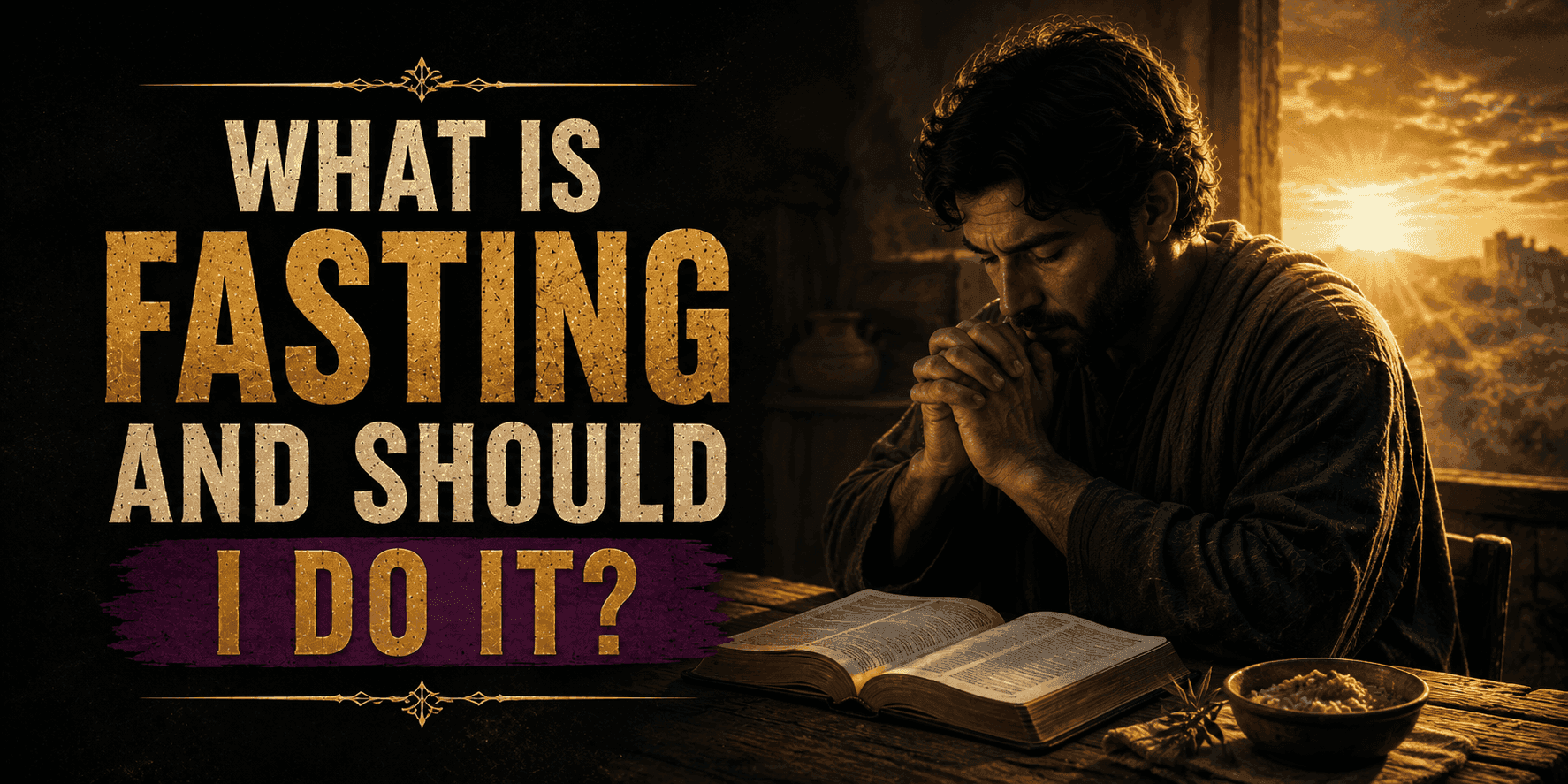
📖 What Is Fasting and Should I Do It?
You have heard church people talk about fasting.
Maybe your pastor announced a fast for the new year.
Maybe a friend mentioned giving up food for a few days and you did not know what to say.
And some part of you wondered if you were missing something.
📌 Here is the honest answer before anything else. Christian fasting is not a test you are failing. It is a tool most believers were never actually taught how to use.
If you have typed "what is fasting" into your phone, hoping for a straight answer instead of a lecture, you are exactly who this guide is for.
Maybe you have heard the confusing parts too.
- 🔲 Fast hard enough and God will finally answer that prayer.
- 🔲 Real Christians fast. Weak ones do not.
- 🔲 Skip food and you will feel closer to God automatically.
None of that is actually what the Bible teaches.
Jesus talked about fasting like it was already a normal part of life for His followers. Not a special move for the super spiritual. Not a hunger strike to force God's hand.
📖 Scripture treats fasting as plainly expected as prayer.
But it also gives real boundaries, real purpose, and real caution.
This guide walks through what fasting actually is, what it is not, who fasted in Scripture and why, and how to start small and safely if you decide to try it. Including an honest word if you have a health condition or a history that makes fasting from food a bad idea for you.
Take a breath. No guilt here.
Let's see what God's Word actually says.
Why This Matters for Your Faith
You could skip fasting your whole Christian life and still get into heaven.
So why does it matter?
Because fasting is one of the few spiritual habits that puts your body on the line, not just your calendar.
Reading the Word takes minutes. Prayer takes attention. Fasting takes your appetite, your comfort, your routine, and sets all of it aside on purpose.
⚠️ That is exactly why it exposes something a quiet time rarely does.
Skip one meal on purpose and watch what surfaces.
- ❓ How attached are you to comfort?
- ❓ How quickly does your mood turn when a desire gets denied?
- ❓ What do you reach for first when you feel empty, God or a snack?
The world tells you appetite rules you. That every craving deserves an answer right now.
Fasting quietly argues the opposite.
📌 It says your body is not in charge. Your spirit is, and your spirit answers to God.
That is not punishment. That is freedom. The same freedom that lets you say no to anything else that tries to run your life.
Fasting will not save you. Only Christ does that. But it can train you to want God more than you want to be comfortable, and that is a fight worth having.
Think about how many decisions in a normal day get driven by a small appetite you never even examine. What you eat, what you watch, what you reach for the second things get quiet.
Fasting takes one of those appetites and puts it directly in front of you, on purpose, so you can choose God over it with your eyes open instead of drifting past the choice without ever noticing you made it.

What the Bible Actually Teaches About Fasting
1. What Fasting Actually Is (and Is Not)
Start with a clear definition, because most of the confusion begins here.
📌 Biblical fasting is choosing to go without food, or something else you depend on, for a set time, so you can focus on God.
That is the whole idea. Now here is what it is not.
- 🔲 It is not a hunger strike to pressure God into moving faster.
- 🔲 It is not a diet with a Bible verse attached to make it feel holy.
- 🔲 It is not a way to earn extra credit with God or impress other Christians.
- 🔲 It is not a punishment you owe God for something you did wrong.
Every time Scripture shows someone fasting, the food is never the point.
The food steps aside so something else can get the attention it was taking up.
Think of it like turning down the volume on one voice, your stomach, so you can finally hear another one clearly.
That is the whole mechanism. Nothing mystical. Nothing magic.
And it is not only food. Scripture also shows people fasting from other things, like Daniel setting aside rich food and wine for three weeks while he sought God, or a married couple in 1 Corinthians 7 setting aside time together for prayer, by agreement, for a season. The pattern stays the same even when the object changes. Something ordinary and good gets paused on purpose, for a set time, so something greater can take its place.
2. Jesus Expected You to Do This
Here is something that surprises a lot of Christians.
Jesus never said if you fast. He said when.
"Moreover when ye fast, be not, as the hypocrites, of a sad countenance: for they disfigure their faces, that they may appear unto men to fast. Verily I say unto you, They have their reward. But thou, when thou fastest, anoint thine head, and wash thy face; That thou appear not unto men to fast, but unto thy Father which is in secret: and thy Father, which seeth in secret, shall reward thee openly."
Jesus placed those words right between His teaching on giving and His teaching on prayer.
📌 In Jesus' mind, fasting sits in the same category as prayer and giving. Normal practices for anyone following Him.
Notice what He does not say. He does not say fast and your prayers get answered faster. He does not say fast and God owes you something.
He only corrects how people fast, not whether they should.
Wash your face. Anoint your head. In other words, keep living. Do not turn your fast into a performance for an audience.
When the disciples of John asked why Jesus' own disciples did not fast, He answered this way.
"Then came to him the disciples of John, saying, Why do we and the Pharisees fast oft, but thy disciples fast not? And Jesus said unto them, Can the children of the bridechamber mourn, as long as the bridegroom is with them? but the days will come, when the bridegroom shall be taken from them, and then shall they fast."
Jesus was the bridegroom, standing right there. Of course His disciples were not mourning.
But He said plainly that after He was gone, His followers would fast. That is you. That is every Christian reading this right now.
And He modeled it Himself before He ever taught it, fasting forty days in the wilderness before His ministry even started.
"Then was Jesus led up of the Spirit into the wilderness to be tempted of the devil. And when he had fasted forty days and forty nights, he was afterward an hungred."
If the Son of God prepared for His calling this way, fasting is not beneath you either.
3. Why People in the Bible Actually Fasted
Scripture never gives fasting one single reason. It shows real people reaching for it in real moments.
📌 Esther called an entire fast before she risked her life to approach the king.
"Go, gather together all the Jews that are present in Shushan, and fast ye for me, and neither eat nor drink three days, night or day: I also and my maidens will fast likewise; and so will I go in unto the king, which is not according to the law: and if I perish, I perish."
Esther did not fast to force an outcome. She fasted because she needed courage for something terrifying, and she wanted God, not just her own nerve, carrying her into that throne room.
📌 Daniel fasted while seeking God over the future of his people.
"And I set my face unto the Lord God, to seek by prayer and supplications, with fasting, and sackcloth, and ashes:"
Another time, he went without rich food for three full weeks while waiting on an answer from God.
"In those days I Daniel was mourning three full weeks. I ate no pleasant bread, neither came flesh nor wine in my mouth, neither did I anoint myself at all, till three whole weeks were fulfilled."
📌 David fasted while pleading for his sick child's life, and then stopped the moment the child died.
"David therefore besought God for the child; and David fasted, and went in, and lay all night upon the earth."
"But now he is dead, wherefore should I fast? can I bring him back again? I shall go to him, but he shall not return to me."
⚠️ Read that carefully. David fasted while he pleaded, and he stopped fasting the moment the answer came, even though the answer was not what he wanted.
Fasting did not control God. It carried David through his grief while he waited on God's will, whatever it turned out to be.
📌 Anna spent her widowhood in fasting and prayer, simply waiting on God in the temple.
"And she was a widow of about fourscore and four years, which departed not from the temple, but served God with fastings and prayers night and day."
📌 The whole city of Nineveh fasted together after Jonah preached, and it marked real repentance, not religious theater.
"So the people of Nineveh believed God, and proclaimed a fast, and put on sackcloth, from the greatest of them even to the least of them."
📌 The early church fasted together before major decisions, like sending out missionaries and appointing leaders.
"As they ministered to the Lord, and fasted, the Holy Ghost said, Separate me Barnabas and Saul for the work whereunto I have called them. And when they had fasted and prayed, and laid their hands on them, they sent them away."
Courage. Direction. Grief. Patient waiting. Repentance. Decisions. The reasons change, but the pattern never does.
📌 Fasting clears space so you can hear God more clearly in a moment that matters.
4. The Heart God Is Actually After
Here is the part a lot of fasting advice skips entirely.
You can go without food perfectly and still completely miss what God wanted. Isaiah 58 makes that painfully clear.
God's people were fasting and genuinely confused about why nothing was changing.
"Wherefore have we fasted, say they, and thou seest not? wherefore have we afflicted our soul, and thou takest no knowledge? Behold, in the day of your fast ye find pleasure, and exact all your labours."
They skipped meals while still mistreating the people around them. God calls that out plainly as fasting for strife and show, not for Him.
Then He defines the fast He actually wants.
"Is not this the fast that I have chosen? to loose the bands of wickedness, to undo the heavy burdens, and to let the oppressed go free, and that ye break every yoke? Is it not to deal thy bread to the hungry, and that thou bring the poor that are cast out to thy house? when thou seest the naked, that thou cover him; and that thou hide not thyself from thine own flesh?"
💡 Read that twice. The fast God wanted was not only about an empty stomach. It was about a changed life.
Loosening wickedness. Freeing the oppressed. Feeding the hungry. Covering the naked.
Skipping lunch means nothing if it never touches how you actually treat people.
The prophet Joel puts the same warning into one line about the heart behind the whole practice.
"Therefore also now, saith the LORD, turn ye even to me with all your heart, and with fasting, and with weeping, and with mourning: And rend your heart, and not your garments, and turn unto the LORD your God: for he is gracious and merciful, slow to anger, and of great kindness, and repenteth him of the evil."
Rend your heart, not your garments.
In other words, the outward act of repentance was never the goal. A genuinely changed heart was.
Fasting without that heart is just skipping meals.
5. What Fasting Actually Does for You
So if it is not a formula, what is it actually good for?
✅ Fasting sharpens prayer. Physical hunger has a way of reminding you all day what you are actually seeking God for.
✅ Fasting exposes what controls you. Food, your phone, entertainment, whatever you give up reveals how tightly you were gripping it.
✅ Fasting builds spiritual endurance. It is one small way of practicing self control, the kind Scripture says is a fruit of the Spirit, not a personality trait some people simply have.
✅ Fasting humbles you. There is nothing like an empty stomach to remind you that you are not in total control of your own body, your schedule, or your life.
None of that happens automatically. It happens when fasting is paired with actual time in God's presence, not just an empty stomach and a normal day.
That is why Scripture almost never mentions fasting alone. It is nearly always fasting and prayer, together. If you are not sure how to pray when the words will not come, start there before you start a fast. The fasting makes room. The prayer is what fills it.
That order matters more than most people realize. A fast with no prayer in it is just a skipped meal with extra guilt attached. The hunger pang is not the prayer. It is only the reminder to go pray.
6. The Caution Nobody Should Skip
This needs to be said plainly, not buried at the bottom.
⚠️ If you have a health condition such as diabetes, a heart condition, or you are pregnant or nursing, talk to a doctor before fasting from food. This is not a suggestion, it is wisdom.
⚠️ If you have a history of disordered eating, fasting from food is not the right practice for you, and no verse in this article is asking you to prove your faith that way.
God never asks you to risk real harm to show devotion. He asked for Isaac on the altar and then stopped Abraham's hand. He is not in the business of destroying the body He gave you.
If food fasting is not safe for you, fasting still applies to your life. Fast from something else that has a grip on you. Social media. Streaming shows. Shopping. The point was never the food itself. It was always making room for God.
And if you are simply new to this, start gentler than you think you need to. A skipped snack is not a small, embarrassing version of fasting. It is fasting, and God measures the heart behind it, not the number of hours on the clock.
Practical Tips: How to Start Fasting
You do not need a forty day wilderness fast to begin.
Start small, start honest, and let it grow from there.
- Start with one meal, not a whole day. Skip breakfast or lunch and spend that time in prayer instead of eating. One meal is a real fast, and it is a sustainable place to begin.
- Pick a reason before you start. A decision you are facing, a person you are praying for, a sin you want freedom from. Fasting without a focus just turns into skipping a meal.
- Fill the empty space with God, not just silence. Use the time you would have spent eating to pray, read Scripture, or sit quietly with God. The empty stomach is not the point. What fills it is.
- Drink water. Most biblical fasting that lasted more than a day or two still involved water. Going without any liquids at all is a much more serious and rare kind of fast, and not where a beginner should start.
- Tell almost no one. Jesus was specific about this. Fasting is between you and your Father, not a post for other people to see.
- Expect to feel it, and keep going anyway. Irritability and distraction are normal the first few times. That discomfort is often exactly where the real lesson starts.
- End it gently. Break a fast with a light meal, not a huge one. Your body will thank you, and so will tomorrow's stomach.
- Stop immediately if something feels medically wrong. Dizziness, fainting, or anything alarming is your body telling you to eat. Obeying your body in that moment is not a failure of faith.
Pick one of these and try it once before you try all of it.
A single honest meal given up to God teaches more than a plan you never actually start.
Top 5 Bible Verses About Fasting
If you only remember five verses about fasting, make them these.
1. Matthew 6:16 to 18
"Moreover when ye fast, be not, as the hypocrites, of a sad countenance: for they disfigure their faces, that they may appear unto men to fast. Verily I say unto you, They have their reward. But thou, when thou fastest, anoint thine head, and wash thy face; That thou appear not unto men to fast, but unto thy Father which is in secret: and thy Father, which seeth in secret, shall reward thee openly."
This is Jesus' one direct teaching on how to fast, and it settles the audience question before anything else. Your fast is for your Father, not for anyone watching.
If you remember nothing else about fasting, remember who it is for.
2. Isaiah 58:6 and 7
"Is not this the fast that I have chosen? to loose the bands of wickedness, to undo the heavy burdens, and to let the oppressed go free, and that ye break every yoke? Is it not to deal thy bread to the hungry, and that thou bring the poor that are cast out to thy house? when thou seest the naked, that thou cover him; and that thou hide not thyself from thine own flesh?"
This is the verse that keeps fasting honest. An empty stomach that never changes how you treat people has missed the entire point God is making here.
3. Joel 2:12 and 13
"Therefore also now, saith the LORD, turn ye even to me with all your heart, and with fasting, and with weeping, and with mourning: And rend your heart, and not your garments, and turn unto the LORD your God: for he is gracious and merciful, slow to anger, and of great kindness, and repenteth him of the evil."
Rend your heart, not your garments. This is the verse to pray before any fast of repentance, so the outward act never stands in for the inward change.
4. Esther 4:16
"Go, gather together all the Jews that are present in Shushan, and fast ye for me, and neither eat nor drink three days, night or day: I also and my maidens will fast likewise; and so will I go in unto the king, which is not according to the law: and if I perish, I perish."
This is the verse for the moment you need courage, not just information. Esther did not fast to feel better. She fasted because she was about to do something terrifying for other people's sake.
5. Acts 13:2 and 3
"As they ministered to the Lord, and fasted, the Holy Ghost said, Separate me Barnabas and Saul for the work whereunto I have called them. And when they had fasted and prayed, and laid their hands on them, they sent them away."
This is the verse for a major decision. The early church did not guess at major moves. They fasted first, and the Holy Ghost spoke clearly into that space.

Frequently Asked Questions About Fasting
Is fasting required for Christians?
No specific fast is commanded for every believer at a fixed time. But Jesus spoke of fasting as something His followers would naturally do, not an optional extra for the especially devoted. Think of it the way you think of prayer. Nobody can force you, and every believer benefits from practicing it.
What should I fast from if not food?
Anything that takes up the space food usually takes. Social media, streaming shows, a favorite hobby, or shopping are all common choices. The question to ask is simple. What do you reach for automatically, and what would it feel like to reach for God instead for a set time?
How long should a beginner fast?
Start with one meal. That is a complete, real fast, and it teaches you what a longer one would feel like without the risk. Many Christians grow from there into a full day, occasionally longer, but there is no prize for jumping straight to forty days.
Can you drink water while fasting?
Yes, and for most beginners you should. A water only fast is still a fast from food, and it is far safer than going without any liquid at all. Going without water too is a rare, far more serious kind of fast and not the place to start.
Is fasting a way to make God answer my prayers faster?
No. David fasted while his child was sick and stopped the moment the child died, because fasting was never a lever on God's will. Fasting prepares your heart to receive whatever God decides. If you are wrestling with why God does not seem to answer some prayers on your timeline, fasting will not fix that by force. It does not pressure Him into deciding your way.
What if I have a medical condition or a history of disordered eating?
Then food fasting is not for you right now, and that is not a lesser faith. Talk to a doctor first if you have any health condition, and if you have struggled with disordered eating, choose a different kind of fast entirely. God is not asking you to put your body at risk to prove anything.
Should I tell people I am fasting?
Jesus specifically said not to make it visible for attention. A spouse who needs to know for practical reasons, or a small group fasting together for one purpose, is different from announcing it so people notice how devoted you are. Keep the audience small and the motive clean.
Is intermittent fasting the same as biblical fasting?
Not quite. Intermittent fasting is a health strategy built around meal timing. Biblical fasting can use a similar schedule, but the purpose is completely different. The goal is not a healthier body. The goal is a clearer focus on God, with the body stepping aside to make room for that.
Did Jesus actually fast, and for how long?
Yes. Jesus fasted forty days and forty nights in the wilderness before He began His public ministry, and Scripture says He was genuinely hungry afterward. He modeled the practice before He ever taught it, which is worth remembering the next time fasting feels like a burden only asked of you.
What is the point of fasting if God already knows my heart?
Fasting is not information for God. It is a change in you. Skipping a meal does not teach God anything new, but it can teach you how attached you really are to comfort, and it clears space for you to actually listen instead of just talk. The point was always your heart, not His information.
Final Thoughts
If you remember nothing else from this guide, remember these three things.
📌 Fasting is not a hunger strike to force God's hand. It never controlled Him for David, Esther, or Daniel, and it will not control Him for you either.
📌 The fast God wants reaches further than your stomach. Isaiah 58 ties it directly to how you treat the people around you.
📌 Jesus said when, not if. Fasting is not for the extra devoted few. It is a normal part of following Him, available to you starting with one skipped meal.
You do not need forty days to begin.
Pick one meal this week. Set it aside for prayer instead. Tell no one but God, and bring Him whatever you are actually facing right now.
That single honest meal given up is worth more than a plan you never start.
He is not keeping score on how long you can go without eating.
He just wants the attention the food was taking up.