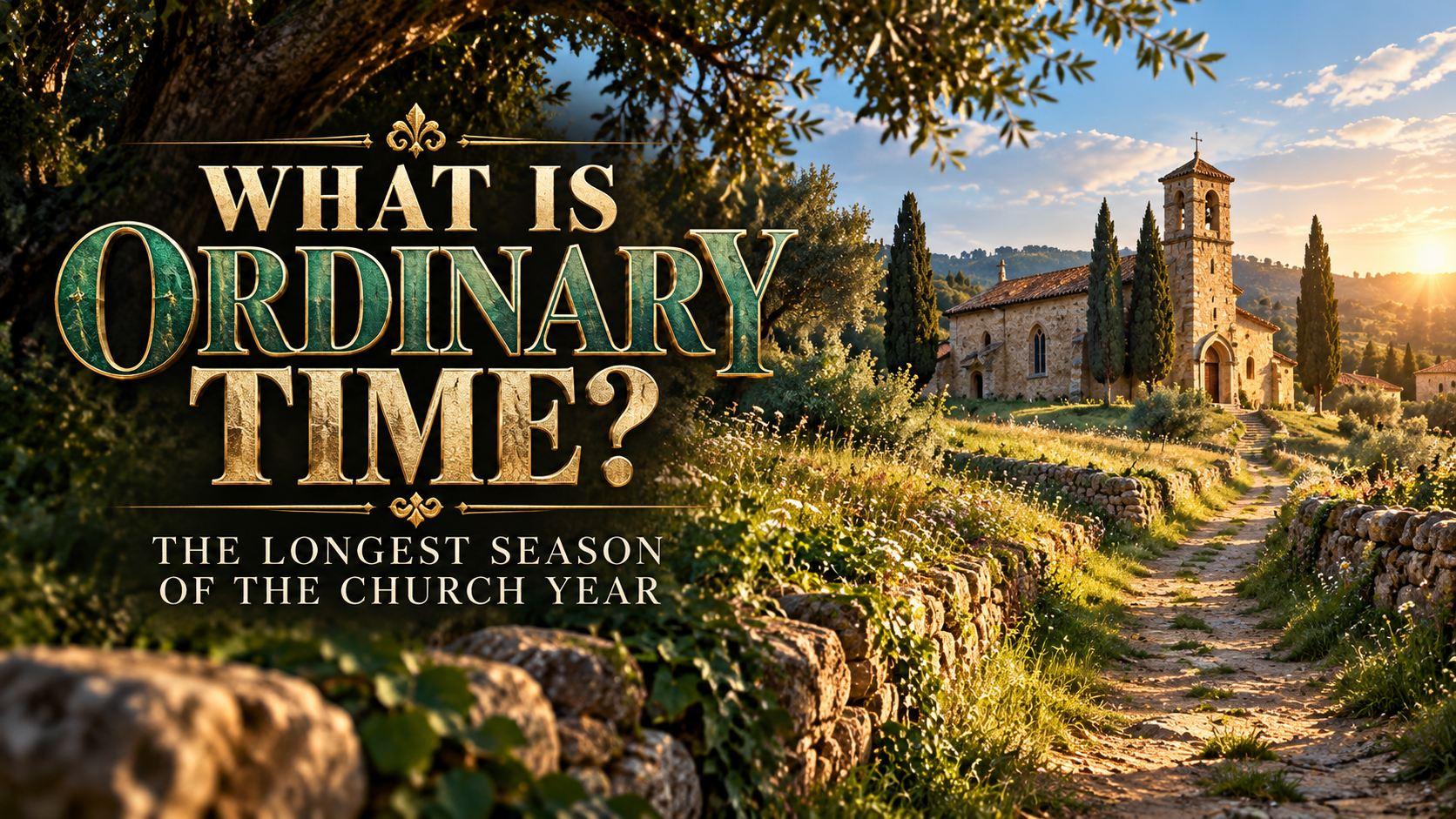
📖 What Is Ordinary Time? The Longest Season of the Church Year
Advent gets candles. Lent gets ashes and a fast. Christmas gets a whole season of its own, and Easter gets fifty days of celebrating.
Then there is the stretch your pastor or your Catholic coworker calls Ordinary Time, and it sounds like the church simply ran out of things to say about those weeks.
📌 Here is the plain answer. Ordinary Time is not a gap between the real seasons. It is the longest season on the whole church calendar, thirty three or thirty four weeks a year, and the word ordinary does not mean plain. It means ordered, numbered, counted.
This guide walks through where that name actually comes from, exactly when the season starts and ends, why its length changes most years, what it looked like before 1969, and why its color is green.
Every historical and liturgical claim below links back to a named source you can check yourself.
Why This Matters for Your Faith
It is easy to treat Ordinary Time as the part of the year you can skip past to get to the next real season.
⚠️ But most of your Christian life happens during weeks exactly like these. No fast. No countdown. No decorations. Just an ordinary Tuesday, asking you to still follow Jesus on it.
"And Jesus increased in wisdom and stature, and in favour with God and man."
💡 Even Jesus had years the Gospels compress into one verse. Most of His earthly life was not a miracle on a feast day. It was ordinary growth, in an ordinary house, in an ordinary town. A church calendar that gives more than half the year to a season with no special drama is not being lazy. It is telling you the truth about where most of your own faith will actually be lived out.

What Ordinary Time Actually Is
1. What the Word Ordinary Actually Means
Say the season's name out loud to most people and they hear the everyday meaning of ordinary. Plain. Unremarkable. Nothing going on.
📌 That is not where the word comes from. Catholic writer Jennifer Gregory Miller, in a Catholic Culture commentary on the season, traces ordinary to the Latin root ordo and ordinalis, the source of the English word ordinal. She writes that "the weeks of Ordinary Time are ordered weeks, numbered sequentially."
Ordinal numbers are first, second, third, and so on. That is literally what the Sundays of this season are called on a Catholic calendar. The Second Sunday in Ordinary Time. The Twentieth Sunday in Ordinary Time. Counted weeks, not empty ones.
Not every writer on the subject thinks the name lands well even once you know the history. John Grondelski, writing for the National Catholic Register, argues that calling a season Ordinary still leaves most people with the impression it is about "whatever's left over" once the real seasons are accounted for. He is not disputing where the word came from. He is pointing out that the technical meaning rarely survives contact with how English speakers actually use the word.
2. The Two Blocks: After Christmas, and After Easter
Ordinary Time is not one continuous run through the calendar. It comes in two separate pieces, split apart by Lent and Easter sitting in the middle of the year.
The official Vatican document that created the modern calendar, the Universal Norms on the Liturgical Year and the General Roman Calendar, describes the season in paragraph 43 as the weeks left over once Advent, Christmas, Lent, and Easter are accounted for, in which "the mystery of Christ itself is honoured in its fullness, especially on Sundays."
The USCCB's own page on the liturgical year puts the two blocks in plain terms, a shorter stretch "of 4 to 8 weeks after Christmas Time," and a much longer one "lasting about six months after Easter Time," during which the church considers the fullness of Jesus' teachings and works among His people.
📌 Picture the year as two mountains with a plain on either side. The Christmas mountain, the long plain of winter and early spring Ordinary Time, the Easter mountain, and then a much longer plain running all the way through summer and fall until Advent begins the climb again.
3. How the First Block Starts: The Baptism of the Lord
The Universal Norms set the actual start date in paragraph 44. Ordinary Time "begins on the Monday which follows the Sunday occurring after 6 January," and runs "up to and including the Tuesday before the beginning of Lent."
That Sunday after January 6 has its own name on the calendar. Paragraph 7 of the same document states plainly that "the Sunday following 6 January is the Feast of the Baptism of the Lord." Ordinary Time's first numbered week opens the very next morning.
That is not a coincidence of timing. The season that follows is built around Christ's adult, public ministry, and His baptism in the Jordan is the hinge the Gospels themselves use to open that ministry. The calendar is simply following the same order Scripture already set. Epiphany and the days immediately around it are the last stop before that shift.

4. How It Ends: The Solemnity of Christ the King
The second, much longer block starts the Monday after Pentecost and keeps running until the Universal Norms close it out, ending "before First Vespers of the First Sunday of Advent."
Paragraph 7 names the exact Sunday that caps the whole season off. The Last Sunday in Ordinary Time is the Solemnity of Our Lord Jesus Christ, King of the Universe, the final numbered Sunday of the entire church year, every single time.
📌 That placement is deliberate. Every ordinary week of discipleship the season has walked through all year ends the same way, standing in front of a King, right before Advent begins the next cycle all over again.
5. Why the Season Runs Thirty Three Weeks Some Years, Thirty Four Others
Ordinary Time does not have a fixed number of weeks. The Universal Norms state it directly in paragraph 43. The season covers "thirty three or thirty four weeks," depending on the year.
Easter moves. It can fall as early as late March or as late as April 25, and Lent always begins forty six days before it, counting Sundays. A late Easter pushes Lent's start later too, which stretches the first block of Ordinary Time out by a week or more compared to a year with an early Easter.
Christ the King stays fixed as the final Sunday no matter what, so the stretching and shrinking all happens in that first winter block, between the Baptism of the Lord and Ash Wednesday. Count the actual numbered weeks assigned for a given year, and the total lands on thirty three in years with an early Easter, thirty four in years with a late one.
6. Before 1969: Sundays After Epiphany, Sundays After Pentecost
Ordinary Time as a single, continuously numbered season is younger than it looks. Pope Paul VI approved the Universal Norms in 1969, effective the following year, replacing a calendar that had split these same weeks into two differently named, separately counted periods.
John Grondelski's National Catholic Register piece lays out what those two older names were. The weeks now making up the first block of Ordinary Time were called Sundays After Epiphany. The far longer second block was Sundays After Pentecost, a name the older calendar still uses today wherever the pre 1969 form of the Mass is celebrated.
Jennifer Gregory Miller's commentary describes why the reform changed it. The old system created what she calls "the confusion of Time after Epiphany Sundays inserted at the end of the year" whenever Easter fell early and the Pentecost count ran out of room. A single, continuously numbered season solved that problem by simply never running out of numbers.
📌 Say plainly what changed and what did not. The weeks themselves are the same weeks the church has always kept. Only the naming and numbering system around them is new, a 1969 fix for a counting problem, not a new season invented from nothing.
7. Why the Color Is Green
Walk into a Catholic parish on most Sundays of the year and the color at the altar will be green. The USCCB's own page on liturgical colors lists green as the color for Ordinary Time, plain and simple.
Green is the color of a plant that is still growing, not yet finished, not yet in bloom. That is exactly the picture Jesus Himself reached for when He described what this unremarkable, uncelebrated kind of time is actually for.
"So is the kingdom of God, as if a man should cast seed into the ground; And should sleep, and rise night and day, and the seed should spring and grow up, he knoweth not how. For the earth bringeth forth fruit of herself; first the blade, then the ear, after that the full corn in the ear."
💡 Nobody watches a seed and sees a miracle happening in real time. They see dirt, for weeks, until one day there is a stalk. Ordinary Time is the church telling you that most of your own growth in Christ will look exactly that unremarkable, right up until the day it very much is not.

Practical Tips for Keeping Ordinary Time Well
You do not need a parish calendar on your wall to let this season actually shape you.
- Stop waiting for a special season to take your faith seriously. If discipleship only happens during Advent or Lent, you have missed roughly ten months of the year it was always meant to cover.
- Read Mark 4:26 to 28 on a day that feels completely uneventful. Let it reframe what an ordinary Tuesday is actually doing in your spiritual life.
- Notice the green. If your own church follows the liturgical colors, let that color be a weekly reminder that growth, not drama, is the normal shape of following Jesus.
- Pick one small habit and keep it for the whole stretch. A short daily reading plan or a single memorized verse, kept for thirty three weeks straight, will change you more than one intense week of Lent ever could on its own.
- Do not confuse ordinary with unimportant. The word describes how the weeks are numbered, not how much they matter to your own walk with God.
- Mark the two hinge points on your own calendar. The Baptism of the Lord and the Solemnity of Christ the King are easy to miss, and both say something worth pausing on about who Jesus actually is.
- Ask what your own tradition calls this stretch. Whether you hear Ordinary Time or the Season After Pentecost, the weeks underneath are the same weeks, and the different names different churches use are worth understanding rather than dismissing.
Top Bible Verses About Ordinary, Everyday Growth
Ordinary Time has no feast of its own to preach on, so the Sunday readings spend the season walking straight through Jesus' public ministry. These five passages carry the theme underneath that choice.
1. Mark 4:26 to 29
"So is the kingdom of God, as if a man should cast seed into the ground; And should sleep, and rise night and day, and the seed should spring and grow up, he knoweth not how. For the earth bringeth forth fruit of herself; first the blade, then the ear, after that the full corn in the ear. But when the fruit is brought forth, immediately he putteth in the sickle, because the harvest is come."
Jesus picked an ordinary farming picture on purpose. The man in the parable does not understand how the seed grows. He just keeps living his ordinary days while it does.
2. Luke 2:51 and 52
"And he went down with them, and came to Nazareth, and was subject unto them: but his mother kept all these sayings in her heart. And Jesus increased in wisdom and stature, and in favour with God and man."
Luke covers years of Jesus' childhood in one sentence. Most of the Son of God's earthly life was lived in exactly the kind of unremarkable, undocumented time this season is named for.
3. Colossians 2:6 and 7
"As ye have therefore received Christ Jesus the Lord, so walk ye in him: Rooted and built up in him, and stablished in the faith, as ye have been taught, abounding therein with thanksgiving."
Paul describes faith with the same picture the season does. Being rooted and built up does not happen in one dramatic moment. It happens across ordinary weeks of simply walking with Christ.

4. Philippians 1:6
"Being confident of this very thing, that he which hath begun a good work in you will perform it until the day of Jesus Christ:"
Paul is not confident because of a single breakthrough. He is confident because God finishes what He starts, across every ordinary day between the start and the finish.
5. 2 Peter 3:18
"But grow in grace, and in the knowledge of our Lord and Saviour Jesus Christ. To him be glory both now and for ever. Amen."
The command is simply grow. Not perform a feat, not keep a fast, just keep growing, which is the one command that can only ever be obeyed in ordinary time.
Frequently Asked Questions About Ordinary Time
What is Ordinary Time in the Catholic Church?
Ordinary Time is the name for the thirty three or thirty four weeks of the church year that fall outside Advent, Christmas, Lent, and Easter, counted in ordinal, numbered Sundays rather than tied to a particular event like Christ's birth or resurrection.
Why is it called Ordinary Time if it is not plain or unimportant?
The word ordinary here comes from the Latin ordinalis, meaning numbered or ordered, not from the everyday English sense of plain. The Sundays are literally called the First, Second, Third Sunday in Ordinary Time, and so on, straight through the count.
When does Ordinary Time start?
The first block starts the Monday after the Feast of the Baptism of the Lord, the Sunday following January 6, and runs until the Tuesday before Ash Wednesday. The second, longer block starts the Monday after Pentecost Sunday.
When does Ordinary Time end?
The first block ends right before Lent begins. The second and much longer block ends on the Solemnity of Christ the King, the final Sunday of the entire church year, the week before the First Sunday of Advent.
How many weeks is Ordinary Time?
Thirty three weeks in years with an earlier Easter, thirty four in years with a later one, because a later Easter pushes Lent's start back and stretches the winter block of Ordinary Time by an extra week or more.
What color is worn during Ordinary Time?
Green, which the USCCB's own guide to liturgical colors assigns specifically to Ordinary Time, a traditional picture of living, growing things rather than a finished harvest.
What did the church call these weeks before 1969?
The winter weeks were called Sundays After Epiphany, and the much longer summer and fall stretch was Sundays After Pentecost, two separately counted periods that the 1969 reform replaced with one continuous numbered season.
Do Protestant churches observe Ordinary Time?
Many do, through the Revised Common Lectionary shared by several mainline traditions. The Christian Resource Institute's own lectionary guide labels the same stretch Counted Sundays After Pentecost, the same ordinal counting Ordinary Time uses, under a different name. Many other Protestant churches follow no fixed church calendar for these weeks at all. The wider liturgical calendar is kept with real variation across denominations.
Is Ordinary Time the same as the Season After Pentecost?
They overlap but are not identical. Season After Pentecost usually refers only to the second, longer block, while Ordinary Time on the Catholic calendar also covers the shorter winter block between the Baptism of the Lord and Ash Wednesday.
Does anything special happen during Ordinary Time?
Individual saints' feast days and holy days still fall throughout it, and the Sunday readings walk steadily through Jesus' public ministry and teaching. The season has no single theme of its own on purpose, which is exactly the point its name is making.
Final Thoughts
Strip away the confusion around the name, and three things remain true about Ordinary Time.
📌 It is the longest season on the calendar, not a gap between the real ones. Thirty three or thirty four weeks, built around the steady, unremarkable work of Christian growth rather than a single feast.
📌 Ordinary means numbered, not unimportant. The weeks are counted in order, the way a seed grows in order, blade, then ear, then the full corn, with nothing skipped.
📌 It opens with Christ's baptism and closes with Christ as King. Everything ordinary in between sits inside those two bookends, which is the whole argument for taking an ordinary Tuesday seriously.
Most of your life with God will not happen on a feast day. It will happen on a week nobody marked on any calendar at all. Ordinary Time is the church telling you, every single year, that this is exactly where growth was always supposed to happen.
📚 Sources
Every claim in this article traces back to one of these. All links checked 8 November 2026.
- Universal Norms on the Liturgical Year and the General Roman Calendar
Sacred Congregation for Divine Worship, approved by Pope Paul VI, hosted by the Liturgy Office of the Catholic Bishops' Conference of England and Wales · 1969
The source for paragraphs 43 and 44 defining Ordinary Time, its thirty three or thirty four week length, and its exact start and end dates, and for paragraph 7 naming the Baptism of the Lord and the Solemnity of Christ the King as its two hinge points.
- The Liturgical Year
United States Conference of Catholic Bishops (USCCB)
The source for Ordinary Time's two block description, the four to eight week winter stretch and the roughly six month summer and fall stretch, and for the season covering the fullness of Jesus' teachings and works.
- Understanding the Liturgical Colors
United States Conference of Catholic Bishops (USCCB)
The source for green being the color assigned to Ordinary Time.
- Our Ordinary Walk of Life: Understanding Tempus per Annum
Catholic Culture, by Jennifer Gregory Miller
The source for the Latin root ordo and ordinalis behind the word ordinary, and for the pre 1969 calendar's confusion over Sundays after Epiphany running out of room at the end of some years.
- Do We Need Sundays After Pentecost?
National Catholic Register, by John Grondelski
The source for the pre 1969 names Sundays After Epiphany and Sundays After Pentecost, still used today in the older form of the Mass, and for the critique that the name Ordinary Time can read as 'whatever's left over.'
- Year A: Sundays after Pentecost (Ordinary Time)
The Christian Resource Institute (crivoice.org), by Dennis Bratcher
The source for several Protestant traditions using the Revised Common Lectionary and labeling these same weeks Counted Sundays After Pentecost.