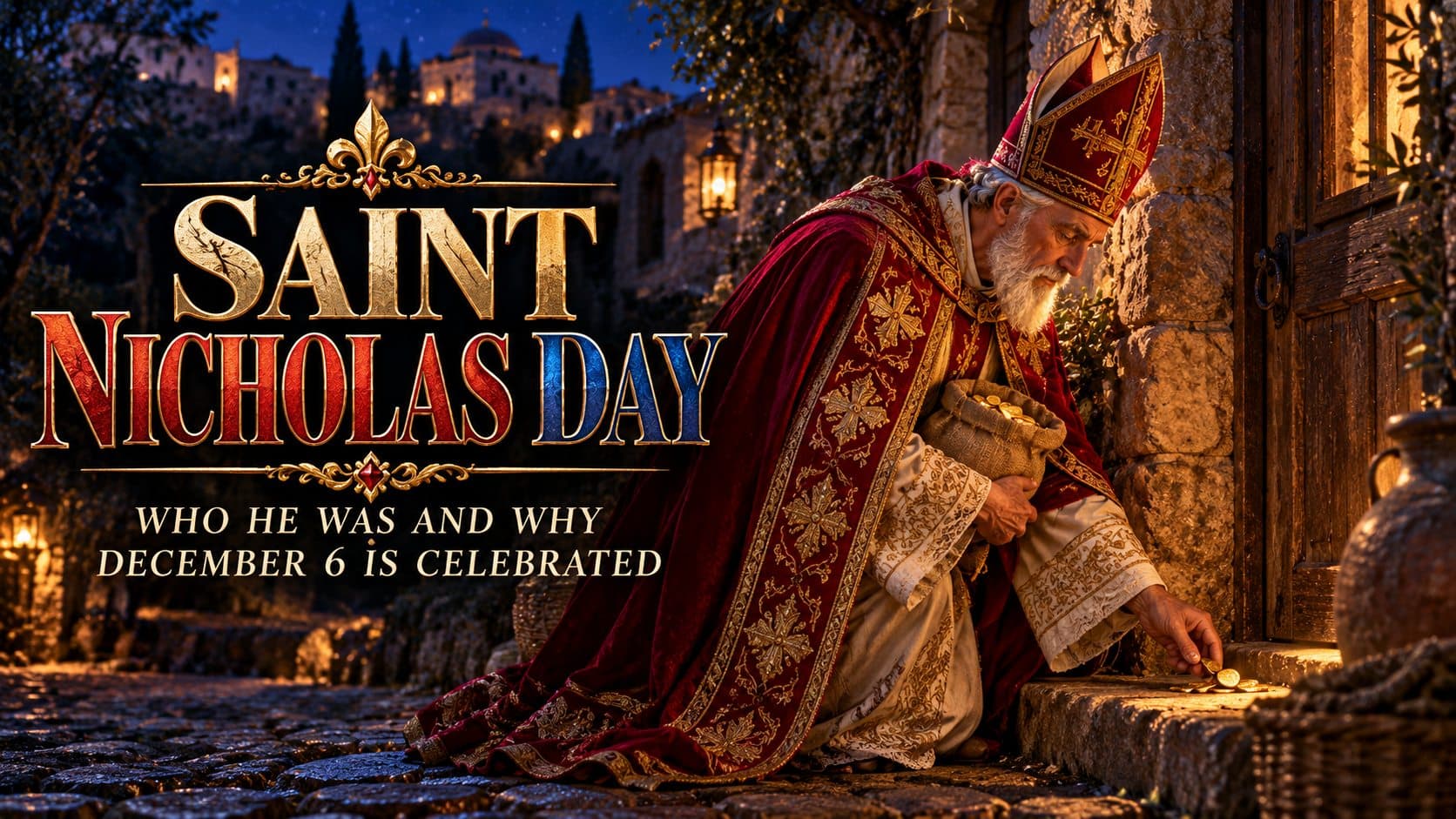
📖 When Is Saint Nicholas Day? Who Was Saint Nicholas and Why December 6 Is Celebrated
Every December 6, somewhere in the world, a kid finds a shoe by the door full of chocolate and a few coins.
Ask most adults where that started and you get a shrug, or just one word: Santa.
But Santa Claus did not start as a sleigh, a chimney, or a marketing campaign.
📌 He started as a real bishop in the Roman Empire who gave away his whole inheritance and spent time in prison for his faith.
Centuries of legend grew up around that man faster than anyone could check the facts.
This guide does the checking. Who Saint Nicholas actually was, what counts as history and what counts as legend, why December 6 became Saint Nicholas Day, and how a quiet bishop from Asia Minor turned into the man in the red suit.
Who Saint Nicholas Was
Saint Nicholas was born around the year 270, in the city of Patara, in the Roman province of Lycia, in what is now southern Turkey.
Tradition says his parents were wealthy Christians who died in an epidemic while he was still young, and that he spent his entire inheritance caring for the poor and the sick.
⚠️ Be honest about what that sentence actually is. It is tradition, not a documented fact.
The Catholic Encyclopedia puts the historical record plainly: "there is scarcely anything historically certain about him except that he was Bishop of Myra in the fourth century."
📌 One confirmed fact carries almost the whole biography: a man named Nicholas really did serve as bishop of Myra, a port city on the Lycian coast, sometime in the 300s.
Everything else, his childhood, his famous good deeds, even some of his dates, comes from accounts written down generations after he died.
That does not make those accounts worthless. It means they should be read as the Church's memory of him, not as a court transcript.

The Story of Saint Nicholas
1. A Bishop Forged in Persecution
Myra sat inside the Roman Empire during one of the worst stretches to be a Christian leader in it.
Under Emperor Diocletian's persecution, tradition holds that Nicholas was exiled and imprisoned for his faith.
National Geographic's account of the era notes that so many clergy filled the prisons that there was reportedly no room left for the actual criminals.
💡 Picture that. The empire had so thoroughly targeted church leaders that bishops were taking up jail cells meant for thieves.
He was released only after Constantine came to power and Christianity gained legal protection.
📌 The man who later gave gifts in secret first learned what it cost to stay a Christian in public.
2. The Gift That Became a Legend
The most repeated story about Nicholas involves a father with three daughters and no money for their dowries.
Without a dowry in that world, marriage was out of reach, and the daughters faced being sold into servitude instead.
According to the St. Nicholas Center, which gathers the traditional accounts of his life, Nicholas secretly tossed a bag of gold through the family's window on three separate nights, one for each daughter.
Some versions say the bags landed in stockings hung by the fire to dry. Other versions use gold balls instead of coins.
📌 Either way, that detail is why children still hang stockings on December 6, and why pawnbrokers, of all people, claim Nicholas as their patron, after the three gold balls.
He did not hand the gold over in person. He did not wait to be thanked. Giving in the dark was the whole point.
"I have shewed you all things, how that so labouring ye ought to support the weak, and to remember the words of the Lord Jesus, how he said, It is more blessed to give than to receive."
💡 Centuries before Nicholas threw a single coin, Paul had already named exactly what made that gift worth repeating for seventeen hundred years.
3. The Bishop Who Calmed the Storm
Before he became a bishop, tradition says Nicholas sailed on a pilgrimage toward the Holy Land.
A storm struck on the voyage, and the sailors feared the ship would be lost.
According to the St. Nicholas Center, Nicholas prayed through the storm, and the wind and the waves went still.
It is one reason sailors and travelers still claim him as a patron today.
A psalm had already described exactly this kind of terror at sea, long before anyone told this story about Nicholas.
"Then they cry unto the LORD in their trouble, and he bringeth them out of their distresses. He maketh the storm a calm, so that the waves thereof are still. Then are they glad because they be quiet; so he bringeth them unto their desired haven."
💡 The psalm does not mention Nicholas by name. It describes every sailor who has ever been afraid in a storm, and the God who answers that fear with calm.
4. Did Saint Nicholas Really Confront Arius at Nicaea?
The most dramatic story about Nicholas places him at the Council of Nicaea in AD 325, the meeting that produced the Nicene Creed and settled, for the whole church, that Jesus Christ is fully God.
Legend says Nicholas was so provoked by the heretic Arius, who denied Christ's divinity, that he struck him across the face.
⚠️ That slap story is almost certainly not history. National Geographic traces it to a legend that first appears in writing in the fourteenth century, roughly a thousand years after the council itself.
Even his presence at Nicaea is disputed. The Catholic Encyclopedia says there is reason to doubt it, since his name does not appear on any of the old lists of bishops who attended.
📌 What is solid is the creed itself, not the legend about who threw a punch over it. The council's actual conclusion about who Jesus is still gets recited by Catholics, Orthodox Christians, and most Protestants today, something covered in full in what the later split over church authority actually changed.
5. Death and a Church Built Around His Bones
Tradition dates Nicholas's death to December 6, in either 343, 345, or 352. No single year is firmly settled.
He was buried in his own cathedral in Myra, and for centuries that grave became a pilgrimage site.
In 1087, Italian sailors from Bari removed most of his remains and carried them to Italy.
His bones have rested since in the Basilica of San Nicola in Bari, where they remain today.
📌 That is also why you will sometimes see him called Saint Nicholas of Bari instead of Myra.
6. How a Quiet Bishop Became Santa Claus
In the Netherlands, Nicholas became Sinterklaas, a tall figure in a bishop's robe who still arrives every December 6.
Dutch settlers carried that figure across the Atlantic to the Hudson River valley in the 1600s.
Washington Irving's 1809 satire gave Americans their first detailed version of the Dutch saint, flying over rooftops in a wagon.
Clement Clarke Moore's 1823 poem swapped the wagon for a sleigh and eight named reindeer.
Illustrator Thomas Nast finished the job across the late 1800s, drawing the round, jolly figure most people picture today and placing him at the North Pole, a detail you can read more about in what Christmas itself is actually about.
📌 None of that happened to the real Nicholas. It happened to his legend, more than a thousand years after he died, on a different continent.
7. One Saint, Kept Differently in December
Catholic and Orthodox Christians formally honor Nicholas as a saint, which is different from worshiping him.
The Catechism of the Catholic Church teaches that the saints in heaven, being closer to Christ, "fix the whole Church more firmly in holiness" and continue praying to the Father for believers still on earth.
That is why a Catholic might ask for Saint Nicholas's intercession, the way you might ask a friend to pray for you, not pray to him as if he were God.
Many Protestants, especially in Germany and the Netherlands, keep the December 6 custom of shoes and small gifts without that doctrine attached at all, where it survived as a children's tradition more than a devotional one, a divide covered more broadly in how Catholics and Protestants honor the saints differently.
Other Protestants, especially in traditions wary of venerating saints at all, skip the day entirely and keep Nicholas as a generosity role model instead of a saint to pray to.
✅ None of that is a reason to argue about it. Scripture never commands or forbids marking the day, so it falls to each believer's own conscience.

Lessons From His Life
1. Generosity means little if it needs an audience
Nicholas threw the gold through a window at night and let the family guess who did it.
📌 The best things you do for people should survive them never finding out it was you.
❓ Who have you helped lately without telling a single person?
2. A real leader bears the cost before he gets the credit
Nicholas went to prison for his faith years before anyone wrote down a story about his generosity.
The gold came after the suffering, not instead of it.
⚠️ Faith that only shows up when it is safe is not the faith Nicholas lived.
3. Let the legend point past itself
Every version of this story, the gold, the storm, even the disputed slap at Nicaea, points to the same thing: a man whose faith was serious enough that people kept telling stories about him for seventeen centuries.
💡 The legend is not the point. What the legend is trying to say about generosity and courage is the point, something worth remembering any time a story about faith starts sounding too tidy, a habit this series tries to practice in sorting out which Christmas claims actually hold up.
Key Verses From His Story
1. Acts 20:35
"I have shewed you all things, how that so labouring ye ought to support the weak, and to remember the words of the Lord Jesus, how he said, It is more blessed to give than to receive."
Paul is quoting Jesus here, not inventing a nice sentiment on his own.
📌 Nicholas's gold through the window is this verse, acted out, centuries later.
2. Proverbs 19:17
"He that hath pity upon the poor lendeth unto the LORD; and that which he hath given will he pay him again."
Notice who actually receives the gift, in God's accounting.
💡 Give to a poor family and the ledger says you lent it to the LORD Himself.
3. Psalm 107:28 to 30
"Then they cry unto the LORD in their trouble, and he bringeth them out of their distresses. He maketh the storm a calm, so that the waves thereof are still. Then are they glad because they be quiet; so he bringeth them unto their desired haven."
This is the psalm behind the sailor legend, and the reason Nicholas is still patron of sailors.
⚠️ The calm never comes from the sailors. It always comes from the One they cry out to.
4. 1 Timothy 3:2 to 3
"A bishop then must be blameless, the husband of one wife, vigilant, sober, of good behaviour, given to hospitality, apt to teach; Not given to wine, no striker, not greedy of filthy lucre; but patient, not a brawler, not covetous."
Paul wrote this list of qualifications for a bishop before Nicholas was ever born.
📌 Whatever else the legends get wrong, the job Nicholas actually held already had a biblical job description attached to it.

Frequently Asked Questions About Saint Nicholas Day
Was Saint Nicholas a real person?
Yes. The Catholic Encyclopedia states plainly that there is scarcely anything historically certain about him beyond the fact that he served as Bishop of Myra in the fourth century. The man was real. Most of the specific stories about him come from later tradition rather than eyewitness record.
When is Saint Nicholas Day?
December 6 every year, the traditional date of his death. Some countries, including parts of Germany, celebrate the evening before, December 5, with children leaving a shoe out to be filled overnight.
Why is Saint Nicholas Day on December 6?
Because tradition holds that Nicholas died on that date, in either 343, 345, or 352. The church calendar marks a saint's feast day on the date of death, not birth, since it was understood as the day he entered eternal life.
How did Saint Nicholas become Santa Claus?
Through the Netherlands first, where he became Sinterklaas. Dutch settlers brought that figure to the Hudson River valley, Washington Irving wrote him into a popular 1809 satire, Clement Clarke Moore's 1823 poem gave him a sleigh and reindeer, and illustrator Thomas Nast finished the modern image across the late 1800s.
Did Saint Nicholas really slap Arius at the Council of Nicaea?
Almost certainly not. National Geographic traces that legend to a text that first appears in the fourteenth century, roughly a thousand years after the council took place in AD 325. No source from anywhere near that era records it.
Was Saint Nicholas even at the Council of Nicaea?
It is disputed. The Catholic Encyclopedia notes that his name is absent from every old list of bishops who attended, which is reason to doubt his presence there at all, even though later tradition places him firmly in the room.
How do people celebrate Saint Nicholas Day today?
In Germany, Austria, and the Netherlands, children leave a shoe by the door on the night of December 5, hoping to find it filled with small gifts, chocolate, or coins the next morning. In Eastern Orthodox churches, December 6 carries its own liturgical feast and prayers.
Where are Saint Nicholas's relics now?
Most of his remains have rested in the Basilica of San Nicola in Bari, Italy, since Italian sailors carried them there from Myra in 1087. That transfer is the reason he is sometimes called Saint Nicholas of Bari.
Is Saint Nicholas Day only a Catholic holiday?
No. Eastern Orthodox churches keep it as a major feast, and many Protestant communities in Europe keep the gift giving custom as a cultural tradition rather than a religious observance. Other Protestants, especially those wary of venerating saints, do not mark the day at all, and Scripture leaves that choice to each believer.
Final Thoughts
Strip away the sleigh, the red suit, and the slap that almost certainly never happened, and one real man is still standing there.
📌 A bishop who gave away what he had, suffered for what he believed, and let both of those things stay quiet enough that we are still arguing over the details seventeen centuries later.
That is a strange kind of legacy. The parts people remember best, the gold, the storm, the punch, are the least certain parts. The part that is actually documented, a faithful bishop in a hard century, gets the least attention of all.
Maybe flip that this December. Keep the stocking by the fire if your family does. But let the one confirmed fact do the work this year: a Christian who gave quietly and paid a real cost for his faith is worth remembering on December 6, Santa suit or not.
If you want to see the season this bishop's feast day opens into, Advent itself starts just a few days later.
📚 Sources
Every claim in this article traces back to one of these. All links checked 28 October 2026.
- St. Nicholas of Myra (Or Nicholas of Bari)
Michael Ott, The Catholic Encyclopedia (1911), New Advent
The source for the statement that almost nothing is historically certain about Nicholas beyond his episcopate, the doubt over his presence at Nicaea, his death date, and the 1087 relic transfer.
- Who Was St. Nicholas?
Nate Barksdale, History.com
The source for the sailor and dowry legends spreading within a century of his death, and the Sinterklaas to Santa Claus timeline through Irving, Moore, and Nast.
- Who Is St. Nicholas?
St. Nicholas Center
The source for the detailed dowry and sailor storm stories, the imprisonment under Diocletian, and the Council of Nicaea tradition.
- How the Council of Nicaea changed Christianity forever
National Geographic
The source for the fourteenth century origin of the Arius slap legend and its doubtful historical accuracy.
- Catechism of the Catholic Church, Paragraph 5: The Communion of Saints
The Holy See, vatican.va
The source for CCC 956 on the intercession of the saints, quoted for the Catholic teaching on honoring Nicholas as a saint rather than worshiping him.