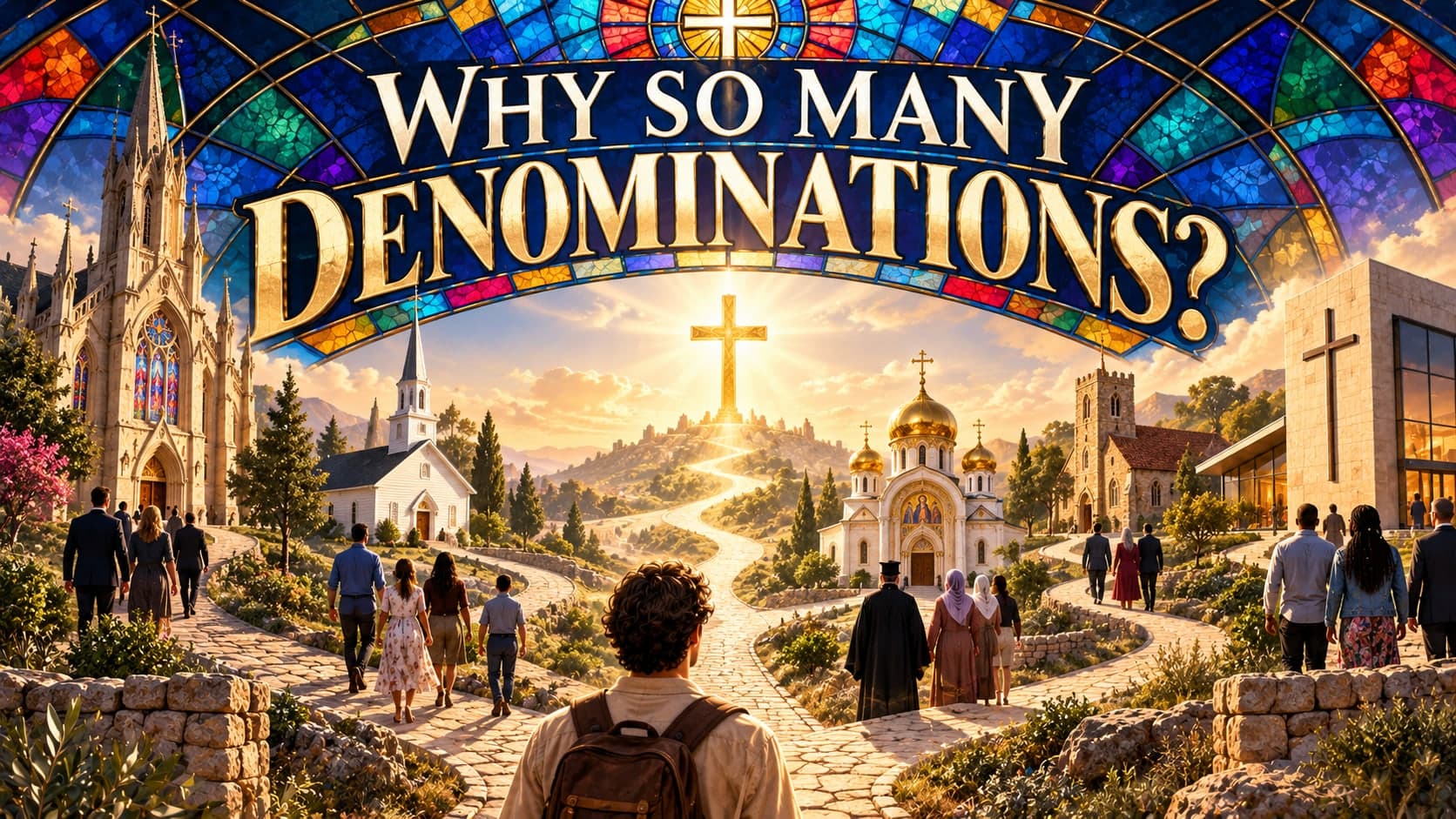
⛪ Why So Many Denominations? The Real History Behind Christian Divisions
You just moved to a new town, or maybe you are getting serious about your faith for the first time.
You open your phone and search for a church.
And the list throws a wall of confusing labels back at you.
- 🔲 Baptist
- 🔲 Catholic
- 🔲 Orthodox
- 🔲 Methodist
- 🔲 Pentecostal
- 🔲 Non denominational
So many Christian denominations, all claiming to follow the same Jesus.
📌 And it raises an honest question. If we all read the same Bible, why are there so many different denominations?
Maybe someone told you their denomination is the only one that really gets it right, and every other one is missing something important.
That can make picking a church feel like picking a side in a fight you never signed up for.
Or maybe you grew up inside one denomination your whole life.
And you are only now asking where it came from, and whether the differences even matter.
Here is what might surprise you.
Jesus never started a denomination.
The apostles never founded one either.
What you see today is the result of nearly two thousand years of history, culture, courage, and human weakness, all tangled together.
This guide walks through where denominations actually came from.
What is really at stake spiritually when Christians divide.
How to choose a church home without picking a fight.
Five Bible verses about unity worth carrying with you.
And honest answers to the questions people actually ask about denominations, without crowning one as the winner.
Let's start at the beginning.
Why This Matters for Your Faith
It would be easy to treat this like trivia. A history lesson you skim and forget.
But how you think about denominations shapes how you treat other Christians.
And that is not a small thing.
There are two ditches on this road, and both of them do real damage.
⚠️ The first ditch is denominational pride.
This is the belief that your group has it all figured out, and everyone in a different tradition is somehow a lesser Christian. That pride is not new. Paul confronted it in Corinth, where believers were splitting into camps around their favorite preacher instead of Christ.
📖 Reading what the Bible actually is shows you it was never written to build one denomination's brand. It was written to point every believer to Jesus.
⚠️ The second ditch is the opposite mistake.
This is deciding all denominations are meaningless, so doctrine does not matter at all. That sounds humble, but it quietly throws away real convictions that Christians have contended for since the first century.
Not every difference between churches is small.
Some of them are worth caring about deeply.
The trick is telling which differences those actually are.
💡 Here is the truth this whole guide is built on.
Denominations are a real, human, historical fact.
But unity in Christ was never meant to depend on everyone agreeing about every detail. It was meant to rest on a shared faith in who Jesus is and what He did.
Getting that right protects you from both ditches at once.
The History Behind Every Christian Denomination
To understand today's church labels, you have to start almost two thousand years back.
1. The Unity of the Early Church
When Jesus gave the Great Commission, He did not hand His disciples a denomination to build.
He gave them a mission.
"Go ye therefore, and teach all nations, baptizing them in the name of the Father, and of the Son, and of the Holy Ghost."
The earliest believers were not even called Christians at first.
Acts 9:2 calls them followers of the Way.
There was no headquarters. No official name. No membership card.
📌 What held them together was shared devotion, not shared paperwork.
They met in homes. They broke bread together. They endured real persecution for the name of Jesus.
As churches spread across the Roman Empire, believers in different cities naturally developed their own flavor. Greek speaking congregations. Latin speaking congregations. Jewish believers. Gentile believers.
By the second and third centuries, five major centers of Christian leadership had formed: Rome, Constantinople, Alexandria, Antioch, and Jerusalem.
It was still one Church.
But language, distance, and culture were already quietly pulling in different directions.
2. Constantine and the Merging of Church and Empire
For close to three hundred years, following Jesus could get you killed.
Then everything changed.
In 313 AD, Emperor Constantine legalized Christianity through the Edict of Milan. You can read the full story of the man who legalized Christianity, but the short version is this. Persecution ended overnight, and the faith moved from something practiced underground to something favored by the empire itself.
That sounds like good news, and in many ways it was.
But it also changed the shape of the church.
Buildings went up. Political influence grew. Structure formalized fast.
By the end of the fourth century, Christianity became the official religion of Rome.
The bishop of Rome gained more and more authority in the west.
Meanwhile the eastern churches kept a model where councils of bishops led together, with no single ruling figure.
Two different visions of church leadership were now growing side by side.
⚠️ And once faith became tied to political power, disagreements about doctrine also became disagreements about who was really in charge.
3. The Great Schism of 1054
Over the centuries that followed, tension between the eastern and western churches kept building.
The issues were not one single thing. They stacked up.
- 🗣️ Language and cultural drift
- 👑 How much authority the Pope should have
- 📖 A theological dispute over the wording used to describe the Trinity
- 🏛️ Plain political rivalry between Rome and Constantinople
In 1054, the two sides formally split. Historians call it the Great Schism.
Out of it came two separate communions.
- ➡️ The Roman Catholic Church in the west
- ➡️ The Eastern Orthodox Church in the east
Rome centralized authority under the Pope.
Orthodoxy rejected that and kept its shared leadership among bishops.
Both sides still traced their roots straight back to the apostles.
Both still confessed Jesus as Lord, crucified and risen.
But they were now walking two separate paths.
📌 This was the first major fracture in the visible church, and it was not mainly a fight about the resurrection. It was a fight about authority.
4. The Reformation and the Rise of Protestant Churches
Fast forward roughly five hundred years.
By the 1500s, serious problems had crept into the Roman Catholic Church.
- 💰 The selling of indulgences, essentially paying money to shorten punishment for sin
- 📖 Ordinary people locked out of Scripture because it stayed in Latin
- ⚖️ Church tradition sometimes carrying more weight than the Bible itself
In 1517, a monk named Martin Luther nailed the Ninety Five Theses to a church door in Germany.
He was not trying to start a new religion.
He was calling the church back to Scripture.
That call lit a fire that could not be put out. The Protestant Reformation had begun.
Its core convictions can be summed up in three phrases still quoted today:
- 📖 Scripture alone as the final authority
- 🙏 Salvation by grace through faith, not earned by works
- ✝️ Christ alone as the mediator between God and man
This created the second major division in church history, between Roman Catholicism and Protestant Christianity.
And once the door to reform opened, it did not stay open for just one group.
Lutherans formed around Luther's teaching.
Reformed churches and Presbyterians emphasized God's sovereignty and covenant theology.
Anglicans developed in England, tied to its own political story.
Baptists insisted on believer's baptism and each local church governing itself.
Methodists grew out of a movement toward disciplined, practical holiness.
Later came Pentecostals, who emphasized the active gifts of the Spirit, and a wave of evangelicals and independent churches who wanted to step away from denominational labels altogether.
💡 Some of these splits were over real theology. Some were cultural. Some were honest attempts to fix genuine corruption. And some, if we are honest, were just pride and personality clashing.
5. Why There Are So Many Denominations Today
So why does your city have a dozen different churches, all holding a Bible, all disagreeing about something?
Usually it comes down to a mix of these things.
- 🧠 Honest disagreement over secondary doctrines, like how baptism should be practiced
- 🌍 Cultural and language differences across countries and generations
- ⚖️ Different convictions about how church leadership should be structured
- 🏛️ Leftover history from political splits like Constantine's empire and the Great Schism
- 👥 Plain human pride, ambition, and division
Scripture is not silent about that last one.
Paul warned the church at Corinth about believers splitting into rival camps.
"Now I beseech you, brethren, by the name of our Lord Jesus Christ, that ye all speak the same thing, and that there be no divisions among you; but that ye be perfectly joined together in the same mind and in the same judgment."
And Paul also told Titus how to handle someone who was stirring up needless division inside the church itself.
"A man that is an heretick after the first and second admonition reject."
📌 So not every disagreement is treated the same way in the Bible.
Division over the resurrection, the deity of Christ, or salvation by grace is treated as serious error.
Disagreement over how often to take communion, what style of music to sing, or which day to gather is treated very differently.
Despite all the visible separation, most denominations still hold the historic essentials in common.
- ✅ Jesus is Lord
- ✅ He died for sin and rose again bodily
- ✅ Salvation is by grace through faith
- ✅ Scripture is the authoritative Word of God
The visible church is divided organizationally.
But among those who hold to these essentials, a deeper unity in Christ still exists, even across different buildings and different names on the sign outside.

Practical Tips: How To Choose a Church Home
History explains where denominations came from.
But you still have to walk into a building this Sunday and decide where you belong.
Here are eight things worth thinking through as you look.
- Look for a church anchored in Scripture, not personality. A gifted speaker can fill a room for a season, but only the Word of God builds a lasting faith. Learning how to read the Bible for yourself is the best filter you have for judging what you hear from any pulpit.
- Check what they teach about the essentials first. Ask directly what they believe about who Jesus is, His resurrection, and how a person is saved. If those answers line up with Scripture, you are looking at a Christian church, whatever name is on the sign.
- Expect real differences on secondary issues, not on primary ones. Baptism methods, church government, and worship style can vary widely between faithful churches. The resurrection of Jesus is not one of those negotiable issues.
- Visit more than once before you decide. One Sunday tells you almost nothing. Sit through a few services, meet some people, and see how the church treats you when nobody is performing for a first impression.
- Ask how leadership handles correction and disagreement. A healthy church can talk through hard questions without falling apart. That says more about its health than any statement on its website.
- Look for real community, not just a good service. A church is meant to be a family you do life with, not a show you watch once a week. If nobody knows your name after months of attending, that is worth noticing.
- Do not go looking for a perfect denomination. Every congregation is full of believers still growing, including whichever one you eventually join. The goal is faithfulness, not flawlessness.
- Pray before you decide, and give it time. This is not a decision to rush or to make out of fear of picking wrong. Ask God for wisdom, stay teachable, and trust Him to lead you somewhere you can grow.
Top 5 Bible Verses About Unity in the Church
If denominational division ever discourages you, come back to these five verses.
They show you what God has always wanted for His church.
1. John 17:21
"That they all may be one; as thou, Father, art in me, and I in thee, that they also may be one in us: that the world may believe that thou hast sent me."
Jesus prayed this the night before He went to the cross.
Not for Himself. For every believer who would ever follow Him, including you.
Notice what He prayed for. Not identical buildings, or one single organization. He prayed for a oneness like the oneness He shares with the Father.
And notice the reason attached. So the world may believe.
Division does not just hurt the church. It quietly damages the church's witness to a watching world.
2. Ephesians 4:4 to 6
"There is one body, and one Spirit, even as ye are called in one hope of your calling; One Lord, one faith, one baptism, One God and Father of all, who is above all, and through all, and in you all."
Count how many times the word one appears in these three verses.
Paul is not describing an ideal that never happened. He is describing a spiritual fact.
Every believer, in every denomination, who trusts the one Lord and shares the one faith is part of the same body.
The building you attend on Sunday does not create that unity. It already exists in Christ.
3. 1 Corinthians 1:10
"Now I beseech you, brethren, by the name of our Lord Jesus Christ, that ye all speak the same thing, and that there be no divisions among you; but that ye be perfectly joined together in the same mind and in the same judgment."
Paul wrote this to a church that was already splitting into camps.
Some said they followed Paul. Some said Apollos. Some said Peter.
Sound familiar.
His plea was not for everyone to agree on every opinion. It was to stop letting loyalty to a personality replace loyalty to Christ.
That warning is just as needed now as it was in Corinth.
4. Psalm 133:1
"Behold, how good and how pleasant it is for brethren to dwell together in unity!"
This is a short verse, but do not rush past it.
David is not just describing unity. He is celebrating it.
Good and pleasant, he calls it. Worth noticing. Worth pursuing.
If you have ever felt the tension between denominations, this verse is a reminder of what you were made for instead.
5. Romans 14:1
"Him that is weak in the faith receive ye, but not to doubtful disputations."
Paul wrote this chapter to a church arguing over food and holy days, matters of personal conviction rather than core doctrine.
His instruction was to receive one another, not to turn every disputable matter into a wall.
This is the verse for the moment you meet a Christian from a different denomination and feel tempted to argue about a secondary issue instead of simply welcoming them as family.

Frequently Asked Questions About Denominations
Is it a sin to switch denominations?
No, switching denominations is not automatically a sin. Christians move for many honest reasons, like relocating, wanting deeper Bible teaching, or growing in conviction about a secondary issue. What matters is your motive. If you are running from accountability rather than toward growth, that is worth examining honestly, but the switch itself is not a sin. It can even be a sign you are asking honest questions instead of coasting on tradition.
Which denomination is the right one?
Scripture does not hand out a single correct denomination, so this guide will not either. What matters most is whether a church holds to the essentials: Jesus as Lord, His death and resurrection, and salvation by grace through faith. Beyond that, faithful believers land in different traditions for honest reasons. Look for sound teaching and real community, not a denominational label that guarantees you are automatically right.
Do denominations affect your salvation?
No. Salvation rests on faith in Jesus Christ, not on which denomination is printed on your church bulletin. Ephesians 4 describes one Lord and one faith, not one approved organization. A person trusting in Christ alone for salvation is saved, whether they worship as a Baptist, a Catholic, an Orthodox believer, or in a non denominational church down the street.
Is the Catholic Church the original church?
Roman Catholicism and Eastern Orthodoxy both trace an unbroken line back to the early church before their split in 1054, and both have a real historical claim to ancient roots. Protestant churches trace their theology back to the same early church too, through the Reformation's call to return to Scripture. Rather than one group being the sole original church, all three see themselves as continuing what the apostles started, just through different paths.
What is the difference between a denomination and a cult?
A denomination holds to the historic essentials of the Christian faith, like the deity of Christ, His bodily resurrection, and salvation by grace, even while disagreeing with other denominations on secondary issues. A cult typically denies one or more of those essentials, often adds new scripture or a new prophet with final authority, and tightly controls members. The difference is not about which building looks nicer. It is about whether the core gospel stays intact.
Why do denominations disagree about baptism?
Christians agree baptism matters because Jesus commanded it, but they read certain passages differently. Some denominations baptize infants as a sign of God's covenant, while others baptize only believers who can profess their own faith first. Both sides are trying to honor Scripture faithfully. This is a real and long standing disagreement, but it falls into the secondary category rather than the core essentials of the gospel.
Can Christians from different denominations worship together?
Yes, and Scripture actually points that direction. Ephesians 4 describes one body and one Spirit among all who trust the one Lord. Christians from different traditions can pray together, serve together, and worship together around the essentials they share, even while belonging to different local congregations day to day. Unity was never meant to require uniformity.
Is a non denominational church better than a denominational one?
Not automatically. A non denominational church still has beliefs and leadership structures, it simply is not formally connected to a larger group. That can mean more flexibility, but it can also mean less accountability if leadership goes off course. What makes a church healthy is sound teaching and genuine community, not whether it carries a denominational name.
Did Jesus start a denomination?
No. Jesus commissioned His disciples to make disciples of all nations, not to found a particular organization or brand. Denominations developed over centuries through history, culture, reform movements, and yes, human division. Understanding that history is exactly what this guide has walked through, and it is one reason so many people also ask why there are so many Bible translations in the first place. Growth and disagreement have always been part of how the church spread across the world.
Final Thoughts
If you remember nothing else from this guide, remember these three things.
📌 Jesus never started a denomination, and He prayed for His church to be one. The labels you see today came from history, not from His original design.
📌 Denominations formed through a real mix of theology, culture, reform, and human pride. Some divisions were necessary. Some were avoidable. Both are part of the honest story.
📌 Unity in Christ was never about erasing every difference. It was about a shared faith in who Jesus is and what He did on the cross.
You do not have to resolve two thousand years of church history to grow in your faith today.
You just have to know what actually matters, and hold the rest with an open hand.
So here is your one next step.
The next time you meet a Christian from a different denomination, look for what you share before you look for what divides you.
You will probably find more in common than you expected.
And that is exactly what Jesus prayed for.