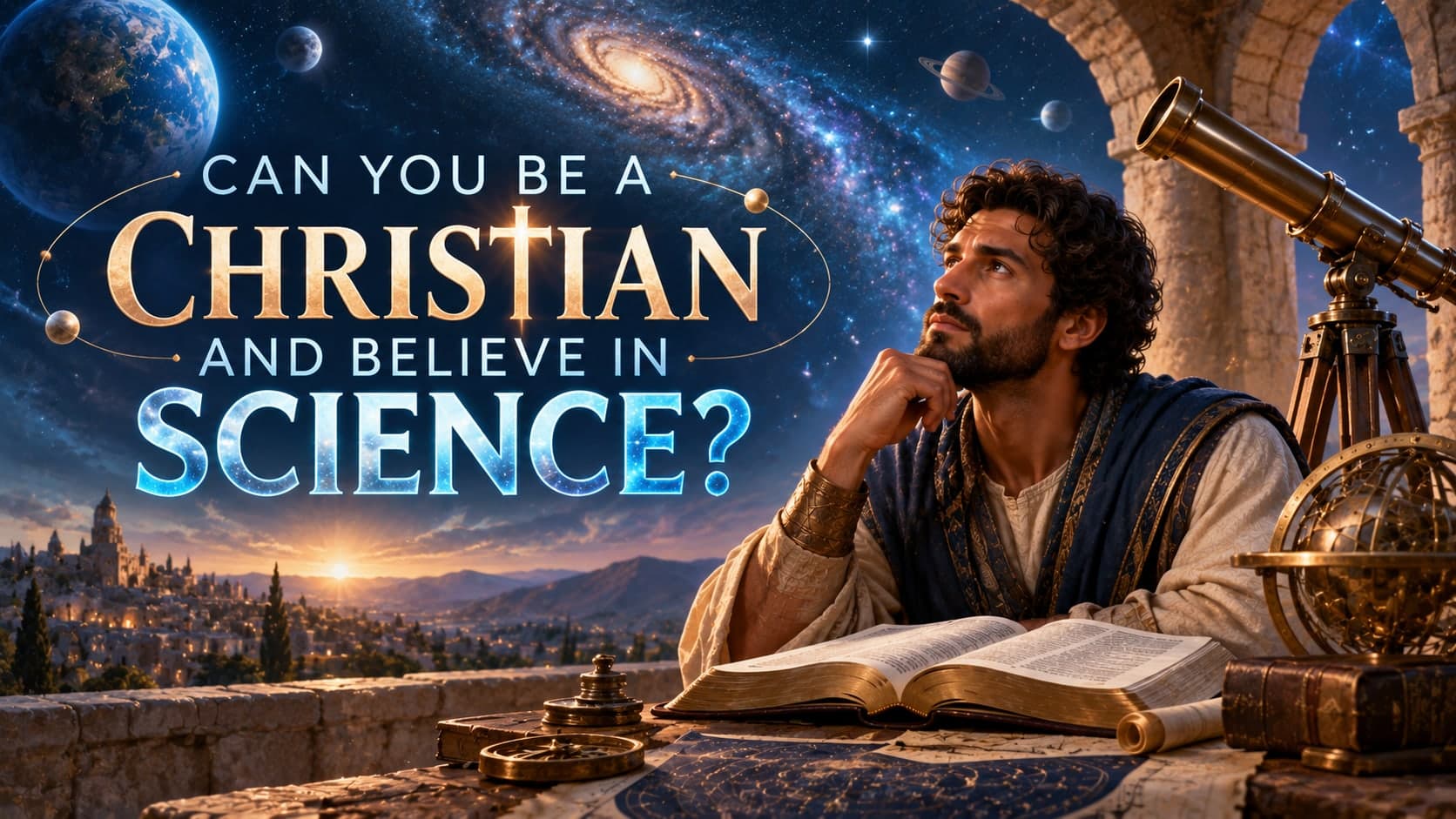
📖 Can You Be a Christian and Believe in Science? An Honest Answer
Somewhere along the way, someone made you feel like you had to pick a side.
Faith or facts.
The Bible or the lab.
Church on Sunday or the periodic table on Monday.
Maybe it was a professor who rolled his eyes when you mentioned church. Maybe it was a pastor who made your biology textbook sound like the enemy.
📌 Here is the honest answer, right up front. Yes. You can be a Christian and believe in science. Millions of serious scientists always have.
Christianity and science were never supposed to be enemies.
That is not a dodge. That is not a "both sides" answer to keep everyone comfortable.
- 🔲 Choose the faith your family raised you in.
- 🔲 Choose the field you have worked years to get into.
- 🔲 Pick one, and quietly grieve the other.
That is a false choice. And it has talked a lot of good, honest, thinking Christians out of both their faith and their curiosity.
Here is what might surprise you.
Some of the sharpest minds who ever studied the natural world were devoted believers. Not in spite of their science. Because of it.
This guide will walk you through why the "war" between faith and science is newer than you have probably been told, how to read Genesis honestly, the different ways faithful Christians understand creation, and what actually has to be true for your faith to stand.
You do not have to check your brain at the door of the church.
And you do not have to check your Bible at the door of the lab.
Let's walk through why.
Why This Question Weighs on You
This is not really a question about biology or the Big Bang.
It is a question about whether you belong.
Maybe you are the only Christian in your research group, and you have learned to stay quiet when the conversation turns to origins.
Maybe you are the only person in your small group who has ever taken a real interest in the age of rocks, and it feels like a suspicious hobby.
⚠️ Both worlds have, at times, told you that curiosity and faith cannot share the same head.
Some scientists talk as if belief in God is a leftover superstition science will replace.
Some churches talk as if scientific questions are the first step toward walking away from God.
Neither one is telling you the truth.
Part of learning how to defend your faith is learning you do not need to defend it by pretending your questions do not exist.
The stakes are not small. Your career, your family, your church, and your own sense of whether you can trust your mind are all wrapped up in this one question.
📌 You get to be a whole person. Thinking and believing were never meant to live in separate rooms.

Why Faith and Science Were Never Really at War
1. Yes, You Can Believe Both
Start with the plain answer again, because it deserves more than one line.
Yes.
You can run experiments on Monday and sing hymns on Sunday. You can love data and love the God who, Christians believe, designed the world the data describes.
📌 Some of the founders of modern science were serious, convinced believers.
Isaac Newton, who gave the world the laws of motion and gravity, wrote far more about theology and Scripture than he ever wrote about physics.
Johannes Kepler, who worked out how the planets actually move, once described his discoveries as thinking God's thoughts after Him.
Gregor Mendel, the monk whose pea plants laid the foundation for modern genetics, did his groundbreaking work in a monastery garden.
And this is not only history. Francis Collins, who led the Human Genome Project, has written openly about coming to faith in Christ as an adult scientist studying the evidence in front of him.
These were not people doing science quietly despite their faith. For many of them, studying creation was an act of worship, a way of tracing the handiwork of the God they already believed in.
❓ If some of the best scientific minds in history saw no contradiction, why would you assume there has to be one?
2. A Newer Fight Than You Think
Here is something worth knowing. The idea that science and faith have always been at war is a fairly recent story, and a shallower one than it gets credit for.
For most of the last several centuries, the people doing the world's leading scientific work were largely doing it inside a Christian framework, not against one, believing the universe was orderly because a rational God made it that way.
The popular picture of scientists and believers locked in a centuries long war owes a lot to a handful of 19th century books written to push that narrative, more than it owes to an honest reading of history.
That does not mean there have never been real disagreements. There have.
But "faith and science have always been enemies" is a story, not a fact. You do not have to organize your whole life around a story that is not true.
3. Reading Genesis Honestly
So if faith and science are not enemies, what do you do with Genesis 1 and 2?
Start here.
Genesis was written to an ancient audience, in the ancient world's way of talking about origins, not in the language of a modern lab report.
That does not make it less true. It means you have to ask what kind of truth it is claiming to tell you.
Read plainly, Genesis is not competing with a biology class. It is a theological claim, standing at the front of the whole Bible, making a few enormous statements.
- 🟢 God created everything that exists. Nothing made itself.
- 🟢 What God made was good.
- 🟢 Human beings, uniquely, bear His image.
Scripture states the first claim in its very first verse:
"In the beginning God created the heaven and the earth."
And the third claim, a few verses later:
"So God created man in his own image, in the image of God created he him; male and female created he them."
Those two truths, that God made everything and that you specifically carry His image, do not depend on settling every detail of how or exactly how long.
Here is where thoughtful, Bible believing scholars genuinely disagree, and where this guide will not pretend there is a quiet consensus.
They disagree on how literally to read the timeframe of Genesis 1. They disagree on the exact mechanism God used to form the first humans. They agree completely that He did it, on purpose, and that it was good.
💡 The most important sentence in Genesis 1 might be the shortest one. God said it was good. Not an accident. Not chaos figuring itself out. Intended.
4. The Three Main Christian Views on Creation
This is the part where a lot of guides pick a side and call the other views compromise.
This guide will not do that.
⚠️ Sincere, Bible believing Christians land in different places on this question, and have for a long time.
You should know the main positions so you can think clearly, not so you can be talked into one before you understand any of them.
📌 Young Earth Creationism. God created the universe and everything in it in six ordinary days, in the relatively recent past. Christians who hold this view believe it takes Genesis 1 at its most straightforward, plain reading, and they consider that faithfulness to the text, not a rejection of science.
📌 Old Earth Creationism. The universe and the earth are genuinely old. Christians who hold this view accept the ancient timeline mainstream science describes, while still holding that God directly and specially created life, and specially created the first humans, rather than leaving it to unguided natural processes.
📌 Evolutionary Creation, sometimes called Theistic Evolution. God used the process of evolution, over long ages, as His chosen means of bringing about life, including human life. Christians who hold this view see evolution the way they see gravity or embryology, a natural process God designed and sustains, not a rival explanation that replaces Him.
Three different answers to how and when. One shared answer to who and why.
📌 This article is not going to tell you which of these three is correct. Faithful, careful, Bible loving Christians, including respected pastors, scientists, and theologians, hold each of these three positions in good conscience.
If you feel pressure from your church to land on one answer before you have thought it through, or pressure from your lab to treat belief in a Creator as automatically unscientific, both pressures are asking you to skip a step that deserves real thought.
Take the time. Read. Ask people you trust in more than one camp. This is not a hill worth losing your peace, or your friendships, over.
5. What Actually Matters, No Matter Which View You Hold
Here is a test worth applying. Ask what has to be true for the gospel to stand, and what is a secondary question you can hold with an open hand.
These are not secondary. Christians across every creation view affirm them together.
- ✅ God created intentionally. The universe is not an accident.
- ✅ Humanity bears God's image, and that gives every person real worth.
- ✅ The Bible is trustworthy, telling the truth about who God is and who you are.
Paul made the case that creation itself points back to its Maker:
"For the invisible things of him from the creation of the world are clearly seen, being understood by the things that are made, even his eternal power and Godhead; so that they are without excuse:"
Notice what that verse does not do. It does not settle the age of the earth. It settles who is behind it.
Now compare that to the secondary questions. Exactly how old the earth is, and exactly what mechanism God used to form the first humans, are important questions worth studying carefully. But they are not the hinge your faith swings on.
📌 The resurrection of Jesus is the hinge your faith swings on. Not your position on Genesis.
If you have never settled whether you actually know you are saved, that question deserves your attention far more urgently than the age of the earth does.
Keep the main thing the main thing, and you can hold the secondary questions with curiosity instead of fear.
6. You Do Not Have to Choose Anymore
If you have spent years quietly feeling like a traitor to one side or the other, hear this clearly.
📌 You are allowed to breathe easier.
You do not have to leave your faith at the lab door, and you do not have to leave your mind at the church door.
Some of your questions may take years to work through. That is fine. God is not intimidated by your questions, and He is not waiting for you to stop asking before He will still call you His.
Whatever field you are in, and whatever conclusion you eventually land on about creation, you can stay exactly where you are. A Christian, and a thinking person, at the very same time.

Practical Tips for Living With an Honest Faith and an Honest Mind
Living with real questions is not the same as living without a foundation.
Here are eight habits that will help you stay grounded while you keep learning, whether you are a student, a professional, or just tired of feeling stuck between two worlds.
- Study both, honestly. Do not skip the hard chapters of Genesis, and do not skip the hard chapters of your textbook. Reading only what confirms what you already believe is not faith. It is avoidance.
- Separate the gospel from the debate. Get clear in your own mind that your salvation does not depend on winning an argument about origins. That clarity will keep you calm in conversations that would otherwise rattle you.
- Talk to real people, not just headlines. Find Christians in your field who hold a different creation view than you expected, and actually listen to how they got there before you decide they are wrong.
- Do not let one loud voice define a whole group. An outspoken atheist online, or one overly certain pastor, is not the entire scientific community, and not the whole church. Christians have disagreed honestly about secondary questions for a long time, and the church has survived every one.
- Read one serious book outside your current view. Pick something written by a thoughtful Christian who holds a different position than you, and read it charitably before you argue with it.
- Keep worship going while you think. Do not wait for perfect intellectual certainty to keep praying and opening your Bible. Faith was never meant to wait on the sidelines until every question closes.
- Watch for pride on every side. Certainty can be pride in disguise, and so can cynicism. Both can make you feel smarter than the people who disagree with you. Neither one makes you right.
- Give yourself permission to say "I do not know yet." That is not unbelief. That is honesty. God has never once been threatened by an honest question.
Top 5 Bible Verses About Christianity and Science
You could study these questions for a lifetime.
But if you want a place to start, start with these five verses.
1. Genesis 1:1
"In the beginning God created the heaven and the earth."
Ten words. Arguably the most important sentence in the history of ideas.
Before there is a law, a promise, or a character in Scripture, there is a Creator and a creation.
This is the verse to return to when the debate about mechanism has swallowed the point. Something did not come from nothing on its own. Someone made it.
2. Genesis 1:27
"So God created man in his own image, in the image of God created he him; male and female created he them."
Whatever your view on how humanity came to be, this verse tells you why humanity matters.
You are not an accident of chemistry that eventually learned to ask questions.
You carry the image of the God who made the questions worth asking in the first place.
That truth does not shift no matter which creation view you hold. It is the floor every position stands on.
3. Psalm 19:1 and 2
"The heavens declare the glory of God; and the firmament sheweth his handywork. Day unto day uttereth speech, and night unto night sheweth knowledge."
David wrote this thousands of years before telescopes.
He looked up and saw a message. Not silence. Not randomness. Speech.
Every field of science that studies the sky, the earth, or the human body is, in a sense, reading the message this verse describes in finer and finer detail.
The instrument keeps changing. The message does not.
4. Colossians 1:16 and 17
"For by him were all things created, that are in heaven, and that are in earth, visible and invisible, whether they be thrones, or dominions, or principalities, or powers: all things were created by him, and for him: And he is before all things, and by him all things consist."
Paul is not talking about the church in this verse. He is talking about the universe.
Every law of physics that holds the world together, this verse says, holds together in Christ.
Studying how the universe works is not a rival project to studying who holds it together. It is the same universe.
Gravity did not stop needing Him the day someone finally wrote an equation for it.
5. Proverbs 25:2
"It is the glory of God to conceal a thing: but the honour of kings is to search out a matter."
This might be the most freeing verse in this whole guide.
God hides things in creation on purpose. And He calls searching them out an honor, not a threat.
Every honest experiment, every careful measurement, every late night in a lab chasing down an answer, can be an act of the very thing this verse describes.
Curiosity is not the enemy of worship. In this verse, it looks a lot like worship.
Frequently Asked Questions About Christianity and Science
Can you be a Christian and believe in evolution?
Yes. Many Christians hold evolutionary creation, believing God used evolutionary processes as His means of creating life. Others hold to a more direct, special creation instead. Both groups affirm that God created intentionally and that humanity bears His image, and this article does not take a side between them.
Is the Big Bang compatible with the Bible?
Many old earth Christians see the Big Bang as fitting well with "In the beginning God created," a universe with a definite start. Christians who hold a young earth view instead understand Genesis to describe a much shorter, more recent creation. Sincere, Bible believing Christians land on both sides of this question.
Do you have to believe in a literal six day creation to be a Christian?
No. Thoughtful, Bible believing scholars have long held different views on how literally to read the six days of Genesis 1. What they agree on is that God created everything, on purpose, and that it was good. Your salvation rests on Christ, not on your position on the length of a day in Genesis 1.
What is the difference between young earth and old earth creationism?
Young earth creationism holds that God created everything in six ordinary days, in the relatively recent past. Old earth creationism accepts an ancient universe and earth, while still holding that God directly and specially created life and humanity. Both are held today by faithful, careful Christians.
What is theistic evolution, or evolutionary creation?
It is the view that God used evolution over long ages as His chosen means of bringing about life, including human life. Christians who hold this view see evolution as a natural process God designed and sustains, not a rival explanation that removes Him from the picture. It is one of the three main Christian positions on creation, alongside young earth and old earth creationism.
Did many famous scientists actually believe in God?
Yes. Isaac Newton, Johannes Kepler, and Gregor Mendel were serious believers who saw their scientific work as an exploration of God's creation. In modern times, Francis Collins, who led the Human Genome Project, has spoken openly about his faith. Believing in God has never been incompatible with rigorous, respected science.
Is science trying to disprove God?
Science as a method studies the natural world through observation and testing. It cannot weigh in on whether a Creator stands behind that world, because that question sits outside what the method measures. Some individual scientists are outspoken atheists, and some are committed believers. The method itself is neutral, even when scientists are not.
How old is the earth according to the Bible?
The Bible does not give a scientific date for the earth's age, and faithful Christians read the evidence differently. Some, working from the genealogies, land on a relatively young earth. Others accept the ancient timeline mainstream science describes. The Bible is far more concerned with who created the earth and why than with its exact age.
Can I disagree with my church about creation and still belong?
Yes. Creation views are a secondary issue, not a test of salvation. Plenty of solid, Bible teaching churches include members who hold different positions on young earth, old earth, and evolutionary creation. If yours treats one view as a requirement for fellowship, that is worth a gentle, honest conversation with your pastor.
Where do I start if I want to study this more?
Start with the text itself. Read Genesis 1 and 2 slowly, more than once, before reading anyone's opinion about it. Then find one honest, well written book from each of the three main views and read them side by side. You are not looking for the view with the loudest defenders, but the one you can hold with a clear conscience before God.
Final Thoughts
If you remember nothing else from this guide, remember these three things.
📌 Yes, you can be a Christian and believe in science. Newton, Kepler, Mendel, and Francis Collins are proof enough that a serious mind and a sincere faith were never enemies.
📌 Genesis makes theological claims, and sincere Christians read its details differently. Young earth, old earth, and evolutionary creation are all held by faithful believers, and this guide will not tell you which one is right.
📌 What matters most does not change no matter which view you hold. God created intentionally, you bear His image, and the Bible is trustworthy.
You do not have to resolve every question about origins before you can trust God with your life.
You just have to keep showing up. To the text. To the questions. To Him.
So here is your one next step.
Open Genesis 1 tonight and read it slowly, the way you would read it if no one had ever told you it was controversial.
Let it say what it actually says.
And bring your honest questions to the God who was never afraid of them.