📖 Numbers 26 Explained: The Census That Only Two Men Survived
No battle in this chapter. No ritual either. Just a roll call, tribe by tribe, taken in a camp still grieving.
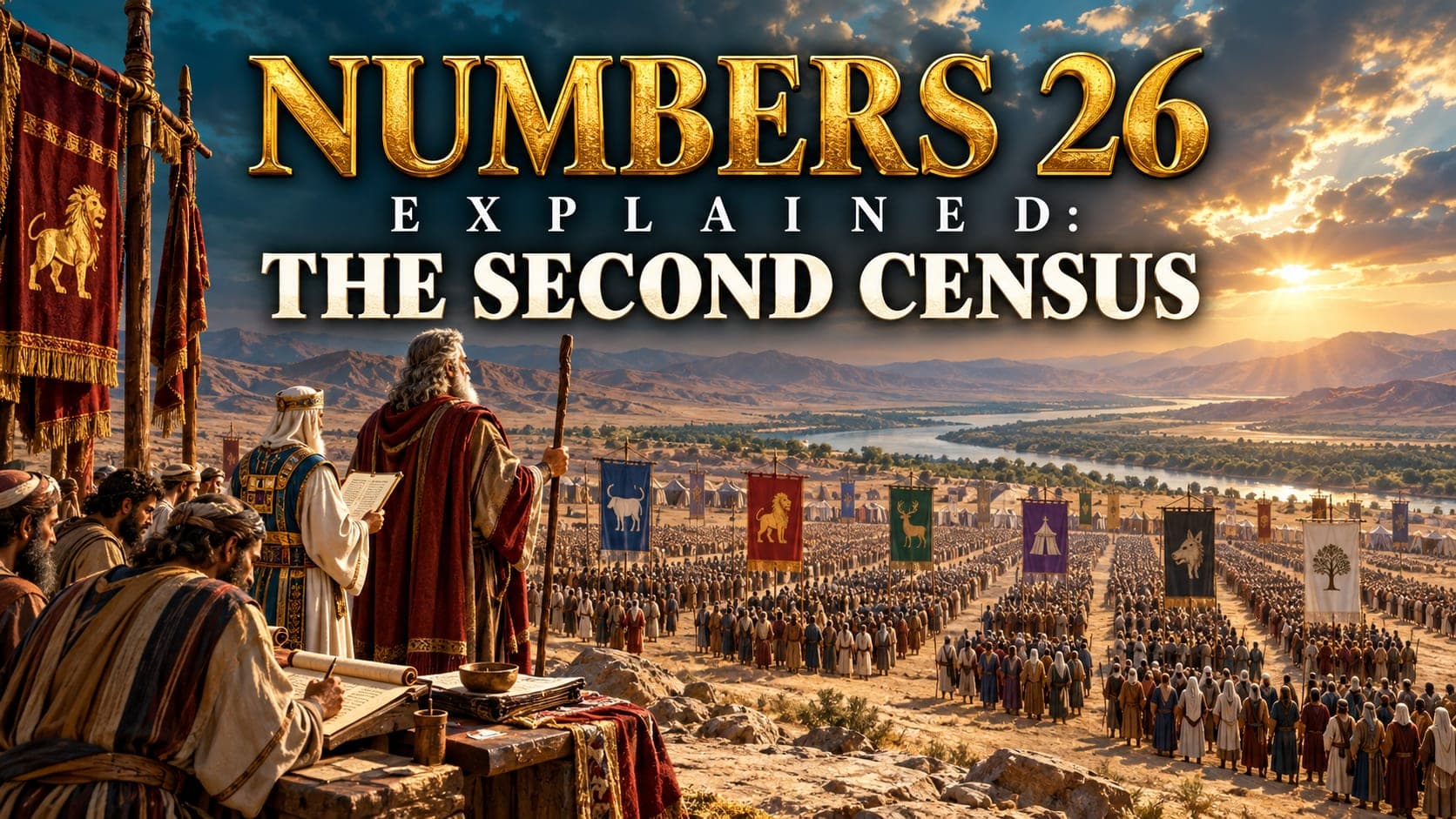
Numbers 26 explained is the second census in the book, ordered right after the plague at Baalpeor, and it quietly does something no sword ever managed. It counts the nation God swore would die in the wilderness, name by family, and finds almost no one left who remembers leaving Egypt.
Maybe you have watched a long season of waiting finally close, not with a dramatic ending, but with a list.
- ❓ Why order a headcount right after a plague just killed thousands?
- ❓ Why does one tribe's number collapse while another nearly doubles?
- ❓ Why does a military census stop to mention a man with no sons?
- ❓ Why does the chapter end by naming only two survivors?
📌 This is the chapter where a promise made 38 years earlier finally comes due, counted out one family at a time.
This walkthrough goes through the whole chapter in order: the command for a new census, Reuben's family and the rebellion it still remembers, Simeon's sudden drop, the rest of the tribes tallied by name, the land divided by lot, the Levites counted on their own terms, and the final line that closes out an entire generation.
Sixty five verses of names and numbers, and almost none of the names belong to anyone still alive.
What Happened Just Before This Chapter
Numbers 25 ended with Israel still camped at Shittim, a plague just stopped, 24,000 dead, and Phinehas granted a covenant of peace for the one act that turned God's anger aside. The chapter closed with a command to move against Midian, the nation behind the scheme at Baalpeor.
Numbers 26 opens in that same bruised camp, on the plains of Moab, with God speaking to Moses and Eleazar before a single step is taken toward Midian. Before Israel fights anyone else, God wants to know exactly who is left to fight.

Numbers 26 Explained Verse by Verse
1. A Census Ordered in the Middle of Grief (verses 1 to 4)
The command comes while the plague is still fresh, not months later once the camp has settled.
"And it came to pass after the plague, that the LORD spake unto Moses and unto Eleazar the son of Aaron the priest, saying, Take the sum of all the congregation of the children of Israel, from twenty years old and upward, throughout their fathers’ house, all that are able to go to war in Israel."
📌 Notice who God speaks to. Not Moses and Aaron, the pair who led the first census. Eleazar stands in his father's place now, high priest since Aaron died on Mount Hor. This census is already being taken by a different generation of leadership than the one that started the count 38 years earlier.
Moses passes the command to the people with almost identical wording, naming exactly where they stand.
"And Moses and Eleazar the priest spake with them in the plains of Moab by Jordan near Jericho, saying, Take the sum of the people, from twenty years old and upward; as the LORD commanded Moses and the children of Israel, which went forth out of the land of Egypt."
💡 The phrase "which went forth out of the land of Egypt" is doing quiet work here. Moses is still described that way, but as the chapter unfolds, almost no one being counted actually fits that description anymore. They left Egypt as infants, or they were born in the wilderness after it.
2. Reuben, and a Rebellion the Census Still Remembers (verses 5 to 11)
Reuben opens the list as Jacob's firstborn tribe, and the count stays simple until one family name pulls the chapter backward.
"And the sons of Eliab; Nemuel, and Dathan, and Abiram. This is that Dathan and Abiram, which were famous in the congregation, who strove against Moses and against Aaron in the company of Korah, when they strove against the LORD: And the earth opened her mouth, and swallowed them up together with Korah, when that company died, what time the fire devoured two hundred and fifty men: and they became a sign. Notwithstanding the children of Korah died not."
📌 A census is the last place you would expect a flashback, and this one includes two. Dathan and Abiram belonged to Reuben. Their revolt alongside Korah swallowed them into the earth decades earlier, and the list pauses just long enough to make sure no reader forgets why their line stops here.
⚠️ The last line is the detail easiest to miss. "The children of Korah died not." Korah himself was consumed with the two hundred and fifty men who burned, but his own sons lived on. Judgment in this chapter is specific. It falls on the man who led the revolt, not automatically on every descendant who shared his name.
3. Simeon's Number Falls Off a Cliff (verses 12 to 14)
The chapter moves to Simeon next, and the contrast with 38 years earlier is impossible to miss.
"Those that were numbered of them, even of the tribe of Simeon, were fifty and nine thousand and three hundred."
"These are the families of the Simeonites, twenty and two thousand and two hundred."
📌 Simeon drops from 59,300 to 22,200. No other tribe loses anywhere near that share of its people. The text never states a reason here, but the previous chapter already named the man at the center of the plague that just ended: Zimri, "a prince of a chief house among the Simeonites." A tribe whose own leading family led the way into Baalpeor is the tribe that comes out of this census the smallest it has ever been.
Numbers 26 does not spell out the connection in so many words, so this stays a strong inference rather than a stated fact. But the timing, one chapter after 24,000 died and one chapter naming a Simeonite prince as part of the cause, makes the drop hard to read as a coincidence.
4. Nine More Tribes, Counted Family by Family (verses 15 to 51)
Gad, Judah, Issachar, Zebulun, Manasseh, Ephraim, Benjamin, Dan, Asher, and Naphtali follow in the same pattern: family names, then a total. Most of the list reads like a ledger. Two moments break the rhythm.
Inside Judah's count, the text pauses to note that two of Judah's own sons, Er and Onan, died in Canaan long before the Exodus, a detail the first census had no reason to repeat since it was already old news by then. Inside Manasseh's count comes the detail the rest of the book will build on.
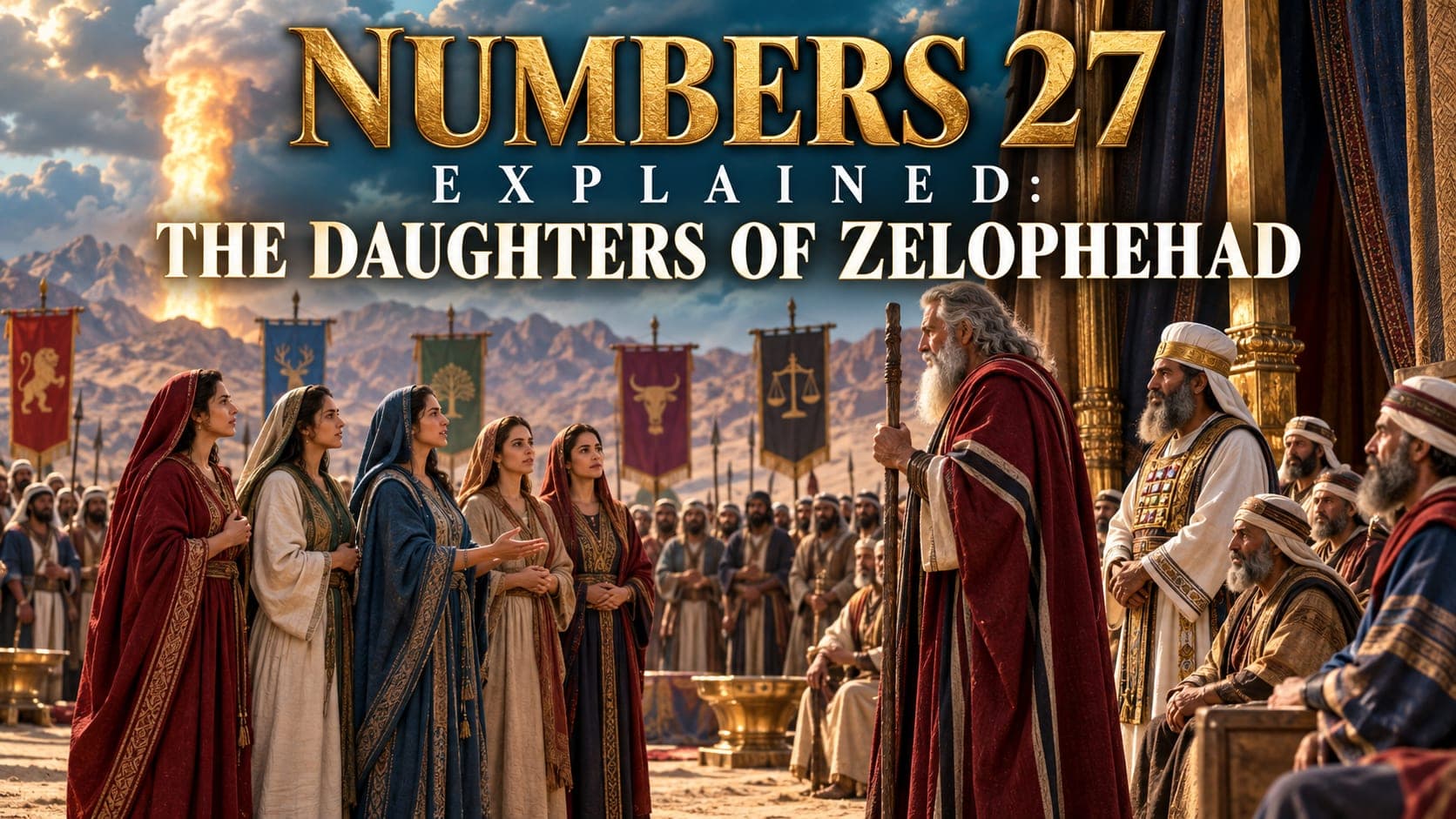
"And Zelophehad the son of Hepher had no sons, but daughters: and the names of the daughters of Zelophehad were Mahlah, and Noah, Hoglah, Milcah, and Tirzah."
💡 Naming five daughters by name, inside a census meant to count men able to go to war, is unusual enough to notice. A military roll has no use for daughters. Scripture includes them anyway, setting up a question about inheritance the very next chapter will have to answer, once the land these numbers are about to divide comes up for a family with no son to receive it.
Asher's count carries a smaller version of the same thing, naming a daughter, Sarah, the only other woman named anywhere in this chapter. Whatever reason Scripture had for recording these two women by name among hundreds of thousands of men, it was deliberate both times.
When every family has been counted, one number sums up the whole nation.
"These were the numbered of the children of Israel, six hundred thousand and a thousand seven hundred and thirty."
"Even all they that were numbered were six hundred thousand and three thousand and five hundred and fifty."
📌 601,730 against 603,550. Thirty eight years, an entire generation replaced, and the total barely moved. Judah, Issachar, Benjamin, Asher, and Manasseh grew, Manasseh most of all, nearly doubling. Simeon, Ephraim, and Naphtali shrank enough to cancel most of that growth out. A nation that should have multiplied freely in four decades instead spent most of that time standing still, which is exactly what a 40 year sentence in the wilderness looks like from the outside.
5. Land Divided by Lot, Not by Preference (verses 52 to 56)
The reason for the headcount finally surfaces once every tribe has a number attached to it.
"Unto these the land shall be divided for an inheritance according to the number of names."
"Notwithstanding the land shall be divided by lot: according to the names of the tribes of their fathers they shall inherit."
💡 Two different rules sit side by side here, and both apply at once. Verse 54 already said the bigger a tribe's number, the bigger its share of land. Verse 55 then says the actual location of that share, which specific stretch of ground, is settled by lot, not by request. Size decides how much a tribe gets. Chance, under God's direction, decides where.
📌 Not one tribe gets to pick the best valley or the easiest border. The land was never going to be divided by which leader argued hardest or which tribe arrived first. The census fixed the portions. The lot fixed the place.
6. The Levites, Counted on Separate Terms (verses 57 to 62)
Before the chapter closes, one more family gets counted, and the rules change the moment the text reaches them.
"And unto Aaron was born Nadab, and Abihu, Eleazar, and Ithamar. And Nadab and Abihu died, when they offered strange fire before the LORD. And those that were numbered of them were twenty and three thousand, all males from a month old and upward: for they were not numbered among the children of Israel, because there was no inheritance given them among the children of Israel."
📌 The Levites are counted from one month old, not twenty years old, and the number sits entirely outside the 601,730 total. Every other tribe is being measured for an inheritance of land. The Levites have none coming, so the census that governs land has no reason to measure them by the same rule. Their reminder of Nadab and Abihu, dead for offering strange fire, mirrors Reuben's reminder of Dathan and Abiram. Both priestly and lay families carry their own cautionary name inside this same list.
7. Everyone Who Left Egypt Is Already Gone (verses 63 to 65)
The chapter closes with the line that gives every number before it its real weight.
"But among these there was not a man of them whom Moses and Aaron the priest numbered, when they numbered the children of Israel in the wilderness of Sinai. For the LORD had said of them, They shall surely die in the wilderness. And there was not left a man of them, save Caleb the son of Jephunneh, and Joshua the son of Nun."
📌 Of every man counted in the first census at Sinai, only two names still answer at this one. The oath behind this was spoken decades earlier, after ten of twelve spies came back convinced the Promised Land could not be taken.
"Your carcases shall fall in this wilderness; and all that were numbered of you, according to your whole number, from twenty years old and upward, which have murmured against me, Doubtless ye shall not come into the land, concerning which I sware to make you dwell therein, save Caleb the son of Jephunneh, and Joshua the son of Nun."
💡 Numbers 14 read like a threat at the time it was spoken. Numbers 26 is that same sentence read back as a finished fact, verified by an actual headcount instead of taken on faith. Caleb and Joshua trusted God at the border of the land they were told not to fear. Thirty eight years and one census later, trust is the only reason either of their names still appears on a list of the living.

Hard Questions Numbers 26 Raises
Does Numbers 26 prove every single adult who left Egypt was dead by now? Not quite as broadly as it first sounds. The oath in Numbers 14, and the census here, specifically concern men twenty years old and upward who were counted at Sinai, the group able to go to war. Women, and anyone under twenty at that first census, were never the ones the oath named, so the chapter's claim is precise rather than universal: not one of the men originally numbered for battle remains, except Caleb and Joshua.
Why did Simeon's number fall so much further than any other tribe's? The text does not state the reason directly inside this chapter. The strongest clue sits one chapter earlier, where Zimri, a Simeonite prince, stood at the center of the sin that triggered the plague. Reading the two chapters together, a tribe whose own leadership led into Baalpeor coming out smallest is a connection the order of the chapters invites, even though Numbers 26 itself never says so in plain words.
Why mention that Korah's own sons survived, right after naming Dathan and Abiram's fate? The distinction matters for how Scripture treats guilt. Korah led the rebellion and died with it. His sons did not lead it, and the text records them continuing. Judgment in this census falls on the people who actually acted, not automatically on every descendant carrying the same family name.
Does land divided "by lot" mean the location was left to chance? The method was random from a human point of view, casting lots rather than a vote or a claim staked first. Scripture elsewhere treats the lot as a way of putting a decision directly into God's hands rather than human negotiation, so the randomness of the method and the belief that God still governed the outcome are not treated as contradictions here.
Why record daughters by name in a census built to count men for war? Numbers 26 never explains why Zelophehad's five daughters and Asher's daughter Sarah get named when the chapter's whole purpose is counting fighting men. What is clear from what follows is that Zelophehad's daughters are not a throwaway detail. Their lack of a brother becomes the exact problem the next chapter in this book has to solve.
Top Verses From Numbers 26
1. Numbers 26:64 and 65
"But among these there was not a man of them whom Moses and Aaron the priest numbered, when they numbered the children of Israel in the wilderness of Sinai. For the LORD had said of them, They shall surely die in the wilderness. And there was not left a man of them, save Caleb the son of Jephunneh, and Joshua the son of Nun."
A promise spoken as a threat in Numbers 14 comes back here as a confirmed headcount. Only two men prove it was never an empty warning.
2. Numbers 26:51
"These were the numbered of the children of Israel, six hundred thousand and a thousand seven hundred and thirty."
A number almost identical to the one taken 38 years earlier, hiding a complete replacement of nearly every person it represents.
3. Numbers 26:33
"And Zelophehad the son of Hepher had no sons, but daughters: and the names of the daughters of Zelophehad were Mahlah, and Noah, Hoglah, Milcah, and Tirzah."
Five names tucked inside a military roll, planting a question about inheritance the book has not finished answering yet.
4. Numbers 26:9 to 11
"And the sons of Eliab; Nemuel, and Dathan, and Abiram. This is that Dathan and Abiram, which were famous in the congregation, who strove against Moses and against Aaron in the company of Korah, when they strove against the LORD: And the earth opened her mouth, and swallowed them up together with Korah, when that company died, what time the fire devoured two hundred and fifty men: and they became a sign. Notwithstanding the children of Korah died not."
A census stops to remember exactly who rebelled and exactly who survived it, down to naming which sons lived past their father's judgment.

Frequently Asked Questions About Numbers 26
What is Numbers 26 about?
Numbers 26 records the second census of Israel, taken on the plains of Moab after the plague at Baalpeor. It counts every tribe by family, totals 601,730 men able to go to war, sets the rule for dividing the Promised Land, counts the Levites separately, and closes by noting that almost none of the men counted in the first census were still alive.
Why did God order a second census so soon after a plague?
Numbers 26:1 and 2 tie the command directly to the aftermath of the plague, and verses 52 to 56 explain the purpose: the land was about to be divided among the tribes according to their numbers, and the camp needed an accurate count before that could happen.
Why did Simeon's numbers drop so sharply in Numbers 26?
Simeon fell from 59,300 in the first census to 22,200 here, a far steeper drop than any other tribe. Numbers 26 does not state the reason, but Numbers 25:14 names a Simeonite prince, Zimri, as central to the sin at Baalpeor the chapter before, which makes the timing hard to read as coincidence.
Who were Dathan and Abiram in Numbers 26?
Dathan and Abiram were Reubenites who joined Korah's rebellion against Moses and Aaron. Numbers 26:9 and 10 recalls that the earth swallowed them along with Korah, and that 250 men died by fire in the same judgment.
Did Korah's sons die with him?
No. Numbers 26:11 says plainly, "the children of Korah died not." Korah led the rebellion and was consumed in it, but his own sons are recorded continuing afterward, a detail the text places right beside his judgment on purpose.
Why does Numbers 26 mention Zelophehad having no sons?
Numbers 26:33 names Zelophehad's five daughters inside a census meant to count fighting men, which is unusual on its own. The detail sets up the inheritance question his daughters bring to Moses in the very next chapter of the book.
How was the Promised Land divided among the twelve tribes?
Numbers 26:54 ties the size of each tribe's share to its population from this census, and verses 55 and 56 say the specific location of each share was decided by lot, not by request. A bigger tribe got more land; where that land actually sat was left to the lot.
Why were the Levites counted separately from the rest of Israel?
Numbers 26:62 explains it directly: the Levites were not numbered among the other tribes because they were receiving no inheritance of land. Since the main census existed to divide land, a tribe with none coming had no reason to be measured by the same count.
Does Numbers 26 mean the entire generation that left Egypt had died?
It means every man who was twenty or older at the first census, the group bound by the oath in Numbers 14:29 and 30, had died except Caleb and Joshua. Women and anyone under twenty at that earlier count were never the specific group that oath named.
Why do only Caleb and Joshua remain from the first census?
Numbers 14:29 and 30 recorded God's oath that the generation who refused to trust Him at the border of Canaan would die in the wilderness, naming Caleb and Joshua as the only exceptions because they trusted Him when the other ten spies did not. Numbers 26:65 confirms that oath came true exactly as spoken.
Final Thoughts
Numbers 26 looks like paperwork. Read closely, it is actually a verdict, carried out quietly over 38 years.
📌 A number can confirm a promise just as surely as a miracle can. No plague, no fire, no dramatic scene closes this story. A simple count does it, matching exactly what God said decades earlier at Numbers 14.
📌 Judgment in this census is specific, not inherited by name alone. Dathan and Abiram died for what they did. Korah's own sons lived. The chapter is careful enough to say so both times.
📌 A detail that looks small, like five daughters with no brother, can decide what comes next. Zelophehad's family gets one verse here and an entire chapter's worth of attention soon after.
You are probably not waiting on tribal land or a wilderness sentence to run out. But you may be living inside a long season where the ending, when it finally comes, will not look dramatic either.
Read Numbers 14:29 and 30 next to Numbers 26:65, and let this chapter answer a question worth asking about your own waiting: does God keep a hard promise exactly as quietly as He keeps a good one?