📖 Deuteronomy 9 Explained: Not For Your Righteousness
Walled cities. Giants in the land. And Moses opens by telling Israel the exact opposite of what they want to hear.
Deuteronomy 9 explained is Moses stopping Israel right before they cross into Canaan to take away the one explanation they might reach for once they win: that God is giving them this land because they earned it. He spends almost the whole chapter proving, with their own worst moments, that they did not.
Maybe you have quietly assumed God blesses you because you are, on balance, a good person.
- ❓ Why does Moses call Israel "stiffnecked" right before promising them a whole land?
- ❓ What actually happened at Horeb while Moses was up on the mountain?
- ❓ Did God really almost destroy Aaron, and does the Bible say that anywhere else?
- ❓ What was Moses actually asking for when he fell down for forty days, twice?
📌 Deuteronomy 9 hands Israel the land and takes away their excuse for bragging about it, in the same chapter.
This walkthrough goes through the whole chapter in order: the giants waiting across the Jordan, the warning not to credit their own righteousness, the golden calf story retold from Moses' own memory, the forty days he spent face down on the ground, and the prayer that talked God out of ending Israel on the spot.
Twenty nine verses, and Moses barely mentions himself in a single one of them.
What Happened Just Before This Chapter
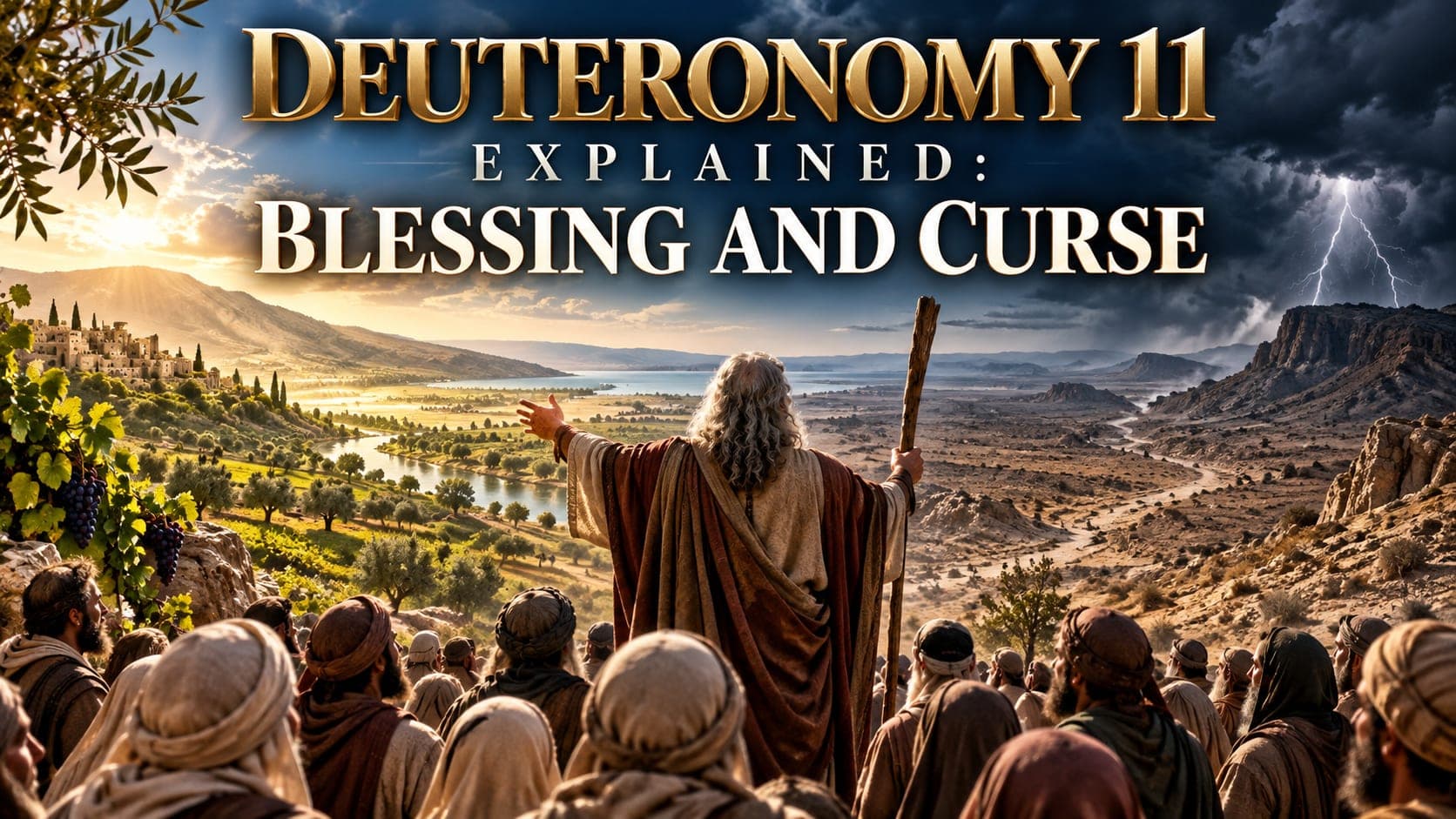
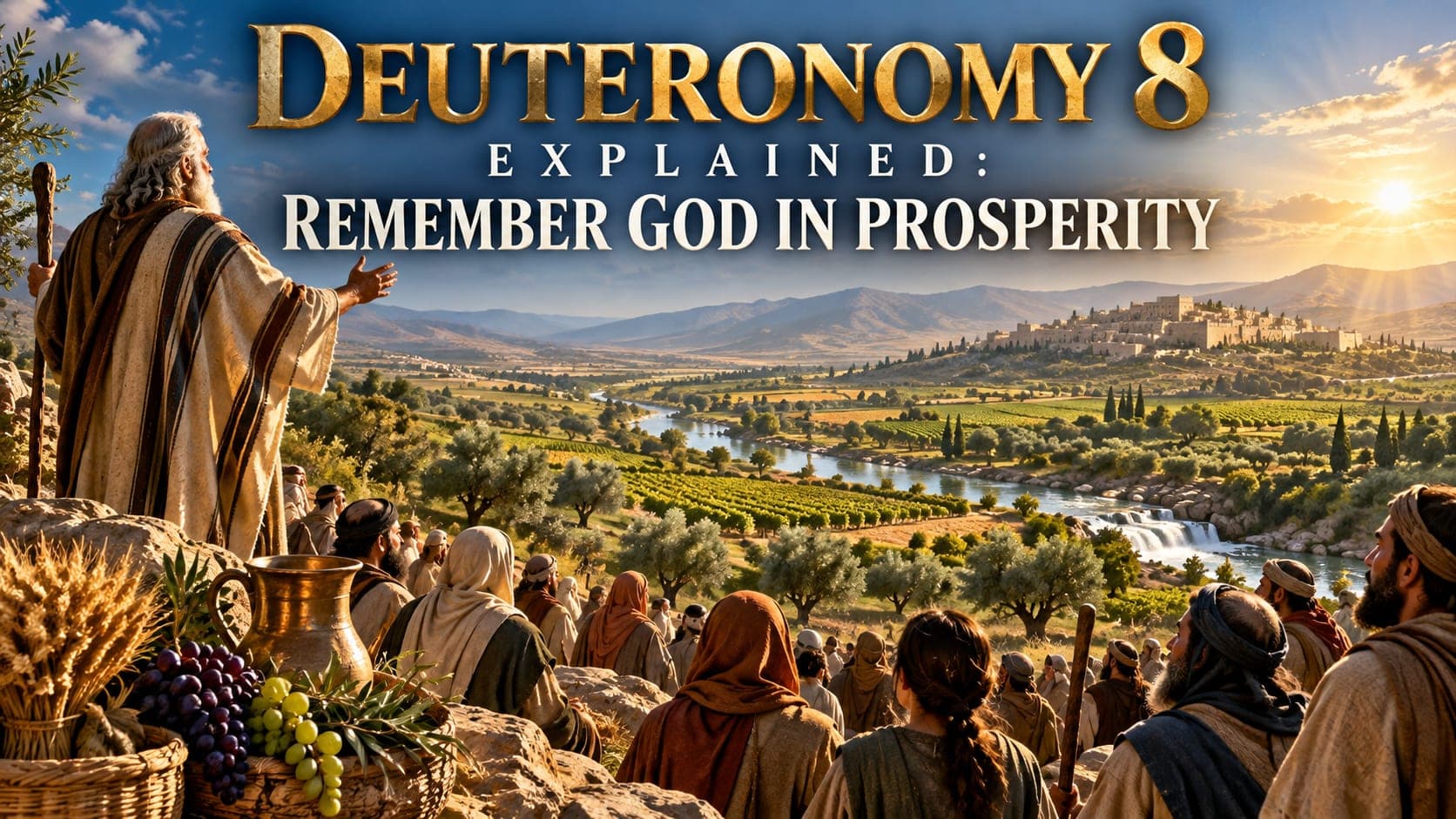
Deuteronomy 8 ended on a warning about the moment Israel gets full and comfortable in the good land: the risk that they will say in their hearts, "my power and the might of mine hand hath gotten me this wealth." Moses closed that chapter by reminding Israel it is God who gives the power to get anything at all.
Deuteronomy 9 reaches for the same danger from a different angle. Instead of warning against pride after the land is won, Moses gets ahead of it before the fighting even starts. He knows exactly what a winning army tells itself about why it won, so he spends this chapter making sure Israel never gets the chance to tell that story about themselves.

Deuteronomy 9 Explained Verse by Verse
1. Giants, Fenced Cities, and a Consuming Fire (verses 1 to 3)
Moses opens with the exact fear Israel has been carrying since the spies first brought back their report.
"Hear, O Israel: Thou art to pass over Jordan this day, to go in to possess nations greater and mightier than thyself, cities great and fenced up to heaven, A people great and tall, the children of the Anakims, whom thou knowest, and of whom thou hast heard say, Who can stand before the children of Anak!"
📌 "Cities great and fenced up to heaven" is not a measurement. It is how terrified Israel already was of these walls. The spies who scouted this same land a generation earlier used almost identical language, and that report started a rebellion that cost an entire generation forty years in the wilderness.
"And there we saw the giants, the sons of Anak, which come of the giants: and we were in our own sight as grasshoppers, and so we were in their sight."
That earlier report, back in Numbers 13, had turned this same fear into refusal. Moses knows the Anakim are the loudest reason a whole generation already died in the desert instead of walking into this land. Rather than pretend the fear is not real, he answers it directly.
"Understand therefore this day, that the LORD thy God is he which goeth over before thee; as a consuming fire he shall destroy them, and he shall bring them down before thy face: so shalt thou drive them out, and destroy them quickly, as the LORD hath said unto thee."
💡 Moses does not tell Israel the giants are smaller than reported. He tells them who is crossing the Jordan ahead of them. The size of the enemy never changes between Numbers 13 and this chapter. What changes is which army Israel is being told to look at first.
2. "Not For Thy Righteousness" (verses 4 to 6)
Moses sees exactly where this is going to lead once the walls actually fall, and he cuts the sentence off before Israel ever gets to say it.
"Speak not thou in thine heart, after that the LORD thy God hath cast them out from before thee, saying, For my righteousness the LORD hath brought me in to possess this land: but for the wickedness of these nations the LORD doth drive them out from before thee."
"Not for thy righteousness, or for the uprightness of thine heart, dost thou go to possess their land: but for the wickedness of these nations the LORD thy God doth drive them out from before thee, and that he may perform the word which the LORD sware unto thy fathers, Abraham, Isaac, and Jacob."
📌 Moses gives three reasons for the conquest, and Israel's own goodness is not one of them. The nations are removed for their own wickedness, and the land is given because of a promise made to Abraham, Isaac, and Jacob, long before Israel existed as a nation to be good or bad at anything.
Then Moses states it a second time, in case the first sentence left any room to argue.
"Understand therefore, that the LORD thy God giveth thee not this good land to possess it for thy righteousness; for thou art a stiffnecked people."
⚠️ "Stiffnecked" pictures an ox that will not turn its head toward the yoke, stubborn against being led. Moses does not soften the word or explain it away. He uses it about the very people he is about to march into the most important land they will ever receive.
3. "Ye Have Been Rebellious": The Golden Calf, Retold (verses 7 to 17)
Moses backs up his claim with evidence, and the evidence is Israel's own record, starting with the day they left Egypt.
"Remember, and forget not, how thou provokedst the LORD thy God to wrath in the wilderness: from the day that thou didst depart out of the land of Egypt, until ye came unto this place, ye have been rebellious against the LORD."
Then he names the worst single instance of it, the moment Israel broke the covenant before the ink on the tablets had even had time to be read.
"Also in Horeb ye provoked the LORD to wrath, so that the LORD was angry with you to have destroyed you. When I was gone up into the mount to receive the tables of stone, even the tables of the covenant which the LORD made with you, then I abode in the mount forty days and forty nights, I neither did eat bread nor drink water."
Moses was receiving the law at the exact moment Israel was breaking it at the base of the same mountain. Exodus 32tells the fuller story of what the camp did while he was gone.
"And the LORD said unto me, Arise, get thee down quickly from hence; for thy people which thou hast brought forth out of Egypt have corrupted themselves; they are quickly turned aside out of the way which I commanded them; they have made them a molten image."
📌 Notice who God calls the camp at this exact moment: "thy people." He is speaking to Moses about the nation He has just rescued out of Egypt by His own hand, and for this one sentence He hands the ownership of them over to the man standing in front of Him.
What God says next is the hardest line in the whole chapter.
"Furthermore the LORD spake unto me, saying, I have seen this people, and, behold, it is a stiffnecked people: Let me alone, that I may destroy them, and blot out their name from under heaven: and I will make of thee a nation mightier and greater than they."
⚠️ "Let me alone" is not God losing control of a decision He cannot take back. It is an opening, the same kind of opening He gives in Numbers 14 when a later generation rebels after the spies return. Both times, the sentence is followed immediately by someone stepping in to plead for the very people just named for destruction, and both times the pleading works. The text never spells out exactly what would have happened if no one had answered. What it does show, twice, is that someone always did.
4. Broken Tables, a Burned Calf, and Forty More Days Face Down (verses 15 to 21)
Moses comes down the mountain carrying the covenant in stone, and finds the covenant already broken in the camp.
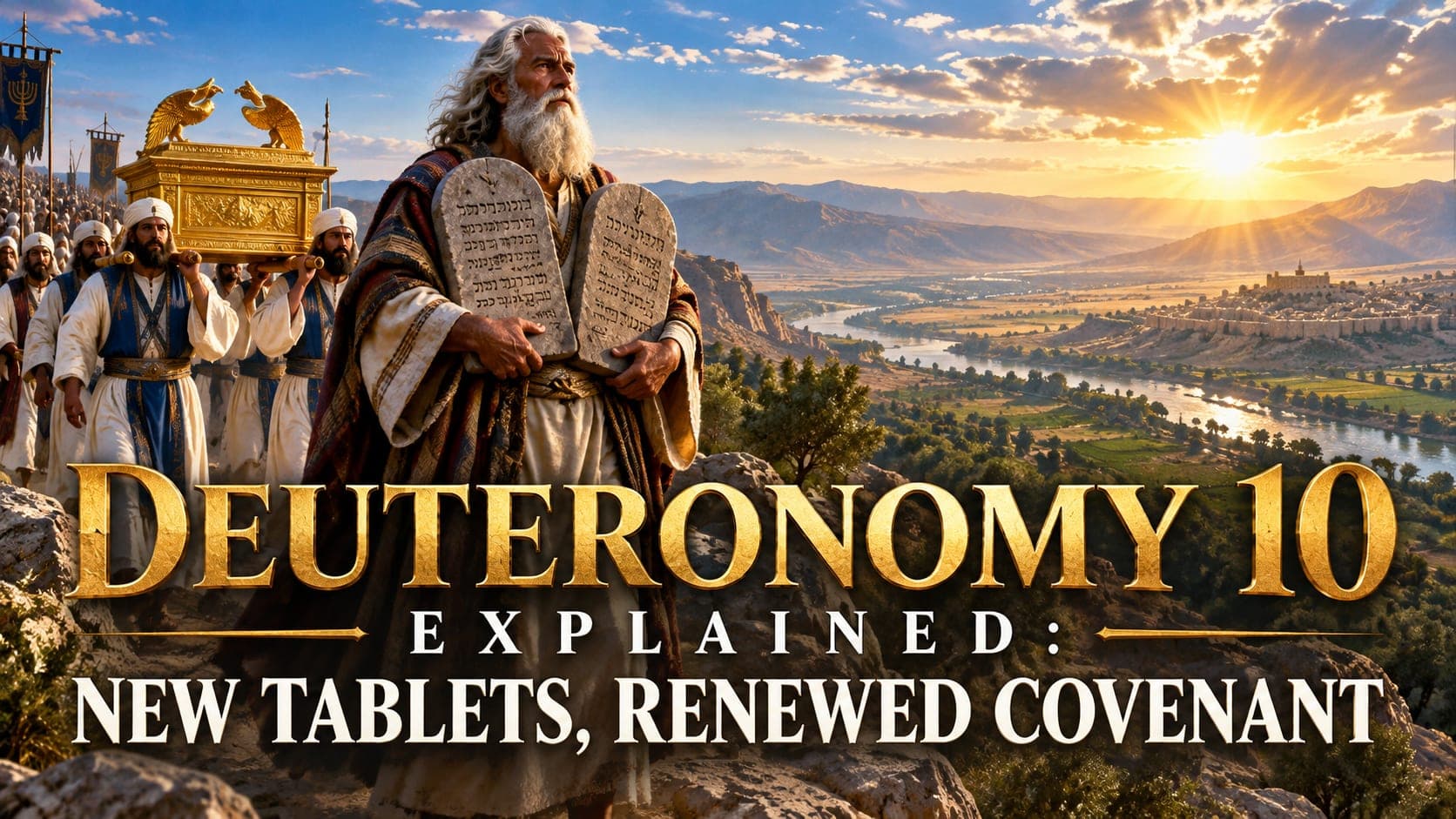
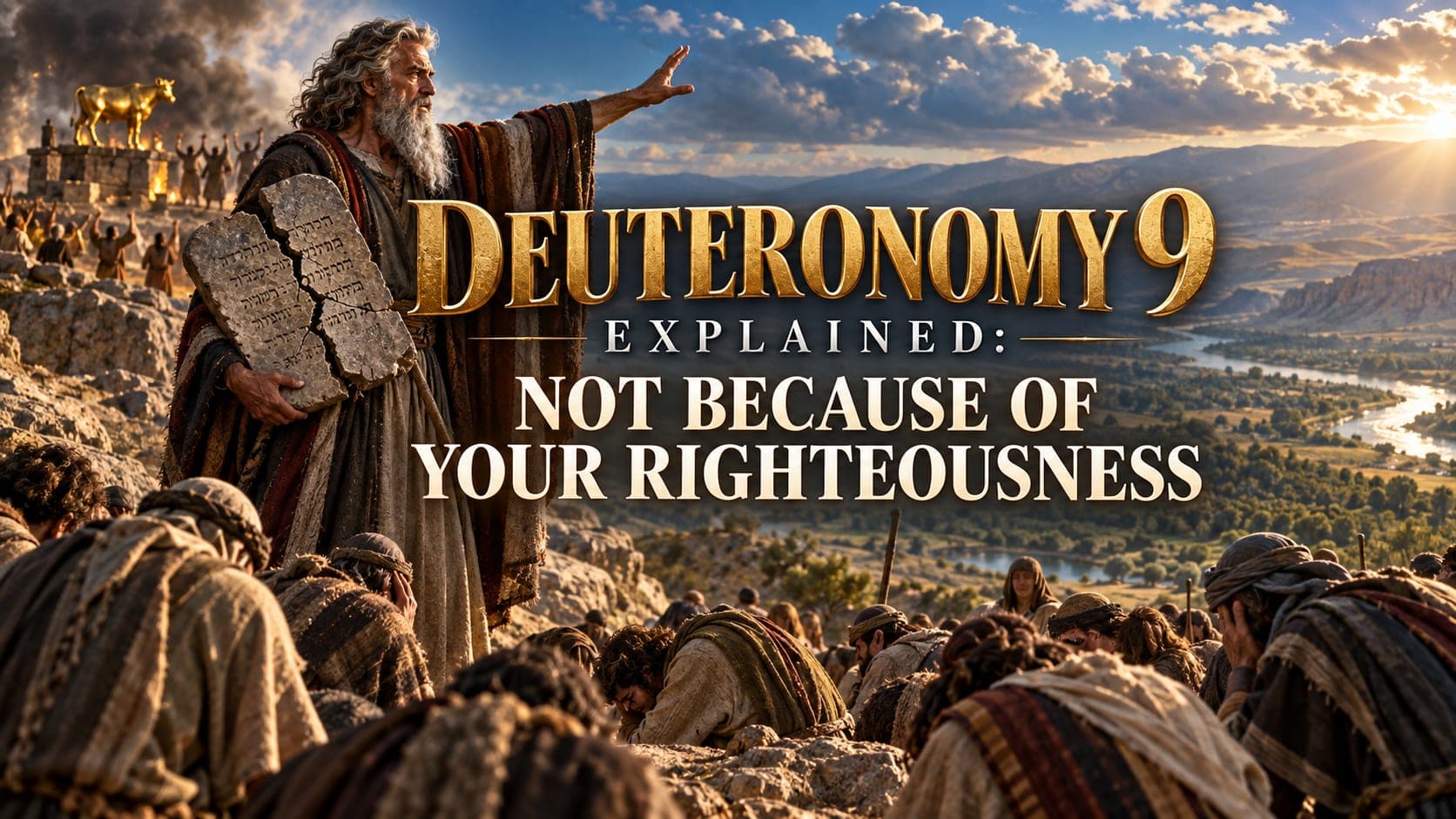
"So I turned and came down from the mount, and the mount burned with fire: and the two tables of the covenant were in my two hands. And I looked, and, behold, ye had sinned against the LORD your God, and had made you a molten calf: ye had turned aside quickly out of the way which the LORD had commanded you. And I took the two tables, and cast them out of my two hands, and brake them before your eyes."
💡 Breaking the tables was not a loss of temper. It pictured exactly what had already happened. Israel broke the covenant at the foot of the mountain before Moses ever broke the stone it was written on. The physical tablets simply caught up to what the camp had already done.
What Moses does next gets almost no attention next to the drama of the broken tablets, but he names it as his own response, in his own words.
"And I fell down before the LORD, as at the first, forty days and forty nights: I did neither eat bread, nor drink water, because of all your sins which ye sinned, in doing wickedly in the sight of the LORD, to provoke him to anger. For I was afraid of the anger and hot displeasure, wherewith the LORD was wroth against you to destroy you. But the LORD hearkened unto me at that time also."
📌 Two separate forty day fasts stand on either side of the golden calf, and both are on Israel's behalf, not God's. The first forty days received the law Israel would break. The second forty days pleaded for the people who broke it. Moses spends eighty days total without bread or water in this single chapter, and every one of them is spent on a people who had just called a melted calf their god.
Then Moses adds one detail Exodus never states as plainly, almost in passing.
"And the LORD was very angry with Aaron to have destroyed him: and I prayed for Aaron also the same time."
⚠️ Exodus 32 names Aaron as the one who built the altar and shaped the calf with his own hands, but it never says outright that God was ready to destroy him for it. Only here, decades later, does Moses reveal how close his own brother came to the same judgment the rest of the camp faced, and that Moses prayed for him by name.
"And I took your sin, the calf which ye had made, and burnt it with fire, and stamped it, and ground it very small, even until it was as small as dust: and I cast the dust thereof into the brook that descended out of the mount."
Grinding gold into dust takes real, deliberate effort. Moses did not simply discard the calf. He made sure nothing recognizable was left of it, and scattered what remained into running water so the camp could never quietly go looking for the pieces.
5. Taberah, Massah, Kibrothhattaavah, and Kadeshbarnea (verses 22 to 24)
Moses makes clear the golden calf was never a single lapse in an otherwise obedient people.
"And at Taberah, and at Massah, and at Kibrothhattaavah, ye provoked the LORD to wrath. Likewise when the LORD sent you from Kadeshbarnea, saying, Go up and possess the land which I have given you; then ye rebelled against the commandment of the LORD your God, and ye believed him not, nor hearkened to his voice. Ye have been rebellious against the LORD from the day that I knew you."
📌 Four place names, four separate failures, and Moses lists them the way a witness lists evidence, not the way a storyteller builds suspense. Kadeshbarnea is the same rebellion covered in Numbers 14, where the spies' report about giants turned into a refusal to enter the land at all. Moses is standing in front of the children of the very generation that refused to walk where he is now telling them to walk.
6. The Prayer That Bought Israel More Time (verses 25 to 29)
Moses closes the chapter by returning to the actual words he prayed at the foot of the mountain.
"Thus I fell down before the LORD forty days and forty nights, as I fell down at the first; because the LORD had said he would destroy you. I prayed therefore unto the LORD, and said, O Lord GOD, destroy not thy people and thine inheritance, which thou hast redeemed through thy greatness, which thou hast brought forth out of Egypt with a mighty hand."
"Remember thy servants, Abraham, Isaac, and Jacob; look not unto the stubbornness of this people, nor to their wickedness, nor to their sin: Lest the land whence thou broughtest us out say, Because the LORD was not able to bring them into the land which he promised them, and because he hated them, he hath brought them out to slay them in the wilderness."
📌 Moses never argues that Israel deserves to be spared. He argues from a promise God already made, from God's own reputation among the nations, and from the fact that Israel still belongs to God no matter how badly they have just behaved. Not one line of this prayer leans on Israel's character.
The prayer, and the chapter, end on exactly that point.
"Yet they are thy people and thine inheritance, which thou broughtest out by thy mighty power and by thy stretched out arm."
💡 The whole chapter started by taking away Israel's claim to righteousness and ends by resting Israel's survival on nothing but belonging. They are not spared because they were good. They are spared because they are still His.
Hard Questions Deuteronomy 9 Raises
Did God really intend to destroy Israel at Horeb, or was "let me alone" always meant to draw Moses into praying? The text states God's anger and His words to Moses as real, not as pretend theater. What it does not fully explain is how that anger relates to God's unchanging character and His earlier promise to Abraham. Most readers take the exchange as a genuine moment of divine judgment that God, in His own freedom, chose to relent from in response to Moses' prayer, rather than as a performance where the outcome was never actually in question. Either way, the text is clear about what role intercession played: Moses prayed, and Israel was not destroyed.
Why does Moses say God was ready to destroy Aaron, when Exodus 32 never says that directly? Exodus 32 names Aaron as the one who built the calf and made the proclamation, but it moves straight to Moses grinding the calf to powder without stating Aaron's own danger. Deuteronomy 9:20 adds a detail the earlier account leaves out rather than contradicting it, the same way a person retelling an old story years later sometimes includes something left unsaid the first time.
Why does the order of events in Deuteronomy 9 read a little differently than Exodus 32? Exodus 32 narrates the golden calf in the order it happened: the calf is burned and ground almost immediately after Moses comes down, and the lawgiving happens again later, on a second set of tables, in Exodus 34. Deuteronomy 9 is a sermon, not a fresh narration, and Moses groups the burning of the calf together with the rest of that whole episode rather than narrating every step in strict order. The two accounts describe the same events without disagreeing about what actually took place.
Does verse 5 mean the Canaanite nations were uniquely wicked, worse than every other nation on earth at the time? The verse states their wickedness as the reason for their removal, without ranking them against nations outside the land. Scripture elsewhere describes practices tied to Canaanite worship, including child sacrifice, as the kind of wickedness in view. The verse's main point stands either way: Israel's righteousness is explicitly ruled out as the reason for the gift of the land.
Top Verses From Deuteronomy 9
1. Deuteronomy 9:4 and 5
"Speak not thou in thine heart, after that the LORD thy God hath cast them out from before thee, saying, For my righteousness the LORD hath brought me in to possess this land: but for the wickedness of these nations the LORD doth drive them out from before thee... Not for thy righteousness, or for the uprightness of thine heart, dost thou go to possess their land."
The verse the whole chapter exists to teach, named out loud before Israel ever has the chance to tell themselves a flattering version of their own story.
2. Deuteronomy 9:6
"Understand therefore, that the LORD thy God giveth thee not this good land to possess it for thy righteousness; for thou art a stiffnecked people."
Moses repeats the point and sharpens it with one plain word, stiffnecked, spoken about the very people about to receive the land anyway.
3. Deuteronomy 9:14
"Let me alone, that I may destroy them, and blot out their name from under heaven: and I will make of thee a nation mightier and greater than they."
A sentence that seems to close the door on Israel entirely, answered in the very next verses by a man who refused to accept it as final.
4. Deuteronomy 9:21
"And I took your sin, the calf which ye had made, and burnt it with fire, and stamped it, and ground it very small, even until it was as small as dust."
Moses calls the calf "your sin" before he ever describes destroying it, naming exactly what was really being ground into dust.
5. Deuteronomy 9:29
"Yet they are thy people and thine inheritance, which thou broughtest out by thy mighty power and by thy stretched out arm."
The last line of Moses' prayer, and the only argument he ever makes for why Israel should be spared: they are not his to let go of.

Frequently Asked Questions About Deuteronomy 9
What is Deuteronomy 9 about?
Deuteronomy 9 is Moses warning Israel, right before they cross into Canaan, not to credit their own righteousness for the land they are about to receive. He proves the point by retelling the golden calf story from his own memory, including his two forty day fasts and the prayer that kept God from ending the nation at Horeb.
Why does Moses call Israel "stiffnecked"?
The word pictures an ox refusing to turn its head toward the yoke, a stubborn resistance to being led. Moses uses it twice in this chapter, in verses 6 and 13, both times right before describing a specific moment Israel rebelled against God.
Why did God let Israel keep the land if they are stiffnecked and sinful?
Verse 5 gives the actual reason: the wickedness of the nations already in the land, and the promise God made to Abraham, Isaac, and Jacob. Israel's own character is explicitly ruled out as the reason, which is the whole point Moses is making.
What happened at Horeb in Deuteronomy 9?
While Moses was on the mountain receiving the law for forty days, Israel built and worshiped a golden calf. God told Moses He was ready to destroy the whole nation, Moses interceded for them, came down and broke the stone tables in response to what he found, then spent another forty days fasting and praying before God relented.
Did God almost destroy Aaron?
Deuteronomy 9:20 says God was very angry with Aaron, enough to have destroyed him, and that Moses prayed for him at the same time he was praying for the rest of the camp. This detail does not appear in Exodus 32, which names Aaron as the one who built the calf but does not describe his own danger as explicitly.
What does "let me alone" mean in Deuteronomy 9:14?
It is God telling Moses, in effect, not to intervene on Israel's behalf. The same pattern appears again in Numbers 14, after a later rebellion, and both times someone steps in to intercede immediately afterward, and the nation is spared.
Why did Moses break the stone tables?
Deuteronomy 9:16 and 17 say Moses broke them after coming down and seeing the golden calf with his own eyes. The broken stone pictured what had already happened at the bottom of the mountain: Israel had broken the covenant before Moses ever broke the tablets it was written on.
What were Taberah, Massah, and Kibrothhattaavah?
Deuteronomy 9:22 names them as three more places Israel provoked God to wrath during the wilderness years, alongside Kadeshbarnea in verse 23, where the nation refused to enter the land after the spies returned. Moses lists them together as proof the golden calf was not an isolated failure.
What did Moses actually pray for at Horeb?
Deuteronomy 9:26 to 29 records the prayer itself. Moses asks God not to destroy His people, appeals to the promise made to Abraham, Isaac, and Jacob, and warns that destroying Israel would give the nations reason to say God was not able to finish what He started.
What is the main lesson of Deuteronomy 9 for today?
That good things in your life, including ones you worked hard for, are never proof you earned them through your own righteousness. Deuteronomy 9 ties every good thing Israel is about to receive back to a promise and a mediator, not to Israel's own record, which the chapter spends almost thirty verses showing was never good enough on its own.
Final Thoughts
Deuteronomy 9 is a strange way to hand someone a gift. Moses spends almost the whole chapter listing reasons Israel does not deserve it.
📌 "Not for thy righteousness" applies to more than a plot of land in Canaan. Whatever good you are standing in right now was never a receipt for your own record.
📌 Someone always stood in the gap. "Let me alone" was answered by a man who refused to let go, forty days and forty nights at a time, twice.
📌 You are still His, even on your worst day. The chapter does not end with Israel earning anything back. It ends with the one line that mattered the whole time: they are still His people.
You are probably not facing walled cities and giants this week. But something good is likely sitting in front of you right now that quietly tempts you toward the sentence Moses told Israel never to say.
So here is your one next step.
Name one good thing in your life you have been crediting to your own righteousness, and trace it back instead to the promise and the mediator that actually got it to you.