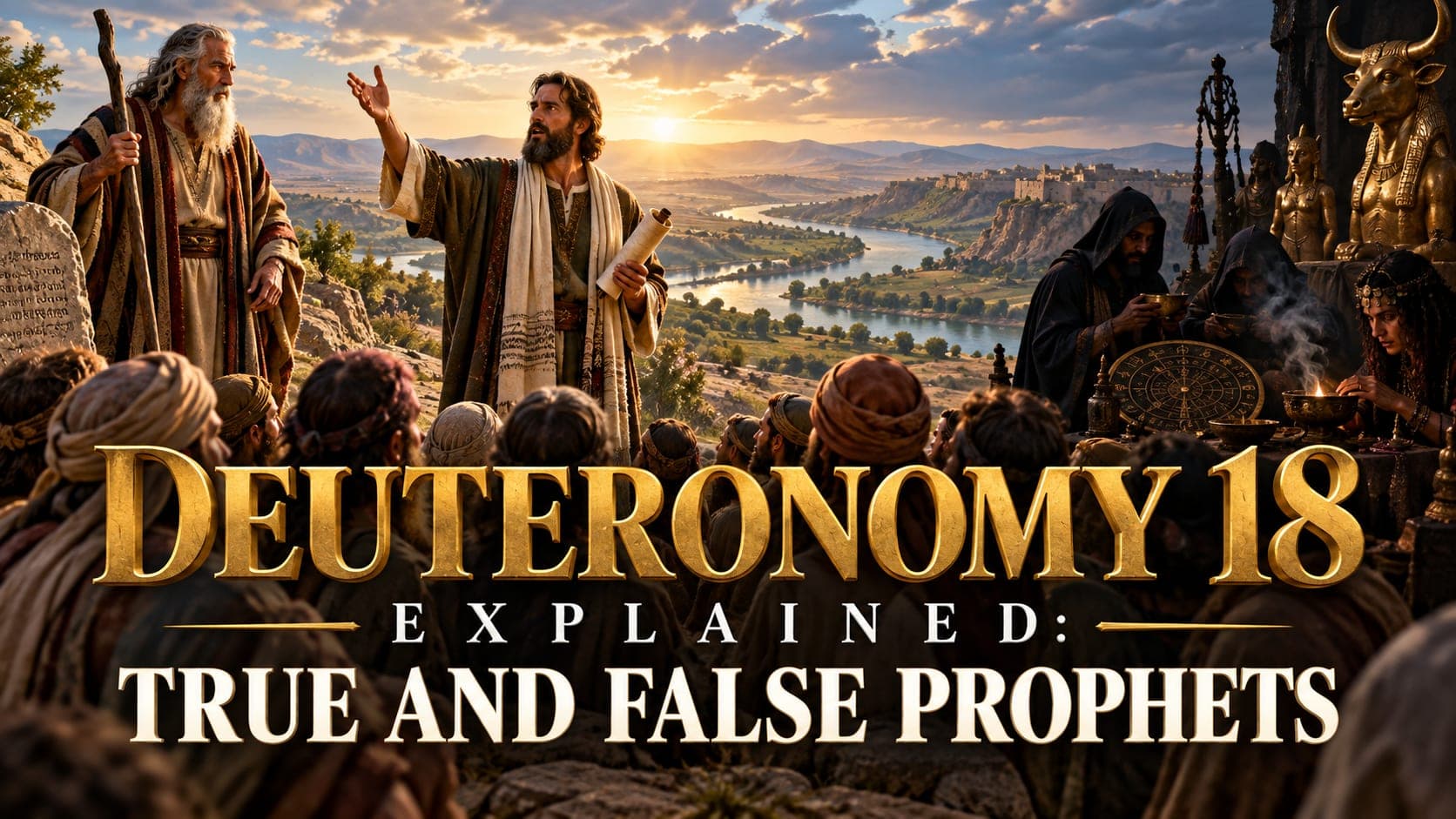
📖 Deuteronomy 18 Explained: No Land for Levites, a Prophet Like Moses
No farmland. No herd of their own to inherit. A whole tribe told their portion is God Himself.
Deuteronomy 18 explained is Moses settling two very different questions in one chapter: how a priest without land actually eats, and how Israel will know a true word from God once Moses himself is gone.
Maybe you have only ever read this chapter as a list of job descriptions, with nothing left to say to you.
- ❓ Why didn't the Levites get their own territory like every other tribe?
- ❓ What do words like divination, charmer, and necromancer actually mean?
- ❓ Who is the Prophet God promises to raise up like Moses?
- ❓ How was Israel supposed to tell a true prophet from a false one?
📌 Deuteronomy 18 answers one question with a promise and the other with a test, and both answers point past Moses to someone still coming.
Twenty two verses, and they move from a priest's dinner table to the dark practices Canaan ran on, and finally to a Prophet Moses will not live to meet.
Read slowly. This chapter is quietly one of the most important in the whole Old Testament.
What Happened Just Before This Chapter
Deuteronomy 17 closed on a throne that did not exist yet, a future king told he would answer to the same law as everyone else, never above it. Moses had just finished writing limits for every level of authority Israel would ever face: a local judge, a central court, and finally a crown.
Deuteronomy 18 keeps climbing that same ladder, but it turns from political power to spiritual authority. It asks how a priest gets fed without owning farmland, what kind of worship Israel must never touch, and who Israel listens to once Moses is no longer standing in front of them.

Deuteronomy 18 Explained Verse by Verse
1. The Priest's Due, Not a Plot of Land (verses 1 to 5)
Moses opens with the one thing Levi will never receive when the land gets divided.
"The priests the Levites, and all the tribe of Levi, shall have no part nor inheritance with Israel: they shall eat the offerings of the LORD made by fire, and his inheritance."
"Therefore shall they have no inheritance among their brethren: the LORD is their inheritance, as he hath said unto them."
📌 Twice in two verses Moses repeats the same fact, and he is not being repetitive by accident. Every other tribe will measure out fields and count boundary stones. Levi gets a sentence instead of a survey: the LORD is their inheritance. That line was meant to be heard as the better deal, not a consolation prize.
So what does a tribe with no farmland actually eat?
"And this shall be the priest's due from the people, from them that offer a sacrifice, whether it be ox or sheep; and they shall give unto the priest the shoulder, and the two cheeks, and the maw."
"The firstfruit also of thy corn, of thy wine, and of thine oil, and the first of the fleece of thy sheep, shalt thou give him."
💡 Specific cuts of meat, specific firstfruits. Nothing here is left vague enough for a stingy household to quietly shortchange the priest. Every Israelite who brought a sacrifice or gathered a harvest was, without exception, also feeding the man who ministered on their behalf.
"For the LORD thy God hath chosen him out of all thy tribes, to stand to minister in the name of the LORD, him and his sons for ever."
The priesthood was never a career a man applied for. It was a standing God Himself assigned, generation after generation, to one tribe out of twelve.
2. A Levite Who Comes From Any Gate (verses 6 to 8)
Not every Levite lived next to the altar. Most lived scattered through the towns thatNumbers 35 had already set aside for them, forty eight cities with no farmland attached, tucked inside every other tribe's territory.
"And if a Levite come from any of thy gates out of all Israel, where he sojourned, and come with all the desire of his mind unto the place which the LORD shall choose;"
"Then he shall minister in the name of the LORD his God, as all his brethren the Levites do, which stand there before the LORD."
📌 "With all the desire of his mind" is a strange phrase to attach to a job transfer, until you notice what it rules out. This was never a Levite being summoned or rotated on a schedule. A Levite living far from the sanctuary could choose, out of his own desire, to go minister at the chosen place, and he had to be welcomed exactly like the Levites already serving there.
"They shall have like portions to eat, beside that which cometh of the sale of his patrimony."
💡 "Patrimony" means whatever a Levite's own family still held, property, a house in one of those forty eight cities, something passed down that was his to sell. Serving at the sanctuary did not cancel out whatever he already owned on his own account. The equal portion was added to what he had, never a replacement that quietly cost him something else.
3. The Abominations Israel Must Not Learn (verses 9 to 14)
Moses turns sharply from the altar to the darker practices waiting in Canaan.
"When thou art come into the land which the LORD thy God giveth thee, thou shalt not learn to do after the abominations of those nations."
"There shall not be found among you any one that maketh his son or his daughter to pass through the fire, or that useth divination, or an observer of times, or an enchanter, or a witch."
"Or a charmer, or a consulter with familiar spirits, or a wizard, or a necromancer."
⚠️ "Maketh his son or his daughter to pass through the fire" names child sacrifice, the practice associated with the god Molech that the rest of the Old Testament keeps warning Israel away from. Everything named after it is a different route to the same goal: trying to control the future, find hidden information, or reach the dead through a method other than trusting God plainly. Casting lots to predict events, reading signs in clouds or birds, muttering a charm, channeling a spirit for guidance, these were not harmless folk customs in this world. They were the standard religious toolkit of the nations Israel was about to displace, the same familiar spirits Leviticus 19 had already told Israel to leave alone.
"For all that do these things are an abomination unto the LORD: and because of these abominations the LORD thy God doth drive them out from before thee."
"Thou shalt be perfect with the LORD thy God."
📌 "Perfect" here does not mean flawless performance. It means whole, undivided, all in with one God instead of hedging with a second set of spiritual tools on the side. The seven practices just listed are not seven unrelated sins. They are seven versions of the same hedge: looking somewhere besides God for answers only He actually has.
"For these nations, which thou shalt possess, hearkened unto observers of times, and unto diviners: but as for thee, the LORD thy God hath not suffered thee so to do."
💡 The nations Israel was replacing leaned on diviners because they had no prophet who actually spoke for their god. Verse 14 sets up the very next section perfectly. Israel was never going to be left to guess the future through charms, because God was about to give them something the surrounding nations never had.
4. A Prophet Like Moses (verses 15 to 19)
Instead of divination, Israel gets a promise.
"The LORD thy God will raise up unto thee a Prophet from the midst of thee, of thy brethren, like unto me; unto him ye shall hearken;"
Moses explains exactly why Israel needed this kind of mediator, reaching back to the day Israel heard God's own voice and could not bear it, the same terror Deuteronomy 5 describes in full.
"According to all that thou desiredst of the LORD thy God in Horeb in the day of the assembly, saying, Let me not hear again the voice of the LORD my God, neither let me see this great fire any more, that I die not."
"And the LORD said unto me, They have well spoken that which they have spoken."
📌 Israel's fear at Horeb was not a failure God simply tolerated. God called it well spoken. A direct, unfiltered encounter with God was more than the people could survive. What they needed instead was a human mediator who could carry God's own words without the fire and the trembling attached.
"I will raise them up a Prophet from among their brethren, like unto thee, and will put my words in his mouth; and he shall speak unto them all that I shall command him."
"And it shall come to pass, that whosoever will not hearken unto my words which he shall speak in my name, I will require it of him."
💡 Notice whose words these actually are. The Prophet does not speak his own opinion. God puts the words directly into his mouth, which is exactly why ignoring him carries the same weight as ignoring God. Peter later stands up in Jerusalem and applies this verse directly to Jesus, and Stephen does the same thing before the very council that will stone him.
5. The Test for a Word Not From the LORD (verses 20 to 22)
A true Prophet comes with a warning attached about the fake version.
"But the prophet, which shall presume to speak a word in my name, which I have not commanded him to speak, or that shall speak in the name of other gods, even that prophet shall die."
⚠️ Two separate ways to fail this test, not one. A false prophet either invents words and slaps God's name on them, or openly speaks for a different god altogether. Both get the same sentence, because both are the exact abomination verses 9 through 14 just spent describing a different way.
Then Moses anticipates the obvious follow up question.
"And if thou say in thine heart, How shall we know the word which the LORD hath not spoken?"
"When a prophet speaketh in the name of the LORD, if the thing follow not, nor come to pass, that is the thing which the LORD hath not spoken, but the prophet hath spoken it presumptuously: thou shalt not be afraid of him."
📌 The test is patient on purpose: wait and watch whether the word actually happens. No committee, no vote, no feeling in the room. Time itself exposes a presumptuous word, and once it does, verse 22 gives Israel permission to simply stop fearing a man who was never speaking for God in the first place.

Hard Questions Deuteronomy 18 Raises
Is the Prophet like Moses in verse 15 only Jesus, or does it describe the whole line of Old Testament prophets? The verse sits inside a passage explaining why Israel needed any mediator at all after Horeb, which fits every prophet God sent in the centuries that followed. The New Testament, though, treats one specific fulfillment as final rather than ongoing. Peter tells a crowd in Jerusalem that this exact Prophet has come, and Stephen says the same thing to the Sanhedrin, both naming Jesus. The pattern of prophets prepared Israel to recognize the pattern; the New Testament says the pattern was always pointing at one particular arrival.
Does the fulfillment test in verses 21 and 22 contradict Deuteronomy 13, where a false prophet's sign can actually come true? The two chapters are testing different things, not disagreeing. Deuteronomy 13 tests the content of a message: does this voice try to pull you after another god, no matter what sign comes with it. If so, the sign coming true changes nothing. Deuteronomy 18 tests an ordinary prophetic word about what will happen: if it never happens, that alone proves the word was not from the LORD. One guards against a dramatic but idolatrous sign. The other guards against a confident but empty prediction.
If Levi had no tribal land, how could a Levite still have a "patrimony" to sell, as verse 8 mentions? Having no farmland as an inheritance did not mean owning nothing at all. The Levitical cities already measured out in Numbers 35 gave Levites houses and small plots inside those forty eight towns. A patrimony there, something a family could sell or pass down, sat alongside the priestly portion rather than replacing it.
Do the practices named in verses 10 and 11 still matter if nobody burns a child or reads omens in a bird's flight anymore? The specific methods have changed with the culture, but the text is not really regulating methods. It is forbidding a posture: reaching past God to some other source for guidance, power, or contact with the dead. Whatever modern form that search takes, the warning still names the same underlying problem Moses was confronting here.
Top Verses From Deuteronomy 18
1. Deuteronomy 18:15
"The LORD thy God will raise up unto thee a Prophet from the midst of thee, of thy brethren, like unto me; unto him ye shall hearken;"
One of the clearest Messianic promises in the Torah, given generations before Israel ever has a king and well over a thousand years before the Prophet it describes arrives.
2. Deuteronomy 18:18 and 19
"I will raise them up a Prophet from among their brethren, like unto thee, and will put my words in his mouth; and he shall speak unto them all that I shall command him. And it shall come to pass, that whosoever will not hearken unto my words which he shall speak in my name, I will require it of him."
The words belong to God, not the messenger, which is exactly why ignoring the message carries the weight it does.
3. Deuteronomy 18:21 and 22
"And if thou say in thine heart, How shall we know the word which the LORD hath not spoken? When a prophet speaketh in the name of the LORD, if the thing follow not, nor come to pass, that is the thing which the LORD hath not spoken, but the prophet hath spoken it presumptuously: thou shalt not be afraid of him."
A patient, workable test for a presumptuous word, and permission to stop fearing a man once that word fails.
4. Deuteronomy 18:13
"Thou shalt be perfect with the LORD thy God."
Six words that summarize everything just forbidden in verses 10 and 11. Wholeness toward one God, not a hedge kept on the side.
5. Acts 3:22 and 23
"For Moses truly said unto the fathers, A prophet shall the Lord your God raise up unto you of your brethren, like unto me; him shall ye hear in all things whatsoever he shall say unto you. And it shall come to pass, that every soul, which will not hear that prophet, shall be destroyed from among the people."
Peter, standing in Jerusalem, reaches back across more than a thousand years and names Deuteronomy 18's promised Prophet directly.

Frequently Asked Questions About Deuteronomy 18
What is Deuteronomy 18 about?
Deuteronomy 18 explains how the priests and Levites were provided for without a tribal land inheritance, forbids the occult practices of the nations Israel was displacing, promises a future Prophet like Moses, and gives Israel a way to test whether a prophetic word actually came from the LORD.
Why didn't the Levites get their own territory like the other tribes?
Deuteronomy 18:1 and 2 state plainly that the LORD Himself was their inheritance instead of land. They lived in forty eight scattered cities measured out in Numbers 35 and were fed through the priestly portions named in this chapter, firstfruits and specific cuts of every sacrifice offered.
What does "pass through the fire" mean in Deuteronomy 18:10?
It refers to child sacrifice, the practice tied to the god Molech that the rest of the Old Testament repeatedly condemns. Moses lists it first among the abominations Israel must never learn from the nations around them.
What do divination, charmer, and necromancer mean in the Bible?
They describe different methods used in the ancient world to predict the future, manipulate events, or contact the dead apart from God, things like reading omens, casting spells, or consulting a spirit through a medium. Deuteronomy 18:10 to 12 names several specific forms and calls every one of them an abomination to the LORD.
Who is the Prophet like Moses in Deuteronomy 18:15?
The New Testament answers this directly. Both Peter in Acts 3:22 and Stephen in Acts 7:37 apply this promise to Jesus, naming Him as the Prophet Moses said God would raise up from among Israel's own brethren.
Why did Israel need a Prophet like Moses in the first place?
Deuteronomy 18:16 and 17 explain it directly. At Horeb, Israel was too afraid of hearing God's own voice and seeing His fire to want a direct encounter again. God called that fear well spoken and promised a human mediator to carry His words instead.
How was Israel supposed to tell a true prophet from a false one?
Deuteronomy 18:22 gives a fulfillment test: if a prophet speaks in the LORD's name and the thing he predicted never happens, that proves the word was not from God. The doctrine test in Deuteronomy 13 works alongside it, checking what a prophet is actually urging people to do.
Does a prophecy coming true always mean it was from God?
Not by itself. Deuteronomy 13 already describes a false prophet whose sign does come to pass, and the test there is whether he is pulling people toward another god. Deuteronomy 18's fulfillment test applies specifically to an ordinary prophetic word, not to a sign offered to justify idolatry.
Is astrology or fortune telling still forbidden for Christians today?
The specific practices Deuteronomy 18:10 and 11 name belonged to Canaanite religion, but the underlying warning still stands: seeking guidance, power, or contact with the dead from any source other than God. Modern versions of that search look different, but the text is forbidding the posture, not only the ancient methods.
What did it mean for a Levite to eat "like portions" in verse 8?
A Levite who traveled from his own town to minister at the chosen place received the same share of the priestly provisions as the Levites already serving there, in addition to whatever family property, his patrimony, he still held back home.
Final Thoughts
Deuteronomy 18 answers two very different anxieties with the same quiet confidence.
📌 A tribe with no land still had enough, because God Himself was the portion. The Levites' provision depended on every other Israelite's obedience, and Moses spelled out exactly what that provision had to look like.
📌 Every shortcut to hidden knowledge gets the same verdict: abomination. Divination, charms, and contact with the dead were never neutral curiosities. They were the standard religion of a people God was displacing.
📌 A silencing fear at Horeb turned into a promise, not a punishment. Israel could not bear hearing God directly, so God promised a Prophet who could carry His words safely, a promise Peter and Stephen later point straight at Jesus.
You do not wonder whether your tribe gets farmland, and you are not tempted to burn anything in a fire pit for answers. But you still decide, this week, whether you wait on God's actual word or reach for a faster source instead.
So here is your one next step.
Name the one question you have been most tempted to get a shortcut answer for, and take it to God's word instead before you take it anywhere else.