📖 Deuteronomy 20 Explained: War, Mercy, and the Law That Spares Trees
Horses. Chariots. An army bigger than yours standing across the field.
Deuteronomy 20 explained is Moses handing Israel a field manual for war before a single battle in the land has happened. Who gets sent home before the fighting starts. What offer a distant city gets before Israel ever draws a sword. What happens to the nations already living in the land God is giving them. And one strange, careful rule about trees in the middle of a siege.
Maybe you have skipped this chapter because war laws feel like the least spiritual part of the Bible.
- ❓ Why does a priest, not a general, talk to the troops before battle?
- ❓ Why does Israel send soldiers home for building a house or planting a vineyard?
- ❓ Why do distant cities get an offer of peace, but the nations in the land do not?
- ❓ Why does a chapter about killing stop to protect fruit trees?
📌 Deuteronomy 20 is not a chapter cheering for war. It is Moses setting hard limits on it, before Israel has fought a single battle in Canaan.
Twenty verses, and they cover who fights, who is sent home, who gets offered peace, who does not, and what even an army at war is never allowed to destroy.
Read slowly. This is one of the hardest chapters in Deuteronomy, and it deserves an honest look rather than a quick skip.
What Happened Just Before This Chapter
Deuteronomy 19 closed the courtroom laws Moses had been building since chapter 16: cities of refuge, two or three witnesses, a penalty for lying under oath. That chapter protected Israel from an injustice committed by one neighbour against another.
Deuteronomy 20 widens the lens from a courtroom to a battlefield. The question is no longer how Israel treats a fellow Israelite accused of wrong. It is how Israel, as a whole nation, is allowed to treat an enemy once war actually starts.

Deuteronomy 20 Explained Verse by Verse
1. Do Not Be Afraid of What You Can See (verses 1 to 4)
Moses opens with the exact sight that would make any soldier's stomach drop.
"When thou goest out to battle against thine enemies, and seest horses, and chariots, and a people more than thou, be not afraid of them: for the LORD thy God is with thee, which brought thee up out of the land of Egypt."
Israel had no chariot corps. Egypt did, and Israel watched God drown an entire chariot army in the sea at the exodus. 📌 Moses does not tell Israel the enemy army is small. He tells them the size of the enemy is not the number that decides the battle.
Then comes a detail easy to miss on a first read.
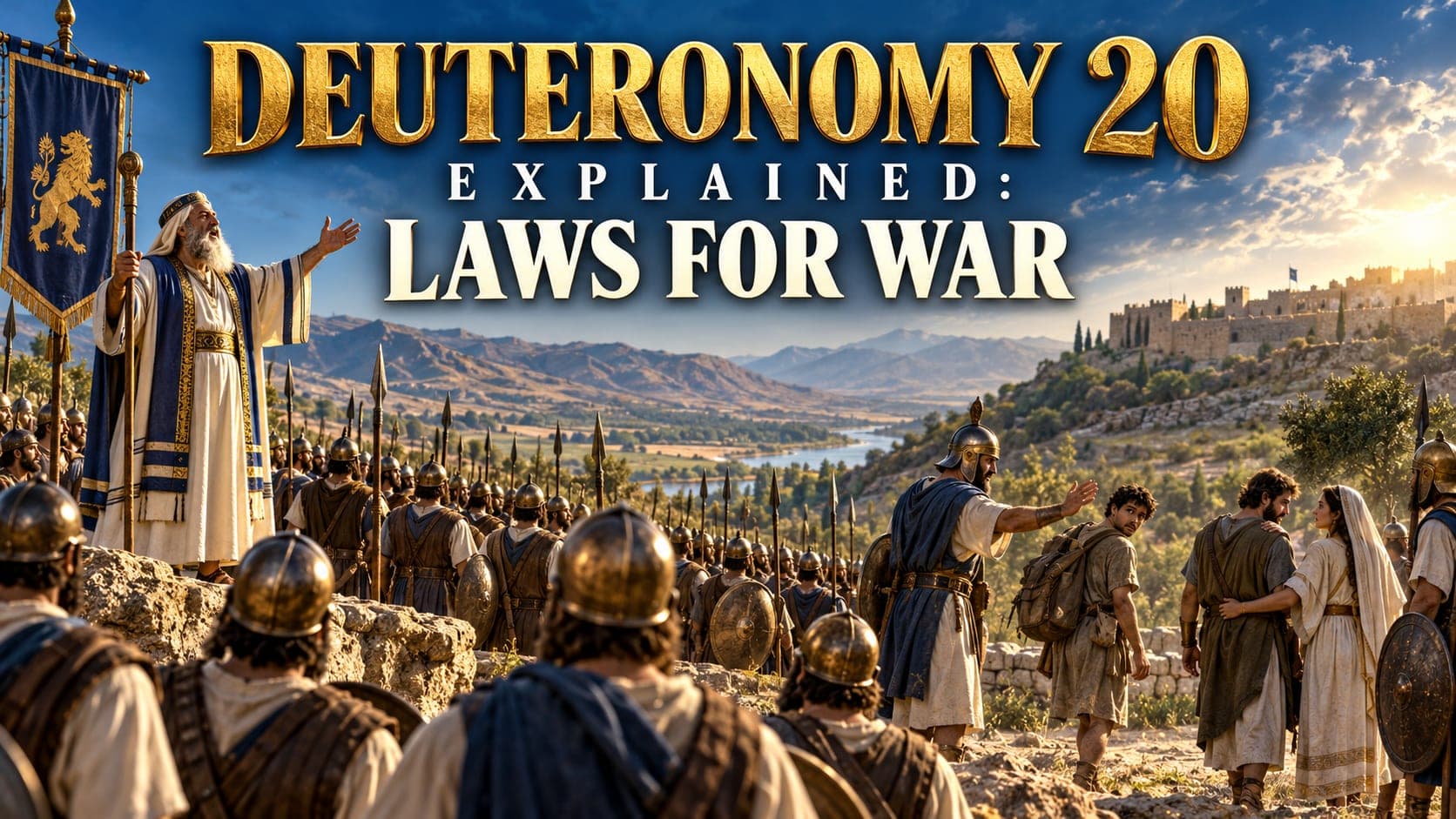
"And it shall be, when ye are come nigh unto the battle, that the priest shall approach and speak unto the people, And shall say unto them, Hear, O Israel, ye approach this day unto battle against your enemies: let not your hearts faint, fear not, and do not tremble, neither be ye terrified because of them;"
💡 A priest, not a general, gives the pep talk. Courage in this chapter is not a motivational trick. It is a theological claim the priest is responsible to speak out loud at the exact moment fear would otherwise win.
"For the LORD your God is he that goeth with you, to fight for you against your enemies, to save you."
Israel still had to march, still had to swing a sword, still had to stand in the line. But the verse is clear about who the chapter credits with the actual victory.
2. Four Reasons an Officer Sends a Man Home (verses 5 to 9)
Before anyone fights, the officers walk the ranks and start pulling men out of it.
"And the officers shall speak unto the people, saying, What man is there that hath built a new house, and hath not dedicated it? let him go and return to his house, lest he die in the battle, and another man dedicate it."
"And what man is he that hath planted a vineyard, and hath not yet eaten of it? let him also go and return unto his house, lest he die in the battle, and another man eat of it."
"And what man is there that hath betrothed a wife, and hath not taken her? let him go and return unto his house, lest he die in the battle, and another man take her."
📌 Three men are excused for the same reason stated three different ways: each one started something good and has not yet finished it. A house not yet lived in. A vineyard not yet tasted. A wife not yet married. Moses will not send a man to die with his life's work still unfinished behind him while someone else inherits it.
The fourth man excused has nothing unfinished at all.
"And the officers shall speak further unto the people, and they shall say, What man is there that is fearful and fainthearted? let him go and return unto his house, lest his brethren’s heart faint as well as his heart."
⚠️ Notice the stated reason is not embarrassment for the frightened man. It is protection for everyone standing next to him. Fear spreads through a line of soldiers faster than courage does, and Moses treats that as a fact to plan around, not a weakness to shame.
"And it shall be, when the officers have made an end of speaking unto the people, that they shall make captains of the armies to lead the people."
3. An Offer of Peace Before a Single Arrow Flies (verses 10 to 15)
Once the army is sorted, Moses gives the rule for any city outside the land itself.
"When thou comest nigh unto a city to fight against it, then proclaim peace unto it."
"And it shall be, if it make thee answer of peace, and open unto thee, then it shall be, that all the people that is found therein shall be tributaries unto thee, and they shall serve thee."
💡 Peace was the first offer, not the fallback. A city that surrendered kept its people alive. They became tributaries, paying tax and serving Israel, hard terms, but terms that let an entire population go on living.
Moses does not pretend every city would take that offer.
"And if it will make no peace with thee, but will make war against thee, then thou shalt besiege it:"
"And when the LORD thy God hath delivered it into thine hands, thou shalt smite every male thereof with the edge of the sword: But the women, and the little ones, and the cattle, and all that is in the city, even all the spoil thereof, shalt thou take unto thyself; and thou shalt eat the spoil of thine enemies, which the LORD thy God hath given thee."
A rejected offer of peace led to a harsh outcome for the men of that city, but women and children were spared and taken in rather than destroyed. This is the rule for cities outside Canaan itself, and Moses states that limit plainly in the very next verse.
"Thus shalt thou do unto all the cities which are very far off from thee, which are not of the cities of these nations."
4. No Peace Offer for the Nations Already in the Land (verses 16 to 18)
Verse 15 drew a line. Verse 16 names exactly who stands on the other side of it.
"But of the cities of these people, which the LORD thy God doth give thee for an inheritance, thou shalt save alive nothing that breatheth:"
"But thou shalt utterly destroy them; namely, the Hittites, and the Amorites, the Canaanites, and the Perizzites, the Hivites, and the Jebusites; as the LORD thy God hath commanded thee:"
Six named nations, the same group named throughout Deuteronomy, already living inside the exact borders of the land God promised to Israel. This command is not aimed at distant enemies in some future war. It is aimed at the specific population already occupying the inheritance Israel is about to receive.
Verse 18 states the reason, in Moses' own words, before anyone has to guess at it.
"That they teach you not to do after all their abominations, which they have done unto their gods; so should ye sin against the LORD your God."
📌 The stated reason is religious contamination, not ethnicity. Deuteronomy 9 already made the same point from the other direction: Israel was not given this land for its own righteousness. Here Moses gives the matching half of that claim. These nations are not removed for who they were born. They are removed for what their worship would teach Israel to become.
5. The Law That Protects a Tree in the Middle of a Siege (verses 19 and 20)
After the hardest verses in the chapter, Moses ends with an order almost nobody expects.
"When thou shalt besiege a city a long time, in making war against it to take it, thou shalt not destroy the trees thereof by forcing an axe against them: for thou mayest eat of them, and thou shalt not cut them down (for the tree of the field is man’s life) to employ them in the siege:"
💡 "The tree of the field is man's life" is the plainest line in the whole chapter. A fruit tree feeds people for years. Cutting it down for a few days of siege ramp gains almost nothing and destroys a food supply that outlasts the war itself, for whichever side eventually eats from it.
A second verse draws the line between what is protected and what is not.
"Only the trees which thou knowest that they be not trees for meat, thou shalt destroy and cut them down; and thou shalt build bulwarks against the city that maketh war with thee, until it be subdued."
A "bulwark" is a siege rampart or earthwork, built from whatever non fruit timber was on hand. 📌 Even at the furthest edge of a chapter about warfare, Moses still draws a line between what war requires and what it merely wastes.

Hard Questions Deuteronomy 20 Raises
Why do distant cities get an offer of peace while the nations already in the land get none? The text draws this line itself in verses 15 and 16. Cities "very far off" and "not of the cities of these nations" receive the peace offer of verse 10. The six nations named in verse 17, already living inside the exact land God promised Israel, are placed under a separate and harsher command. This is not Israel choosing harsher treatment for whichever enemy it happens to meet. Moses sets two different categories before a single battle has even started.
Is the command in verses 16 and 17 a call for Israel to commit genocide? What the text says is narrower than that word suggests. The command names six specific nations, inside one specific land, tied to one stated reason in verse 18: stopping their religious practices from spreading into Israel's worship. It is not a general rule for how Israel is to treat any enemy anywhere, and Deuteronomy 7 repeats the same limited scope. How Christians weigh the command's severity still varies. Some read it as a unique act of judgment on nations whose worship included practices Scripture elsewhere calls abominable, carried out at one moment in redemptive history that does not repeat. Others point out that Judges 1 records many of these same nations still living in the land afterward, which suggests the command's language of total destruction functioned, at least in part, as the kind of sweeping victory language common across ancient Near Eastern war accounts, read against a result that Scripture itself shows was not literally total. Both views take the text seriously; they differ on how literally to press "save alive nothing that breatheth."
Does Deuteronomy 20 contradict Jesus telling His followers to love their enemies? Jesus teaches personal enemy love in the Sermon on the Mount, one person's response to someone who wrongs them directly. Deuteronomy 20 is a national war code for a covenant people living under a government God Himself was directing at a specific moment in history. A command about how an ancient nation conducted war under direct divine instruction is not the same kind of statement as an instruction for how an individual treats a personal enemy today, and the New Testament never applies this chapter as a pattern for Christian behavior now.
Why protect fruit trees in verse 19 while commanding the destruction of whole cities in verse 16? The two commands are not weighed against each other by the same scale. The command regarding the six nations is about ending a specific religious threat to Israel's covenant. The fruit tree law is about what any war, against anyone, actually needs to accomplish its goal. Even a chapter willing to command the harshest outcome for one specific enemy still refuses to let Israel destroy something with no military purpose at all.
Top Verses From Deuteronomy 20
1. Deuteronomy 20:4
"For the LORD your God is he that goeth with you, to fight for you against your enemies, to save you."
A priest spoke this line to soldiers staring at a bigger army than their own. It names who the chapter actually credits with the victory before a single sword is drawn.
2. Deuteronomy 20:1
"When thou goest out to battle against thine enemies, and seest horses, and chariots, and a people more than thou, be not afraid of them: for the LORD thy God is with thee, which brought thee up out of the land of Egypt."
Fear in this verse is tied to what the eyes can count: horses, chariots, numbers. The command not to fear is tied to something the eyes cannot count at all.
3. Deuteronomy 20:8
"And the officers shall speak further unto the people, and they shall say, What man is there that is fearful and fainthearted? let him go and return unto his house, lest his brethren’s heart faint as well as his heart."
Fear is treated as something that spreads, not something to hide or shame. Moses builds an army that protects its own morale rather than pretending everyone is fearless.
4. Deuteronomy 20:10
"When thou comest nigh unto a city to fight against it, then proclaim peace unto it."
Peace is the opening move, not the last resort tried after everything else fails. A city that said yes kept its people alive.
5. Deuteronomy 20:19
"When thou shalt besiege a city a long time, in making war against it to take it, thou shalt not destroy the trees thereof by forcing an axe against them: for thou mayest eat of them, and thou shalt not cut them down (for the tree of the field is man’s life) to employ them in the siege:"
A rule about trees sitting right beside the hardest verses in the chapter. Even here, Moses will not let destruction become a habit instead of a last necessity.

Frequently Asked Questions About Deuteronomy 20
What is Deuteronomy 20 about?
Deuteronomy 20 lays out Israel's rules for war: why soldiers should not fear a larger enemy army, which men are excused from fighting, the offer of peace given to distant cities, the command against the nations already living in Canaan, and a law protecting fruit trees during a siege.
Why did a priest speak to the army instead of a military commander?
Verses 2 and 3 have the priest, not a general, remind the soldiers that the LORD goes with them. The chapter treats courage before battle as a matter tied directly to Israel's relationship with God, not only to military strategy.
Who was excused from fighting in Israel's army?
Four kinds of men: someone with a new house he had not yet dedicated, someone with a new vineyard he had not yet eaten from, someone betrothed to a wife he had not yet married, and anyone who was fearful or fainthearted.
Why were fearful soldiers sent home instead of made to fight anyway?
Verse 8 gives the stated reason: fear in one man could spread and weaken the resolve of the soldiers around him. Sending him home protected the whole army's courage, not just his own comfort.
What happened to a city that accepted Israel's offer of peace?
Verse 11 says its people became tributaries who served Israel. The terms were not easy, but accepting peace kept the entire population alive rather than facing a siege.
Why were the nations already in Canaan treated differently than distant cities?
Verses 16 through 18 state the reason directly: these specific nations would teach Israel to copy their religious practices, which Moses calls abominations. The command is tied to that specific danger, not to warfare against any enemy in general.
Does Deuteronomy 20 mean God commands genocide?
The command in this chapter names six specific nations in one specific land for one stated reason, rather than setting a general rule for how Israel treats any enemy. Christians read its severity differently, and Judges 1 shows these same nations still living in the land afterward, but the text itself limits the command's scope rather than leaving it open ended.
Why does the chapter protect fruit trees during a siege?
Verse 19 calls a fruit tree "man's life" because it feeds people for years, far longer than the siege itself lasts. Only trees that did not produce food could be cut down for building siege works.
Does this chapter apply to how nations should fight wars today?
Deuteronomy 20 was written for Israel under a specific covenant with God at a specific point in its history, not as a universal manual for any nation's army. Christians generally read it as describing that particular moment rather than as standing law for every war since.
Final Thoughts
Deuteronomy 20 refuses to let war become either cowardice or cruelty without limits.
📌 Fear gets named out loud instead of hidden. A priest spoke to an army staring down chariots, and officers sent home anyone whose fear could spread to the man beside him.
📌 Peace was always offered first. A distant city that said yes to verse 10 kept its people alive. Only a refusal led anywhere near a siege.
📌 Even the hardest command in the chapter is not the whole chapter. The nations named in verse 17 faced a severe judgment for a stated reason, and the very next verses still refuse to let that severity spill over into destroying a fruit tree that served no purpose in the fight.
You are probably not marching toward a literal battlefield this week. But you do face moments that feel like staring at horses and chariots: a diagnosis, a decision, a fight you did not pick.
So here is your one next step.
Name the thing in front of you that looks bigger than you are, and read Deuteronomy 20:4 over it before you decide how afraid to be.