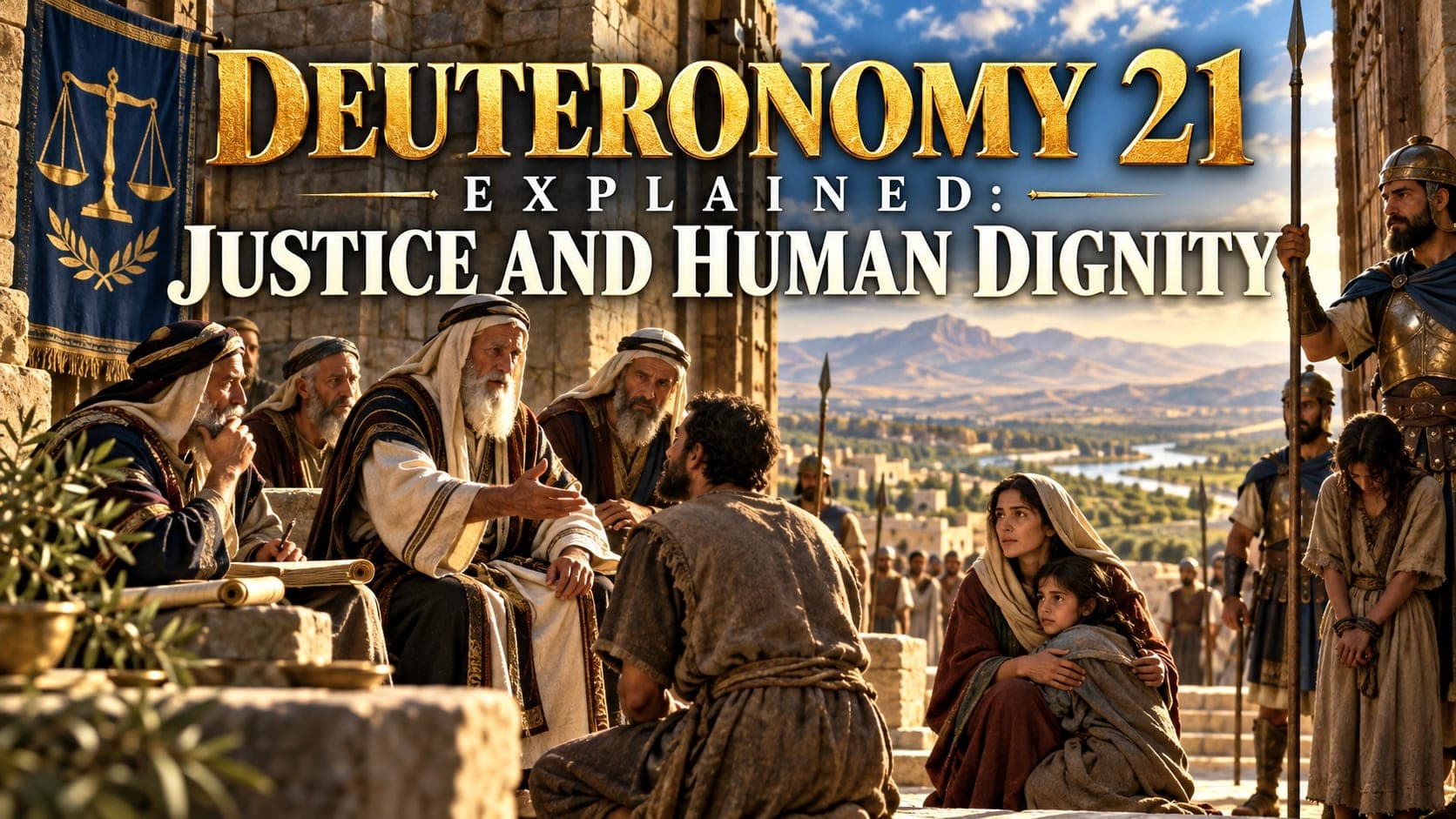
📖 Deuteronomy 21 Explained: Bloodguilt, Inheritance, and the Curse on a Tree
A body is found in a field. No weapon. No witness. No name for who did it.
Deuteronomy 21 explained is Moses answering four very different situations where the normal rules of evidence and justice run out: an unsolved killing with no suspect, a woman taken home from a war Israel did not start the way she wanted it, a father with two wives and an inheritance problem he did not create, and a son who has become more than his parents can handle.
You may have read this chapter once and skipped past it as four unrelated laws with nothing in common.
- ❓ Why does killing a cow fix a murder nobody confessed to?
- ❓ What is actually happening when the elders wash their hands?
- ❓ Why does a firstborn son keep his double share even if his father cannot stand his mother?
- ❓ What does "cursed is he that hangeth on a tree" have to do with Jesus?
📌 Every law in this chapter exists to stop someone with more power, speed, or grief than sense from writing the ending before the truth catches up.
Twenty three verses, moving from an empty field to a courtroom gate to a dead body still hanging where the law says it cannot stay.
Read slowly. The last verse alone is quoted by Paul to explain the cross.
What Happened Just Before This Chapter
Deuteronomy 20 set the rules for war before Israel had fought a single battle in Canaan: who was excused from fighting, which cities got offered peace, and the strange command to spare fruit trees even in a siege. That chapter was about what an army could and could not do to an enemy.
Deuteronomy 21 narrows the lens to four situations that same army, and that same settled nation, would actually run into once the fighting stopped: a corpse with no known killer, a captive brought home from one of those wars, a family with more than one wife, and a son who will not be corrected. The subject changes completely four times in one chapter, but the concern underneath it does not. Every case here is a moment where someone could get hurt twice, once by the original wrong, and again by a response to it that nobody actually checked.

Deuteronomy 21 Explained Verse by Verse
1. A Body in a Field, and a Heifer That Answers For It (verses 1 to 9)
Moses opens with the one kind of killing none of the earlier laws can touch: nobody knows who did it.
"If one be found slain in the land which the LORD thy God giveth thee to possess it, lying in the field, and it be not known who hath slain him: Then thy elders and thy judges shall come forth, and they shall measure unto the cities which are round about him that is slain:"
📌 No suspect means no trial. Deuteronomy 19 already gave Israel a careful process for a known killer, but that process has nothing to work with here. So instead of a trial, Moses gives a measurement. Officials literally pace out the distance from the body to every nearby town, because the town that turns out to be closest carries the weight of what happens next, whether its people had anything to do with the death or not.
"And it shall be, that the city which is next unto the slain man, even the elders of that city shall take an heifer, which hath not been wrought with, and which hath not drawn in the yoke; And the elders of that city shall bring down the heifer unto a rough valley, which is neither eared nor sown, and shall strike off the heifer’s neck there in the valley:"
💡 Notice what this is not. There is no altar here, no fire, no priest lifting anything up to God. The heifer has never worked and never worn a yoke. The valley has never been plowed or planted. Everything about the scene is deliberately unused, untouched by ordinary life, because this is not a sacrifice for sin. It is a visible, physical way of saying that a life was taken here and the debt for it has now been paid in the one place closest to where it happened.
Priests are present, but watch exactly what they are given to do.
"And the priests the sons of Levi shall come near; for them the LORD thy God hath chosen to minister unto him, and to bless in the name of the LORD; and by their word shall every controversy and every stroke be tried:"
The priests do not kill the heifer and do not offer it. They stand as the recognized authority who can declare the matter settled, the same role Deuteronomy 17 gave them over hard disputes. The actual act belongs to the elders of the town.
"And all the elders of that city, that are next unto the slain man, shall wash their hands over the heifer that is beheaded in the valley: And they shall answer and say, Our hands have not shed this blood, neither have our eyes seen it."
📌 Washing the hands and declaring innocence out loud is not a private feeling. It is a formal, public statement the elders are putting their own names behind. More than a thousand years later, a Roman governor performs the exact same gesture over a death he knows is wrong, and uses almost the same words.
"When Pilate saw that he could prevail nothing, but that rather a tumult was made, he took water, and washed his hands before the multitude, saying, I am innocent of the blood of this just person: see ye to it."
⚠️ The difference matters as much as the echo. The elders of Deuteronomy 21 genuinely do not know who killed the man in the field. Pilate knows exactly who is about to be crucified and washes his hands anyway, trying to borrow a gesture of real innocence to cover a decision he is making with his eyes open. The same motion can be an honest confession or a performance, depending on what is actually true when the hands go into the water.
Moses closes the ritual with the actual request behind it.
"Be merciful, O LORD, unto thy people Israel, whom thou hast redeemed, and lay not innocent blood unto thy people of Israel’s charge. And the blood shall be forgiven them. So shalt thou put away the guilt of innocent blood from among you, when thou shalt do that which is right in the sight of the LORD."
💡 The whole nation, not just one town, is called "Israel" in that prayer. An unsolved death left sitting in the land was never just one town's problem in this way of thinking. It was a debt the entire covenant people carried until someone, somewhere, formally acknowledged it before God.
2. A Captive Brought Home as a Wife (verses 10 to 14)
Moses moves from an unsolved death straight into the aftermath of the wars Deuteronomy 20 just described.
"When thou goest forth to war against thine enemies, and the LORD thy God hath delivered them into thine hands, and thou hast taken them captive, And seest among the captives a beautiful woman, and hast a desire unto her, that thou wouldest have her to thy wife;"
⚠️ Read this plainly before explaining it: a woman has just lost her home, and likely her family, in a war she had no voice in. Whatever this law regulates, it is not describing a happy beginning. The text itself will say so directly in a few verses.
What it regulates is what happens to her next, and the regulation is not left vague.
"Then thou shalt bring her home to thine house; and she shall shave her head, and pare her nails; And she shall put the raiment of her captivity from off her, and shall remain in thine house, and bewail her father and her mother a full month: and after that thou shalt go in unto her, and be her husband, and she shall be thy wife."
📌 A full month, inside his own house, before marriage can even happen. Shaving the head and paring the nails were recognized mourning practices, the same kind of outward sign of grief Israel used elsewhere. The captivity clothing comes off. And she is given thirty days to weep for the parents she has just lost, not to be quietly absorbed into a new household the same week her old one was destroyed. Whatever else this law is, it refuses to let a man skip straight from the battlefield to a wedding.
"And it shall be, if thou have no delight in her, then thou shalt let her go whither she will; but thou shalt not sell her at all for money, thou shalt not make merchandise of her, because thou hast humbled her."
📌 "Because thou hast humbled her" is the text itself naming real harm, not approving of none. If the marriage does not last, he cannot sell her, cannot treat her as property to be cashed out, cannot profit twice from what the war already cost her. She leaves as a free woman, wherever she chooses to go. In a world where war captives were routinely kept, sold, or discarded with no standing at all, the law refuses him two of the three, and the one it allows still comes with a month of mourning and a real marriage attached, not a transaction.
3. The Firstborn Keeps His Share, Even From a Marriage Gone Cold (verses 15 to 17)
Moses turns from a man's war to a man's household, and the exact problem polygamy kept creating.
"If a man have two wives, one beloved, and another hated, and they have born him children, both the beloved and the hated; and if the firstborn son be hers that was hated:"
"Hated" here does not necessarily mean cruelty. It is the same word Scripture uses for Leah, loved less than her sister Rachel, a comparative kind of language for the wife who simply was not the favorite. This was not a hypothetical scenario for Israel's first family. It was their own family history.
"Then it shall be, when he maketh his sons to inherit that which he hath, that he may not make the son of the beloved firstborn before the son of the hated, which is indeed the firstborn: But he shall acknowledge the son of the hated for the firstborn, by giving him a double portion of all that he hath: for he is the beginning of his strength; the right of the firstborn is his."
📌 A father's feelings about a wife are not allowed to rewrite a son's legal standing. The firstborn gets the double portion because he is the firstborn, a fact of birth order that a father's preference, however strong, cannot override. Favoritism was common in this culture. Moses makes it illegal to let favoritism touch inheritance.
💡 The law has a limit worth noticing. It blocks favoritism, not consequences. When Jacob later gave Joseph's line the double portion instead of his actual firstborn, it was not because he loved Rachel's side of the family more. 1 Chronicles 5:1 states the reason in plain terms.
"Now the sons of Reuben the firstborn of Israel, (for he was the firstborn; but, forasmuch as he defiled his father’s bed, his birthright was given unto the sons of Joseph the son of Israel: and the genealogy is not to be reckoned after the birthright."
Reuben lost his birthright for what he did, not for who his mother was. Deuteronomy 21:15 to 17 was never written to protect a son from his own actions. It was written to protect him from his father's preference for somebody else's mother.
4. A Son His Own Parents Cannot Reach (verses 18 to 21)
From inheritance, Moses turns to the hardest relationship in the chapter.
"If a man have a stubborn and rebellious son, which will not obey the voice of his father, or the voice of his mother, and that, when they have chastened him, will not hearken unto them:"
💡 Notice this is not one bad afternoon. "Will not obey" and "when they have chastened him, will not hearken" describe a pattern that has already been corrected and failed to correct, not a single flare of teenage temper.
"Then shall his father and his mother lay hold on him, and bring him out unto the elders of his city, and unto the gate of his place; And they shall say unto the elders of his city, This our son is stubborn and rebellious, he will not obey our voice; he is a glutton, and a drunkard."
📌 Both parents, together, by name, in public, before the elders. In much of the ancient world a father held the power to deal with a defiant child inside his own household, with no outside check on how. Moses removes that power entirely. A father cannot act alone on his own authority, cannot act in private, and needs his wife's agreement standing beside his own before the case is even heard.
"And all the men of his city shall stone him with stones, that he die: so shalt thou put evil away from among you; and all Israel shall hear, and fear."
⚠️ This is the hardest verse in the chapter, and it deserves an honest look rather than a quick skip, which the Hard Questions section below takes directly.
5. A Body That Cannot Be Left Hanging (verses 22 and 23)
The chapter ends on a short, specific rule about what happens after an execution.
"And if a man have committed a sin worthy of death, and he be to be put to death, and thou hang him on a tree:"
"His body shall not remain all night upon the tree, but thou shalt in any wise bury him that day; (for he that is hanged is accursed of God;) that thy land be not defiled, which the LORD thy God giveth thee for an inheritance."
💡 Displaying an executed body publicly was common practice in the ancient world. Moses sets a hard limit on it here: buried the same day, every time, because a hanging body left exposed was treated as a defilement of the very land God had given Israel to live on.
📌 Paul reaches back across more than a thousand years and quotes this exact verse to explain what happened on the cross.
"Christ hath redeemed us from the curse of the law, being made a curse for us: for it is written, Cursed is every one that hangeth on a tree:"
Jesus had broken no law worthy of death. Deuteronomy 21:23 describes a curse that belonged to a guilty man. Paul says Christ took exactly that curse, the one this verse names, though it was never His to carry.

Hard Questions Deuteronomy 21 Raises
Why does an entire town have to perform a ritual for a murder nobody in it committed? The text never accuses the townspeople of the killing. The ritual is not a confession of guilt. It is a formal acknowledgment that a life was taken on the land they are responsible for, and that the debt for it will not simply be ignored because no one was caught. The nearest town carries the weight of proximity, not the weight of suspicion.
Does Deuteronomy 21:18 to 21 really mean parents could have a disobedient teenager executed? The plain words describe a severe, sustained pattern, "stubborn," "rebellious," already "chastened" without effect, "a glutton, and a drunkard," not a single episode of backtalk. No narrative anywhere in Scripture records this law ever being carried out. Later Jewish legal tradition set the conditions for applying it so narrowly, requiring both parents to agree on every detail and more, that many rabbis concluded it described an extreme case meant to warn, more than a sentence meant to be regularly carried out. The requirement that both parents agree, in public, before the elders, was itself already a serious check on any parent acting alone out of simple frustration.
Is Deuteronomy 21:10 to 14 approving of what happens to a woman taken captive in war? The law itself calls it humbling her, which is the text naming real harm rather than celebrating a conquest. Set against how war captives were commonly treated in the ancient world, kept, sold, or discarded with no standing at all, this law forces a month of mourning before marriage, requires an actual marriage rather than concubinage, and forbids selling her if it ends. Numbers 31 shows the same era's wars could be brutal; this law limits what a victor could do with one of their outcomes, rather than removing the outcome's harm altogether.
Why would God's own law call being hanged on a tree a curse, and then let that describe His Son's death? That is exactly the tension Paul is working with in Galatians 3:13. The curse named in Deuteronomy 21:23 was real and was always meant for someone guilty. Paul's point is not that the verse stopped being true. It is that Jesus, who was not guilty, was treated as though the curse belonged to Him, so that it would not have to belong to anyone who trusts Him instead.
Top Verses From Deuteronomy 21
1. Deuteronomy 21:23
"His body shall not remain all night upon the tree, but thou shalt in any wise bury him that day; (for he that is hanged is accursed of God;) that thy land be not defiled, which the LORD thy God giveth thee for an inheritance."
The verse Paul quotes directly to explain the cross in Galatians 3:13. A curse written for a guilty man, carried instead by one who was not.
2. Deuteronomy 21:6 and 7
"And all the elders of that city, that are next unto the slain man, shall wash their hands over the heifer that is beheaded in the valley: And they shall answer and say, Our hands have not shed this blood, neither have our eyes seen it."
A gesture Pilate borrows more than a thousand years later, over a death he actually caused instead of one he had no part in.
3. Deuteronomy 21:17
"But he shall acknowledge the son of the hated for the firstborn, by giving him a double portion of all that he hath: for he is the beginning of his strength; the right of the firstborn is his."
A son's legal standing, protected from his father's feelings about his mother. Birth order decided this, not affection.
4. Deuteronomy 21:14
"And it shall be, if thou have no delight in her, then thou shalt let her go whither she will; but thou shalt not sell her at all for money, thou shalt not make merchandise of her, because thou hast humbled her."
The law names the harm plainly instead of pretending it away, and still refuses to let a man profit twice from it.
5. Galatians 3:13
"Christ hath redeemed us from the curse of the law, being made a curse for us: for it is written, Cursed is every one that hangeth on a tree:"
Paul names Deuteronomy 21:23 outright and applies it to Jesus, a curse written for the guilty, carried by someone who was not.

Frequently Asked Questions About Deuteronomy 21
What is Deuteronomy 21 about?
Deuteronomy 21 covers four situations: a ritual for an unsolved murder with no known killer, the treatment of a woman taken captive in war and married, the inheritance rights of a firstborn son from an unloved wife, the process for a persistently rebellious son, and a rule requiring an executed body to be buried the same day.
What was the heifer ritual for an unsolved murder?
The nearest town's elders killed a heifer that had never worked in an unplowed valley, washed their hands over it, and declared their innocence before the LORD. It was not a sacrifice at an altar. It was a formal, public way of acknowledging an unsolved death and asking God to forgive the guilt of blood that no one could be tried for.
Why did the elders wash their hands in Deuteronomy 21?
Washing the hands was a formal declaration of innocence, backed by the spoken words "our hands have not shed this blood, neither have our eyes seen it." Pilate performs the same gesture in Matthew 27:24, though in his case to distance himself from a death he actually had the power to stop.
What does Deuteronomy 21 say about a captive woman taken as a wife?
She had to be brought into the man's house, given a full month to mourn her parents and leave behind the clothing of her captivity, and only then could the marriage happen. If he later had no delight in her, he had to let her go free and was forbidden from selling her, because the text says plainly that he had humbled her.
What is the double portion law for a firstborn son?
If a man had two wives and loved one more than the other, he still had to give his actual firstborn son a double share of the inheritance, even if that son's mother was the wife he favored less. A father's personal feelings could not override birth order in Deuteronomy 21:15 to 17.
Why was Leah called "hated" in the Bible?
Genesis 29:31 uses the word in a comparative sense, meaning loved less than her sister Rachel, not literal cruelty. It is the same kind of language Deuteronomy 21:15 uses for the less favored of two wives, describing Israel's own first family rather than a hypothetical case.
Does Deuteronomy 21 allow parents to have a rebellious child stoned?
The text describes a severe, repeated pattern that correction has already failed to fix, not an ordinary act of teenage disobedience, and it requires both parents to agree and bring the case publicly before the elders rather than letting a father act alone. No story in the Bible records this law ever being carried out.
Was the rebellious son law in Deuteronomy 21 ever actually used?
Scripture never records a single case of it happening. Later Jewish legal tradition narrowed the conditions for applying it so far that many rabbis treated it as a strong warning against the direction a child's defiance could lead, rather than a sentence meant to be regularly carried out.
What does "cursed is he that hangeth on a tree" mean?
It meant an executed body left displayed on a tree was treated as a curse that defiled the land, which is why Deuteronomy 21:23 required same day burial. Paul quotes this exact verse in Galatians 3:13 to describe what Christ took on at the cross.
How does Deuteronomy 21:23 connect to Jesus on the cross?
Galatians 3:13 names this verse directly and says Christ was made a curse for His people, the same curse Deuteronomy 21:23 attaches to someone hanged on a tree, even though Jesus had done nothing that made Him deserve it.
Why does this chapter cover four such different topics?
An unsolved killing, a war captive, an inheritance dispute, and a rebellious son do not share a subject, but they share a shape: each one is a situation where someone with more power, speed, or grief than patience could act before the truth or the law actually caught up, and Moses builds a check into every single one.
Final Thoughts
Deuteronomy 21 keeps circling back to the same instinct in four unrelated situations.
📌 An unanswered question is not the same as no answer at all. A murder with no known killer still had to be formally acknowledged before God, never simply forgotten because nobody could be tried for it.
📌 The law protects people from being treated as leftovers. A grieving captive gets a month before marriage and cannot be sold later. A firstborn keeps his share no matter which wife his father preferred.
📌 A curse written for the guilty became the curse Christ carried. Deuteronomy 21:23 names exactly what Galatians 3:13 says Jesus took on, in a trade only grace explains.
You will probably never wash your hands over a heifer or bring a case to a city gate. But you make smaller versions of these same calls most weeks: whether to let an unresolved situation sit honestly instead of pretending it is settled, and whether to treat someone who already lost something as a leftover or as a person still owed real care.
So here is your one next step.
Name one unresolved thing you have been treating as settled, and bring it honestly before God the way this chapter refused to let Israel skip that step.