📖 Deuteronomy 7 Explained: No Covenant, No Compromise, No Fear
Seven nations. No treaty. No marriage. No pity.
Deuteronomy 7 explained is Moses telling Israel exactly how to enter a land already full of people, cities, and gods, without quietly becoming just another nation that worships whatever is popular where it lives. The command is hard to read. The reason behind it is not what most people assume.
Maybe you have wondered why a book about loving God spends a whole chapter on war.
- ❓ Why does God tell Israel to show no mercy to seven named nations?
- ❓ Why forbid marriage, of all things, as the danger to guard against?
- ❓ Does "the fewest of all people" even make sense for a nation that just left Egypt as a multitude?
- ❓ Why clear out the land little by little instead of all at once?
📌 Every hard command in this chapter traces back to one stated reason, said out loud in the middle of it: these nations will turn your heart toward their gods, and that is the only outcome Moses is actually trying to prevent.
This walkthrough goes through the whole chapter in order: the ban on covenants and marriage, the reason Israel was chosen that has nothing to do with being impressive, the blessings promised for obedience, the command not to be afraid, the slow pace of the conquest, and the warning not to even keep the gold off a melted down idol.
Twenty six verses, and almost none of them are really about the seven nations at all.
What Happened Just Before This Chapter
Deuteronomy 6 gave Israel the Shema and a plan to keep loving God with everything they had, woven into every ordinary hour of the day. It also warned about the one danger Moses already saw coming: a full table in the promised land making God easy to forget.
Deuteronomy 7 names a second danger sitting right beside the first one. Before Israel can even settle in and grow comfortable, they first have to walk into a land where seven established nations are already living, worshiping gods Israel has never had to resist up close before. This chapter is Moses setting the terms for that entrance, and almost every term exists to protect the command he just finished giving.

Deuteronomy 7 Explained Verse by Verse
1. No Covenant, No Marriage (verses 1 to 5)
Moses opens with the list itself, naming every nation Israel will meet in the land.
"When the LORD thy God shall bring thee into the land whither thou goest to possess it, and hath cast out many nations before thee, the Hittites, and the Girgashites, and the Amorites, and the Canaanites, and the Perizzites, and the Hivites, and the Jebusites, seven nations greater and mightier than thou;"
📌 Notice who Moses says is greater and mightier. Not Israel. The seven nations about to be driven out are the stronger side on paper, walled cities and established kings against a people who just spent forty years in tents. Whatever happens next will not be explained by Israel's own strength.
Then comes the part readers tend to flinch at.
"And when the LORD thy God shall deliver them before thee; thou shalt smite them, and utterly destroy them; thou shalt make no covenant with them, nor shew mercy unto them: Neither shalt thou make marriages with them; thy daughter thou shalt not give unto his son, nor his daughter shalt thou take unto thy son."
⚠️ "Shew mercy" here is a covenant term, not a claim about Israel's emotions. The same phrase describes the loyalty a treaty partner owes another nation. Moses is forbidding a political alliance and a family alliance, not commanding Israel to feel nothing. The ban on marriage sits right next to the ban on treaties because, in that world, the two usually sealed the same kind of arrangement.
Moses states the reason immediately, without making Israel guess at it.
"For they will turn away thy son from following me, that they may serve other gods: so will the anger of the LORD be kindled against you, and destroy thee suddenly."
📌 The danger named is not foreign blood. It is foreign worship. Moses does not say these marriages are forbidden because the nations are different people. He says exactly what he is afraid of: a son pulled toward other gods inside his own home, by the very family meant to teach him the Shema. Numbers 25 had already shown Israel this exact failure happening in real time, Israelite men joining Moabite worship through the relationships they formed at Baalpeor, with a plague as the result. Moses is not inventing a hypothetical risk here.
The command that follows is just as specific as the warning.
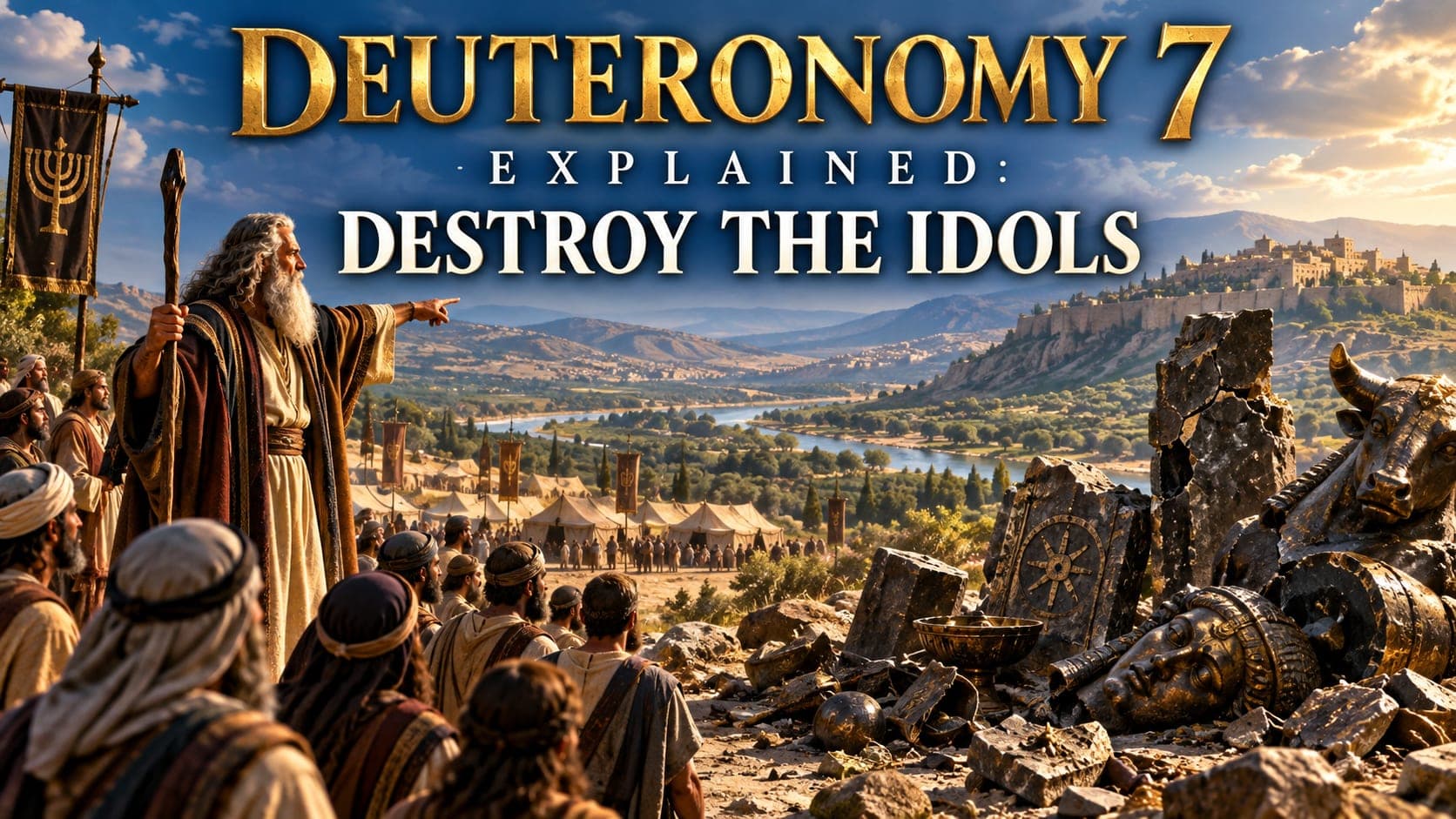
"But thus shall ye deal with them; ye shall destroy their altars, and break down their images, and cut down their groves, and burn their graven images with fire."
💡 Every item on this list is a piece of worship infrastructure, not a person. Altars, images, groves, carved idols. The same instruction appears almost word for word in Exodus 34, given years earlier for the same reason: a land this full of active idolatry cannot simply absorb Israel without a fight for Israel's own loyalty.
2. Chosen Because Loved, Not Because Impressive (verses 6 to 11)
Moses now explains why any of this applies to Israel specifically.
"For thou art an holy people unto the LORD thy God: the LORD thy God hath chosen thee to be a special people unto himself, above all people that are upon the face of the earth."
That sentence could sound like flattery, the kind of line that makes a nation proud. Moses immediately takes the pride out of it.
"The LORD did not set his love upon you, nor choose you, because ye were more in number than any people; for ye were the fewest of all people: But because the LORD loved you, and because he would keep the oath which he had sworn unto your fathers, hath the LORD brought you out with a mighty hand, and redeemed you out of the house of bondmen, from the hand of Pharaoh king of Egypt."
📌 "The fewest of all people" is not about the size of the whole nation leaving Egypt. It is about the size of Israel next to the seven nations just named in verse 1. Compared to established, walled, fortified kingdoms that had lived in the land for generations, a people who had spent decades as wandering tent dwellers were the smaller, weaker side by any ordinary measure. Moses is not minimizing Exodus' description of a numerous people. He is comparing Israel to exactly the nations in front of them right now, and the comparison does not flatter Israel.
💡 The whole explanation for why Israel is in this moment at all comes down to love and a kept promise, nothing Israel earned by being large, strong, or impressive. That removes any room for Israel to read this chapter as a story about their own merit.
Moses then widens the point into a statement about God's own character.
"Know therefore that the LORD thy God, he is God, the faithful God, which keepeth covenant and mercy with them that love him and keep his commandments to a thousand generations; And repayeth them that hate him to their face, to destroy them: he will not be slack to him that hateth him, he will repay him to his face."
⚠️ The same God is described as keeping mercy for a thousand generations and repaying those who hate Him without delay. Both halves describe the same consistent character from two different directions. A God faithful enough to keep a promise for a thousand generations is also faithful enough not to quietly let real hatred of Him slide. Moses closes this section the same way he closes almost every section in this book.
"Thou shalt therefore keep the commandments, and the statutes, and the judgments, which I command thee this day, to do them."
3. What Obedience Actually Brings (verses 12 to 16)
Moses now lists what obedience earns, in concrete, physical terms a farming people would recognize instantly.
"Wherefore it shall come to pass, if ye hearken to these judgments, and keep, and do them, that the LORD thy God shall keep unto thee the covenant and the mercy which he sware unto thy fathers: And he will love thee, and bless thee, and multiply thee: he will also bless the fruit of thy womb, and the fruit of thy land, thy corn, and thy wine, and thine oil, the increase of thy kine, and the flocks of thy sheep, in the land which he sware unto thy fathers to give thee."
"Thou shalt be blessed above all people: there shall not be male or female barren among you, or among your cattle. And the LORD will take away from thee all sickness, and will put none of the evil diseases of Egypt, which thou knowest, upon thee; but will lay them upon all them that hate thee."
📌 Every blessing named here is ordinary life working the way it was supposed to. Children born, crops growing, animals bearing young, health instead of the diseases Egypt was known for. The promise is not a dramatic miracle on command. It is a whole life free of the quiet failures that haunted a people who had just come out of slavery.
Then the chapter turns back to the nations named at the very start.
"And thou shalt consume all the people which the LORD thy God shall deliver thee; thine eye shall have no pity upon them: neither shalt thou serve their gods; for that will be a snare unto thee."
💡 The chapter says plainly, in its own words, what the entire danger has been from verse one: "that will be a snare unto thee." Not a snare to the nations being displaced. A snare to Israel. The command is framed, every time Moses explains it, as protection for Israel's own loyalty, not punishment handed out for its own sake.
4. Do Not Be Afraid, Remember Egypt (verses 17 to 21)
Moses anticipates the exact fear Israel is about to feel and answers it before it has a chance to take hold.
"If thou shalt say in thine heart, These nations are more than I; how can I dispossess them? Thou shalt not be afraid of them: but shalt well remember what the LORD thy God did unto Pharaoh, and unto all Egypt; The great temptations which thine eyes saw, and the signs, and the wonders, and the mighty hand, and the stretched out arm, whereby the LORD thy God brought thee out: so shall the LORD thy God do unto all the people of whom thou art afraid."
📌 Moses does not tell Israel their fear is irrational. He tells them exactly where to point it instead. The same questions, how can I possibly face this, get answered with a specific memory, not a vague pep talk. Egypt was real, visible, and far more powerful than Israel on paper, and it still fell.
God then adds a detail with no clear modern parallel.
"Moreover the LORD thy God will send the hornet among them, until they that are left, and hide themselves from thee, be destroyed. Thou shalt not be affrighted at them: for the LORD thy God is among you, a mighty God and terrible."
⚠️ Whether "the hornet" names a literal swarm, a figure of speech for panic and confusion sent ahead of Israel's armies, or both, the text does not fully spell out, and any firm claim beyond that is guesswork rather than something the verse states. What the verse does state plainly is the reason fear gets no foothold: "the LORD thy God is among you."
5. Little by Little (verses 22 to 24)
Moses now corrects an assumption nobody said out loud: that total victory would arrive all at once.
"And the LORD thy God will put out those nations before thee by little and little: thou mayest not consume them at once, lest the beasts of the field increase upon thee."
💡 The pace itself is described as a mercy, not a delay to be impatient about. A land emptied of people in a single stroke would be overrun by wild animals before Israel could even settle it. Numbers 33 had already commanded Israel to drive out the land's inhabitants once they crossed over, and this verse explains why that process was always going to take time rather than a single campaign season.
The chapter does not soften what still has to happen along the way.
"But the LORD thy God shall deliver them unto thee, and shall destroy them with a mighty destruction, until they be destroyed. And he shall deliver their kings into thine hand, and thou shalt destroy their name from under heaven: there shall no man be able to stand before thee, until thou have destroyed them."
6. Not Even the Gold (verses 25 and 26)
Moses ends on a command small enough to miss, aimed at the one temptation everything else in the chapter overlooked.
"The graven images of their gods shall ye burn with fire: thou shalt not desire the silver or gold that is on them, nor take it unto thee, lest thou be snared therein: for it is an abomination to the LORD thy God."
"Neither shalt thou bring an abomination into thine house, lest thou be a cursed thing like it: but thou shalt utterly detest it, and thou shalt utterly abhor it; for it is a cursed thing."
📌 The word "snared" appears again here, the same word used ten verses earlier for serving the nations' gods. Moses is not worried only about Israel bowing to a statue. He is worried about Israel keeping the melted down metal of a destroyed idol as a souvenir, letting a profitable habit quietly survive the very thing it was attached to. An idol was dangerous even after it stopped being worshiped, because the desire that reached for it never automatically burned with the wood and stone.

Hard Questions Deuteronomy 7 Raises
Is this chapter commanding something like genocide? The text itself frames the command as judgment on persistent, entrenched idolatry rather than on ethnicity. Verse 4 states the reason as spiritual danger, turning Israel's sons toward other gods, not ancestry. The exceptions elsewhere in Scripture point the same direction: Rahab and her family are spared in Jericho, and the Gibeonites secure a treaty, both because of how they responded to Israel's God, not because of their bloodline. The sharpest honest answer is that this was a specific, time bound instruction tied to Israel's entry into a particular land at a particular moment, not a general pattern of warfare Scripture authorizes believers to repeat. The New Testament never repeats a command like it for the church.
Why forbid marriage specifically, instead of just forbidding idol worship directly? Marriage was the most common way ancient households absorbed a spouse's family gods alongside their own. Verse 4 names the actual mechanism Moses is worried about: a son raised partly inside a household still devoted to other gods. The ban targets the doorway the danger was most likely to walk through, not marriage itself as something inherently wrong.
How can "the fewest of all people" be true of a nation Exodus describes leaving Egypt in huge numbers? The comparison in verse 7 is explicitly against the seven nations named in verse 1, not against the rest of the ancient world. Compared to long established, fortified kingdoms that had occupied the land for generations, a people recently out of the wilderness were genuinely the smaller, weaker party, whatever their numbers were in absolute terms.
Did Israel actually carry out verses 2 and 5? Not fully. The book of Judges opens by listing nation after nation Israel failed to drive out completely, and the rest of Israel's history shows exactly the danger this chapter warned about, intermarriage and idol worship, becoming a recurring national problem rather than a risk that was avoided.
Top Verses From Deuteronomy 7
1. Deuteronomy 7:6
"For thou art an holy people unto the LORD thy God: the LORD thy God hath chosen thee to be a special people unto himself, above all people that are upon the face of the earth."
The identity the whole chapter is built to protect. Being set apart was never Israel's own achievement, which is exactly why the next two verses refuse to let them think it was.
2. Deuteronomy 7:7 and 8
"The LORD did not set his love upon you, nor choose you, because ye were more in number than any people; for ye were the fewest of all people: But because the LORD loved you, and because he would keep the oath which he had sworn unto your fathers, hath the LORD brought you out with a mighty hand, and redeemed you out of the house of bondmen, from the hand of Pharaoh king of Egypt."
The flattest statement in the Old Testament of why Israel was chosen at all. Love and a kept promise, with nothing in the sentence that Israel could take credit for.
3. Deuteronomy 7:9
"Know therefore that the LORD thy God, he is God, the faithful God, which keepeth covenant and mercy with them that love him and keep his commandments to a thousand generations;"
A promise of faithfulness stretched across a thousand generations, long after everyone Moses was speaking to had died, and still holding true for anyone who loves God today.
4. Deuteronomy 7:16
"And thou shalt consume all the people which the LORD thy God shall deliver thee; thine eye shall have no pity upon them: neither shalt thou serve their gods; for that will be a snare unto thee."
The verse that names the real target of every hard command in this chapter. The danger was always framed as a snare to Israel, not a verdict on the nations for its own sake.
5. Deuteronomy 7:21
"Thou shalt not be affrighted at them: for the LORD thy God is among you, a mighty God and terrible."
The short answer to the fear Moses knew Israel would feel standing in front of seven stronger nations. Not a denial of the danger, a bigger truth placed right beside it.

Frequently Asked Questions About Deuteronomy 7
What is Deuteronomy 7 about?
Deuteronomy 7 commands Israel not to make treaties or marriages with the seven nations already living in the promised land, explains that Israel was chosen out of love rather than size or strength, lists the blessings obedience will bring, tells Israel not to fear nations stronger than themselves, and warns against keeping even the gold off a destroyed idol.
Why did God command Israel to destroy the Canaanite nations?
Deuteronomy 7:4 and 7:16 both state the reason directly: contact with these nations would turn Israel toward their gods and become a snare. The command is framed throughout the chapter as protection for Israel's loyalty to God, not as punishment given for its own sake.
Does Deuteronomy 7 command genocide?
The text ties the command to the nations' entrenched idolatry and its danger to Israel, not to ethnicity, and it names exceptions elsewhere in Scripture, such as Rahab and the Gibeonites, based on their response to Israel's God rather than their bloodline. Most Christian readers treat this as a specific, time bound instruction tied to Israel's entry into the land, not a pattern repeated anywhere in the New Testament for believers to follow.
Why does Deuteronomy 7 forbid marriage with the nations in the land?
Verse 4 names the exact danger: a son raised partly in a household still devoted to other gods. Marriage was the most common way a family's gods entered a household in the ancient world, so the ban targets that specific doorway rather than marriage in general.
What does "the fewest of all people" mean in Deuteronomy 7:7?
It compares Israel to the seven established nations named in verse 1, not to the rest of the ancient world. Against long settled, fortified kingdoms, a people recently out of the wilderness were genuinely the smaller and weaker side.
Why did God choose Israel if not because of their size or strength?
Deuteronomy 7:8 gives two reasons: God loved them, and He kept the oath He swore to Israel's fathers. Neither reason depends on anything Israel accomplished or possessed on their own.
What is the hornet mentioned in Deuteronomy 7:20?
Scripture does not fully explain whether it names a literal swarm of insects, a figure of speech for panic sent ahead of Israel, or both. What the verse states plainly is the point behind it: God Himself clearing the way before Israel arrives.
Why did God drive out the nations little by little instead of all at once?
Deuteronomy 7:22 gives the reason directly: clearing the land all at once would let wild animals overrun it faster than Israel could settle it. The gradual pace is presented as wisdom built into the plan, not a delay or a weakness in it.
Why does Deuteronomy 7 warn against keeping gold or silver from idols?
Verse 25 calls it a snare, the same word used earlier for serving the nations' gods. Moses is warning that the desire behind an idol can survive the idol itself, so even its melted down metal was dangerous to bring home.
Did Israel actually obey Deuteronomy 7?
Largely, no. The book of Judges opens by listing nations Israel failed to fully drive out, and intermarriage with idol worshiping neighbors became a recurring problem throughout Israel's later history, exactly the outcome this chapter warned against.
Final Thoughts
Deuteronomy 7 is one of the hardest chapters to read so far in this book, and it is also one of the clearest about its own reasoning.
📌 Every hard command traces back to one stated danger, not many hidden ones. Moses says plainly, more than once, that the real threat was a heart turned toward other gods, not the existence of the people who worshiped them.
📌 Being chosen was never about being impressive. Israel was the weaker side standing next to seven stronger nations, and the only reason any of this happened at all was love and a kept promise.
📌 A snare does not need to still be standing to work. The warning about melted down gold shows that a dead idol can still pull at the same desire a living one did, long after the thing itself is gone.
You are probably not walking into a land full of altars this week. But something in your life may still be playing the role this chapter warns about, pulling your loyalty somewhere it was never meant to go.
So here is your one next step.
Name whatever in your own life still functions as a snare, even in a form that looks harmless now, and deal with it the way this chapter asks Israel to deal with theirs.