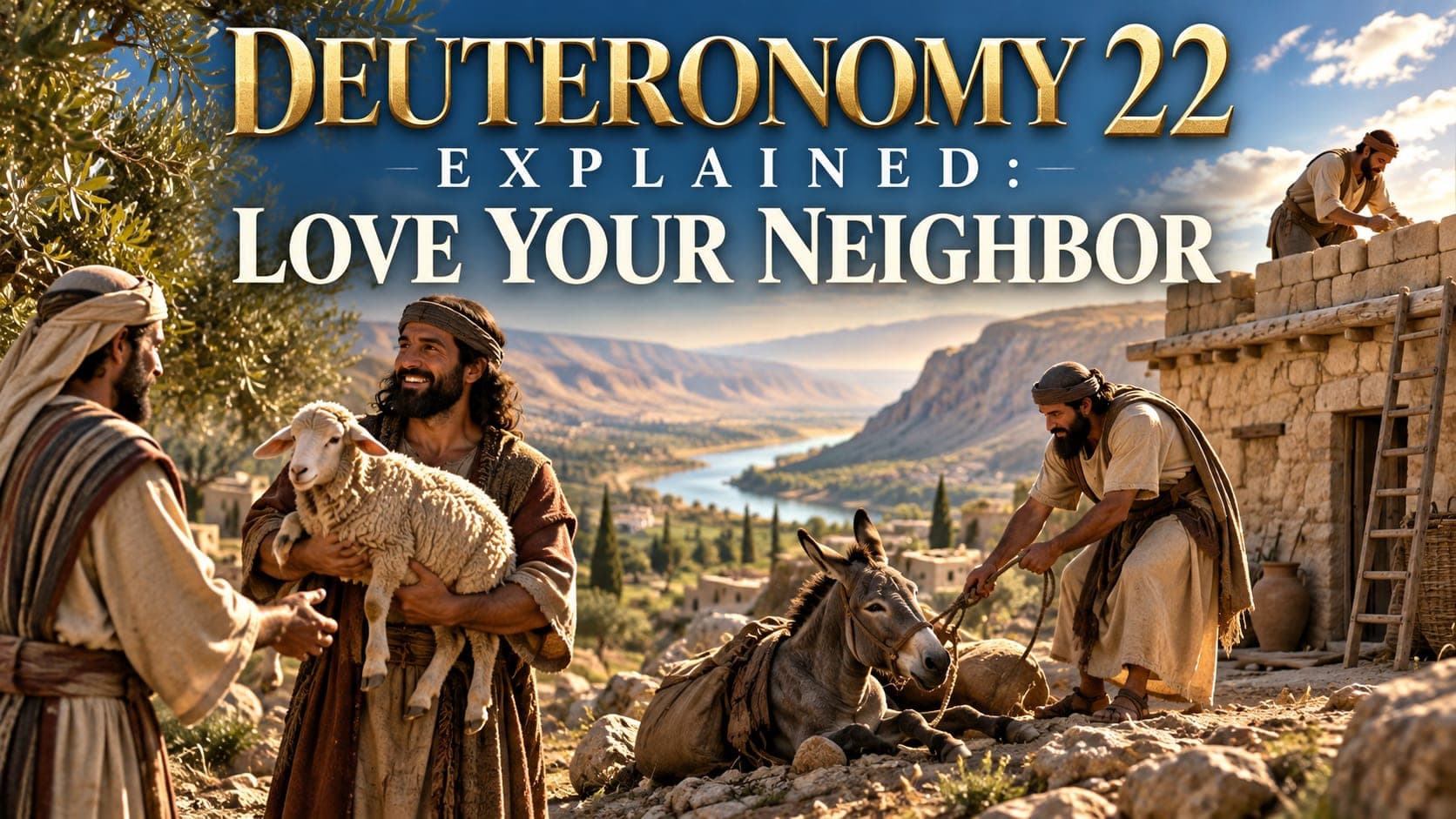
📖 Deuteronomy 22 Explained: Lost Property, Forbidden Mixtures, and a Marriage on Trial
Your neighbour's ox wanders into your field. Nobody else is watching.
Deuteronomy 22 explained is Moses moving fast through a dozen different situations in thirty verses: a lost animal nobody has claimed yet, two laws about not blurring lines God drew, a roof that could kill a guest, three rules against mixing what was meant to stay separate, a new bride accused by her own husband, and the hardest verses yet on assault and consent.
You may have read this chapter once and felt like it was just a pile of unrelated rules.
- ❓ Why does God care if your coat is woven from two kinds of thread?
- ❓ What does a bird's nest have to do with any of this?
- ❓ How could a cloth decide whether a new bride lived or died?
- ❓ Why does the same crime get two different verdicts depending on where it happened?
📌 Almost every law in this chapter protects something, or someone, that cannot protect itself: a lost animal, a nest, a reputation, a woman with no one in the room to speak for her.
Thirty verses, and the setting changes nearly every time the subject does. Watch how often Moses refuses to let Israel look away from something smaller or weaker than itself.
Read slowly. The hardest verses here deserve an honest look rather than a quick skip.
What Happened Just Before This Chapter
Deuteronomy 21 covered four hard situations an already settled Israel would run into: an unsolved killing, a captive brought home as a wife, a disputed inheritance, and a son past correcting. Each one asked who carries the weight once the normal process runs out.
Deuteronomy 22 keeps asking a version of the same question, except now in the smaller moments of ordinary life that chapter 21 never touched: a wandering animal, a roof under construction, a brand new marriage, a field at night. Nothing here involves an army or a case that could end in exile. It is Moses building the same careful attention into daily life that the last chapter built into extraordinary loss.

Deuteronomy 22 Explained Verse by Verse
1. What You Cannot Pretend Not to See (verses 1 to 4)
Moses opens with the easiest law in the whole Bible to break quietly, because breaking it looks exactly like doing nothing at all.
"Thou shalt not see thy brother’s ox or his sheep go astray, and hide thyself from them: thou shalt in any case bring them again unto thy brother. And if thy brother be not nigh unto thee, or if thou know him not, then thou shalt bring it unto thine own house, and it shall be with thee until thy brother seek after it, and thou shalt restore it to him again."
📌 "Hide thyself" is the phrase Moses keeps returning to, three times across these four verses. That is his way of naming the one option that is actually off the table. If you know whose animal it is, bring it back. If you do not, take it home and hold it until the owner comes looking. Either way, it is never yours to simply ignore.
"In like manner shalt thou do with his ass; and so shalt thou do with his raiment; and with all lost thing of thy brother’s, which he hath lost, and thou hast found, shalt thou do likewise: thou mayest not hide thyself. Thou shalt not see thy brother’s ass or his ox fall down by the way, and hide thyself from them: thou shalt surely help him to lift them up again."
Verse 3 widens the law from one animal to any lost thing at all, clothing included. Verse 4 adds a second scenario that is not about something lost but something stuck, an animal fallen down by the road with no one around to lift it back up. 💡 Centuries later, Jesus tells a story built on the same refusal to let something lost just stay lost.
"What man of you, having an hundred sheep, if he lose one of them, doth not leave the ninety and nine in the wilderness, and go after that which is lost, until he find it?"
The animal changes. The refusal to walk past something lost does not. Loving your neighbour in this chapter does not start with a speech. It starts with what you actually do about someone else's wandering or fallen animal when nobody else would ever know if you had kept walking.
2. Three Rules With Nothing in Common, Except What They Protect (verses 5 to 8)
Moses jumps from a wandering ox to clothing, a bird's nest, and a roof, four verses with no shared subject at all.
"The woman shall not wear that which pertaineth unto a man, neither shall a man put on a woman’s garment: for all that do so are abomination unto the LORD thy God."
⚠️ The text states the verdict, "abomination," without stating its own reasoning, which is worth saying plainly rather than guessing past. Many Bible teachers connect this law to the same refusal to blur what God set apart that sits in the mixture laws coming right after it in this chapter. Others note that dressing as the opposite sex was reportedly part of some pagan worship practices in the ancient world, though Deuteronomy itself never names that as the reason. Both readings take the command seriously. Neither can claim more certainty than the text itself gives.
From clothing, Moses jumps to a nest in a tree.
"If a bird’s nest chance to be before thee in the way in any tree, or on the ground, whether they be young ones, or eggs, and the dam sitting upon the young, or upon the eggs, thou shalt not take the dam with the young: But thou shalt in any wise let the dam go, and take the young to thee; that it may be well with thee, and that thou mayest prolong thy days."
💡 Notice what the law actually protects. Not the eggs or the chicks, which Israel could take for food. The mother, who has to be let go so she can nest and feed again. One meal today is allowed. Wiping out next year's whole brood in a single afternoon is not, the same logic behind the fruit trees Deuteronomy 20 refused to let a siege destroy: protect what keeps producing life long after today's use of it.
Then, just as suddenly, a building code.
"When thou buildest a new house, then thou shalt make a battlement for thy roof, that thou bring not blood upon thine house, if any man fall from thence."
📌 A battlement, a low wall or rail around a flat roof used for sitting, sleeping, and working, was not decoration. It was the only thing standing between a guest and a fall. "That thou bring not blood upon thine house" makes the missing wall itself the offense, not just whatever accident follows from skipping it. Moses does not wait for someone to die before calling the omission a danger worth legislating against.
3. No Mixing Allowed: Seeds, Animals, and Thread (verses 9 to 12)
Four verses, four different materials, and the same instruction underneath every one of them: do not combine what was meant to stay distinct.
"Thou shalt not sow thy vineyard with divers seeds: lest the fruit of thy seed which thou hast sown, and the fruit of thy vineyard, be defiled."
"Thou shalt not plow with an ox and an ass together. Thou shalt not wear a garment of divers sorts, as of woollen and linen together."
An ox and a donkey pull at different paces and different strengths, so yoking them together punishes the weaker animal with every single step, not just the farmer's convenience. The fabric law reaches past farming into the one thing almost everyone wore every day. Leviticus 19 had already given Israel nearly the same three commands.
"Ye shall keep my statutes. Thou shalt not let thy cattle gender with a diverse kind: thou shalt not sow thy field with mingled seed: neither shall a garment mingled of linen and woollen come upon thee."
💡 Deuteronomy repeats a command Israel had already heard, which is its own kind of emphasis. Then, right beside three laws about not mixing things, Moses closes the section with a command to add something visible.
"Thou shalt make thee fringes upon the four quarters of thy vesture, wherewith thou coverest thyself."
Numbers 15 gives the reason behind this same command elsewhere: the fringes were meant as a visible reminder to keep every one of God's commands, not a fashion choice. 📌 Right after four verses about keeping categories separate, Moses commands a mark that keeps one thing constantly in view: whose instructions you actually belong to.
4. A Wife's Name Put on Trial (verses 13 to 21)
Moses turns from a roof and a fringe to the hardest set of verses so far: a brand new marriage, and an accusation that could end a woman's life.
"If any man take a wife, and go in unto her, and hate her, And give occasions of speech against her, and bring up an evil name upon her, and say, I took this woman, and when I came to her, I found her not a maid:"
"Hate her" here does not have to mean cruelty. It can describe a husband who has simply gone cold on the marriage and is looking for a way out. What he does next is what makes this law necessary: instead of ending things honestly, he invents a lie that her virginity was already gone before the wedding, a charge that could cost her everything if it stuck.
The bride's own parents answer the charge, and they do not answer with words alone.
"Then shall the father of the damsel, and her mother, take and bring forth the tokens of the damsel’s virginity unto the elders of the city in the gate: And the damsel’s father shall say unto the elders, I gave my daughter unto this man to wife, and he hateth her; And, lo, he hath given occasions of speech against her, saying, I found not thy daughter a maid; and yet these are the tokens of my daughter’s virginity. And they shall spread the cloth before the elders of the city."
📌 "The tokens of the damsel's virginity" was almost certainly a bloodstained cloth from the wedding night, kept as physical evidence rather than left as one person's word against another's. Unlike Numbers 5, which turned an unprovable suspicion of unfaithfulness into a ritual test before God when no evidence existed at all, this case did not call for a ritual, because here the husband claimed to already have proof.
"And the elders of that city shall take that man and chastise him; And they shall amerce him in an hundred shekels of silver, and give them unto the father of the damsel, because he hath brought up an evil name upon a virgin of Israel: and she shall be his wife; he may not put her away all his days."
⚠️ The law turns the husband's own weapon back on him. He wanted an exit. He was fined a hundred shekels, double the fifty shekels you will see a few verses from now in an entirely different case, and he lost the one thing he was trying to get: he could never divorce her. His money went to the father he had tried to shame.
Then Moses states the opposite outcome, if the accusation turned out to be true.
"But if this thing be true, and the tokens of virginity be not found for the damsel: Then they shall bring out the damsel to the door of her father’s house, and the men of her city shall stone her with stones that she die: because she hath wrought folly in Israel, to play the whore in her father’s house: so shalt thou put evil away from among you."
This is the harshest verdict in the chapter, and it deserves the honest look the Hard Questions section below gives it, rather than a quick pass here.
5. Adultery, Assault, and the Difference a Field Makes (verses 22 to 29)
From one marriage's accusation, Moses moves into clear cases of proven wrong, and two very different scenes involving a betrothed woman.
"If a man be found lying with a woman married to an husband, then they shall both of them die, both the man that lay with the woman, and the woman: so shalt thou put away evil from Israel."
📌 Unlike the case before it, verse 22 requires no tokens and no trial by evidence. A man "found lying with a woman married to an husband" is a case where both parties share the same verdict, consensual adultery treated as a shared wrong rather than one party's fault alone. Centuries later, a crowd drags a woman caught in exactly this situation to the one teacher they thought would side with the stones.
"So when they continued asking him, he lifted up himself, and said unto them, He that is without sin among you, let him first cast a stone at her."
"She said, No man, Lord. And Jesus said unto her, Neither do I condemn thee: go, and sin no more."
💡 Jesus never says the law in Deuteronomy 22:22 was wrong. He exposes something this chapter never regulates: who in the crowd was actually qualified to be the one holding the stone. Verse 22 names the correct penalty for a real wrong. John 8 asks whether justice can only be carried out by hands clean enough to throw first.
Back in Deuteronomy, the next two cases turn on where an assault happened, not whether it did.
"If a damsel that is a virgin be betrothed unto an husband, and a man find her in the city, and lie with her; Then ye shall bring them both out unto the gate of that city, and ye shall stone them with stones that they die; the damsel, because she cried not, being in the city; and the man, because he hath humbled his neighbour’s wife: so thou shalt put away evil from among you."
📌 The law states its own logic out loud: "because she cried not, being in the city." In a city, someone nearby could plausibly hear a call for help, so the law assumes she had an opportunity to resist and did not use it. That single assumption carries the entire weight of the verdict, which is exactly why everything changes the moment the setting does.
"But if a man find a betrothed damsel in the field, and the man force her, and lie with her: then the man only that lay with her shall die: But unto the damsel thou shalt do nothing; there is in the damsel no sin worthy of death: for as when a man riseth against his neighbour, and slayeth him, even so is this matter: For he found her in the field, and the betrothed damsel cried, and there was none to save her."
⚠️ "There is in the damsel no sin worthy of death" does not reduce her penalty. It removes it entirely and states her innocence in plain words. Verse 27 explains why with its own comparison: no witness, no one close enough to hear her cry, nothing resembling a chance to be rescued. The law compares the attacker to a murderer, not to a party in a mutual wrong. 📌 Verses 23 to 27 judge a case entirely on whether the victim had a real chance to be heard, never on whether the assault happened.
One more case closes the section, and its wording changes in a way worth noticing.
"If a man find a damsel that is a virgin, which is not betrothed, and lay hold on her, and lie with her, and they be found; Then the man that lay with her shall give unto the damsel’s father fifty shekels of silver, and she shall be his wife; because he hath humbled her, he may not put her away all his days."
💡 Verse 25 used the specific word "force." Verse 28 does not repeat it; it says only "lay hold on her, and lie with her." That change in wording is why many Hebrew scholars read this case differently from the one just before it, closer to a seduction a man talked a woman into than an assault forced on her, the same situation Exodus 22 had already covered in almost identical terms.
"And if a man entice a maid that is not betrothed, and lie with her, he shall surely endow her to be his wife. If her father utterly refuse to give her unto him, he shall pay money according to the dowry of virgins."
⚠️ The fifty shekel payment and the lifelong marriage read as strange protections to modern ears, so it is worth being honest about what problem they were actually solving. In a culture with no independent income for women, where virginity decided a woman's whole future marriage prospects, a man who took that future from her became permanently, financially responsible for her instead of walking away and leaving her unable to marry anyone else. "He may not put her away all his days" names what this case and the false accusation case in verse 19 actually share: a woman is never left to carry the cost alone while the man who caused it goes free.
6. A Line No Son Could Cross (verse 30)
The chapter closes with its shortest and most absolute verse.
"A man shall not take his father’s wife, nor discover his father’s skirt."
"Discover his father's skirt" is the King James way of saying take his father's wife sexually, the same relationship Leviticus 18 names directly as forbidden. 📌 Paul confronts this exact situation happening inside a real church centuries later, proof the boundary in this one short verse was never only a theoretical case.
"It is reported commonly that there is fornication among you, and such fornication as is not so much as named among the Gentiles, that one should have his father’s wife."
Paul calls it fornication "not so much as named among the Gentiles," meaning even cultures without God's law found this particular violation shocking. The line Deuteronomy 22:30 draws in one sentence, Corinth still had to be reminded of a thousand years later.

Hard Questions Deuteronomy 22 Raises
Does Deuteronomy 22:20 and 21 really command stoning a bride over a lost virginity claim that could never be proven decades later? The text ties the penalty to a specific finding at the time: the tokens of virginity were not found when the elders checked, inside a legal process that had already heard both sides and physically examined the claimed evidence. It is not describing a vague rumor years after the wedding. It describes a formal verdict reached the same way verse 18 and 19 reached the opposite verdict, through evidence brought before judges, not gossip. Christians differ on how this severity should be read today. Some see it as evidence that Israel treated sexual deception inside marriage with the same seriousness as murder, at a specific moment in its covenant history. Others note that, as with other capital laws in Deuteronomy, no narrative in Scripture records this particular penalty actually being carried out.
Does Deuteronomy 22:28 and 29 really force a victim to marry the man who assaulted her? The wording shift from "force her" in verse 25 to "lay hold on her" in verse 28, without repeating the specific word for force, leads many Hebrew scholars to read this case as closer to seduction than assault, the same case Exodus 22:16 and 17 describes using the word "entice." Whatever the exact nature of the encounter, the fifty shekel payment and the permanent marriage were not designed as a reward for the man. They were designed as the strongest protection that culture had against leaving a woman with a ruined marriage prospect and no one financially responsible for her future. That does not make the mechanism one Christians should treat as a model for handling assault today; the New Testament never applies it that way, and neither should anyone reading it now.
Why does the verdict in verses 23 to 27 depend on whether the assault happened in a city or a field? The text states its own reasoning plainly: in a city, the law assumes a cry for help could plausibly be heard, so silence was treated as consent. In a field, the law explicitly removes that assumption and states the woman's complete innocence, because there was no one close enough to help either way. This is an ancient legal test built around the ability to call for rescue, not a modern definition of consent, and the chapter itself draws the line as carefully as it can with the evidence available to judges who had no other way to investigate what happened.
What was actually being protected by the law against cross dressing in verse 5? The text gives the verdict, "abomination," without stating the specific reasoning behind it, which should be admitted honestly rather than filled in with confidence the text itself does not offer. The most common readings connect it either to the same refusal to blur categories God set apart that sits in the mixture laws right beside it, or to a specific concern about imitating pagan ritual practices common in the region. Both are reasonable. Neither can be stated as more certain than the verse itself allows.
Top Verses From Deuteronomy 22
1. Deuteronomy 22:1 and 2
"Thou shalt not see thy brother’s ox or his sheep go astray, and hide thyself from them: thou shalt in any case bring them again unto thy brother. And if thy brother be not nigh unto thee, or if thou know him not, then thou shalt bring it unto thine own house, and it shall be with thee until thy brother seek after it, and thou shalt restore it to him again."
The chapter opens by removing the one option that feels the most harmless: pretending you did not see. Nobody would know, and Moses still will not let it stand.
2. Deuteronomy 22:8
"When thou buildest a new house, then thou shalt make a battlement for thy roof, that thou bring not blood upon thine house, if any man fall from thence."
A cheap wall stands between a careless building code and someone's life. The law treats skipping it as the offense, long before any accident actually happens.
3. Deuteronomy 22:26 and 27
"But unto the damsel thou shalt do nothing; there is in the damsel no sin worthy of death: for as when a man riseth against his neighbour, and slayeth him, even so is this matter: For he found her in the field, and the betrothed damsel cried, and there was none to save her."
Not a reduced penalty. A declared innocence, stated as plainly as Scripture states anything, for a woman the law compares to the victim of a murder rather than a party to a sin.
4. Deuteronomy 22:19
"And they shall amerce him in an hundred shekels of silver, and give them unto the father of the damsel, because he hath brought up an evil name upon a virgin of Israel: and she shall be his wife; he may not put her away all his days."
A man who tried to use a lie to end his marriage loses the one exit he wanted. The law turns his own weapon back on him.
5. John 8:7
"So when they continued asking him, he lifted up himself, and said unto them, He that is without sin among you, let him first cast a stone at her."
Jesus does not cancel Deuteronomy 22:22. He asks a question this chapter never has to answer: who in the crowd is actually clean enough to be the one holding the stone.

Frequently Asked Questions About Deuteronomy 22
What is Deuteronomy 22 about?
Deuteronomy 22 covers a wide range of daily life laws: returning a lost or fallen animal, a prohibition on cross dressing, protecting a bird's nest, a roof safety rule, laws against mixing seeds, animals, and fabrics, a virginity dispute between a husband and his new wife, adultery, two different verdicts for assault depending on where it happened, and a ban on a son taking his father's wife.
Why does Deuteronomy 22 forbid wearing clothes made of two materials?
Verses 9 to 11 forbid mixed seeds, mixed draft animals, and fabric woven from wool and linen together, the same three commands Leviticus 19:19 already gave. The text does not fully explain its own reasoning, but most readings connect it to the same principle running through the chapter: do not blur categories God set apart.
What does Deuteronomy 22:5 say about cross dressing?
It forbids a woman wearing what belongs to a man and a man wearing a woman's garment, calling the practice an abomination. Scholars connect it either to the same refusal to blur categories seen in the mixture laws nearby, or to a specific concern about imitating pagan ritual practices, without the text itself stating which.
What is the bird's nest law in Deuteronomy 22?
Verses 6 and 7 allow taking eggs or young birds from a nest but require letting the mother bird go free. The law protects her ability to nest and feed again, trading one meal today for a food source that keeps producing for years.
Why did Israel need a law about roof battlements?
Flat roofs were used daily for sitting, sleeping, and working, so a low wall around the edge was the only thing stopping a fall. Verse 8 calls skipping that wall a way of bringing blood upon the house, treating the missing safety feature itself as the offense.
What was the virginity test in Deuteronomy 22?
When a husband falsely accused his new wife of not being a virgin at marriage, her parents could bring physical evidence, almost certainly a bloodstained cloth from the wedding night, before the city elders. If the evidence supported her, the husband was fined and could never divorce her. If it did not, she faced death by stoning.
Why did the punishment for assault depend on whether it happened in a city or a field?
In a city, the law assumed a cry for help could plausibly be heard, so silence counted against the woman. In a field, verses 26 and 27 remove that assumption entirely and state her complete innocence, since no one was close enough to come to her aid either way.
Does Deuteronomy 22 force a woman to marry the man who assaulted her?
Verses 28 and 29 describe a case many Hebrew scholars read as seduction rather than assault, since the specific word for force used in verse 25 is not repeated. The payment and permanent marriage functioned as the strongest financial protection available to a woman whose marriage prospects had been damaged, not as a model the New Testament ever applies to how assault should be handled.
Does John 8 contradict Deuteronomy 22:22?
No. Jesus never says the penalty in Deuteronomy 22:22 was wrong. He questions whether the specific crowd in front of him, none of whom could claim to be sinless themselves, had the standing to carry it out that day.
What does "discover his father's skirt" mean in Deuteronomy 22:30?
It is the King James translation's way of saying a son taking his father's wife sexually, the same relationship Leviticus 18 forbids directly. Paul confronts this exact situation inside a real church in 1 Corinthians 5:1, showing the command still mattered a thousand years later.
Final Thoughts
Deuteronomy 22 keeps changing subjects, but it keeps asking the same thing.
📌 Looking away was never a neutral choice. A wandering ox, a fallen animal, a nest, a roof without a wall, each one is a small test of whether you act on what you see or pretend you did not see it.
📌 Evidence mattered more than accusation, in both directions. A husband who lied about his wife paid for the lie. A victim with no witness to her cry was still declared innocent by name.
📌 The hardest verses in this chapter were never written to end a conversation. They were written to make Israel look closely at exactly the kinds of cases a quick glance would get wrong.
You probably will not meet a wandering ox or a dispute over a dowry this week. But you will meet smaller versions of the same test: something you noticed that was not your problem, and a choice about whether to actually do something about it.
So here is your one next step.
Name the one thing you have been quietly hiding yourself from this week, and go do something about it today instead of tomorrow.