📖 Deuteronomy 23 Explained: Who Belongs, Clean Camps, and Keeping Your Word
Who gets to stand in the assembly. Who does not. And why a grudge against one nation gets dropped while a grudge against another one does not.
Deuteronomy 23 explained is twenty five verses that read like a list of unrelated rulings until you notice what ties them together: belonging, cleanness, and a promise that does not get to expire just because keeping it got inconvenient. Who can join Israel's worship. How a war camp stays fit for God to walk through it. Who gets protection when they show up with nowhere else to go. What money is too dirty for God's house. And why eating your neighbor's grapes is fine, but filling a basket with them is theft.
At first glance it looks like a drawer full of mismatched rules Moses never organized.
- ❓ Why would God bar anyone from His own assembly?
- ❓ Why forgive Egypt, the nation that enslaved Israel, before forgiving Moab?
- ❓ What does a shovel have to do with holiness?
- ❓ Why does a promise you spoke out loud matter more than one you never made?
📌 Every law in this chapter is Moses drawing a line between what Israel owes God, what Israel owes a stranger, and what Israel owes its own word.
Walk through it slowly. A few of these verses get quoted out of context more than almost any other chapter in Deuteronomy, and the full picture looks very different from the one line people usually pull out of it.
What Happened Just Before This Chapter
Deuteronomy 22 closed with the hardest laws yet on sexual sin inside Israel: seduction, assault, and a father's wife placed permanently off limits to his own son.
Deuteronomy 23 shifts from who you may not sleep with to who may stand with you in worship at all. It is still protecting the same thing chapter 22 protected: a community that stays whole instead of corroding from the inside, whether the threat is a broken marriage bed or a compromised assembly.

Deuteronomy 23 Explained Verse by Verse
1. Who Was Kept Out of the Assembly, and Why (verses 1 to 3)
The chapter opens with three groups barred from Israel's formal congregation.
"He that is wounded in the stones, or hath his privy member cut off, shall not enter into the congregation of the LORD."
"A bastard shall not enter into the congregation of the LORD; even to his tenth generation shall he not enter into the congregation of the LORD."
"The congregation of the LORD" is not a seat in the back row. It is full standing in Israel's covenant assembly, the body that led worship and spoke for the nation before God. 📌 These verses are not a verdict on a person's worth. They are a rule about a specific office, in a specific worship system, at a specific point in Israel's history.
The third group named goes further than the first two, with a reason attached right away.
"An Ammonite or Moabite shall not enter into the congregation of the LORD; even to their tenth generation shall they not enter into the congregation of the LORD for ever:"
2. The Grudge Against Moab, and the Brothers Israel Still Had to Love (verses 4 to 8)
Moses does not leave the Ammonite and Moabite ban unexplained for long.
"Because they met you not with bread and with water in the way, when ye came forth out of Egypt; and because they hired against thee Balaam the son of Beor of Pethor of Mesopotamia, to curse thee."
Two specific acts, not a general dislike. Moab and Ammon refused basic hospitality to a nation passing through exhausted, then paid a prophet for hire to curse them. The full story of Balaam and the talking donkey shows exactly how that plan went, and verse 5 states the outcome plainly.
"Nevertheless the LORD thy God would not hearken unto Balaam; but the LORD thy God turned the curse into a blessing unto thee, because the LORD thy God loved thee."
💡 The ban is tied to a corporate, national betrayal, not to anyone's ancestry on its own. That distinction matters for what comes right after it.
"Thou shalt not abhor an Edomite; for he is thy brother: thou shalt not abhor an Egyptian; because thou wast a stranger in his land."
⚠️ Read that again. Egypt enslaved Israel for four hundred years, and Moses still forbids holding it against them. Edom descended from Esau, Jacob's brother, and the family tie earns its own protection. Grudges in this chapter are measured by what actually happened, not by how old or how bitter the feeling is.
Verse 8 even sets a path back in for the two nations just named.
"The children that are begotten of them shall enter into the congregation of the LORD in their third generation."
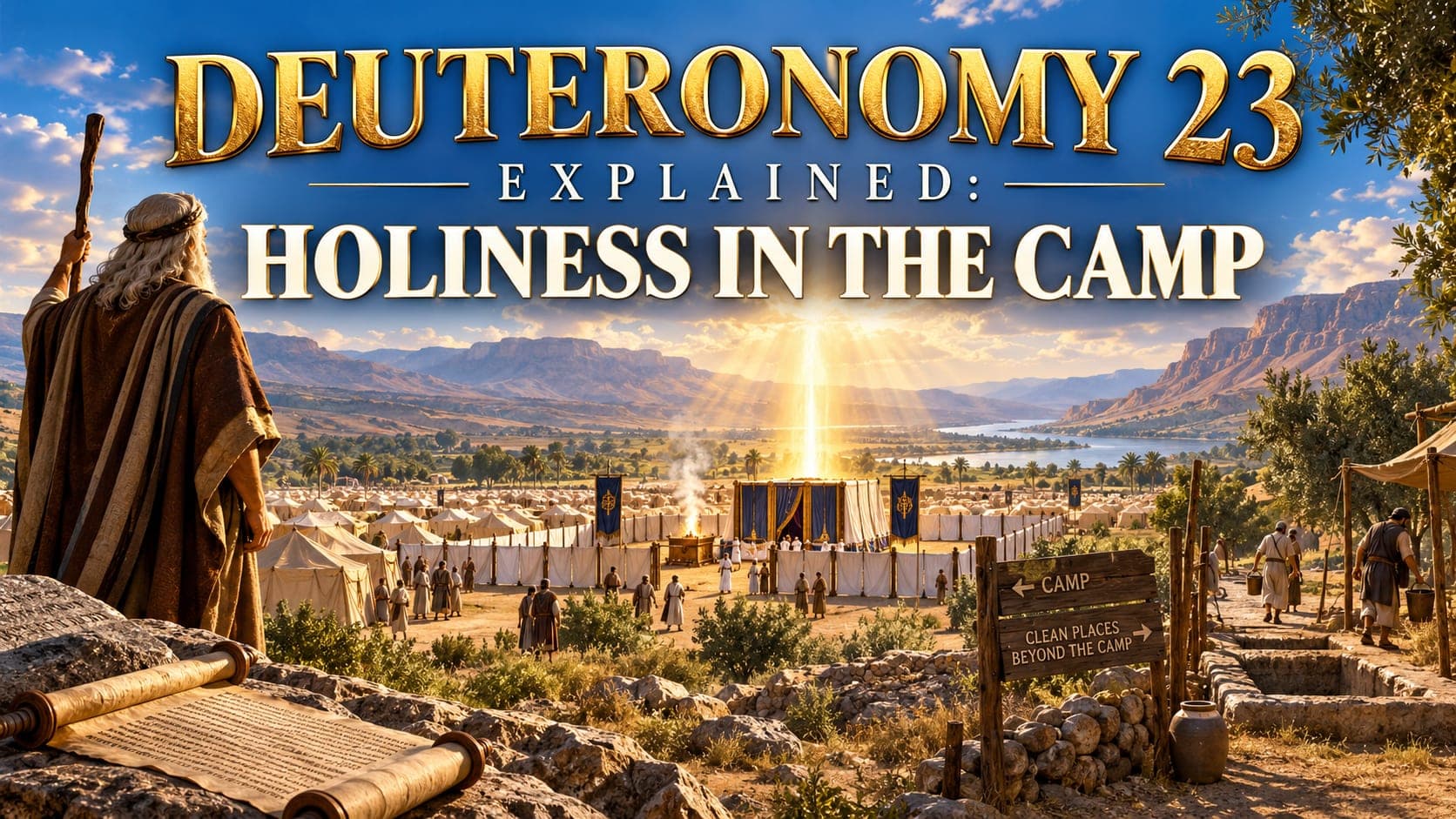
3. Keeping a War Camp Fit for God to Walk Through (verses 9 to 14)
From who belongs in worship, Moses turns to something far more physical: sanitation in an army camp.
"When the host goeth forth against thine enemies, then keep thee from every wicked thing."
"Thou shalt have a place also without the camp, whither thou shalt go forth abroad: And thou shalt have a paddle upon thy weapon; and it shall be, when thou wilt ease thyself abroad, thou shalt dig therewith, and shalt turn back and cover that which cometh from thee:"
A "paddle" here is a small digging tool, carried on a soldier's own weapon belt, for burying waste outside the camp instead of leaving it exposed. The reason is not written down as a health rule. It is written as a worship rule.
"For the LORD thy God walketh in the midst of thy camp, to deliver thee, and to give up thine enemies before thee; therefore shall thy camp be holy: that he see no unclean thing in thee, and turn away from thee."
📌 God is described as actually walking through the camp, not watching it from a distance. A command that sounds like basic hygiene turns out to be about keeping a dwelling fit for that kind of presence.
4. Shelter for a Runaway, and Money God's House Would Not Touch (verses 15 to 18)
Next comes a law that protects someone with nowhere else to turn.
"Thou shalt not deliver unto his master the servant which is escaped from his master unto thee: He shall dwell with thee, even among you, in that place which he shall choose in one of thy gates, where it liketh him best: thou shalt not oppress him."
Set beside laws about Ammon, Moab, Edom, and Egypt, most readers of this law understand the servant here as a foreigner fleeing a foreign master, not an Israelite bondservant governed by the release laws of Deuteronomy 15. Rather than hand a desperate refugee back for punishment, Israel is told to give him a home and leave him unharmed.
The next law protects something different: what God's house will accept.
"There shall be no whore of the daughters of Israel, nor a sodomite of the sons of Israel. Thou shalt not bring the hire of a whore, or the price of a dog, into the house of the LORD thy God for any vow: for even both these are abomination unto the LORD thy God."
Many of Israel's neighbors funded their temples through cult prostitution tied to fertility worship. ⚠️ Moses bans the practice outright, and then bans even the money it earned from ever reaching the altar as a gift. A clean offering could not be laundered from a dirty source.
5. Interest, Vows, and a Hungry Neighbor Passing Through (verses 19 to 25)
The chapter closes with three everyday situations rather than battlefield or worship ones.
"Thou shalt not lend upon usury to thy brother; usury of money, usury of victuals, usury of any thing that is lent upon usury: Unto a stranger thou mayest lend upon usury; but unto thy brother thou shalt not lend upon usury: that the LORD thy God may bless thee in all that thou settest thine hand to in the land whither thou goest to possess it."
This is not a rule against business loans to foreign traders. It targets charging interest on a struggling neighbor's bread or seed money, the kind of debt that could trap a family for a generation. The Jubilee laws and Exodus 22's restitution rules protect the same vulnerable neighbor from a different angle: this law keeps a loan from becoming a trap in the first place.
Then Moses turns from money to speech.
"When thou shalt vow a vow unto the LORD thy God, thou shalt not slack to pay it: for the LORD thy God will surely require it of thee; and it would be sin in thee. But if thou shalt forbear to vow, it shall be no sin in thee."
📌 Silence was never the sin. A broken promise was. Nobody had to vow anything. Once a vow left someone's mouth, though, it became a debt owed to God Himself, due in full.
The final two verses step into an ordinary field.
"When thou comest into thy neighbour's vineyard, then thou mayest eat grapes thy fill at thine own pleasure; but thou shalt not put any in thy vessel. When thou comest into the standing corn of thy neighbour, then thou mayest pluck the ears with thine hand; but thou shalt not move a sickle unto thy neighbour's standing corn."
💡 A hungry traveler could eat his fill walking through someone else's field. Filling a basket to carry home, or swinging a sickle to harvest someone else's crop, crossed straight from hospitality into theft. The line was exact: your hand and your hunger, not your tools and your profit.

Hard Questions Deuteronomy 23 Raises
Does verse 1 mean God rejects people because of a physical condition? The text restricts entry to one specific role, Israel's formal covenant assembly, not a person's standing with God. Scripture itself overturns any reading of this verse as God's last word on the subject. Centuries later, Isaiah promises eunuchs a place inside God's own house:
"Neither let the son of the stranger, that hath joined himself to the LORD, speak, saying, The LORD hath utterly separated me from his people: neither let the eunuch say, Behold, I am a dry tree. For thus saith the LORD unto the eunuchs that keep my sabbaths, and choose the things that please me, and take hold of my covenant; Even unto them will I give in mine house and within my walls a place and a name better than of sons and of daughters: I will give them an everlasting name, that shall not be cut off."
And in Acts, an Ethiopian eunuch is the very man Philip baptizes without hesitation, the moment he believes. The restriction in Deuteronomy 23:1 belonged to its own moment in Israel's worship system. It was never the end of the story.
How does Ruth, a Moabite, become an ancestor of David and Jesus if verse 3 bars Moabites forever? Christians read this differently. Some point out that the ban answers a specific national betrayal, Moab's leaders hiring Balaam and refusing hospitality, and read Ruth's case as an individual who left that nation behind entirely, declaring to Naomi, "thy people shall be my people, and thy God my God." Others note that Nehemiah still treats Deuteronomy 23:3 to 6 as binding generations later, which shows the ban was taken seriously as written, even while individual converts like Ruth were welcomed in. Both readings take the text seriously. They differ on how to hold the national ban and Ruth's welcome together.
Does verse 15 mean the Bible approves of slavery? The verse does not establish slavery. It limits what Israel could do with someone already enslaved elsewhere who showed up seeking safety. Rather than return a fugitive for punishment, the standard practice among Israel's neighbors, Israel is commanded to shelter him and forbidden from oppressing him. That is a restraint on a practice the ancient world already took for granted, not an endorsement of it.
Why can Israel charge a stranger interest but not a brother? The word translated "stranger" here points to a foreign trader doing business across a border, not the resident alien or sojourner Israel is commanded elsewhere to protect and never exploit. The law is not about nationality for its own sake. It is about keeping debt between neighbors who depended on each other from turning into a tool that could quietly enslave one of them.
Top Verses From Deuteronomy 23
1. Deuteronomy 23:5
"Nevertheless the LORD thy God would not hearken unto Balaam; but the LORD thy God turned the curse into a blessing unto thee, because the LORD thy God loved thee."
A hired curse that never landed, turned into a blessing instead. The verse credits nothing to Israel's own strength, only to being loved.
2. Deuteronomy 23:7
"Thou shalt not abhor an Edomite; for he is thy brother: thou shalt not abhor an Egyptian; because thou wast a stranger in his land."
Israel is told to let go of a grudge against the nation that enslaved it for four centuries. Few verses in Deuteronomy ask for more.
3. Deuteronomy 23:14
"For the LORD thy God walketh in the midst of thy camp, to deliver thee, and to give up thine enemies before thee; therefore shall thy camp be holy: that he see no unclean thing in thee, and turn away from thee."
God is not stationed outside the camp watching from safety. He is described as walking through the middle of it, which is exactly why holiness mattered there.
4. Deuteronomy 23:21
"When thou shalt vow a vow unto the LORD thy God, thou shalt not slack to pay it: for the LORD thy God will surely require it of thee; and it would be sin in thee."
A promise spoken out loud to God is treated as a debt, not a suggestion. The chapter takes words this seriously on purpose.
5. Deuteronomy 23:24
"When thou comest into thy neighbour's vineyard, then thou mayest eat grapes thy fill at thine own pleasure; but thou shalt not put any in thy vessel."
A line drawn precisely between a hungry traveler fed by a neighbor's generosity and a thief helping himself to someone else's harvest.

Frequently Asked Questions About Deuteronomy 23
What is Deuteronomy 23 about?
Deuteronomy 23 covers who could enter Israel's formal worship assembly, sanitation rules for a war camp, protection for a runaway seeking refuge, a ban on cult prostitution money in God's house, lending without interest to a struggling neighbor, keeping vows, and the limits on eating from someone else's field.
Why were Ammonites and Moabites barred from the congregation?
Verses 4 and 5 give the stated reason: they refused Israel bread and water on the way out of Egypt, and their leaders hired Balaam to curse Israel for money. The ban answers a specific national betrayal.
Why does God tell Israel not to abhor Egypt after four hundred years of slavery?
Verse 7 gives the reason in the same breath as the command: Israel had been a stranger in Egypt's land. The verse does not deny what Egypt did; it still forbids turning that history into an ongoing grudge.
What was the paddle used for in verses 12 and 13?
A small digging tool soldiers carried for burying human waste outside the camp. The reason given is not hygiene for its own sake, but keeping the camp fit for the LORD, who is described as walking through the middle of it.
Who was the runaway servant in verses 15 and 16?
Set beside the surrounding laws about foreign nations, most readers understand this as a foreign slave fleeing a foreign master, not an Israelite servant covered by the separate release laws elsewhere in the Law. Israel is told to shelter him rather than return him.
Why does verse 18 call certain money an abomination?
It refers to earnings from cult prostitution, a common funding source for pagan worship among Israel's neighbors. Moses bans both the practice and any attempt to give its profits to God as a vow offering.
Does Deuteronomy 23 forbid all interest on loans?
It forbids charging interest to a fellow Israelite, specifically a brother in need. Verse 20 permits interest with a stranger, generally understood as a foreign trader doing ordinary business, not the vulnerable resident alien protected elsewhere in the Law.
What happens if someone makes a vow to God and breaks it?
Verse 21 calls it sin. Verse 22 makes clear nobody was required to vow in the first place. The obligation began only once the words were actually spoken.
Why could someone eat a neighbor's grapes but not harvest them?
Verses 24 and 25 draw the line at tools and containers. Eating by hand while passing through was treated as hospitality. Using a sickle or filling a vessel to carry food away was treated as taking someone else's crop.
Does this chapter still apply to Christians today?
The specific worship assembly rules belonged to Israel's covenant system under the Law. The underlying values Moses keeps returning to, honest dealing with a neighbor, keeping your word, and refusing to let an old grudge outlast its reason, carry straight into how the New Testament calls Christians to live.
Final Thoughts
Deuteronomy 23 looks like a list of odd rules until you notice what each one is actually weighing.
📌 A grudge gets measured by what actually happened, not by how long it has been held. Egypt enslaved Israel for centuries and still gets forgiven in the same verse that explains why. Moab's betrayal was specific, and so was its consequence.
📌 A word spoken out loud to God becomes a debt the moment it leaves your mouth. Silence carried no penalty here. A broken promise did.
You are not standing outside a war camp with a paddle in your hand this week. But you probably are carrying a grudge you have never actually measured against what happened, or a promise you made and have quietly stopped intending to keep.
So here is your one next step.
Name one grudge and one unkept promise honestly today, and let Deuteronomy 23 decide which one actually deserves to still be standing.